Hezbollah’s Fiber-Optic Drones Are Killing Israeli Soldiers and Israel Has No Answer
1
IDF Soldier Killed by Fiber-Optic Drone
15 km
Max Confirmed Hezbollah Drone Range
$30
Cost per km of Fiber-Optic Cable (Bulk)
🔴 The Weapon
What a Fiber-Optic Drone Is — and Why It Cannot Be Jammed
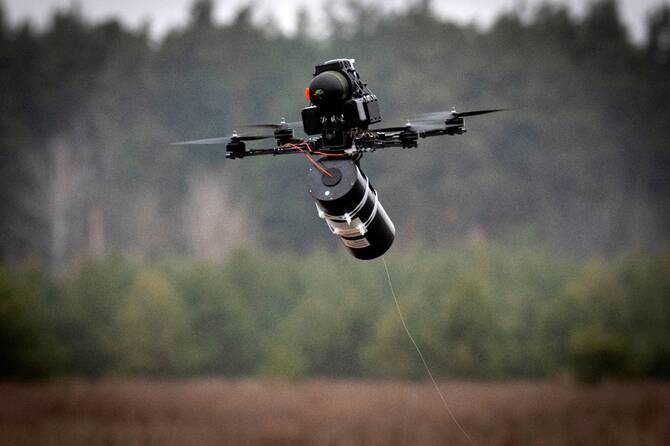
Most attack drones are controlled by radio signals. Radio signals can be jammed, intercepted, or spoofed — and for years, electronic warfare has been one of the primary tools that advanced militaries use to neutralise drone threats. A fiber-optic drone removes this vulnerability entirely. Instead of a radio link, a physical cable no thicker than dental floss connects the operator directly to the drone, carrying real-time video and control signals through light rather than radio waves. There is nothing for a jammer to catch.
The drone is typically a small, commercially available FPV (first-person view) frame fitted with a shaped-charge explosive — often anti-armour warheads originally designed for rocket-propelled grenades. The operator watches through a live feed from the drone’s camera and flies it manually to the target. Because the cable transmits data rather than radio, it is invisible to spectrum monitoring systems. Because the drone is small and flies low and fast, it is extremely difficult to detect on radar.
Robert Tollast, a drone expert and researcher at the Royal United Services Institute in London, described the threat directly. In fields across Ukraine, he noted, fiber-optic cables have become so common that front-line towns are coated in shimmering threads resembling massive spiderwebs. Cables extending as far as 50 kilometres have been recorded. The technology is not new — it first appeared on the Ukrainian battlefield in spring 2024 — but it is now arriving in Lebanon with full operational maturity.
🔴 Hezbollah’s Deployment
Locally Built, Cheap to Produce, Aimed at Troops Inside the Ceasefire Zone
Hezbollah announced it began using fiber-optic guided drones for the first time on March 2, 2026, at the start of the latest round of fighting. An Israeli military official told AP that Israel believes the drones are assembled locally in workshops across southern Lebanon, requiring little more than an off-the-shelf drone frame, a small amount of explosives, and transparent wire available on the consumer market. They are not being imported as finished weapons — they are being manufactured in volume.
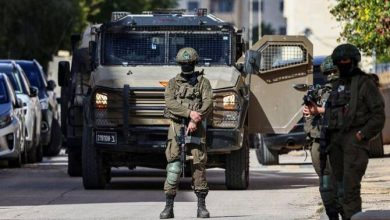
The drones have been deployed primarily against Israeli soldiers operating inside Lebanon’s declared security zone and against towns on the northern Israeli border. Hezbollah has published attack videos through its Al-Manar TV station and social media channels showing strikes on Israeli tanks, Namer armoured personnel carriers, and engineering vehicles. The IDF has confirmed dozens of drone-related injuries in recent weeks.
The deadliest confirmed strike came on April 26, when a fiber-optic drone hit Israeli soldiers repairing a tank in the southern Lebanese town of Taybeh. Sgt. Idan Fooks, 19, was killed and six others wounded, four seriously. A second drone was fired moments later as an Israeli Air Force Black Hawk helicopter arrived to evacuate the casualties — the drone detonated just metres from the aircraft. A third soldier later died of wounds. The incident marked the first fatal FPV drone strike on Israeli forces in this round of fighting.
Eyewitness — Kiryat Shmona, April 13, 2026
“We are very worried about these drones because there’s no way to shoot it down, because we can’t detect it. They told me, ‘You have a lot of luck.'”
Zevik Glidai, 78, math teacher and volunteer ambulance driver, Kiryat Shmona — whose backyard was struck by a fiber-optic drone carrying 2kg of explosives that failed to detonate. His home is 2km from the Lebanon border.
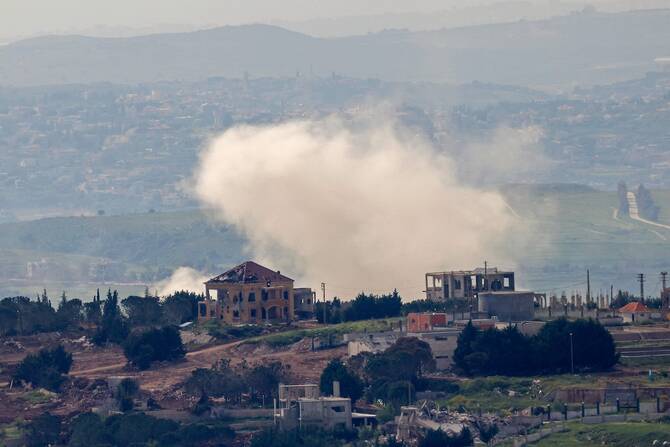
Smoke rises over the southern Lebanese village of Taybeh near the border, as seen from Upper Galilee. The April 26 fiber-optic drone attack that killed Sgt. Idan Fooks occurred in this town. Photo: AFP / Arab News.
🔴 The IDF’s Problem
Israel Knew for a Decade — and Still Has No Defence
The gap in Israel’s preparedness is not a surprise failure — it is a documented institutional one. Haaretz reporting confirms that fiber-optic guided drones are not a new concept for those involved in Israeli defence procurement. The concept emerged more than a decade ago, and these drones became a defining feature of the Russia-Ukraine war over two years before appearing in Lebanon. The IDF watched Ukraine and drew no operational conclusions.
Ran Kochav, a former head of the Israeli military’s air defence command, stated the problem plainly: Israel spent years strengthening its systems against rockets and missiles, and drones were not seen as a top priority. He said Israel is failing in its attempts to defend against the fiber-optic variant specifically. The IDF’s initial assessment was that Hezbollah’s range was limited to a few kilometres. That assessment was wrong — IDF analysts later discovered launches occurring from up to 15 kilometres away.
On April 11 — weeks into the current conflict — Israel’s Defence Ministry Directorate of Defense Research and Development issued a public tender calling for technological solutions to the fiber-optic drone threat. The timing is damning: a public request for bids, issued after soldiers were already being hit, two years after such systems first appeared in Ukraine. Independent analyst Jakub Janovsky observed that a kilometre of fiber-optic cable costs around $30 when bought in bulk — meaning range is cheap to extend, and Hezbollah has every incentive to do so.
Israeli Front-Line Commander — Via Ynet / Al Jazeera
“There isn’t much to do about it. The briefing the forces get amounts to: ‘Be alert, and if you spot a drone, shoot at it.'”
🟡 The Ukraine Connection
A Technology Refined Over Two Years on Europe’s Front Line
Russia pummels Ukraine almost nightly with Shahed long-range drones — a design originally from Iran. Ukraine responded by developing fiber-optic FPV drones to counter Russian electronic warfare. Russia adopted the technology in turn. By the time fiber-optic drones appeared on the Ukrainian battlefield in spring 2024, both sides were producing them at scale, refining range, payload, and operator training in live combat conditions. The result is a mature, battle-tested system arriving in Lebanon as a finished weapon concept.
The technology transfer route is not fully established in open sources. What is clear is that Hezbollah has built local production capability rather than importing finished drones — the components are commercially available globally, and the assembly knowledge has been widely disseminated through open-source Ukrainian and Russian drone communities. Kochav stated directly that Israel should have assumed Iranian allies would follow Russia’s lead and adopt the technology.
i24NEWS analysis raises the possibility that Ukraine could share counter-drone expertise with Israel as part of a closer alignment between the two countries — a strategic reversal of the technology flow. The irony is significant: the same conflict that generated the drone threat may also generate part of the solution.
🔵 Countermeasures
Nets, Cages, and Rifles — Israel’s Current Answer
In the absence of a technological solution, Israeli forces have resorted to physical countermeasures. Nets and cages have been added to military vehicles — mirroring exactly the improvised armour that Ukrainian and Russian ground forces adopted in 2022 and 2023. Some Israeli combat units have independently begun hanging physical nets over positions, windows, and doors in the hope that a drone will tangle in the material before its warhead detonates. These are workarounds, not solutions.
Kochav noted that Israel does already possess relevant detection technology — systems that track changes in light, identify signals, and recognise the acoustic signature of drone propellers. The problem is that these systems have not been widely deployed along the northern border. The capability exists; the deployment decision was not made.
Netanyahu has reportedly instructed senior military officials to accelerate the development of technological countermeasures. Northern Command is simultaneously pushing for greater operational flexibility to conduct deeper strikes against Hezbollah drone-operating cells — pushing them north of the Litani River and into the Beqaa Valley, beyond effective drone range. That push requires diplomatic clearance from Washington that has not yet been granted.
Robert Tollast — RUSI, London / via AP
“If you know what you’re doing, it’s absolutely deadly. It can fly low and creep up on a target.”
Strategy Battles Assessment
The Unjammable Drone Is Not a Tactical Problem — It Is a Strategic Indictment
The fiber-optic drone is not a surprise weapon. It is a weapon that Israel watched being developed and deployed in Ukraine for two years, assessed as a potential threat, and then failed to prepare for. The public tender issued on April 11 — after soldiers were already dead and wounded — is not a response to a new threat. It is a bureaucratic admission that the IDF’s institutional processes did not move fast enough to match a threat that was entirely visible and documented.
The deeper strategic problem is cost asymmetry. Hezbollah is assembling these drones from consumer components for a few hundred dollars each. Israel’s air defence architecture — Iron Dome, David’s Sling, Arrow — was built to intercept rockets and ballistic missiles at unit costs measured in tens of thousands of dollars per interception. A fiber-optic drone does not interact with that system at all. It flies under radar, cannot be jammed, and is too small and fast for conventional interception. The multibillion-dollar defence network is simply not the right tool.
What the Taybeh attack also revealed is a second-order danger: the deliberate targeting of medical evacuation helicopters. The Black Hawk near-miss was not accidental. Hezbollah operators watched the first drone hit, waited for the casualty evacuation response, and launched a second drone at the helicopter. This is a deliberate tactic — inherited directly from Ukraine, where both sides have targeted evacuation vehicles to compound battlefield costs. Israel is encountering, in Lebanon, the full playbook of a two-year drone war it chose not to study carefully enough.
Strategy Battles — Related Coverage
Sources
- Arab News / AP (Lidman, Mroue, Burrows) — “Hezbollah adopts a new weapon: Fiber-optic drones, used widely in the war in Ukraine” — April 30, 2026
- Times of Israel — “Fatal Hezbollah attack exposes gaps in IDF preparedness for FPV drones” — April 27, 2026
- Al Jazeera — “How Hezbollah’s fibre optic drones test Israel’s sophisticated radar system” — April 29, 2026
- Haaretz — “Israel’s New Buffer Zone in Lebanon Won’t Stop Hezbollah’s Fiber Optic Drones” — April 23, 2026
- Haaretz — “IDF Knew of Hezbollah’s Drone Threat for a Decade. Why Is It Still Defenseless?” — April 29, 2026
- i24NEWS — “IDF’s new enemy on the Lebanon battlefield: Hezbollah FPV suicide drones” — April 28, 2026
- Euromaidan Press — “Technology Russia and Ukraine refined on their battlefield just hit Israeli Black Hawk in Lebanon” — April 29, 2026
Editorial Verification
Death of Sgt. Idan Fooks confirmed by Times of Israel by name, unit, date. IDF public tender for counter-drone solutions confirmed via Times of Israel (April 11 date). Zevik Glidai Kiryat Shmona incident confirmed by named witness via AP wire. RUSI attribution to Robert Tollast confirmed by name via AP. Jakub Janovsky citation confirmed by Times of Israel. IDF 15km range discovery confirmed by Times of Israel. The statement from the front-line Israeli commander is reported via Ynet/Al Jazeera as anonymous; presented as such. Technology transfer route from Ukraine to Hezbollah is not confirmed in open sources; reported as analysis. IDF helicopter type (Black Hawk) confirmed via Euromaidan Press / The Telegraph citation.
Approved for Publication
Marcus V. Thorne
Lead Editor, Strategy Battles
©StrategyBattles.net 2026
This article is for news and analysis purposes only. Based on publicly available news sources and military updates. All rights reserved. Not for commercial reuse without permission.