Myanmar Tatmadaw Offensive Resistance Fractures as China Cuts Rebel Arms
8,000+
Civilians Killed Since 2021 Coup
Millions
Internally Displaced Persons
4
Active Front Lines: Sagaing, Rakhine, Kachin, Kayin
📍 Myanmar Civil War — Active Conflict Zones, April 30, 2026

Active conflict zones are approximate based on IISS Myanmar Conflict Map and open-source reporting. Front lines are fluid. Map: Strategy Battles / OSINT, April 30, 2026.
🟡 The Strategic Shift
A Year Ago the Tatmadaw Was Losing — Today the Picture Has Changed
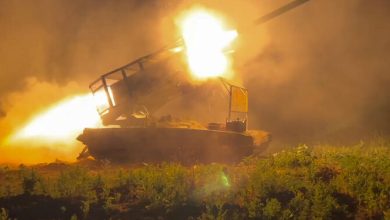
A little over a year ago, Myanmar’s military was reeling. The Three Brotherhood Alliance — a coalition of experienced ethnic armed groups that launched Operation 1027 in October 2023 — had driven the Tatmadaw out of vast stretches of the country’s north, capturing towns, overrunning bases, and humiliating a military that had ruled through force for decades. The city of Lashio, home to the Tatmadaw’s Northeast Command, fell. More than 2,000 soldiers surrendered at Laukkai, including six generals.
Today, that trajectory has reversed. With its ranks swollen by tens of thousands of new conscripts mobilised under mandatory service legislation, and with China having cut arms supplies to two of the three Brotherhood Alliance members, the Tatmadaw has retaken the strategic initiative. Morgan Michaels, a Singapore-based analyst at the International Institute of Strategic Studies who runs the IISS Myanmar Conflict Map project, assessed the situation bluntly.
Morgan Michaels — IISS Myanmar Conflict Map / via AP, April 30, 2026
“I think we’re nearing a crescendo here where the Tatmadaw is going to reassert itself and the resistance movement is going to peter out. The Tatmadaw has retaken the strategic initiative and everything is in the Tatmadaw’s favor.”
Michaels cautioned that armed resistance would continue in Myanmar until a comprehensive negotiated political solution was reached, and that the conflict was not close to over.
🔵 The China Factor
Beijing Pulled the Plug on the Militias — and Naypyidaw Is the Beneficiary
China’s role in Myanmar’s civil war is not that of a bystander. Beijing invested billions of dollars in Myanmar’s mines, oil and gas pipelines, and infrastructure as part of the China-Myanmar Economic Corridor — a key Belt and Road artery — and supplies arms to the Tatmadaw alongside Russia. When the Three Brotherhood Alliance launched Operation 1027 in late 2023, China initially tolerated it, partly because the junta had allowed organised crime networks to proliferate in the border regions, disrupting Chinese commercial operations and embarrassing Beijing.
But once the alliance’s advances began threatening broader stability and Chinese economic assets, Beijing reversed course. It cut arms and ammunition supplies to two of the three Brotherhood Alliance members and pressured them into Chinese-mediated ceasefires. The Myanmar National Democratic Alliance Army and the Ta’ang National Liberation Army both agreed to halt operations. Only the Arakan Army — fighting in the western state of Rakhine, geographically distant from China’s core interests — remained actively engaged against the Tatmadaw.
ISP-Myanmar’s 2026 Annual Strategic Review confirmed the consequence of what it called China’s “Five Cuts” strategy — severing water, electricity, internet, logistic supplies, and manpower to pressure ethnic armed groups in northeastern Myanmar. The result has sharply disrupted trade routes and compounded the humanitarian crisis for civilians already suffering from the conflict and from the Sagaing-Mandalay earthquake. In ISP-Myanmar’s survey of over 1,000 respondents, 85 percent reported shortages of imported goods and 92 percent of households said they had been directly affected.
🔴 The Active Fronts
Four Theatres Still Burning Across the Country
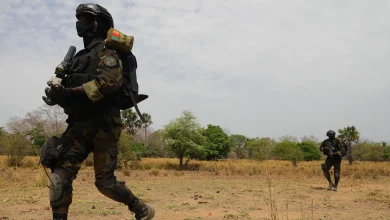
The most significant current Tatmadaw operation is in Sagaing region, where a large-scale offensive is pressing toward the northern city of Indaw. Indaw was captured by People’s Defense Force groups with Kachin Independence Army support last year and represents a direct challenge to Tatmadaw control of central Myanmar. The offensive is a priority because Sagaing is the Bamar ethnic heartland — losing it to resistance forces carries both military and political weight that the junta cannot absorb.
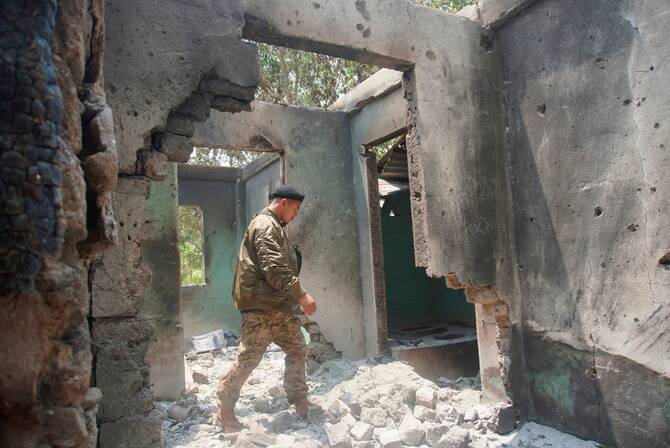
In the east, the Karen National Liberation Army is pushing toward a Tatmadaw stronghold near the Thai border in Kayin state — the scene of the image carried by Arab News, showing a Karen National Union commander inspecting a captured Tatmadaw base at Infantry Battalion 275 in Myawaddy township. The Tatmadaw is simultaneously on the defensive there while committing offensive resources to Sagaing — a two-front strain that reflects the over-extension that has defined its position since 2023.
In Rakhine state to the west, the Arakan Army — the sole remaining active member of the Three Brotherhood Alliance — continues operations against Tatmadaw positions. The Tatmadaw retains naval assets off the western coast to bombard Arakan Army positions, but cannot dislodge the group from territory it has held and consolidated. In the far north, the Kachin Independence Army operates along the Chinese border, where control of rare earth mining areas gives the conflict a direct economic dimension that Beijing watches closely.
🔴 The Resistance Problem
Infighting, Supply Failures, and Five Years of Fatigue
The resistance is not a unified force and never has been. The People’s Defense Forces are affiliated with the shadow National Unity Government but operate across hundreds of groups with different ethnic, regional, and organisational loyalties. The Burma Liberation Democratic Front — an alliance of 20 PDFs fighting in Sagaing and Mandalay — acknowledged the problem directly in a written response to AP: while there is a shared goal of overthrowing the junta and building a federal union, there are persistent gaps in grand strategy, tactics, and approach that the Tatmadaw is actively exploiting.
Supply issues have compounded the fragmentation. China’s embargo on arms to the MNDAA and TNLA removed two of the best-equipped ethnic forces from the active fight. Smaller PDF groups have always depended on captured weapons and limited external supply lines. After five years of war, ammunition shortages, weariness among fighters, and a civilian population drained by displacement and economic collapse are all factors that the Tatmadaw’s conscript-swelled force does not face to the same degree.
Aung Thu Nyein, a Myanmar political analyst now based in Thailand, offered a stark summary of where the civilian population stands after five years: many, he said, no longer care much who wins — they simply want the fighting to stop.
Aung Thu Nyein — Myanmar Political Analyst, Thailand / via AP
“There are many saying that the local population doesn’t care much who will win the war, but [just want] to stop fighting.”
🟡 The Political Manoeuvre
Min Aung Hlaing Sworn In as President — Offers Peace Talks with a Deadline
Min Aung Hlaing, who led the 2021 coup that ousted Aung San Suu Kyi, was sworn in as president earlier this month following elections that UN experts characterised as neither free nor fair. China — which had been pushing for the election to proceed — immediately congratulated him and dispatched its foreign minister to meet with him in person. The TNLA militia, one of the ceasefire groups China helped broker, also sent congratulations and pledged to uphold the ceasefire.
In one of his first acts as president, Min Aung Hlaing invited all armed resistance forces — both EAOs and PDFs — to new peace talks, with a deadline of July 31 and a caveat that groups should not arrive with “unrealistic demands.” The National Unity Government immediately denounced the offer as aimed at prolonging military rule rather than ending it. No mention was made of the NUG itself in the invitation, a deliberate exclusion that underscored the offer’s limitations as a genuine peace process.
Michaels assessed the likely intent as tactical rather than strategic — a bid to negotiate limited ceasefires with individual groups, freeing up Tatmadaw resources to concentrate against those still fighting, while adding a veneer of legitimacy useful for improving relations with ASEAN neighbours operating under sanctions pressure.
Strategy Battles Assessment
Beijing Is the Only Actor That Matters — and It Has Chosen Stability Over Democracy
The most important strategic development in Myanmar’s civil war is not on any battlefield. It is in Beijing’s decision to cut arms to the Brotherhood Alliance and broker bilateral ceasefires that fragment the resistance. ISP-Myanmar’s conclusion is correct: Beijing’s roadmap is now the only strategic process actively shaping the trajectory of Myanmar’s conflict. The UN has failed. ASEAN has failed. The United States has effectively withdrawn from the region as a meaningful actor. What remains is China managing Myanmar’s instability in its own interest — preserving the economic corridor, securing the rare earth supply chain, and producing a stable junta that China can do business with.
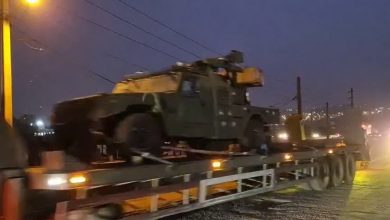
The Tatmadaw cannot win this war in the conventional sense. It has air power, artillery, armour, and naval assets that the resistance cannot match — but it cannot hold rural territory across a country the size of France, and it cannot overcome the fundamental political reality that it is governing by coercion. The IISS assessment that the conflict is a strategic stalemate — neither side can be decisively beaten — is almost certainly correct for the medium term. What the Tatmadaw can do is grind down the resistance through attrition, exploit factional divisions, and use Chinese-brokered ceasefires as tools to redirect firepower.
For the Indo-Pacific strategic picture, Myanmar matters beyond its own borders. It is the hinge between China’s southwestern flank and India’s northeastern frontier, a transit state for the China-Myanmar Economic Corridor, and a test case for whether Beijing can manage a failing state in its periphery without triggering the kind of instability that spills across borders into Thailand, India, and Bangladesh. The answer, for now, is that it can — at enormous cost to Myanmar’s civilian population, which has absorbed the consequences of every strategic decision made in Naypyidaw, Beijing, and Washington for the past five years.
Strategy Battles — Related Coverage
Sources
- Arab News / AP — “Myanmar army shifts to offense as resistance weakens in bloody civil war” — April 30, 2026
- Asia Times — “Myanmar’s war headed for a tipping point in 2026” — January 31, 2026
- ISP-Myanmar — “The State of Myanmar: Annual Strategic Review and Foresight 2025-2026” — January 31, 2026
- ISP-Myanmar Op-27 — “Prospective 4th Generation Tatmadaw: Pathways to Reform or Further Regression?” — 2026
- IISS Myanmar Conflict Map Project — Morgan Michaels, Singapore (cited via AP wire, April 30, 2026)
- Burma Liberation Democratic Front — Written statement to AP, April 2026
- National Unity Government — Statement on Min Aung Hlaing peace offer, April 2026
Editorial Verification
Morgan Michaels IISS attribution confirmed by name via AP wire. Aung Thu Nyein attribution confirmed by name via AP. Civilian death toll of 8,000+ is an AP aggregate figure sourced to multiple tracking efforts; not independently verified by Strategy Battles. ISP-Myanmar survey data (85%/92% shortage figures) sourced to ISP-Myanmar Annual Review 2025-2026, a credible independent Myanmar research body. Min Aung Hlaing sworn in as president confirmed by multiple outlets. UN expert characterisation of elections as not free or fair confirmed via multiple reports. Burma Liberation Democratic Front statement confirmed as written AP response. NUG peace offer rejection confirmed via AP. China foreign minister visit confirmed via multiple sources. Conflict zones on map are approximations based on IISS and open-source data; front lines are fluid and should not be taken as precise delineations.
Approved for Publication
Marcus V. Thorne
Lead Editor, Strategy Battles
©StrategyBattles.net 2026
This article is for news and analysis purposes only. Based on publicly available news sources and military analysis. All rights reserved. Not for commercial reuse without permission.