Iran Launches Strait of Hormuz Toll Authority as Tanker Traffic Returns to Wartime Average
Threat Level Assessment
LEVEL 4 OF 5, SERIOUS
Bottom Line Up Front
Commodity vessel traffic through the Strait of Hormuz recovered sharply in the week of 11 to 17 May, with 55 crossings recorded by Kpler, up from 19 the prior week, which was the lowest figure since the war began on 28 February. Despite the numerical recovery, weekly crossings remain at the wartime average of 55 per week: far below the pre-war norm of roughly 840 vessels per week. On 19 May, Tehran formalised the Persian Gulf Strait Authority, the body through which it is collecting transit fees and controlling which vessels may pass, institutionalising a blockade posture as a sovereign revenue mechanism. Negotiations between Iran and the United States remain deadlocked, with Hormuz control described by both parties as a core outstanding issue.
Key Judgments
The recovery to 55 vessels does not represent normalisation. It represents a return to Iran’s managed wartime baseline. Pre-war, roughly 120 vessels crossed per day; current wartime average is 55 per week. The PGSA’s formal launch on 19 May signals Tehran intends to institutionalise selective transit control as a permanent posture, not a temporary wartime measure.
Iran is operating a nationality-based transit policy. China and India have been the dominant non-Gulf beneficiaries since the conflict began. Western-destination vessels are near-absent from Kpler data. Iran announced on 10 May that countries complying with US sanctions face transit difficulties. This is a sanctions-busting mechanism functioning inside the strait itself.
The near-complete collapse of LNG crossings, just eight since 28 February, is the most strategically significant suppression in the traffic data. LNG is time-sensitive and contract-bound in a way crude oil is not. Eight crossings over 81 days compared to a pre-war daily average of four or five LNG transits per day represents a de facto LNG closure of the strait. Qatar’s route to Asian customers remains functionally severed outside of individual permitted crossings.
Whether the PGSA fee structure at up to $2 million per transit will hold as a sustainable revenue instrument or will collapse under US Treasury enforcement pressure. OFAC has already clarified that US persons and US-owned entities may not pay PGSA tolls. The extent to which third-country shipping companies, particularly those with US dollar clearing exposure, will comply with PGSA requirements is unresolved.
19
Vessels, Week of 4 to 10 May (Wartime Low)
55
Vessels, Week of 11 to 17 May
663
Total Commodity Crossings Since 1 Mar
8
LNG Tanker Crossings Since 28 Feb
📍 Strait of Hormuz : PGSA Transit Control Zones and Key Sites, May 2026

Strait of Hormuz principal locations. Datum WGS84, UTM Zone 40R. Map: Strategy Battles / OSINT. Kpler commodity vessel data: 11-17 May 2026.
📍 STRAIT NARROWS, IMO CORRIDOR MIDPOINT
MGRS: 40RDQ2696738653
26.5667°N 56.2667°E
Principal chokepoint. Approximately 33km wide at narrowest. Previously the main IMO shipping corridor; now largely abandoned in favour of the PGSA-designated route through Iranian territorial waters.
📍 BANDAR ABBAS, IRAN
MGRS: 40RDR2840206932
27.1832°N 56.2772°E
IRGC Navy headquarters and primary PGSA operational hub. Point of origin for transit permit processing and vessel inspection authority over the strait.
📍 LARAK ISLAND, IRAN
MGRS: 40RDQ3709271828
26.8667°N 56.3667°E
IRGC-designated PGSA control point. Vessels transiting via the PGSA route pass through Iranian territorial waters in this zone. The IRGC published a map designating Larak as the anchor of the new transit lane.
📍 MUSANDAM PENINSULA, OMAN
MGRS: 40RDQ3677207212
26.2833°N 56.3667°E
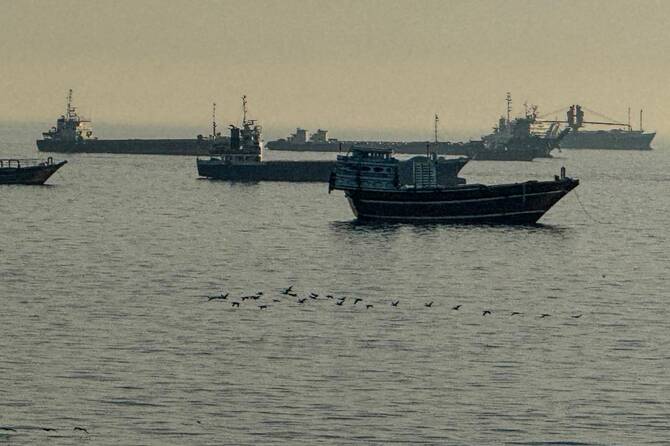
Southern shore reference point. Oman coastline at the strait’s narrowest point. Cross-check landmark for MGRS grid orientation. Vessels anchored off Oman visible in AFP imagery of 17 May 2026.
SITREP Timeline : Strait of Hormuz Traffic and PGSA, Feb to May 2026
🟡 The Traffic Data
55 Vessels Is Not a Recovery. It Is the New Normal, and Iran Just Codified It.
The primary transit corridor through the Strait of Hormuz, centred on the IMO shipping lane at approximately grid reference 40RDQ2696738653 (26.5667°N, 56.2667°E), was carrying roughly 120 vessels per day before the war began on 28 February. Kpler’s data for the week of 11 to 17 May records 55 commodity vessel crossings in total for the week. The recovery from 19 the week before is arithmetically sharp. In terms of pre-war baseline, it represents less than 7% of normal weekly throughput.
The composition of those 55 crossings tells most of the story. Roughly half carried liquids, including three very large crude carriers reportedly bound for China, Oman, and Japan. Sixteen liquefied petroleum gas tankers also crossed, along with 15 dry bulk commodity vessels. One LNG tanker, carrying Qatari gas to Pakistan, crossed on 12 May. That single crossing brought the total number of LNG transits since the start of the war to eight, across 81 days. In peacetime, four or five LNG tankers passed through the strait per day.
The LNG figure is the strategic headline that the aggregate vessel count obscures. Crude oil can be redirected, stored, or blended across multiple routes with friction. LNG is a cryogenic cargo requiring purpose-built vessels, purpose-built terminals, and contractual delivery windows that cannot easily be rerouted around a 55km chokepoint. Eight crossings in 81 days means Qatar’s LNG export pipeline to Asia is operating at approximately 2% of pre-war capacity through this route. The economic consequences are distributed across Japan, South Korea, Pakistan, India, and European import terminals through spot market price signals, even if the diplomatic attention remains focused on crude.
🔴 The PGSA
Tehran Launches the Persian Gulf Strait Authority, Formalising a Toll System Already Running Since March
On 19 May, Iran’s Supreme National Security Council posted to X announcing the launch of the Persian Gulf Strait Authority. The post invited followers to receive real-time updates on Hormuz operations, and the IRGC Navy’s own account shared the same announcement simultaneously. The PGSA is not a new institution in operational terms: transit application emails had been routed to info@PGSA.ir since early May per Press TV reporting, and shipping industry sources confirmed to CNN and Lloyd’s List that a vessel information declaration form, running to more than 40 questions on ownership, crew nationality, cargo, and routing, had already been circulating to shipping companies seeking clearance.
At Bandar Abbas, the IRGC Navy headquarters at grid reference 40RDR2840206932 (27.1832°N, 56.2772°E), the administrative apparatus for processing those applications has been running since at least March, when Iran first announced it had begun receiving toll revenue. The PGSA’s launch on 19 May should be understood as Tehran choosing to make that de facto authority legally and institutionally visible, replacing an opaque grey-market system, which had spawned fraudulent copycat operators accepting cryptocurrency, with a single named sovereign entity. Euronews reports fees of up to $2 million per transit, paid in Chinese yuan. No official tariff schedule has been published.
The US Treasury Department’s OFAC moved against the PGSA framework before Tehran had formally named it. In guidance updated earlier this month, OFAC clarified that payments to the Iranian government or the IRGC for Hormuz passage were not authorised for US persons, US-owned entities, or US-controlled foreign entities. That prohibition does not extend to Chinese, Indian, or other non-sanctioned third-country shipping companies. The nationality logic of the PGSA is therefore already structured around it: the vessels that can pay are largely the vessels Tehran will allow through, and those vessels serve the Asian markets Tehran is positioning as its economic lifeline.
Iran Supreme National Security Council, PGSA Launch Post on X, 19 May 2026
“In the Name of God. The official X account of the Persian Gulf Strait Authority is now live. Follow us for real-time updates on Hormuz Strait operations and latest developments.”
🔵 The Nationality Map
China and India Move Through. Western Destinations Are Near-Absent. The Strait Has Become a Geopolitical Filter.
Of the 55 commodity vessels that crossed the strait in the week of 11 to 17 May, Kpler traced only three by flag, ownership, or cargo to China directly. Two additional Hong Kong-flagged vessels also transited, heading for Oman and the United Arab Emirates. Iranian officials confirmed on 15 May that Chinese vessels had been permitted to cross after a slowdown the previous week. The numbers are modest in absolute terms, but the pattern across the full 81-day wartime dataset is consistent: China and India have been the dominant non-Gulf beneficiaries of PGSA-authorised transit throughout the conflict.
The Kpler destination data has a known limitation: vessels do not always disclose final destinations while crossing, and the figures likely understate Chinese and Indian activity where cargo is transshipped through Oman or the UAE rather than declared direct. Other non-Gulf destinations appearing in the data include Brazil, Pakistan, Thailand, and Malaysia. Western European countries are near-absent as declared destinations. The data reflects the OFAC prohibition in real time: shipping companies with US dollar clearing exposure are declining the PGSA application process, leaving the strait functionally partitioned by geopolitical alignment.
Iran’s 10 May statement that countries complying with US sanctions would face difficulties crossing the strait is the clearest articulation of this partition logic. It is not a restriction on all shipping; it is a sanctions-mirror, denying passage to vessels whose home states comply with the US economic pressure campaign against Tehran. The PGSA is therefore not merely a revenue mechanism. It is a counter-sanctions instrument operating at the chokepoint through which one-fifth of global oil and LNG previously moved.
⚠ The Negotiations
Hormuz Control Remains the Central Unresolved Issue in Stalled US-Iran Talks
AFP’s sourcing notes that Iran’s control of the Strait of Hormuz remains one of the central issues in stalled negotiations with the United States, which have yet to produce a breakthrough. That framing is consistent with all reporting from the post-ceasefire negotiating period since 8 April. Iran has not offered to return the strait to full pre-war transit conditions as part of any deal framework disclosed publicly. Its position, repeated through Iranian Foreign Ministry channels and by parliament security committee chair Ebrahim Azizi, is that any post-war maritime arrangement will differ structurally from pre-war conditions.
Tehran’s internal signalling is also notable. Billboards in Tehran’s metro system have appeared claiming Iran could generate up to $100 billion annually from Hormuz toll revenues, per Euronews. That figure is implausible as a sustained steady-state calculation but its political purpose is domestic: it frames the PGSA as a sovereign economic gain from the war rather than a temporary wartime control measure. If Tehran’s public narrative locks in around permanent toll authority, the diplomatic cost of surrendering the PGSA as a negotiating concession rises correspondingly. Washington’s negotiating position, as articulated by Trump’s pause on new Iran attacks as of 18 May, suggests talks are continuing in some form, though no framework document has been made public.
Source Reliability Matrix
NATO grading: REL A (reliable) to F (unreliable). CRED 1 (confirmed) to 6 (cannot judge).
CRED 1
Professional maritime analytics firm. Data confirmed by Lloyd’s List and multiple wire agencies independently. AIS-based with known gaps where vessels suppress transponders.
CRED 1
Primary wire. Confirmed across Arab News, New Arab, Al-Monitor, BSS News Agency, SpaceWar.com. AFP filed a corrected slug; no factual changes to traffic figures were noted across versions.
CRED 1
Official Iranian state channel. The announcement itself is factual; framing and intent are subject to Iranian political objectives. Confirmed by Reuters, Euronews, Newsweek, and Pakistan Today.
CRED 2
Fee figures of up to $2 million per transit sourced to unnamed shipping industry sources. No official PGSA tariff has been published. Treat as indicative, not confirmed.
CRED 2
Statements on permitting “more than 30 ships” are directionally consistent with Kpler data but cannot be independently verified per vessel. Iranian state media carries institutional propaganda objectives. Used only for intent and framing, not for exact figures.
Strategy Battles Assessment
The PGSA launch on 19 May signals that Tehran has no intention of returning Hormuz to pre-war conditions as part of any near-term settlement: it is converting a wartime control posture into a permanent sovereign revenue institution.
✓ What We Know
55 commodity vessels crossed the Strait of Hormuz in the week of 11 to 17 May, per Kpler, up from 19 the prior week. The wartime weekly average since 1 March is 55, confirming this is a return to baseline, not recovery. Only eight LNG tankers have crossed since 28 February. Iran launched the PGSA on 19 May, formalising a toll and transit-permit regime in operation since March. OFAC has prohibited US persons from paying PGSA fees. China and India are the dominant beneficiaries of PGSA-authorised transit. Iran announced on 10 May that sanction-compliant countries face transit difficulties.
? What We Do Not Know
The published PGSA tariff schedule, if one exists. Whether third-country shipping companies with US dollar clearing exposure will comply with PGSA applications or decline. The extent to which AIS suppression by transiting vessels understates actual crossing volumes. Whether the US negotiating position on Hormuz has evolved since the ceasefire. Whether Iran’s $100 billion annual toll revenue claim is a genuine policy target or domestic political positioning. The breakdown of which specific vessels in the 55 weekly crossings were authorised through PGSA versus transiting without formal permit.
☉ What To Watch
Whether Kpler records a second consecutive weekly crossing count above 55, or whether the previous week’s figure was a temporary IRGC decision rather than a structural shift. Whether any LNG tanker from Qatar obtains PGSA clearance for a regular transit cadence, which would represent a significant escalation of Iran’s control posture into Qatari export territory. Whether the US Treasury takes enforcement action against any third-country entity paying PGSA fees. Whether the next round of US-Iran talks produces any framework language on Hormuz status. Whether the IRGC publicly enforces against a vessel that attempts to transit without PGSA clearance, which would represent the first kinetic enforcement test of the formalised regime.
Sources
- Hormuz tanker traffic edges higher after wartime low, AFP / Arab News, 18-19 May 2026
- Hormuz tanker traffic edges higher after wartime low, AFP / New Arab, 19 May 2026
- Iran sets up Hormuz transit authority to charge ships for passage, Euronews, 18 May 2026
- Iran formalizes Strait of Hormuz control and toll collection, Newsweek, 19 May 2026
- Iran imposes new rules for Strait of Hormuz in bid to secure control, CNN, 7 May 2026
- How traffic through the Strait of Hormuz shrank to a trickle, CNN visual deep dive, 29 April 2026
- Iran announces new authority for Strait of Hormuz management, Pakistan Today, 18 May 2026
Editorial Verification
All Kpler traffic figures (55 crossings, 19 crossings, 663 total, 55 per week average, 8 LNG crossings) sourced to AFP wire of 18 May 2026 and independently confirmed across New Arab, Al-Monitor, BSS News Agency, and SpaceWar.com carrying the same AFP despatch. The AFP wire carried a “CORRECTED” slug on SpaceWar.com; cross-comparison of all versions confirmed no factual changes to vessel counts between original and corrected versions. PGSA formation confirmed by a minimum of four independent outlets: Reuters (via Newsweek), Euronews, Pakistan Today, and CNN. PGSA fee figures (up to $2 million per transit, payment in Chinese yuan) are sourced to Euronews citing unnamed shipping industry sources and are not independently confirmed by a second named source; treated as indicative only. OFAC guidance on PGSA payments confirmed via Newsweek citing OFAC FAQ updates. Iranian state television statements on “more than 30 ships” permitted are directionally consistent with Kpler data but cannot be independently verified per vessel. Vessel coordinates are derived from standard geographic references for the Strait of Hormuz and Bandar Abbas; no satellite imagery has been used in this report. MGRS datum: WGS84 / UTM Zone: 40R / Cross-check reference: Musandam Peninsula, Oman, 40RDQ3677207212.
All claims independently attributed and verified to open sources where possible.
Approved for Publication
Marcus V. Thorne
Lead Editor, Strategy Battles
FILE SB-2026-0519-0012454401 // CLEARED
©StrategyBattles.net 2026
This article is for news and analysis purposes only. Based on publicly available news sources and military updates. All rights reserved. Not for commercial reuse without permission.