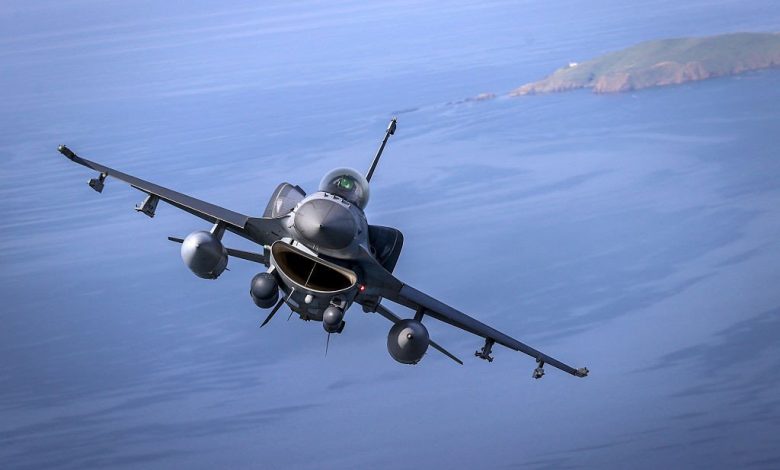
Ukraine Holds New F-16 Talks With Lockheed Martin on Spare Parts and Faster Servicing
Threat Level Assessment
LEVEL 2 OF 5, MONITOR
Bottom Line Up Front
Ukraine’s Deputy Head of the Presidential Office, Brigade General Pavlo Palisa, confirmed on 20 May that he has held a new round of talks with Lockheed Martin focused on accelerating the servicing of Ukraine’s active F-16 fleet, securing spare parts, and expanding technical support lines. The discussions follow a well-documented maintenance backlog affecting the approximately 39 jets Ukraine currently operates, four of which have been lost in combat since the type entered service in August 2024. The talks represent the latest step in a widening industrial relationship between Kyiv and Lockheed Martin, building on a $26 million Pentagon contract from September 2025 and earlier discussions on establishing localised repair facilities on Ukrainian soil.
Key Judgments
The maintenance bottleneck is Ukraine’s most urgent F-16 problem. With roughly 39 jets in service, four combat losses confirmed by Oryx, and ongoing Norwegian airframes stuck at a Sabena Aerospace facility in Belgium missing up to 100 parts per aircraft, the operational availability rate of the fleet is under active pressure. Accelerating servicing is not an abstract industrial goal; it directly sets the number of jets Ukraine can put in the air on any given day.
On-soil repair capacity in Ukraine remains a medium-term objective rather than an imminent deliverable. Discussions between Ukroboronprom and Lockheed Martin on localising maintenance date back to the MSPO 2025 defence exhibition in Poland; a facility-expansion agreement was signed there, but operational timelines have not been publicly confirmed. The January 2026 Sabena Aerospace contract, worth up to $235 million and running through at least 2029, suggests Brussels, not Kyiv, remains the current hub for intermediate and depot-level work.
Whether the 20 May talks produced any binding commitments or are still at the exploratory stage. Palisa’s Telegram post describes discussions but does not announce a signed agreement. Lockheed Martin has not issued a public statement corroborating the meeting’s scope or any deliverables, and Ukrainian Defence Industry JSC has not commented.
4
F-16s Lost, Aug 2024 to May 2026
~39
F-16s in Ukrainian Service, Apr 2026
$26M
Pentagon Contract, Lockheed Martin F-16 Support
1,300+
Russian Aerial Targets Destroyed by F-16s
SITREP Timeline : Ukraine F-16 Fleet, Aug 2024 to May 2026
🔴 The 20 May Talks
A Presidential Office General Sits Across the Table From Lockheed Martin Again, and the Agenda Has Not Changed
Pavlo Palisa, Deputy Head of Ukraine’s Presidential Office and a serving Brigade General, announced on 20 May via his Telegram channel that he had held a fresh round of negotiations with Lockheed Martin Corporation representatives. The stated agenda covered three areas: securing a reliable spare-parts supply, streamlining aircraft maintenance, and exploring options to expand technical support for Ukrainian military aviation more broadly. United24 Media, lb.ua, and BreakingTheNews all reported independently from the same Telegram post within hours of publication.
The framing is notable for what it does not include. Palisa did not announce a signed contract, a firm delivery schedule for additional parts, or a commitment from Lockheed Martin to establish repair infrastructure on Ukrainian soil. The talks are described as focused on jointly accelerating servicing of aircraft that are currently active, rather than on future deliveries or platform upgrades. That narrow focus reflects where the operational pressure is concentrated right now: keeping the jets that Ukraine already has flying, rather than adding new capability.
Palisa closed his update by quoting two Latin military mottos used by Ukrainian forces: “Scuta premite,” meaning press the shields, and “Nunquam retrorsum,” meaning never retreat. The rhetorical flourish is characteristic of his public communications style, but it also signals the broader institutional context: the people running these negotiations are uniformed operators, not procurement bureaucrats, and their urgency is operational rather than administrative.

Ukrainian officials, led by Brigade General Pavlo Palisa, meet with Lockheed Martin representatives on 20 May 2026. Photo: Presidential Office of Ukraine.
🟡 The Maintenance Problem
Thirty-Nine Jets, Four Lost, A Backlog in Brussels, and Boneyard F-16s Arriving in Shrink-Wrap
Ukraine’s F-16 fleet currently stands at approximately 39 operational jets, a figure derived from open-source tracking by Oryx and reported by Technology.org in April 2026. Against the 79 to 87 aircraft pledged by Denmark, the Netherlands, Norway, and Belgium, that number illustrates how far the delivery programme has progressed and where the gaps remain. Belgian transfers have been delayed by the slow arrival of Brussels’ replacement F-35 fifth-generation jets. Norwegian airframes reached a Sabena Aerospace maintenance facility in Belgium with up to 100 missing parts each and without wings, engines, or tails, producing a backlog that has set back their readiness for transfer to Ukraine.
The US has taken two distinct approaches to the spare-parts problem. The Pentagon in May 2025 confirmed it was shipping non-flyable 1980s-vintage F-16As from the Boneyard storage facility at Davis-Monthan Air Force Base in Arizona to Ukraine, transported on Antonov An-124 heavy cargo airlifters after being shrink-wrapped for transit. The Air Force was explicit that these aircraft cannot be made operational: they lack engines and radar and are retired beyond return. The second approach is the industrial contract route: the January 2026 Sabena Aerospace deal, running through 2029 with a $235 million funding ceiling, handles intermediate and depot-level work that exceeds the capacity of Ukrainian line maintenance units.
Neither approach fully solves the problem Palisa is describing. Boneyard parts help fill specific component gaps but do not provide a reliable ongoing supply chain. Brussels-based depot maintenance means turnaround times measured in weeks or months of transit, not days. The core operational ask from the Ukrainian side has been consistent for over a year: shorten the distance between a jet that needs a part and the part that needs to arrive. That is the pressure behind every round of talks with Lockheed Martin.
🔵 What the Fleet Is Actually Doing
Over 1,300 Russian Aerial Targets Destroyed, Custom Tactics Replacing NATO Doctrine, and Four Pilots Dead
Ukraine’s F-16s have been operationally active since August 2024, primarily in an air defence role intercepting Russian cruise missiles, Shahed drones, and glide-bomb carrier aircraft at long range. By November 2025, the fleet had destroyed more than 1,000 aerial targets; by early 2026 that figure had risen past 1,300, according to reporting by Aerotime and Technology.org. The fleet is also hitting ground targets, including strikes in close proximity to frontline positions, a role that puts the jets under additional stress and risk from Russia’s dense surface-to-air missile network.
Four F-16s have been confirmed lost by Oryx since the type entered service. The first was destroyed on 26 August 2024, an ex-Danish example, in circumstances the Ukrainian general staff described as an accident rather than a Russian shoot-down. Subsequent losses include a pilot killed in April 2025, Captain Pavlo Ivanov, aged 26, during a combat mission; the cause of that loss has not been fully established publicly. Ukrainian Air Force officers have been publicly candid that NATO-taught air combat doctrine did not transfer cleanly to the Ukrainian theatre, where Russian ground-based air defences present a qualitatively different threat envelope than any NATO planning scenario. The resultant shift to low-altitude, terrain-hugging flight profiles and new rules of engagement has been documented across multiple pilot interviews.
The operational context matters for the maintenance conversation. Jets flying low-altitude profiles in high-tempo combat environments accumulate airframe stress and component wear faster than peacetime schedules assume. The engine, radar, and avionics workload of a jet flying several sorties per week through contested airspace is substantially higher than the planned-for baseline in a standard F-16 sustainment contract. Lockheed Martin wrote the original sustainment documentation for export customers who are not at war. Ukraine needs documentation, parts cycles, and servicing intervals calibrated for a different operational reality. That is what the 20 May talks are trying to negotiate.
Pavlo Palisa : Deputy Head, Presidential Office of Ukraine : Telegram, 20 May 2026
“The primary goal of the talks is to jointly accelerate the servicing of Ukraine’s currently active aircraft and significantly expand technical support lines. Scuta premite. Nunquam retrorsum.”
🟢 The Industrial Architecture
A $26 Million Documentation Contract, a $235 Million Brussels Hub, and the Longer Goal of Repair Capacity Inside Ukraine
The industrial relationship between Ukraine and Lockheed Martin has been built in layers since 2024. The $26 million contract awarded in September 2025 covered a specific gap: Ukraine lacked country-adapted operational and maintenance documentation for its F-16 fleet, a problem that sounds administrative but is practically significant. Tailored documentation reduces the risk of maintenance errors, speeds technician training, and makes it possible for Ukrainian personnel to work on the jets without routing every technical question through Lockheed Martin’s standard export support chain. The contract runs through May 2029, signalling that the US government expects the F-16 to remain a core Ukrainian Air Force platform for at least the next three years.
Separately, at the MSPO 2025 defence exhibition in Poland, Ukrainian Defence Industry JSC and Lockheed Martin signed an agreement to expand the capabilities of a specific Ukrainian facility, with the stated direction being localised F-16 maintenance. The agreement was confirmed by both Defence Express and Caliber.Az citing the same exhibition reporting. Neither party has publicly specified which facility was involved or what the implementation timeline is. The January 2026 Sabena contract sits alongside this: Brussels handles the work that cannot yet be done inside Ukraine, while the longer-term ambition is to bring that work onshore.
The strategic logic for in-country repair capacity is straightforward. Every F-16 that needs depot-level maintenance currently has to travel to Belgium, absorbing transit time, security exposure, and the scheduling constraints of a commercial facility serving multiple clients. A jet undergoing overhaul in Brussels is not available for operations over Kharkiv. Moving even a portion of that work inside Ukraine would reduce turnaround time and increase mission-capable rates. The obstacle is not intention but infrastructure: establishing a facility capable of F-16 intermediate maintenance requires tooling, personnel certification, parts inventories, and physical security that take time and significant capital to build.
Source Reliability Matrix
NATO grading: REL A (reliable) to F (unreliable). CRED 1 (confirmed) to 6 (cannot judge).
CRED 1
Primary source. Official Telegram channel of the Deputy Head of the Presidential Office. Post confirmed by three independent outlets on same day.
CRED 1
Established Ukrainian English-language outlet. Reporting directly cites the Palisa Telegram post with hyperlink. No independent sourcing beyond the post itself.
CRED 1
Both outlets independently confirmed the boneyard F-16 transfer programme and cited US Air Force spokesperson confirmation. Highly reliable for technical and contract detail.
CRED 2
Both cite Pentagon contract data from 29 January 2026. Contract details are publicly filed; figures treated as confirmed. Norwegian parts-shortage detail sourced from NRK via Aviation24.be.
CRED 2
Derived figure of approximately 39 jets based on pledged deliveries minus confirmed losses. Ukraine does not publicly disclose fleet size. The figure is an open-source estimate, not an official Ukrainian Air Force statement.
Strategy Battles Assessment
Ukraine’s F-16 fleet is performing well in combat but is constrained by a maintenance architecture built for peacetime, and the 20 May talks with Lockheed Martin are an attempt to close that gap before the delivery pipeline expands the problem.
✓ What We Know
Palisa confirmed new talks with Lockheed Martin on 20 May, covering spare parts, servicing speed, and technical support expansion. Ukraine operates approximately 39 F-16s, has lost four in combat, and has destroyed more than 1,300 Russian aerial targets since August 2024. Depot-level maintenance is currently centred at Sabena Aerospace in Brussels, contracted through 2029 at up to $235 million. A $26 million Lockheed Martin documentation contract and a facility-expansion agreement with Ukroboronprom both exist and are running. Boneyard F-16As are being shipped from Arizona as a parts source.
? What We Do Not Know
Whether the 20 May talks produced binding commitments or deliverables. Which Ukrainian facility was referenced in the MSPO 2025 agreement and when it is expected to reach F-16 maintenance capability. The exact current mission-capable rate of the Ukrainian F-16 fleet. Whether the Norwegian backlog at Sabena has been resolved and when those airframes will reach Ukraine. How many of the 87 pledged jets will arrive in 2026 and on what schedule.
☉ What To Watch
Whether Lockheed Martin issues any public statement on the 20 May round, which would indicate the talks have moved past the exploratory phase. Whether the Ukroboronprom facility agreement produces an announced operational milestone. Whether Belgium’s F-35 delivery schedule slippage further delays the 30 F-16s Brussels has pledged, and how that affects Kyiv’s planning horizon. Whether the Sabena Brussels backlog clears and Norwegian jets begin arriving in Ukraine. Whether a future Palisa update announces a specific parts-supply agreement rather than further consultations.
Sources
- Faster Repairs, More Parts: Ukraine Engages Lockheed Martin on F-16s, United24 Media, 20 May 2026
- Pavlo Palisa Telegram post on Lockheed Martin negotiations, t.me/PavloPalisa/242, 20 May 2026
- Palisa discussed F-16 capabilities and spare parts with Lockheed Martin, lb.ua, 20 May 2026
- Pentagon Sending Decommissioned F-16s to Ukraine for Spare Parts, FlightGlobal, 2 May 2025
- US Air Force Taps Boneyard Jets to Keep Ukraine’s F-16s Flying, Air and Space Forces Magazine, May 2025
- $26M Contract for F-16 Documentation Aims to Make Ukraine’s Air Force More Effective, Defence Express, September 2025
- Norwegian F-16s for Ukraine Delayed Amid Maintenance Disputes Involving Sabena Aerospace, Aviation24.be, April 2026
- US to Maintain F-16 Fighter Jets of Ukraine (Sabena Contract Detail), AviationA2Z, February 2026
- Ukraine Has Around Half of the Pledged F-16 Fleet, Technology.org, 17 April 2026
- Ukraine Says F-16s Downed 1,000 Aerial Targets, Aerotime, January 2026
Editorial Verification
The Palisa Telegram statement is confirmed by three independent outlets (United24 Media, lb.ua, BreakingTheNews) reporting on the same day from the same post. Lockheed Martin has not issued a corroborating public statement; the talks and their scope are therefore attributable only to the Ukrainian side as of time of writing. This is noted as a single-source-originator item: the source of the statement is verified across multiple outlets, but only one party to the talks has spoken publicly. The $26 million documentation contract figure is sourced from Pentagon FMS data, confirmed by Defence Express and The Defence Blog independently. The Sabena Aerospace $235 million contract ceiling and $70 million allocated figure are sourced from publicly filed Pentagon contract data as reported by AviationA2Z and Aviation24.be. The boneyard F-16 transfer is confirmed by FlightGlobal citing a US Air Force spokesperson and independently by Air and Space Forces Magazine. The fleet size estimate of approximately 39 jets is an open-source calculation from Technology.org (April 2026) cross-referenced against Oryx; Ukraine does not publicly disclose its F-16 fleet size. Four confirmed F-16 losses are sourced to Oryx open-source tracking. The 1,300-plus aerial targets figure is sourced to Technology.org (November 2025) and Aerotime (January 2026). The Norwegian airframe backlog at Sabena, including the missing-parts detail, is sourced to NRK via Aviation24.be. This article contains no satellite imagery. No geographic coordinates are required for this article as it does not cover a specific military operation at a defined location.
All claims independently attributed and verified to open sources where possible.
Approved for Publication
Marcus V. Thorne
Lead Editor, Strategy Battles
FILE SB-2026-0520-0054654681 // CLEARED
©StrategyBattles.net 2026
This article is for news and analysis purposes only. Based on publicly available news sources and military updates. All rights reserved. Not for commercial reuse without permission.