Iran Claims 35-Ship Hormuz Transit Day as PGSA Maps UAE Waters; Rubio Says Talks Show Slight Progress
Threat Level Assessment
LEVEL 4 OF 5, SERIOUS
Bottom Line Up Front
Iran's Persian Gulf Strait Authority on 22 May published an expanded jurisdiction map claiming waters that extend into UAE sovereign territory, while the IRGC Navy announced that 35 vessels transited the Strait of Hormuz that day under Iranian permission and security. Secretary of State Marco Rubio said talks showed "slight progress" but stressed the Strait and Iran's highly enriched uranium remain the two unresolved sticking points. On the Iraqi flank, the deputy head of Harakat Hezbollah al Nujaba rejected militia disarmament as a "purely American project," complicating the Iraqi federal government's reported plan to confiscate medium and heavy weapons from Iran-aligned Popular Mobilisation Forces factions. ISW-CTP assess that Iran is not trying merely to survive this war but to emerge from it with veto power over one of the world's most critical energy chokepoints.
Key Judgments
The PGSA fee system is a protection racket with legal dressing. Iran created the insecurity through attacks and closure; it is now charging for relief from that insecurity. The system's framing as a fee for services rather than a toll is a deliberate legal manoeuvre designed to find cover under provisions of maritime law that permit service charges but prohibit transit tolls on international straits. The legal cover is thin: five GCC states and the IMO have already rejected it.
The inclusion of Oman in the fee-sharing discussion is a calculated move to acquire legitimacy without UAE participation. Oman's territorial waters form the strait's southern shore; Omani partnership would give the system a veneer of bilateral maritime governance rather than unilateral Iranian coercion. The UAE's absence from the arrangement while its sovereign waters appear on the PGSA map is the clearest indicator that the system is expansionist in design.
The Iraqi militia disarmament process is stalling at the most kinetically capable factions. Harakat Hezbollah al Nujaba, Kataib Hezbollah, and Kataib Sayyid al Shuhada, all of which have conducted attacks on US and regional targets during the war, are either opposed to or ambiguous about the plan. An executive disarmament plan that excises these three groups from meaningful compliance would reduce formal optics of Iranian militia influence without reducing operational capacity.
Whether the "slight progress" Rubio cited on 22 May reflects genuine movement on the two core sticking points, HEU disposition and Hormuz control, or simply reflects a narrowing of procedural gaps around secondary issues. Iran's foreign ministry spokesman said nuclear issues were not under discussion at all. If both descriptions are simultaneously accurate, the gap between stated progress and actual negotiating positions is wider than either side is publicly acknowledging.
35
Vessels via IRGC Permission, 22 May
$2M
Max PGSA Fee Reported Per Transit
5
GCC States File IMO Protest
20%
Global Seaborne Oil via Hormuz (Pre-War)
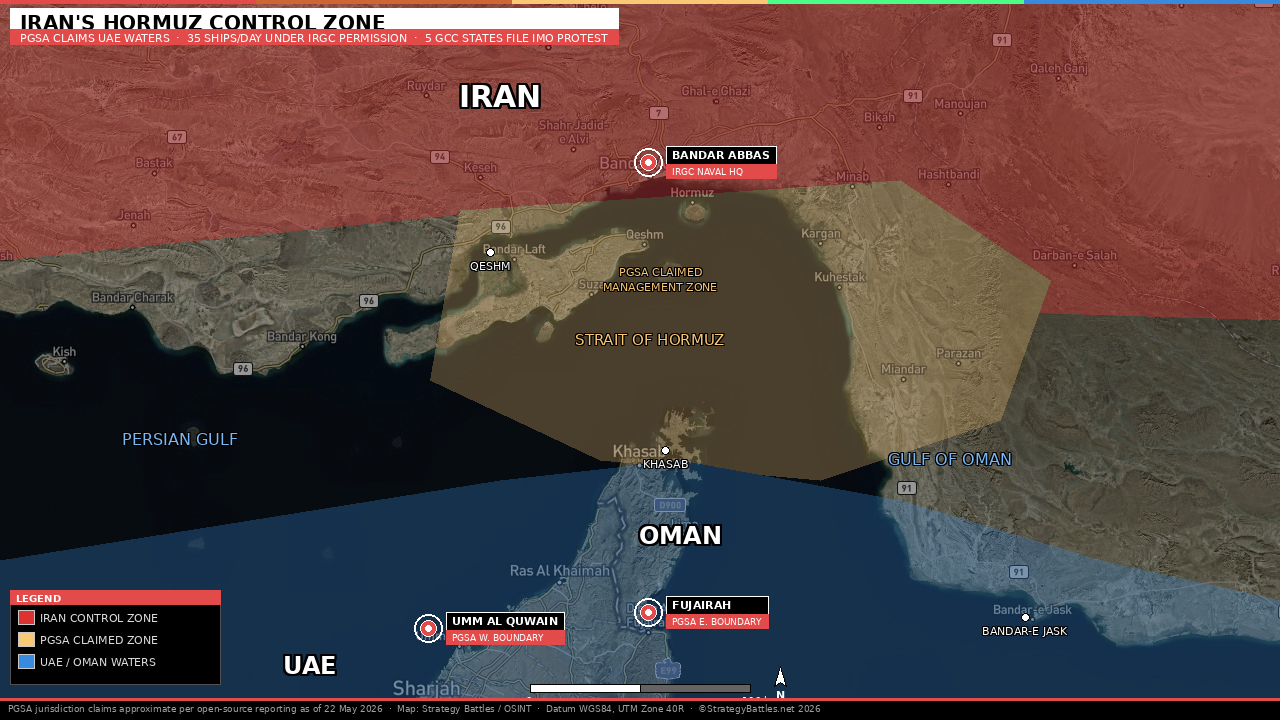
Iranian control and PGSA claimed management zone approximate per open-source reporting as of 22 May 2026. UAE and Oman fills indicative per public reporting. Map: Strategy Battles / OSINT. Datum WGS84, UTM Zone 40R. ©StrategyBattles.net 2026
📍 Bandar Abbas, Iran
PRECISEMGRS: 40RBN 5670 6190
27.1865°N 56.2808°E
Primary IRGC Navy base and port city. Command centre for Hormuz transit enforcement operations and PGSA coordination.
Source: GeoNames / Wikipedia infobox
📍 Strait of Hormuz Narrows
PRECISEMGRS: 40RBN 8500 5000
26.5600°N 56.2500°E
Approximate centre of the strait narrows, approximately 34 km wide at this point. Primary PGSA transit management area. Carries roughly one-fifth of global seaborne oil in pre-war conditions.
Source: Wikipedia / Euronews reporting (strait width 34 km)
📍 PGSA Eastern Boundary, Fujairah
AREA ONLYApproximate Area
Centre of indicative zone. Exact boundary not publicly disclosed.
South of Fujairah, UAE. PGSA jurisdiction map anchors its eastern boundary at this point, claiming waters that enter UAE sovereign territory per House of Saud / Times of Israel open-source reporting of 22 May.
Source: Approximate per House of Saud / Times of Israel PGSA map reporting, 22 May 2026
📍 PGSA Western Boundary, Umm al-Quwain
AREA ONLYApproximate Area
Centre of indicative zone. Exact boundary not publicly disclosed.
Umm al-Quwain coast, UAE. PGSA jurisdiction map anchors its western boundary here, infringing UAE sovereign waters. Site not precisely disclosed in any public PGSA document reviewed.
Source: Approximate per House of Saud / Times of Israel PGSA map reporting, 22 May 2026
SITREP Timeline : Hormuz Control Escalation, Feb to May 2026
🔵 The PGSA Fee System
Protection Racket Or Maritime Service: How Iran Answers That Question Matters More Than The Answer
On 22 May, the Islamic Revolutionary Guards Corps Navy announced that 35 vessels, including oil tankers and container ships, had transited the Strait of Hormuz in the previous 24 hours "after obtaining permission, with the coordination and security protection" of the IRGC Navy. The day before, the number had been 31. The day before that, 26. The trend line is upward, and Iran is making sure the world knows it. These daily announcements are not a shipping bulletin. They are a political signal: the PGSA is open for business, the fee system is operating, and the transit route is under Iranian management.
The Persian Gulf Strait Authority formalised its existence in May 2026, launching an official account on 18 May and publishing a jurisdiction map on 21 to 22 May that placed its claimed management zone across waters touching both Omani and UAE sovereign territory. The vetting process requires operators to submit a 40-question form covering ownership, cargo, crew nationalities, and insurance before a permit is issued. No official tariff exists. Reports from Bloomberg and Reuters indicate that payment requests have reached up to $2 million per transit in some cases, with most vessels paying around $150,000. Payment is reportedly made in Chinese yuan.
ISW-CTP's framing of this as a protection racket is analytically precise. A protection racket is a coercive scheme in which an actor creates or threatens danger and then demands payment in exchange for protection from that danger. Iran closed the Strait of Hormuz to commercial shipping when the war began on 28 February. It has since attacked vessels, threatened to set fire to any ship that transited without authorisation, and has the naval assets to enforce those threats. The "security" the PGSA now offers is protection from Iranian forces. No other actor has threatened shipping in the Strait of Hormuz since February. The "service" being sold is the temporary suspension of Iranian coercion.
The legal distinction Iran is attempting to draw is between a toll, which is prohibited under the UNCLOS transit passage principle for international straits, and a fee for actual services rendered, which can be permitted under certain circumstances. Iran signed but never ratified UNCLOS, so its treaty obligations on this point are limited. But the IMO's secretary general stated on 9 April that there is no international agreement under which tolls can be introduced for transiting international straits and called any such system a dangerous precedent. The IMO Legal Committee adopted a resolution at its 113th session condemning Iran's closure and attacks on vessels. Five GCC states, Bahrain, Kuwait, Qatar, Saudi Arabia, and the UAE, filed a joint letter to the IMO on or around 22 May warning commercial operators against complying with PGSA routing directives.
🟡 The Oman Question
Why Tehran Wants Muscat In The Room And Why Muscat Is Starting To Listen
The New York Times reported on 21 May, confirmed by Business Standard and other outlets, that Iran and Oman have been in discussions about a revenue-sharing arrangement for the PGSA fee system. Oman's inclusion is not an afterthought. The Strait of Hormuz is roughly 34 kilometres wide at its narrowest point, with the shipping lanes running through both Iranian and Omani territorial waters. Any bilateral framework that includes Oman transforms Iran's unilateral action into something that at least superficially resembles a shared maritime management regime.
Oman initially declined. Its concern was the friction with international partners, particularly the United States, that open participation would generate. That calculus shifted when Omani officials began to calculate the projected revenue from a fee system processing dozens of vessels per week. The NYT reported that Oman is now signalling willingness to use its influence with Gulf neighbours and with Washington to push the proposed system. Rubio responded directly, telling reporters that Iran was trying to convince Oman to join a tolling system in an international waterway and that it "can't happen."
The UAE's absence from the Oman discussion is telling in a different way. The PGSA's 22 May jurisdiction map places the claimed management zone boundary at two points on UAE sovereign territory, south of Fujairah on the eastern boundary and Umm al-Quwain on the western side. Oman's participation would legitimise a system that simultaneously infringes UAE sovereignty. Abu Dhabi has been among the most direct voices against Iranian control of the strait, with the head of the UAE's main oil company stating in late May that accepting Iranian control over the waterway would finish freedom of navigation as currently understood.
Secretary of State Marco Rubio : NATO Foreign Ministers Meeting, Helsingborg, Sweden, 22 May 2026
"There's been some slight progress, I don't want to exaggerate it, but there's been a little bit of movement, and that's good. The fundamentals remain the same. Iran can never have a nuclear weapon, it just cannot."
🟡 The Negotiations
Slight Progress, Deep Gaps: What Rubio Said And What Tehran Said About The Same Conversations
Speaking alongside NATO Secretary General Mark Rutte in Helsingborg, Sweden, on 22 May, Rubio characterised the state of US-Iran talks as showing "slight progress" while stressing he did not want to overstate momentum. An unspecified senior Iranian source told Reuters on the same day that both sides had narrowed gaps between their demands. A Pakistani diplomatic source told Saudi media outlet Al Hadath that the main obstacle remained how to handle Iran's highly enriched uranium stockpile, and that closing those gaps would not be easy because both sides maintained "high demands."
Iran's foreign ministry spokesman Esmaeil Baghaei offered a substantially different picture. He was quoted by IRNA as saying diplomacy takes time and that the sides had not reached a point where an agreement was close. He added that nuclear issues were not being discussed at all. If that is accurate, it places the "progress" Rubio cited on procedural or secondary matters while the two headline sticking points, HEU disposition and Hormuz control, remain untouched. The semiofficial Iranian Students News Agency reported that the latest US proposal had narrowed gaps "to some extent" but that further movement required Washington to end what it called the "temptation for war."
Pakistan's military chief, Field Marshal Asim Munir, arrived in Tehran on 22 May to press mediation efforts. Qatar sent a separate negotiating team working in coordination with the United States. Both moves signal that the diplomatic architecture around the talks is expanding, which can reflect genuine momentum or can reflect that direct channels remain blocked and third-party facilitation is filling the gap. Iran's current framework reportedly repeats terms Trump previously rejected, including demands for control of the Strait of Hormuz, compensation for war damage, lifting of sanctions, and the release of frozen assets.
Rubio warned again on 22 May that if a deal cannot be reached, Trump has "other options," without elaborating. Trump has been threatening for weeks that the 8 April ceasefire could end if Iran fails to make a deal. The ceasefire has not collapsed, but it has not produced a framework. With 35 IRGC-supervised transits on 22 May and a jurisdiction map now formally claiming UAE waters, Iran is not sitting idle while negotiations run. It is using the talks to buy time to institutionalise its position at Hormuz.
🔴 The Iraqi Militia File
Disarmament Plan Meets Its Hardest Cases: The Militias Most Closely Tied To Tehran Are Also The Most Resistant
Hussein al Saidi, deputy head of the executive council of Harakat Hezbollah al Nujaba, rejected militia disarmament on 22 May, describing the plan as a "purely American project" and warning that Iraqi officials who insist on integrating the Popular Mobilisation Forces into the Iraqi security establishment will "pay the price" politically. Saidi's statement came in response to reports that an Iraqi committee comprising Badr Organisation head Hadi al Ameri, Prime Minister-designate Ali al Zaidi, and caretaker Prime Minister Mohammad Shia al Sudani is close to finalising an executive plan to disarm the militias, confiscating medium and heavy weapons and restructuring the PMF.
Harakat Hezbollah al Nujaba's leader, Akram al Kaabi, had already declared disarmament a "red line" on 6 May, one day after the US State Department's Rewards for Justice Program offered a $10 million bounty for his whereabouts. Kataib Hezbollah and Kataib Sayyid al Shuhada also reportedly reject the plan. These are not peripheral factions. ISW-CTP assess that Harakat Hezbollah al Nujaba, Kataib Hezbollah, and related groups are more subordinate to Iran than other Iraqi militias and have been the most kinetically active during the war, conducting drone attacks against US installations and Gulf state targets.
The Iraqi Shia Coordination Framework separately announced on 22 May that a federal government committee will be formed to investigate recent drone attacks targeting Saudi Arabia and the UAE, including the 17 to 19 May strikes that hit the Barakah nuclear power plant. The committee structure, with one team reviewing evidence in Saudi Arabia and the UAE and another investigating inside Iraq, is a constructive mechanism. But mechanisms of this kind have been proposed before in Iraq and have produced limited results when the actors under investigation are also embedded in the state security architecture through the PMF.
Iran's separate pressure on its Iraqi partners to reduce kinetic activity, reportedly communicated by IRGC Quds Force Commander Brigadier General Esmail Ghaani during April meetings in Baghdad, adds a complicating layer. Tehran appears to want its Iraqi allies to stop generating US financial pressure on Baghdad, which hits Iran's own sanctions-evasion mechanisms via the Iraqi economy. But it does not appear to want those allies disarmed. The distinction between pausing kinetic operations and surrendering weapons is the space in which Ghaani's "alternative plan" is reportedly being designed.
Sultan Al Jaber, Head of ADNOC, UAE, Late May 2026, via Insurance Journal
"Once you accept that a single country can hold the world's most important waterway hostage, freedom of navigation as we know it is finished. If we do not defend this principle today, we will spend the next decade defending against the consequences."
⚠ The Endgame Question
Iran Is Not Trying To Survive This War: It Is Trying To Win A Permanent Position At Hormuz
ISW-CTP's central assessment in the 22 May special report is that Iran is not positioning itself to merely exit the war. It is positioning itself to emerge from the war in a stronger strategic position, with effective veto power over access to the Strait of Hormuz. That assessment is supported by the evidence. The PGSA was established, its jurisdiction map published, its fee system operationalised, and its Oman partnership discussions opened, all while ceasefire negotiations were running. These are not defensive moves by an Iran trying to survive. They are offensive consolidation moves by an Iran trying to lock in gains before a deal is reached.
The US and its allies face a sequencing problem. A ceasefire that leaves the PGSA in place, even temporarily, risks allowing the system to accumulate precedent. Once 35 vessels per day are transiting under IRGC supervision with fees paid, the system generates institutional momentum: operators adapt their procedures, insurers build PGSA compliance into their frameworks, and the fees begin to appear as a cost of doing business rather than as coercion. Rubio's explicit rejection of any tolling system and his call for all countries to oppose the PGSA are the right signals. Whether they translate into enforcement is the open question.
The US position, per Rubio on 22 May, is that any outcome in which Iran continues to control the strait is "unfeasible" as a durable end to the war. That is correct as a strategic statement. It is also a high bar. Forcing Iran to genuinely relinquish the PGSA and return to pre-war transit conditions requires either a negotiated concession Tehran has consistently indicated it will not make, or a military option that carries its own risks and costs. The "other options" Rubio referenced remain on the table for now. Whether they stay there depends on whether the slight progress he cited becomes something more substantial at the next round of talks.
Source Reliability Matrix
NATO grading: REL A (reliable) to F (unreliable). CRED 1 (confirmed) to 6 (cannot judge).
Primary source. Established analytical institution, named authors, footnoted claims. Cross-confirmed across multiple outlets on all headline assertions.
Negotiations status and Iranian senior source. Anonymous sourcing on Iranian side; Rubio quotes are on-record.
Official Iranian state media. Figures are self-reported by an interested party. Carried by multiple outlets including WION, Seoul Economic Daily, and ANI. Directional trend accepted; precise numbers treated as indicative.
Original reporting on Oman fee-sharing discussions. Unattributed official sourcing. Widely cross-confirmed by Bloomberg, Business Standard, Insurance Journal, and The War Zone.
Used for Iranian official statements only. State-controlled output. Treated as reflecting the Iranian government's public position, not as independently verified reporting.
Regional outlets with access to Iraqi political sources. Senior Iraqi political official cited anonymously in Asharq al Awsat on 9 May. ISW-CTP cites these sources with attribution; Strategy Battles follows the same chain.
Strategy Battles Assessment
Iran is using the ceasefire as installation time: installing the PGSA, normalising daily transit figures, and recruiting Oman before a deal can remove the system. The talks are real but they are running behind the facts on the water.
✓ What We Know
The IRGC Navy reported 35 vessel transits on 22 May under Iranian permission, up from 26 earlier in the week. The PGSA published an expanded jurisdiction map on 22 May claiming waters that extend into UAE sovereign territory. Five GCC states filed a joint IMO protest letter. Rubio confirmed "slight progress" in talks on 22 May; Iran's foreign ministry said nuclear issues were not under discussion. The deputy head of Harakat Hezbollah al Nujaba rejected militia disarmament as a "purely American project" on 22 May. An Iraqi federal committee to investigate 17 to 19 May drone attacks on the UAE and Saudi Arabia was announced by the Shia Coordination Framework.
? What We Do Not Know
Whether any specific concession on HEU or Hormuz was the subject of Rubio's "slight progress" claim, or whether the movement was on secondary procedural matters. Whether Oman will formally join the PGSA system or step back under US pressure. Whether the Iraqi disarmament executive plan has a credible enforcement mechanism for the militias that reject it, or whether it will produce formal compliance from cooperative factions while leaving the most capable groups untouched. The identity of the specific Iraqi militia actors responsible for the Barakah strike and the May Saudi intercepts.
☉ What To Watch
Whether Oman makes a formal public statement on the PGSA, which would represent a significant shift in the diplomatic landscape. Whether daily IRGC-supervised transit figures continue to rise toward pre-war norms, which would give the PGSA system de facto operational legitimacy regardless of legal status. Whether Trump activates the "other options" Rubio referenced, and whether that takes the form of resumed military action or targeted economic pressure on PGSA-compliant operators via OFAC sanctions. Whether the Iraqi investigation committee identifies responsible militia actors by name and whether any enforcement action follows. Whether Pakistan's Field Marshal Munir's Tehran visit produces any movement on the two headline sticking points in the next 72 hours.
Sources
- ISW-CTP, Iran Update Special Report, Christopher Solomon, 22 May 2026
- Reuters/Detroit News: Rubio sees progress in Iran talks, Pakistan renews mediation, 22 May 2026
- The National News: Rubio, slight progress, Hormuz tolls "can't happen," 22 May 2026
- CNBC: US-Iran at odds over HEU and Hormuz tolls, 22 May 2026
- WION: IRGC Navy coordinates passage of 35 ships through Strait of Hormuz, 22 May 2026
- Business Standard / NYT: Iran-Oman Hormuz payment system talks, 22 May 2026
- House of Saud: Iran PGSA Hormuz map, GCC IMO protest, Oman tolls, 22 May 2026
- Euronews: Iran sets up Hormuz transit authority, PGSA fee details, 18 May 2026
- Windward: Iran Hormuz transit toll mechanism and maritime intelligence, 16 May 2026
- Insurance Journal / Bloomberg: Iran expanding Hormuz control, Oman toll update, 21 May 2026
- Times of Israel: Iran broadens Hormuz control, GCC protest, Rubio statement, 22 May 2026
- UN News: Bahrain and US float Security Council resolution on Strait of Hormuz, May 2026
- The New Region: Iraqi militia leader Kaabi rejects disarmament, 6 May 2026
Editorial Verification
Primary source is the ISW-CTP Iran Update Special Report of 22 May 2026. All three headline assertions in that report, the IRGC 35-vessel transit announcement, the Rubio "slight progress" statement, and the Saidi disarmament rejection, are independently confirmed by multiple named outlets. The Rubio quotes are verified on-record via The National News, CNBC, and US News (AP). The IRGC transit figure is confirmed via WION, ANI, Seoul Economic Daily, and PressTV. The Iran-Oman fee-sharing discussions are sourced to the New York Times original reporting (21 May) and cross-confirmed by Bloomberg, Business Standard, The War Zone, and Insurance Journal. The GCC IMO protest letter is confirmed by the Times of Israel and House of Saud open-source analysis. The PGSA jurisdiction map publishing on 22 May is confirmed by House of Saud and Times of Israel. The Saidi disarmament rejection statement is reported by ISW-CTP, citing Iraqi media and Asharq al Awsat. The Harakat Hezbollah al Nujaba leader Kaabi's 6 May "red line" statement is confirmed by The New Region. The Barakah drone strike and Saudi intercepts of 17 to 19 May are reported by ISW-CTP citing Gulf state official statements. The $2 million maximum fee figure is reported by Bloomberg and Euronews; the $150,000 typical payment is from Reuters (20 May). Single-source item flagged: the specific breakdown of the Iraqi disarmament executive plan (weapons confiscation details) is from a single anonymous senior Iraqi political official cited by Asharq al Awsat on 9 May.
Coordinates and map (v8): Static map produced with PIL overlay script sb-map-overlay.py on a satellite base image. Third-party watermarks removed from base before overlay. Territory fills (Iran control zone, PGSA claimed management zone, UAE and Oman waters) are approximate per open-source reporting as of 22 May 2026, based on House of Saud and Times of Israel reporting on the PGSA jurisdiction map. No classified imagery used. No third-party watermarks appear in the published image. Bandar Abbas coordinate (27.1865N, 56.2808E) sourced from GeoNames and Wikipedia infobox. Strait narrows centre-point sourced from Wikipedia and Euronews. PGSA boundary markers at Fujairah and Umm al-Quwain are AREA ONLY: exact boundary not publicly disclosed in any PGSA document reviewed; plotted as indicative zones, no MGRS assigned.
MGRS datum: WGS84 / UTM Zone: 40R / Cross-check reference: Bandar Abbas city centre 40RBN 5670 6190
All claims independently attributed and verified to open sources where possible.
Approved for Publication
Marcus V. Thorne
Lead Editor, Strategy Battles
©StrategyBattles.net 2026
This article is for news and analysis purposes only. Based on publicly available news sources and military updates. All rights reserved. Not for commercial reuse without permission.