Raining Fire Iran’s Cluster Bomb Missiles Are Beating the World’s Best Air Defenses
This analysis is based on the reporting of Joseph Trevithick and Howard Altman at The War Zone, including exclusive interviews with former senior U.S. Army air defense commanders and weapons analysts. It is one of the most technically significant assessments to emerge from the Iran-Israel-U.S. conflict so far.

How the Tactic Works
Ballistic missiles fly along roughly parabolic trajectories, divided into three phases: the boost phase immediately after launch, the mid-course phase in the middle where larger missiles leave the Earth’s atmosphere, and the terminal phase as the missile descends toward its target. Iran’s cluster munition missiles release their submunitions payload during the terminal phase — but at unusually high altitudes, well before the warhead would normally enter the engagement envelope of Israel’s lower-tier terminal defenses.
When Iran first used cluster munition-laden ballistic missiles against Israel during last year’s 12-Day War, authorities confirmed the weapons released their payloads at approximately 23,000 feet — roughly seven kilometres altitude — scattering submunitions across an area approximately ten miles in diameter. Reporting by CNN on two separate attacks in the current conflict documented submunition dispersion across areas between seven and eight miles long. In one case reported by Israel’s Haaretz, submunitions from a single missile hit seven populated areas within a zone nearly 17 miles across — pointing to an even higher release altitude.
Iran calls these “raining warheads.” The description is accurate. One incoming missile becomes dozens, or even scores, of smaller threats dispersing over a wide area simultaneously — and once the payload is released, the defensive calculus changes completely.

Why Terminal Defenses Cannot Stop It
Israel’s David’s Sling system and its Stunner interceptors have a reported maximum engagement altitude of around nine miles — approximately 15 kilometres. But that figure represents an upper ceiling achievable under ideal positional circumstances. A range of factors, especially the position of the launcher relative to the incoming missile’s flight path, determine whether the system can actually reach the top of its theoretical envelope against any given target.
Iran’s high-altitude cluster releases are timed to occur at or near the boundary of what David’s Sling can reliably reach. Once the submunitions scatter at seven kilometres and above, one incoming threat becomes dozens of smaller, faster, independently falling objects — each carrying between four and eleven pounds of explosives and accelerating to ground impact at high velocity. Terminal defense systems like Patriot, designed to engage the missile itself during its final descent, cannot meaningfully engage this kind of dispersed cloud of submunitions.
“Once it hits that point where bomblets are released, so a mechanism within the platform that releases the bomblets, instead of now having one aerial threat, now you obviously have many,” retired Army Colonel David Shank, former Commandant of the Air Defense Artillery School at Fort Sill, told The War Zone. “So, very difficult now to engage multiple aerial threats at one time.”
“Instead of now having one aerial threat, now you obviously have many. Very difficult to engage multiple aerial threats at one time.”
— Retired U.S. Army Col. David Shank, former Commandant of the Air Defense Artillery School, Fort Sill, speaking to The War Zone
The Mid-Course Interceptor Problem
With terminal defenses effectively bypassed by high-altitude releases, the only viable intercept window moves to the mid-course phase of flight — before the missile re-enters the atmosphere and before any payload release can occur. This puts enormous pressure on the most expensive and most finite interceptors in the allied inventory: the U.S. Standard Missile-3 (SM-3), which can engage targets exo-atmospherically from Navy warships, and Israel’s Arrow 3, which operates in a similar upper-tier envelope. THAAD interceptors offer additional capability at the upper end of the terminal phase and can in some circumstances reach near the transition from mid-course to terminal.
The problem is stockpile. These are not mass-produced munitions. SM-3 interceptors cost many millions of dollars each and have historically been procured in relatively small numbers. Arrow 3 interceptors face similar constraints. Reports indicate that inventories of these critical mid-course interceptors have been dwindling after weeks of persistent Iranian ballistic missile attacks. Iran has now fired more than 500 ballistic missiles at Israel in five weeks of fighting. Each salvo that gets through to release its submunitions also imposes defensive costs — forcing the use of interceptors that take years to manufacture and replace.
Shank emphasised to The War Zone that the entire upper-tier system constellation is required to have any realistic chance against this threat. “We’re talking THAAD capability, SM-6/SM-3-capable systems,” he said. “We’re really talking upper-tier in order to defeat that type of target once it is launched.” He also stressed the importance of space-based sensing infrastructure to detect launches and pass targeting data rapidly enough for mid-course intercept attempts to be possible within the extremely compressed timelines involved — sometimes as little as two to four minutes from launch to impact for missiles fired from southwestern Iran toward Gulf targets.

The Warheads Themselves: Iran’s Cluster Munition Arsenal
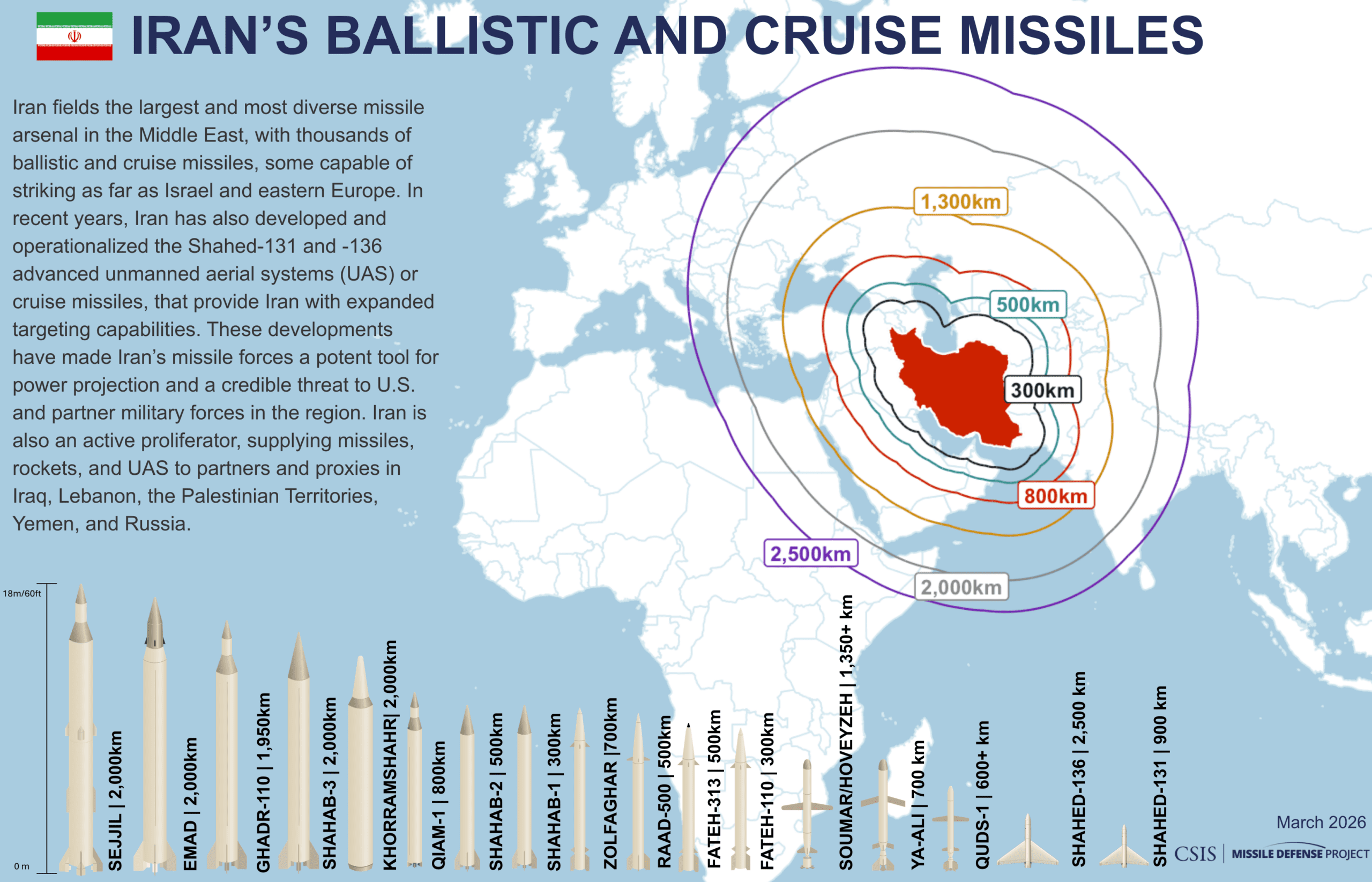
Iran has developed multiple configurations of cluster submunitions dispersed via different ballistic missiles. A typical Iranian cluster warhead reportedly contains between 20 and 30 submunitions, according to Al Jazeera. Larger missiles, particularly members of the Khorramshahr family — Iran’s premier medium-range ballistic missile — are said to carry up to 80 submunitions in a large conical warhead. Behnam Ben Taleblu, a senior fellow at the Foundation for Defense of Democracies, told The War Zone that Iran has shown pictures of “triconic warheads equipped with at least four different sizes and types of bomblets” and that “the regime is basically filling a large conical warhead with lots of bomblets and cluster munitions that basically fuse and disperse upon re-entry into the atmosphere.”
The Khorramshahr-4 is currently the primary delivery system. It is a threshold medium-range ballistic missile modified from an intermediate-range design, capable of carrying the heaviest reported warhead weight among Iran’s current inventory. The damage caused by each submunition is further amplified by the high terminal velocity at which they strike the ground after falling from altitude.
Critically, differentiating between missiles carrying cluster warheads and those with unitary explosive payloads is extremely difficult — likely impossible — before the submunition release actually occurs. This creates an additional layer of defensive complexity. A defender cannot prioritise intercept attempts specifically against cluster munition missiles in the mid-course phase because there is no reliable way to identify which missiles are carrying them before they disperse their payloads.
Iran’s Cluster Warhead Ballistic Missile Tactic — Key Numbers
- Ballistic missiles fired at Israel in 5 weeks: More than 500
- Confirmed cluster warhead missiles: At least 30 (likely significantly more)
- Submunitions per typical warhead: 20 to 30
- Submunitions per Khorramshahr missile: Up to 80
- Explosive per submunition: 4 to 11 pounds
- Release altitude: Approximately 23,000 feet (7km) and above
- Dispersion radius: 7 to 17 miles depending on release altitude
- David’s Sling Stunner max engagement altitude: ~9 miles (15km)
- Time from Iranian launch to Gulf target impact: 2 to 4 minutes
- U.S. Patriot battalions globally: Approximately 16 — modelling suggests 48 needed for full coverage
The Broader Implications: This Goes Well Beyond Israel
What Iran has demonstrated is not a tactic limited to the current conflict. Its strategic implications extend to every adversary that possesses ballistic missiles and is watching the Iran-Israel war unfold. China, Russia, and North Korea have all been described by analysts as attentive observers of how Israel’s layered air and missile defense network is performing under sustained attack.
China in particular possesses a significantly broader array of far more capable ballistic missiles than Iran, and would bring them to bear in far greater numbers in any future high-end conflict in the Pacific. Independent reports have previously highlighted the vulnerability of key U.S. air bases, especially in the Pacific, to cluster munition-laden ballistic missile attacks. Aircraft parked in the open and fuel storage infrastructure are at particular risk. A barrage designed to scatter submunitions across large areas could be used to saturate targets like Andersen Air Force Base on Guam — whose two main runways run roughly two miles long each — with wide-area effects that overwhelm defenses, eat up interceptors, and sow chaos as part of layered strikes combining precise missiles and drone swarms simultaneously.
China has also already explored the concept publicly. In 2024, the Guangdong Aerodynamic Research Academy presented a concept for a hypersonic boost-glide vehicle carrying scatterable payloads including miniature missiles and drones. The GDF-600 design shown at Airshow China 2024 had a payload of 1,200 kg, a speed of up to Mach 7, and a range of 200 to 600 km — a direct conceptual descendant of what Iran is now doing in practice.
The development of precision-guided submunitions capable of being released via ballistic missile would further change the equation entirely. At lower release altitudes, submunitions can be focused on specific target areas rather than general dispersion zones. Even at relatively high altitudes — still within but near the top of a system like Patriot’s interception envelope — a cluster release gives defenders a far smaller intercept window than a traditional unitary warhead, compressing decision timelines and further exhausting finite interceptor stocks.
The Left-of-Launch Solution — and Its Limits
Shank stressed to The War Zone that the most effective response remains what the military calls “left-of-launch” operations — destroying or neutralising missile systems before they can fire. “Obviously, the goal is to kill it before they even launch it through a variety of means,” he said, citing attack operations, offensive cyber capabilities, special operations forces with eyes on targets, and surface-to-surface precision strike as tools available for disrupting missile systems before they reach the launch pad.
The U.S. and Israeli campaign against Iran’s missile infrastructure has been significant — one estimate cited in the conflict puts the damage to Iran’s missile production capacity at around 45 percent. Yet Iran has maintained a persistent tempo of missile attacks for five weeks despite this pressure. It has fired more than 500 ballistic missiles at Israel alone. Left-of-launch is necessary but not sufficient when the adversary has dispersed launchers, mobile platforms, and deep underground storage.
The scale of the Patriot capacity problem was bluntly summarised by Shank. Modelling he observed during his time in uniform showed that effectively defending against high-end ballistic missile barrages including cluster munition missiles required approximately 48 Patriot battalions in one scenario. At the time of that modelling, the U.S. Army had 14 Patriot battalions. Today it has 16. Even counting all allied and partner Patriot-equipped forces globally, 48 battalions is not a number the western alliance currently possesses.
Golden Dome and the Future of Missile Defense
Iran’s demonstration of how high-altitude cluster releases can strain layered defenses makes a compelling case — perhaps unintentionally — for the Trump administration’s Golden Dome missile defense initiative, which places a much higher emphasis on mid-course intercept including the deployment of interceptors in space. Space-based interceptors that could engage ballistic missiles early in their mid-course phase, before submunition release becomes possible, would represent the most complete answer to the tactic Iran is currently employing. Whether Golden Dome can be built at the scale and speed required to address the threat — particularly in the Pacific — remains an open and expensive question.
Iran’s use of high-altitude cluster releases from ballistic missiles is not primarily a technological innovation — the submunitions themselves are relatively straightforward. What is significant is the operational and strategic logic behind it. Iran has identified a seam in the most sophisticated integrated air and missile defense network in the world and has been exploiting it systematically for five weeks. Every missile that gets through to scatter its payload across Israeli population centers is simultaneously a terror weapon against civilians, a drain on finite and irreplaceable upper-tier interceptors, and a proof-of-concept demonstration watched in detail by China, Russia, and North Korea. The lesson those adversaries will take from this conflict is not that Iran’s missiles are dangerous. It is that high-altitude cluster warhead release is an effective technique for defeating layered air defense — and that the western alliance does not currently have enough upper-tier interceptors to sustain a prolonged campaign against an adversary who uses it at scale.
Sources
- The War Zone — Iran Is Piercing Israel’s Ballistic Missile Defenses With High Altitude Cluster Warhead Releases (Trevithick and Altman, April 4, 2026)
- CNN — Iran Cluster Munition Attacks and Israeli Defenses, March 2026
- Times of Israel — Iranian Cluster Bomb Attacks on Central Israel
- Al Jazeera — What Are Iran’s Cluster Munitions That Are Penetrating Israeli Defences