Comet USV Air Defense Missile BlackSea Technologies Unveils AIM-9X Armed Drone Boat Built in 30 Days
13.1m
Length (43ft)
83+ km/h
Max Speed
4,535 kg
Total Payload Capacity
AIM-9X
Air Defence Missile
Hellfire
Surface Strike Missile
30 days
Build Time
🔵 What Was Unveiled
Comet — A Combat-Ready Armed USV Assembled in One Month
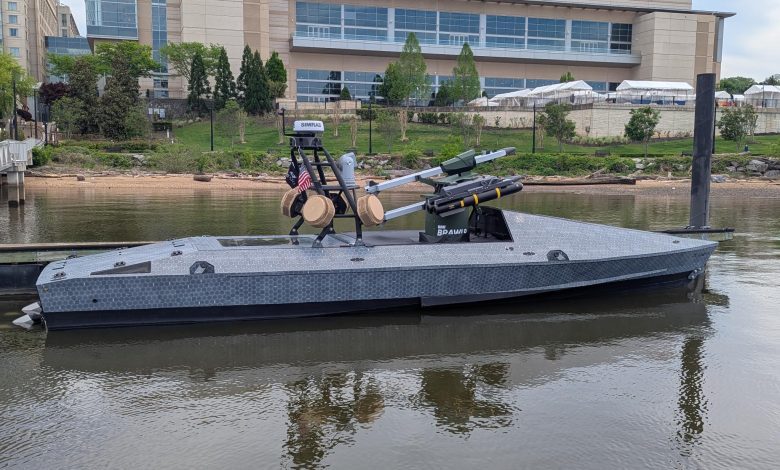
Baltimore-based BlackSea Technologies publicly unveiled its new unmanned surface vessel, Comet, at the Sea-Air-Space 2026 exposition near Washington D.C. on April 19 — in a fully armed configuration at Dock D2. The platform was shown with a dual-rail missile launcher mounted forward, a forward electro-optical and infrared targeting turret, and a Simrad navigation radar. The launcher is compatible with AIM-9X Sidewinder missiles for air defence — capable of engaging drones, helicopters and low-flying aircraft — and AGM-114 Hellfire missiles for surface strike.
The vessel measures 13.1 metres in length with a 3-metre beam, built on a semi-planing aluminium hull with a hexagonal pattern. It reaches a maximum speed exceeding 83 kilometres per hour, with a total payload capacity of 4,535 kilograms. What makes it remarkable is not just the weapons fit — it is the build time. BlackSea confirmed the Comet was assembled in approximately one month. The company named it after a historic Baltimore privateer and its stated philosophy is “move fast and carry more.” Unlike many platforms at defence expos shown as concepts, BlackSea presented Comet as a combat-ready operational system.
🔴 Why It Matters Now
The U.S. Answer to $1.2 Billion in Patriot Missiles Burned Against Shaheds
American forces have burned through approximately 300 Patriot missiles at $4 million apiece intercepting Iranian Shaheds during Operation Epic Fury — a $1.2 billion bill to defeat threats costing $20,000-$50,000 each. The Navy faces the same cost asymmetry at sea. Large surface combatants are not economically or operationally suited to sustained counter-drone operations in the contested littoral environments where Iran’s coastal units operate. What the Navy urgently needs is exactly what Comet offers: a fast, cheap, mission-configurable unmanned vessel capable of carrying air-defence missiles without putting crew at risk.
Ukraine demonstrated only days ago that this concept works in combat — its Magura V7 naval drone launched an interceptor that downed a Shahed-136 in the Black Sea, the world’s first sea-based counter-drone intercept from an unmanned surface vessel. Comet is the U.S. answer to that same operational requirement, scaled up with full AIM-9X and Hellfire capability. The AIM-9X is an infrared-guided missile capable of engaging manoeuvring targets at significant range. The Hellfire has been proven against fast attack boats, armoured vehicles and hardened positions in virtually every U.S. conflict since the 1980s. Putting both on a crewless 43-foot aluminium hull travelling at 83 km/h fundamentally changes forward naval presence.
🟢 The Company Behind It
BlackSea Technologies — Already Inside the Navy Supply Chain With 10,000 Operational Hours
BlackSea Technologies already supports the U.S. Navy’s Small Unmanned Surface Vehicle programme and has delivered its Global Autonomous Reconnaissance Craft with more than 10,000 operational hours accumulated. Its Baltimore facility produces one GARC per day. The Comet shares 75% component commonality with the GARC, meaning established supply chain, production line and autonomy software are already in place. The company has stated it can deliver a prototype of its larger MASC (Modular Attack Surface Craft) — a 66-foot aluminium catamaran for the Navy’s next-generation USV competition — within six months of a contract award.
The Comet’s modular architecture allows the payload bay to be reconfigured between missions — EO/IR surveillance one sortie, AIM-9X air defence the next, Hellfire strike the one after. That flexibility addresses the core operational lesson of both the Ukraine and Iran wars: the threat environment changes faster than procurement cycles, and platforms need to adapt without being replaced.
Strategy Battles Assessment
Comet is the clearest signal yet that U.S. defence industry has absorbed the lessons of the Iran war and is moving to respond. The AIM-9X fit gives a naval drone genuine short-range air-defence capability against Shaheds, cruise missiles and helicopters at sea — without a Patriot or a crewed warship. The 30-day build time is as significant as the weapons fit: this can be produced at scale without multi-year acquisition timelines. Whether the Navy’s procurement process can match the urgency that BlackSea’s engineering team already feels is the real question. Ukraine took three years to evolve its Magura from a strike platform to a missile-armed vessel. BlackSea is compressing that learning curve into a weapons show at National Harbor.
Strategy Battles — Related Coverage
Sources
- Defence Blog — U.S. Firm Unveils Comet Drone Boat Armed with Air Defense Missiles (April 19, 2026)
- Militarnyi — US Presents Comet Surface Drone with Modular Payload (April 19, 2026)
- BlackSea Technologies — Official Platform Page
- Naval News — BlackSea Technologies MASC USV Family (September 2025)
Editorial Verification
All Comet specifications confirmed from Defence Blog, Militarnyi and The Defense News reporting from Sea-Air-Space 2026 on April 19. BlackSea Technologies’ GARC programme and 10,000+ operational hours confirmed from company press releases and Naval News. The MASC six-month prototype commitment is from Naval News September 2025. Original editorial analysis by Strategy Battles.
Approved for Publication
Marcus V. Thorne
Lead Editor, Strategy Battles
©StrategyBattles.net 2026
This article is for news and analysis purposes only. Based on publicly available news sources and military updates. All rights reserved. Not for commercial reuse without permission.