Iran Hormuz Security Warning VP Aref Says Strait Cannot Be Safe If Oil Exports Blocked, Hours Before Islamabad Talks
TUESDAY
Ceasefire Expiry — Apr 22
TUESDAY
Islamabad II Talks
ACTIVE
US Naval Blockade
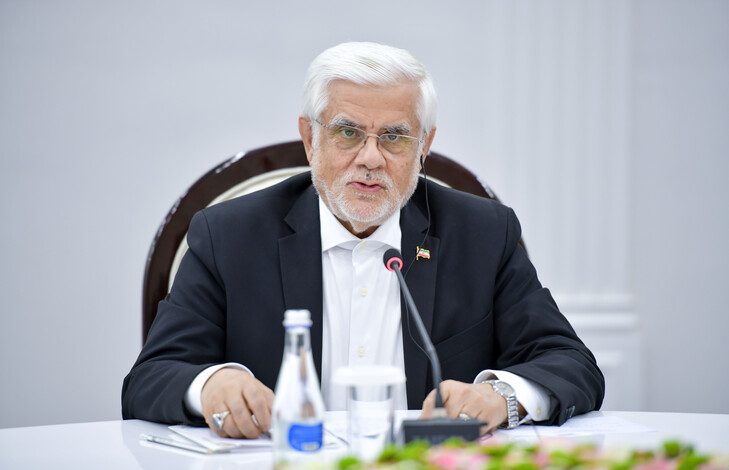
Mohammad Reza Aref — Iran’s First Vice President, April 20, 2026
“The security of the Strait of Hormuz is not free.”
“Stability in global fuel prices depends on a guaranteed and lasting end to the economic and military pressure against Iran and its allies.”
🔴 The Warning
Iran Ties Strait Security to the Lifting of Oil Export Restrictions — Directly
Iran’s First Vice President Mohammad Reza Aref issued a sharp, transactional warning early Monday April 20 — hours before the second round of U.S.-Iran talks in Islamabad is set to begin on Tuesday. Aref stated plainly that security in the Strait of Hormuz cannot be guaranteed if Iran’s oil exports remain restricted by the U.S. naval blockade. The message is not ambiguous: no blockade lifted, no secure strait. The world faces a choice, he said, between “a free oil market for all” or “significant costs for everyone.”
Aref went further, linking Hormuz security directly to the broader pressure campaign: stability in global fuel prices, he said, depends on “a guaranteed and lasting end to the economic and military pressure against Iran and its allies.” That framing explicitly includes not just the naval blockade but the entire sanctions and military posture Washington has maintained. It is the clearest statement yet from a senior Iranian official that Hormuz openness and oil export access are inseparable demands — not separate negotiating tracks.
🟡 The Timing
Same Day as Islamabad II — the Highest-Stakes 24 Hours of the Conflict
Tuesday April 22 is simultaneously the day the ceasefire expires and the day the second round of U.S.-Iran talks in Islamabad is confirmed to begin. That convergence makes this the single most consequential 24-hour window since the war started on February 28. The Aref statement — issued the morning before — is Iran’s public negotiating position going into those talks. It tells Washington exactly what Tehran expects in exchange for guaranteed passage through the world’s most important oil chokepoint: an end to the naval blockade and a broader end to economic pressure.
This also follows Iran reasserting control over Hormuz on April 18 — reversing the brief opening declared on April 17 — after the U.S. confirmed its naval blockade of Iranian ports would stay in place even after FM Araghchi’s “completely open” declaration. Two Indian-flagged vessels were reportedly targeted by Iranian gunboats on April 18. The strait is not open. The blockade is active. The talks are tomorrow. And Iran has just told the world what lifting the blockade will cost.
🔵 The Gap
What Iran Wants vs. What Washington Has Said It Will Offer
Iran’s position, as articulated by Aref, requires the blockade to end before Hormuz security can be assured. Washington’s position — Trump’s Truth Social post from April 17 — is that the naval blockade remains “in full force” until the “transaction with Iran is 100% complete.” That transaction includes a permanent commitment not to develop nuclear weapons, likely a 20-year enrichment suspension, the physical handover of highly enriched uranium stockpiles, and an end to Iranian funding of regional proxies. Iran offered five years in Islamabad I. The U.S. said no.
The IRGC separately warned on April 15 that if the blockade continues, Iran’s armed forces “will not allow any exports or imports to continue in the area of the Persian Gulf, the Sea of Oman and the Red Sea” — a threat that would simultaneously close the Strait, the Gulf of Oman and the Red Sea approach to the Suez Canal. Iran’s parliament hardliners have stated it would be “impossible” to accept even one clause of U.S. demands. Aref’s statement — coming from the First Vice President, not a hardliner — is the moderate version of that same message.
Strategy Battles Assessment
Aref’s statement is Iran’s opening bid for Islamabad II, delivered publicly the morning before the talks. The demand is: lift the blockade, end economic pressure, and the strait becomes secure. The U.S. position is: sign the deal first, blockade lifts after. Both sides are arriving at Tuesday’s talks with incompatible sequencing positions — Iran wants relief first, Washington wants commitments first.
Whether any bridging proposal — a partial blockade easing, a phased relief framework, or Russia’s offer to take Iran’s enriched uranium stockpile — can close that gap in a single day determines what April 22 means for the global economy. If the ceasefire expires without an extension and talks collapse again, Iran has just publicly announced what comes next: the strait locks again, and this time with the Red Sea and Gulf of Oman added.
Strategy Battles — Related Coverage
Sources
- Anadolu Agency — Iran Warns Security of Strait of Hormuz Cannot Be Assured If Oil Exports Restricted (April 20, 2026)
- Al Jazeera — Iran Warns US Naval Blockade Threatens Ceasefire (April 15, 2026)
- Wikipedia — 2026 Strait of Hormuz Crisis (continuously updated)
Editorial Verification
Aref’s direct quotes (“The security of the Strait of Hormuz is not free” and the “free oil market or significant costs” framing) are sourced to Anadolu Agency citing the official Iranian government statement, corroborated by The Nation Pakistan. The confirmation of Islamabad II on Tuesday is sourced to multiple Pakistani and U.S. officials via The Nation Pakistan citing Anadolu Agency. The April 18 Hormuz re-closure and Indian vessel targeting are sourced to the Wikipedia Hormuz crisis tracker citing IRGC and shipping data. The IRGC General Abdollahi threat covering the Persian Gulf, Sea of Oman and Red Sea is sourced to Al Jazeera April 15. Original editorial analysis by Strategy Battles.
Approved for Publication
Marcus V. Thorne
Lead Editor, Strategy Battles
©StrategyBattles.net 2026
This article is for news and analysis purposes only. Based on publicly available news sources and military updates. All rights reserved. Not for commercial reuse without permission.