A-10 Warthog Extended to 2030 Iran War Saves the Thunderbolt II From Retirement After Hormuz Gun Runs
2030
New Retirement Date
3
Squadrons Extended
50 yrs
In Service (First Flew 1976)
Secretary of the Air Force Troy Meink — Official X Post, April 20, 2026
“In consultation with [Defense Secretary Pete Hegseth], we will EXTEND the A-10 ‘Warthog’ platform to 2030. This preserves combat power as the Defense Industrial Base works to increase combat aircraft production.”
Hegseth separately posted: “Long live the Warthog.”
🟢 The Decision
A Retirement That Was Essentially Done — Reversed by One War
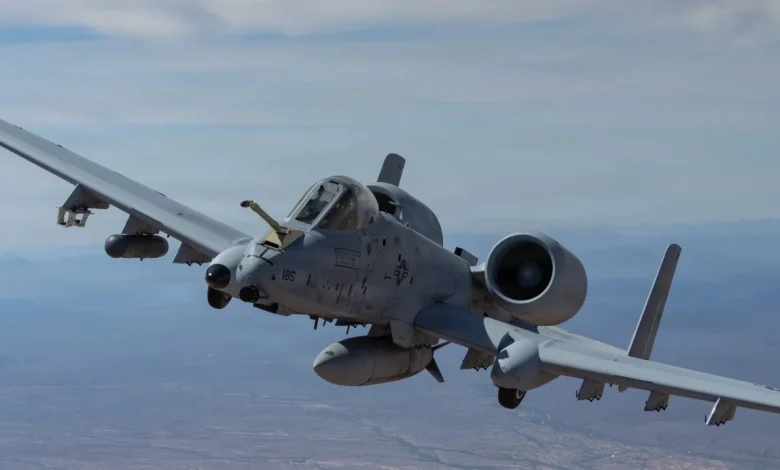
Air Force Secretary Troy Meink announced Monday in an official post that the A-10 Thunderbolt II — the 50-year-old close air support aircraft universally known as the Warthog — will remain in service until at least 2030. The announcement reverses what had been a near-complete retirement process. The Air Force had ended depot-level maintenance at Hill Air Force Base in Utah, graduated its last class of A-10 pilots at Davis-Monthan Air Force Base in early April, and crew chiefs there were already wearing patches marking the end of the aircraft’s era. The 2026 budget had proposed retiring all remaining aircraft. Congress had repeatedly overruled those plans — but the Iran war settled the argument definitively.
Three squadrons will be extended. An active-duty unit from Moody Air Force Base in Georgia and a reserve unit at Whiteman Air Force Base in Missouri will fly through 2030. A third Moody squadron is extended to 2029. As of fiscal 2026 there were 162 A-10s in the Air Force inventory. The number that will remain operational through 2030 has not yet been confirmed. The Air Force’s FY2027 budget, released April 21, is expected to provide additional detail.
🔴 What the A-10 Did in Iran
GAU-8 in the Strait, a Downed Pilot Rescued, One Warthog Lost
The A-10’s continued relevance was demonstrated repeatedly during Operation Epic Fury. The aircraft used its distinctive 30mm GAU-8/A Avenger Gatling gun cannon against Iranian Revolutionary Guard Corps speedboats in the Strait of Hormuz — exactly the kind of low-and-slow, close-in maritime engagement that more sophisticated platforms cannot perform as efficiently. In the most dramatic use of the Warthog during the conflict, A-10s were sent on a combat search and rescue mission on April 3 to recover the pilot of a downed F-15E Strike Eagle inside Iranian airspace.
Chairman of the Joint Chiefs Gen. Dan Caine described what happened in that rescue: A-10s were “violently suppressing and engaging the enemy in a close-in gunfight” as helicopters moved toward the downed pilot. At least seven A-10s participated in the mission. One was severely damaged by Iranian fire — its pilot flew the stricken aircraft toward friendly airspace before ejecting safely. The pilot was subsequently rescued. The aircraft was destroyed. That single mission encapsulated why the Air Force could not credibly announce the Warthog’s retirement while A-10s were actively fighting, being shot at, and saving lives in a war zone.
🔵 The Bigger Picture
40 Years of Attempted Retirements — and Why It Keeps Surviving
The Air Force first tried to retire all A-10s in 1984 — the year production ended. It has been attempting to cut the aircraft for more than four decades. The argument against it has always been the same: it is too slow and too vulnerable for high-end peer conflict against Russia or China, whose integrated air defence systems would make its low-altitude operating profile suicidal. That argument is correct in a Taiwan or European theatre scenario. It is completely wrong for what the A-10 actually does — hunting small boats, providing close air support to ground troops, and performing combat search and rescue in permissive or semi-permissive environments where its loiter time, massive gun, and hardened titanium cockpit bathtub are irreplaceable.
Meink’s stated reason for the extension — “preserving combat power as the Defense Industrial Base works to increase combat aircraft production” — is the Air Force acknowledging a production gap. The industrial base cannot currently replace the combat hours the A-10 provides quickly enough. With F-35 production constrained, F-15EX deliveries limited, and F-47 still years from service, retiring 162 A-10s now would leave a real hole in the close air support mission. Iran made that hole visible. The 2030 extension is a bridge, not a permanence — but it is a bridge the Warthog has now earned in combat for the eighth decade in a row.
Strategy Battles Assessment
The Iran war has now directly reversed a retirement that was months from completion — pilot training ended, depot maintenance shut down, patches already made. That reversal tells you everything about the gap between what the Air Force plans for and what wars actually require. The A-10’s 30mm gun against IRGC speedboats is not glamorous. It is not the future of air power. It is exactly what is needed when a gunboat comes at your destroyer at 40 knots in a strait. The lesson, once again, is that wars dictate the inventory — not procurement officers. The next question is what replaces the Warthog in 2030, because that problem has not gone away.
Strategy Battles — Related Coverage
Sources
- Defence Blog — U.S. Air Force Extends A-10 Warthog Service to 2030 (April 20, 2026)
- Defense One — A-10s Escape Retirement Once Again Amid Continued Use in Iran War (April 20, 2026)
- Air and Space Forces Magazine — Air Force Delays A-10 Retirement Until 2030 (April 20, 2026)
- Task and Purpose — Air Force Can’t Quit the A-10 Warthog, Extends Service Into 2030 (April 20, 2026)
- Military Times — US Air Force Extends A-10 Warthog Through 2030 (April 20, 2026)
Editorial Verification
The extension to 2030 is confirmed by Air Force Secretary Meink’s official X post and corroborated by Defense One, Military Times and Air and Space Forces Magazine. Squadron details (Moody active to 2030, Whiteman reserve to 2030, second Moody to 2029) are sourced to a service spokesperson quoted by Defense One and The Aviationist. A-10 combat use details (Hormuz gun runs, F-15E rescue mission, one A-10 lost) are sourced to Task and Purpose citing Gen. Dan Caine’s public statement and Air and Space Forces Magazine. The pilot training end and depot maintenance closure details are confirmed by Stars and Stripes. Original editorial analysis by Strategy Battles.
Approved for Publication
Marcus V. Thorne
Lead Editor, Strategy Battles
©StrategyBattles.net 2026
This article is for news and analysis purposes only. Based on publicly available news sources and military updates. All rights reserved. Not for commercial reuse without permission.