Ukraine 25000 Ground Robots 2026 Kyiv Targets 100% Robotic Frontline Logistics as Bizon-L Goes NATO
25,000
UGVs Contracted H1 2026
22,000+
Unmanned Missions Past 3 Months
$330M
Spent on Drones & UGVs Since January
📍 Ukraine — UGV Deployment Zone Across the 1,200 km Frontline, April 2026

Ukraine plans to field 25,000 unmanned ground vehicles across the full length of the contact line. Pokrovsk and Myrnograd already see UGVs handle up to 90% of frontline logistics. The NC13 robotic strike unit conducted the first all-unmanned position capture in Kharkiv Oblast last summer. Map: Strategy Battles / OSINT.
🔵 The Numbers
From Garage Prototypes to 25,000 Robots: The Industrial Scale-Up
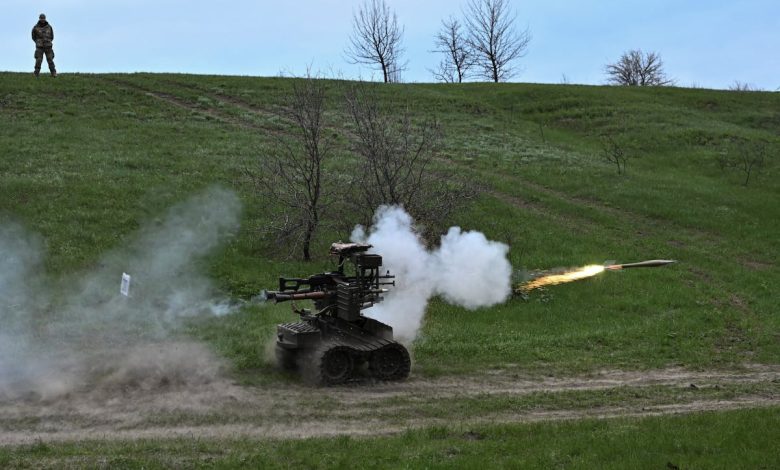
Ukraine to field 25,000 ground robots in 2026 marks a dramatic acceleration of the country's shift toward robotic warfare, with Defense Minister Mykhailo Fedorov announcing that Kyiv will contract 25,000 unmanned ground vehicles in the first half of 2026 alone, more than double the entire 2025 total. The Ministry of Defense has already begun signing contracts for 2027 to give domestic manufacturers a long-term production pipeline, a significant departure from the short-cycle procurement that has dominated Ukrainian defense industry to date.
In March alone Ukrainian forces conducted more than 9,000 missions using UGVs, according to Fedorov's April 18 Facebook announcement. President Volodymyr Zelenskyy added on April 14 that more than 22,000 unmanned missions had been run in the past three months, sparing that many soldiers from what he called the war's most dangerous work. Since January, the Defense Ministry has spent over 14 billion hryvnia, roughly $330 million, pushing more than 181,000 drones, UGVs and electronic warfare systems to the front through a digital procurement system that lets frontline units order equipment directly from domestic manufacturers.
The supply ecosystem behind this scale-up has grown from essentially nothing. Brave1 CEO Andrii Hrytseniuk told Military Times in February that the cluster now contains around 300 ground-drone companies, up from zero in 2022, with 175 grants issued to ground-drone developers in that period. Brave1 is Ukraine's government-backed defense-tech cluster that coordinates grants, testing and frontline feedback for both domestic and international manufacturers.
Defense Minister Mykhailo Fedorov — April 18, 2026
“Our goal: 100% of frontline logistics should be performed by robotic systems. UGVs perform important logistics and evacuation tasks on the front line. In March alone, the military carried out more than 9,000 missions using them.”
🟡 The Bizon-L
300 kg Payload, 50 km Range, NATO Codified: Ukraine's New Logistics Workhorse
Within days of Fedorov's announcement, the Ukrainian Ministry of Defense codified the Bizon-L under NATO cataloging standards on April 23 and cleared it for operational use across Ukraine's armed forces and those of allied nations. The platform is built around a 300-kilogram payload, a stated range of up to 50 kilometers in some specifications and 30 kilometers in others, and is designed for cargo delivery, ammunition resupply and casualty evacuation without requiring personnel on the contact line.
The Bizon-L runs on the Droid Box universal control system from Ukrainian developer DevDroid, which acts as the platform's “brain” and is now reported to be in use across over 1,000 UGVs of various types in Ukrainian service. Communication is provided through LTE, Wi-Fi or Starlink terminals, allowing operators to sit well outside the range of Russian drones while controlling the vehicle. NATO codification matters because it makes the Bizon-L exportable to allied forces and gives Ukrainian manufacturers a foothold in markets that have, until now, been dominated by Western primes with no comparable combat experience.
The Bizon-L is one of a growing family. Other Ukrainian platforms include the Zmiy, an electric, 500 kg payload silent logistics robot codified in late 2024; the TerMIT, a tracked 300 kg payload UGV produced by Tencore at a planned 2,000 units this year; the NUMO multi-purpose tracked UGV; and combat platforms like Krampus, fitted with the RPV-16 rocket flamethrower for storming fortifications. As of April 2025, 55 Ukrainian UGVs had been codified to NATO standards according to Brave1.
🟢 The First All-Robot Capture
NC13 in Kharkiv Oblast: Cardboard Surrender Sign and a Position Taken Without Infantry
In his Arms Makers' Day address, Zelenskyy described an operation last summer in which the NC13 robotic strike unit of the 3rd Separate Assault Brigade used only aerial drones and unmanned ground vehicles to take a fortified Russian position in Kharkiv Oblast. According to brigade commanders cited by CNN on April 20, Russian troops eventually raised a cardboard sign reading “We want to surrender” and were guided into captivity by drones. Zelenskyy framed the operation as the first time in the history of the war that Ukrainian forces captured an enemy position using exclusively unmanned platforms.
That operation is no longer an outlier. According to Modern War Institute analysis, UGVs now conduct roughly 80 percent of logistics in the 3rd Assault Brigade and around 90 percent of logistics in the heavily contested cities of Pokrovsk and Myrnograd. Foreign Policy reported on April 13 that as many as twelve brigades across the Ukrainian army now recruit dedicated robot operators, including the 3rd Assault Brigade, the Khartiia Brigade and the 93rd Mechanized Brigade. Average UGV cost sits below $20,000 per platform, against tens of millions of dollars for an armored vehicle and crew.
The Ukrainian General Staff reports that robotic platforms have reduced personnel casualties by up to 30 percent across units that have integrated them. The Atlantic Council noted that Ukrainian commanders held a single front-line position for almost six weeks in late 2025 using one machine-gun-armed UGV that was reloaded and serviced every 48 hours. The phrase used by Mykola Zinkevych of Ukraine's Third Army Corps, that robots do not bleed, has become the conceptual core of Kyiv's new force-design logic.
🔴 Why Now
The Kill Zone Is the Forcing Function: Russian Fiber-Optic Drones Have Changed the Math
The strategic driver behind Ukraine to field 25,000 ground robots is not enthusiasm for robotics. It is the relentless expansion of the Russian drone kill zone. Foreign Policy reporting cites Ukrainian unmanned-systems officers describing a kill zone now extending up to 9 miles from the contact line, driven by Russian fiber-optic drones that cannot be jammed and elite new Russian piloting units. Ukrainian commander “Bood” of the 12th Azov Brigade put it bluntly to Foreign Policy: sending an armored vehicle to evacuate infantry will result in engagement on the way to the position 100 percent of the time.
UGVs solve a problem that armored vehicles can no longer solve. They are harder to spot than trucks, more difficult to jam than aerial drones, and unlike a wheeled vehicle they do not require a crew to be at risk. The BBC reported in November 2025 that up to 90 percent of supplies to Ukrainian frontline positions around Pokrovsk were already being delivered by UGVs. The Defense Ministry now plans to convert four 700-soldier drone battalions into 2,500-soldier regiments equipped with both aerial drones and UGVs.
The constraints are real. Modern War Institute analysis warns that operating UGVs under constant aerial surveillance and electronic attack is far harder than viral video clips suggest. Robots approaching infantry positions may only survive one or two missions. Autonomous navigation remains immature, and UGV operators must stay in close coordination with aerial drone teams to clear routes and screen for threats. The Ukrainian answer has been to integrate UGVs into multi-domain robotic strike groups rather than treating them as standalone platforms.
Strategy Battles Assessment
25,000 UGVs in six months is not a procurement number. It is a doctrinal commitment. Ukraine is the first military in history to attempt full robotization of frontline logistics under fire, and the implications run well beyond Kyiv. NATO armies that have spent two decades building expensive crewed logistics fleets are watching a peer-state war demonstrate that the entire model is obsolete in any environment where the adversary has fiber-optic drones. The Bizon-L NATO codification matters less for what it does for Ukraine and more for what it signals about export potential: combat-proven, $20,000-per-unit Ukrainian UGVs with NATO catalog numbers will be on offer to allied forces at a price point Western primes cannot match. The constraints are equally important. Robots do not solve the manpower problem on their own. Survivability is poor against fiber-optic attack drones, autonomy is limited, and the operator-to-platform ratio is still high. Ukraine is not replacing its infantry with robots. It is keeping its remaining infantry alive long enough to hold the line. That is a different proposition, and a more honest one.
Strategy Battles — Related Coverage
Sources
- Defense News — Ukraine to field 25,000 ground robots in push to replace soldiers for frontline logistics, by Katie Livingstone (April 24, 2026)
- Ukraine Ministry of Defense — Bizon enters the battlefield: Defence Forces receive a UGV capable of carrying up to 300 kg (April 23, 2026)
- CNN — Robots on the Ukrainian battlefield: 3rd Assault Brigade NC13 operation (April 20, 2026)
- Foreign Policy — Pressed by Russian Drones, Ukraine Turns to Ground Robots in War (April 13, 2026)
- Modern War Institute — Networked for War: Lessons from Ukraine's Ground Robots (April 2026)
- Atlantic Council — Ukraine's robot army will be crucial in 2026 but drones can't replace infantry (January 8, 2026)
- Mezha / Oboronka — Ukraine codifies Bizon-L ground drone with Droid Box control system
Editorial Verification
25,000 UGV figure for H1 2026, the $330M / 14 billion hryvnia spending figure, the 9,000 March missions, the 22,000 missions in three months and the 100% logistics robotization goal are sourced to Defense News reporting on Defense Minister Fedorov's April 18 statement and Zelenskyy's April 14 Arms Makers' Day address. Bizon-L 300 kg payload and NATO codification on April 23 are confirmed via the Ukrainian Ministry of Defense press release. The 50 km range figure cited by Defense News differs from the 30 km figure given in the Mezha / DevDroid release; both are noted. The NC13 first all-unmanned capture operation is sourced to CNN reporting on 3rd Separate Assault Brigade commanders. Casualty reduction estimates and 80%-90% logistics-by-robot ratios are sourced to Modern War Institute, Foreign Policy and BBC. 300 ground-drone companies in Brave1 ecosystem and 175 grants are from Brave1 CEO Andrii Hrytseniuk via Military Times in February. Original editorial analysis by Strategy Battles.
Approved for Publication
Marcus V. Thorne
Lead Editor, Strategy Battles
©StrategyBattles.net 2026
This article is for news and analysis purposes only. Based on publicly available news sources and military updates. All rights reserved. Not for commercial reuse without permission.