US Military Laser Drone Missile Defense: MDA Goes All In
1970s
Airborne Laser Concept Origin
$1.5T
FY2027 Pentagon Budget Request
150 kW
HELLADS Target Power (DARPA)
🔵 The Announcement
MDA Director Tells Congress: We Are “All In” on Laser-Armed Drones
The U.S. Missile Defense Agency is pursuing a new generation of laser-armed unmanned aerial platforms designed to intercept missiles and drones before they reach American airspace. MDA Director Air Force Lt. Gen. Heath Collins made the disclosure during a House Armed Services Subcommittee on Strategic Forces hearing on April 15, testifying on the Pentagon’s planned missile defense activities for fiscal year 2027.
Collins stated his agency was “all in” on bringing directed energy capabilities to bear in an unmanned airborne platform, telling the subcommittee the goal was to “thin the herd” on incoming drones and air threats at the edge of a conflict. His written statement to the committee confirmed the MDA is “accelerating the operational use of high-energy lasers on various platforms” as a “critical, non-kinetic layer” within the broader U.S. missile defense architecture.
Collins did not name specific systems under consideration, nor did he identify a funding figure attached to the effort. The announcement lands inside the Trump administration’s sweeping “Golden Dome for America” homeland missile defense initiative, which received a significant boost in directed energy research and development within the FY2027 budget request.
Lt. Gen. Heath Collins — MDA Director, House Armed Services Subcommittee, April 15, 2026
“We are certainly putting more attention into bringing potentially game-changing directed energy capabilities to bear in an unmanned platform. An air platform is what we’re focused on, so we can bring that capability to the edge of the fight and thin the herd on unmanned aerial vehicles, potentially air threats and the like.”
🔵 The History
A Five-Decade Pursuit That Has Never Yet Delivered a Fielded Weapon
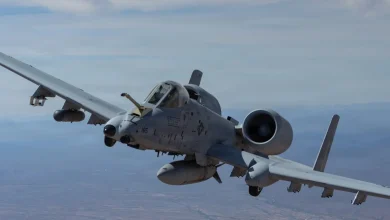
The dream of a laser-armed aerial platform is not new to the Pentagon. The U.S. Air Force established its Airborne Laser Laboratory program as far back as the 1970s, exploring the concept of a laser-carrying aircraft capable of protecting strategic bombers. The concept returned in earnest in 2010, when the Boeing 747-based YAL-1 Airborne Laser Test Bed successfully destroyed ballistic missiles during flight testing. It was cancelled the following year by then-Defense Secretary Robert Gates, who cited “significant affordability and technology problems.”
DARPA’s High Energy Liquid Laser Area Defense System (HELLADS), initiated in 2003, sought to develop a 150-kilowatt laser for integration into manned and unmanned aircraft. It ground to a halt in 2015 without producing a deployable weapon. The MDA’s own Low Power Laser Demonstrator initiative pursued drone-mounted laser weapons for over a decade before then-Undersecretary Michael Griffin poured cold water on the idea in 2020, arguing the engineering and atmospheric challenges made the combination fundamentally unworkable at the required power levels.
More recently, the Air Force’s Airborne High Energy Laser program, which sought to mount a laser on an AC-130J Ghostrider gunship, and the Self-Protect High-Energy Laser Demonstrator effort targeting the F-15 Eagle, both failed to advance to airborne testing at all. Neither produced a weapon that flew. The pattern is consistent: each new wave of institutional enthusiasm for airborne lasers has crashed against the same technical realities.
🟡 The Technical Problem
Why Laser Drones Are Harder Than They Look
Directed energy weapons are superficially appealing. They fire at the speed of light, carry a near-unlimited magazine, and cost almost nothing per shot compared to a Patriot interceptor or AIM-120 AMRAAM. But mounting a laser powerful enough to defeat an incoming ballistic missile or hypersonic glide vehicle onto an airframe small enough to be practical as an unmanned platform is a physics and engineering challenge that has defeated every serious attempt for fifty years.
Atmospheric turbulence is the central constraint. A laser beam must remain coherent and concentrated on a fast-moving target for long enough to generate lethal heat. On the ground, atmospheric distortion is manageable. On a drone moving at speed, keeping that beam locked on a target that is itself moving at speed, through turbulent air, at the power levels required to defeat hardened missile casings, is an enormously difficult problem. The physics does not care about the budget cycle.
Griffin’s 2020 assessment remains technically accurate: the combination of power requirements, thermal management, beam quality, and platform stability does not readily fit onto a single drone airframe. Since then, solid-state laser technology has matured, power density has improved, and thermal management has advanced. But no airborne laser weapon has yet been fielded by any military force in the world for a ballistic missile defense role.
🔵 The Current Landscape
General Atomics, the Navy, and the Return of Industry Optimism
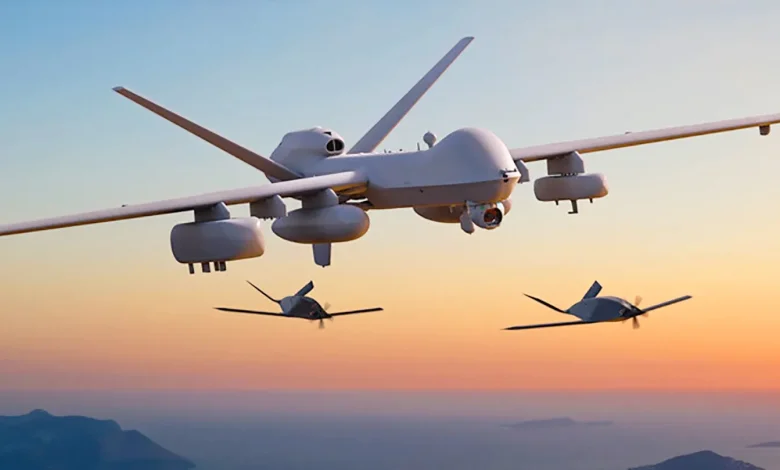
Defence contractor General Atomics has released renderings of its MQ-9B SkyGuardian and MQ-20 Avenger drones fitted with laser weapon pods, though the company has cautioned that these are not tied to any specific government program or contract. The U.S. Navy released a vision of future naval operations in January 2025 that depicted drone wingmen equipped with directed energy weapons running interference for manned aircraft. The MDA itself was reported in mid-2024 to be gearing up for another attempt at airborne lasers, starting with lower-powered systems for tracking and cueing before scaling to high-energy weapons.
The FY2027 Air Force budget is also reported to contain funding to restart an airborne laser weapon program. That means at least three separate institutions within the U.S. defence establishment are now publicly signalling intent to develop airborne directed energy weapons at roughly the same moment: the MDA, the Air Force, and the Navy. Whether this represents genuine convergence around a technological breakthrough or parallel budget optimism is not yet clear.
🟡 The Iran Context
Why the Iran Conflict Has Made the Laser Drone Concept Suddenly Urgent
Collins’ testimony did not occur in a vacuum. The Iran conflict since late February 2026 has demonstrated on a live operational canvas exactly the problem that laser drone advocates say their technology would solve. Gulf state air defence systems, including Patriot and THAAD batteries in the UAE and Kuwait, burned through an estimated 75 percent of available interceptors against Iranian drone and missile salvos. Every kinetic intercept costs tens of thousands to millions of dollars. Each incoming Shahed-type drone can cost as little as a few hundred dollars.
The cost asymmetry is unsustainable at scale. Iran fired over 2,200 drones and 520 ballistic missiles in the conflict’s first weeks, and U.S. intelligence confirmed it retains roughly 40 percent of its pre-war drone arsenal despite sustained strikes. A directed energy weapon that can engage targets at negligible per-shot cost would fundamentally rebalance that equation. The operational case for laser-armed drones has rarely been more vivid.
The question is whether the MDA’s renewed interest reflects a genuine engineering solution to the problems that have killed every previous effort, or whether political urgency and budget availability are once again running ahead of what is technically achievable within any near-term timeframe.
Strategy Battles Assessment
The MDA’s renewed enthusiasm for laser-armed drones is strategically logical but historically unreliable as a near-term procurement signal. Collins’ testimony represents the clearest institutional commitment the MDA has publicly made to airborne directed energy in several years, and the alignment with Golden Dome funding, the FY2027 Air Force restart, and Navy interest suggests a genuinely coordinated push rather than isolated budget optimism. That said, the technical constraints that killed the YAL-1, HELLADS, AHEL, and SHiELD programs have not been publicly resolved. The atmospheric turbulence problem, the thermal management challenge, and the power-to-weight ratio ceiling remain real. Solid-state lasers are better than they were in 2010, but the gap between “more capable than before” and “ready to field on a drone” is large and has historically been underestimated repeatedly.
The Iran conflict has created genuine political urgency. The sight of Gulf states burning through irreplaceable Patriot stocks against cheap Iranian drones has made the cost-asymmetry argument for directed energy more viscerally compelling to policymakers than any white paper could. The risk is that urgency produces funding without the engineering discipline to define achievable milestones, and the MDA finds itself five years from now explaining another programme that proved too challenging to advance to airborne testing. A credible path forward would begin with lower-powered airborne tracking and cueing systems, rigorously demonstrated in realistic conditions, before committing to high-energy intercept capability. The question is whether Congress and the administration will allow that patient approach or demand faster results the technology cannot yet reliably deliver.
Strategy Battles — Related Coverage
Sources
- Defense News — Jared Keller: “The US military wants a fleet of missile-killing laser drones” (April 24, 2026)
- DVIDS — House Armed Services Subcommittee on Strategic Forces Hearing: FY27 Missile Defense Programs (April 15, 2026)
- Lt. Gen. Heath Collins — Written Statement to House Armed Services Subcommittee (April 15, 2026)
- Army Times — “The Pentagon Wants to Field Laser Weapons at Scale Within 3 Years” (March 18, 2026)
- Military Times — “US Military Eyes High-Energy Laser Dome for Domestic Air Defense” (April 13, 2026)
- Breaking Defense — “Missile Defense Agency Has New Hope for Airborne Lasers” (June 2024)
- The War Zone — “MQ-20 Avenger Depicted With Laser Weapon in Its Nose: A Sign of What’s to Come” (2025)
Editorial Verification
Lt. Gen. Collins’ statements are directly sourced to the April 15, 2026 HASC Strategic Forces subcommittee hearing confirmed via DVIDS public record and his written statement, both publicly available. Historical programme data (YAL-1, HELLADS, LPLD, AHEL, SHiELD) is drawn from Defence News, Breaking Defense, and official records and is well-established. Collins did not specify which drone platforms or power levels are under consideration; that information has not been disclosed. The spending figure attached to MDA’s directed energy drone efforts within the FY2027 budget is not publicly confirmed. The Iran interceptor depletion figures (75 percent estimate) are sourced to the Jewish Institute for National Security of America as reported during the conflict period and noted as an estimate. All historical programme cancellation details are confirmed via public reporting.
Approved for Publication / Marcus V. Thorne — Lead Editor, StrategyBattles.net — April 25, 2026
©StrategyBattles.net 2026. All rights reserved. This article is for informational and editorial purposes only. All claims from third-party sources are attributed. Unverified claims are labelled as such. Strategy Battles is an independent military analysis publication.