Two Americans Among 19 Killed in Philippine Army Clash With NPA Rebels in Negros Occidental
19
Killed — 19 April 2026
2
U.S. Nationals Confirmed
8
Separate Firefight Engagements

🔴 The Encounter
Twelve Hours of Fighting in Remote Negros Hamlet
At 3:58 a.m. on Sunday, April 19, troops from the Philippine Army’s 79th Infantry Battalion engaged suspected members of the New People’s Army in Sitio Sinugmawan, Barangay Salamanca, in the municipality of Toboso, northern Negros Occidental. The operation was triggered after a local resident alerted the military to the presence of armed rebels sheltering in a temporary encampment.
What followed was not a single exchange of fire, but a sustained running engagement. After the initial clash, pursuit operations by the 79th Infantry Battalion led to seven consecutive firefights in a secondary area called Sitio Plariding. Each engagement lasted between 10 and 35 minutes. The fighting did not conclude until nearly 3:00 p.m. that afternoon, making it a 12-hour combat event by any practical measure.
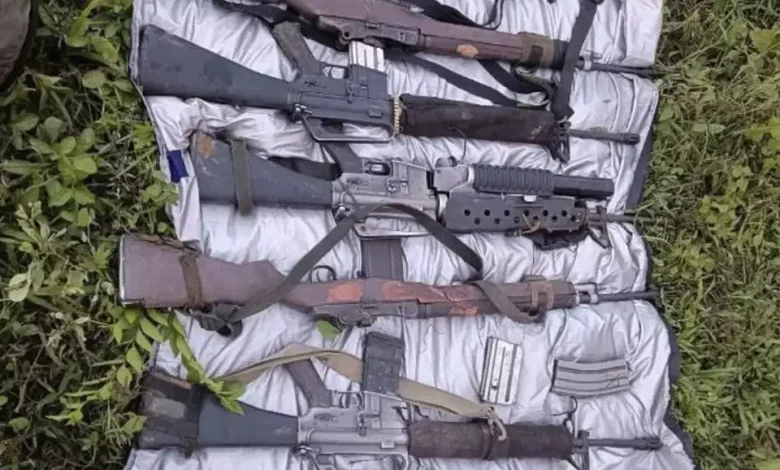
At the conclusion of operations, 19 individuals were dead. One soldier sustained gunshot wounds to both arms during the engagements and was treated at a hospital in Bacolod City. Troops recovered assorted firearms including assault rifles, rifle grenades, a hand grenade, and survival supplies from the scene.
Among those killed was Roger Fabillar, also known as “Kumander Arnel Tapang” and “Ka Jhong,” a long-hunted rebel leader who carried a bounty of P1 to P2 million and was linked by authorities to a series of killings of alleged civilian informants in Toboso, Calatrava, and Escalante City since 2024. His killing was confirmed by Brigadier General Ted Dumosmog, commander of the 303rd Infantry Brigade. The 79th Infantry Battalion operates under that brigade, which in turn falls under the 3rd Infantry Division based in the Visayas.
🟡 The Americans
NTF-ELCAC Confirms Two U.S. Nationals Among Dead
Seven days after the encounter, on April 26, the National Task Force to End Local Communist Armed Conflict confirmed that two of the 19 dead were American nationals. The task force identified them as Lyle Prijoles and Kai Dana-Rene Sorem. Both individuals had reportedly arrived in the Philippines separately in late March 2026 before traveling to Negros Occidental, where the encounter occurred.
The NTF-ELCAC stated that publicly available records showed Prijoles had been affiliated with Anakbayan-USA since 2012, an organisation the task force described as linked to the broader communist movement. NTF-ELCAC Executive Director Undersecretary Ernesto Torres Jr. said the deaths revealed what he called a “disturbing convergence” of foreign nationals in active combat environments.
The US-based advocacy group BAYAN-USA issued its own statement describing Lyle Prijoles as a 40-year-old Filipino-American human rights advocate from California. The group said Prijoles, a graduate of Journalism and Asian-American Studies, had been in Negros to live alongside farming communities and document their experiences with poverty and land tenure disputes. BAYAN-USA described his death as an “unjust murder” and stated he was not a combatant.
BAYAN-USA — Statement, April 2026
Having studied Journalism and Asian-American Studies, Lyle strove to take his education beyond the classroom, and use it to listen to and uplift the stories of marginalized communities who had the courage to stand for their rights.
GMA News noted it was unable to independently verify the NTF-ELCAC’s claims about the identities and affiliations of those killed. The Philippine National Police’s Scene of the Crime Operatives retrieved the remains for identification on April 20, the day following the encounter.
🔵 The Dispute
Armed Rebels or Unarmed Civilians? The Accounts Diverge Sharply
The Philippine Army maintained from the outset that all 19 killed were armed members of the Northern Negros Front, the local NPA unit, which it described as dismantled as a result of the operation. Army spokesperson Colonel Louie Dema-ala pointed to the recovery of 24 firearms as evidence of the armed nature of the encounter, and challenged critics online with a pointed question: if those present were mere researchers and journalists, why were they firing back at troops?
The NPA’s Apolinario Gatmaitan Command told a different story. The group’s Negros Island Regional Operational Command acknowledged that a small armed squad led by Roger Fabillar was present at the site, but insisted the vast majority of those killed were unarmed civilians. A spokesperson named those they said were among the dead: farmer Roel Sabillo, community journalist and youth leader RJ Ledesma, University of the Philippines student leader Alyssa Alano, peasant organizer Maureen Keil Santuyo, and cultural worker Errol Wendel.
NPA — Negros Island Regional Operational Command Spokesperson
Among the casualties were local and foreign journalists and human rights advocates who only carried notebooks, cameras, and the grievances of the poor — tools far more threatening to the status quo than any rifle.
Human rights group Karapatan went further, accusing the Armed Forces of the Philippines of committing “war crimes” in Negros Occidental. Karapatan secretary general Cristina Palabay stated that whether those killed were combatants or civilians, the sheer scale of the casualties raised serious questions about how the operation was conducted. The Commission on Human Rights was called upon by multiple parties to investigate, a call that AFP Chief General Romeo Brawner Jr. said the military welcomed.
The NTF-ELCAC framed the deaths within a broader narrative it has long advanced: that communist fronts in the Philippines engage in what it calls “terror-grooming,” a systematic process of recruiting and radicalising youth and diaspora Filipinos overseas. Torres argued that the incident in Toboso was a product of this process, drawing in individuals from abroad into the direct line of fire of a 57-year-old insurgency. [NTF-ELCAC characterisation; disputed by BAYAN-USA and advocacy groups]
● Background
Negros and the World’s Longest-Running Communist Insurgency
The New People’s Army, the armed wing of the Communist Party of the Philippines, has been waging an insurgency against the Philippine state since 1969. At its peak in the 1980s, the movement claimed tens of thousands of active guerrillas. Decades of military pressure, internal splits, and government integration programmes have significantly reduced its strength, though the AFP acknowledges it continues to operate across multiple regions, with Negros Island historically among its more active zones.
The NTF-ELCAC, established in 2018, coordinates a whole-of-government approach to ending the conflict, combining military operations with development programmes and localized integration efforts. The NPA has consistently accused it of using the counterinsurgency apparatus to target legitimate activists, journalists, and community organisers through a process critics call “red-tagging,” the labelling of individuals as communist sympathisers or rebels to discredit or endanger them.
The security situation in Negros has remained tense in recent years. The NTF-ELCAC stated that since 2025, at least 45 civilians have allegedly been killed by the NPA after being labeled informants or traitors, at a rate of three to four deaths per month. The Army cited this pattern as justification for the intensified operations that led to the Toboso encounter. Mayor Richard Jaojoco of Toboso said the clash displaced around 168 families, more than 600 people, from Barangays Salamanca and San Jose.
Major General Michael Samson — 3rd Infantry Division
We do not rejoice whenever lives are lost. But we cannot prevent such a tragedy, as it is the consequence of taking up arms and fighting against the government.
■ Strategy Battles Assessment
The Toboso encounter is not simply a counterinsurgency story. It is a collision of three overlapping crises in the Philippine state’s long war with the CPP-NPA: the physical battlefield, the information battlefield, and the legal battlefield. The presence of two American nationals among the dead has exported the information dimension of this conflict directly into the United States Filipino diaspora, where it will remain contested for months.
The military’s recovery of 24 firearms from a site with 19 dead is a statistically significant detail. It does not resolve the question of whether everyone present was armed, but it establishes that the encounter site was not devoid of weapons. The NPA’s own acknowledgement that a Fabillar-led armed squad was present undermines the most absolute version of the civilian narrative.
What the encounter reveals more broadly is how the CPP-NPA’s strategy of embedding within or alongside civilian communities and solidarity networks creates legally and morally complex situations at the point of armed contact. The international dimensions, specifically the involvement of diaspora activists and the presence of foreign nationals, will make any definitive accountability finding extremely difficult.
For Philippine authorities, the more strategically significant outcome is the neutralisation of Roger Fabillar and the dismantlement of the Northern Negros Front as an operational unit. The NTF-ELCAC’s decision to publicise the American identities seven days later suggests a deliberate communications strategy aimed at reinforcing its diaspora recruitment narrative ahead of any Commission on Human Rights investigation.
Strategy Battles — Related Coverage
Sources
- NPA Leader, 18 Other Rebels Slain in Negros — Philippine Daily Inquirer, April 21, 2026
- 2 Americans Among 19 Killed in Negros Clash — GMA News, April 26, 2026
- Painful Shared Reality: The Killing of 19 Suspected Rebels in Negros Occidental — Rappler, April 24, 2026
- 19 NPA Rebels Killed in Negros Occidental, PH Army Confirms — Manila Bulletin, April 20, 2026
- Military Leaders Laud Troops After 19 NPA Rebels Killed — SunStar Bacolod, April 20, 2026
- Filipinos Abroad, Foreigners Warned Against Communist Recruitment — Philippine News Agency, April 26, 2026
- Filipino-American Human Rights Advocate Among 19 Killed — Manila Tribune, April 25, 2026
- 2 Americans Killed in Negros Clash — NTF-ELCAC Confirms — Manila Tribune, April 26, 2026
- Bloody Negros Clash: Encounter or Massacre? — Tempo, April 25, 2026
- Fil-Am Among 19 Fatalities in Negros Encounter — Philippine Star, April 26, 2026
Editorial Verification Note
The core facts of this article, including the date, location, number of fatalities, and unit involved, are confirmed by multiple independent Philippine news outlets and official military statements. The identity of Roger Fabillar as among the dead is confirmed by military commanders and multiple outlets.
The identities of the two U.S. nationals, Lyle Prijoles and Kai Dana-Rene Sorem, are sourced from the official NTF-ELCAC statement of April 26, 2026. GMA News noted it could not independently verify NTF-ELCAC claims. The description of Prijoles as a human rights advocate from California is confirmed by BAYAN-USA’s own public statement.
The NPA’s claim that the majority of those killed were unarmed civilians is sourced solely from the Apolinario Gatmaitan Command spokesperson and is disputed by the AFP. This claim is clearly labelled as NPA-sourced and unverified. The characterisation of red-tagging as a systematic practice is acknowledged by multiple human rights bodies but disputed by the Philippine government. All NTF-ELCAC characterisations of victims’ affiliations are sourced from that body and contested by advocacy groups.
Approved for Publication
Marcus V. Thorne
Lead Editor, Strategy Battles
©StrategyBattles.net 2026
This article is for news and analysis purposes only. It is based on publicly available news sources and official statements. The identities and affiliations of those killed remain the subject of active dispute between the Philippine Armed Forces and human rights organisations. All rights reserved. Not for commercial reuse without permission.