17
Civilians Killed (FARDC confirmed)
50km+
Outside ISCAP Normal AO
1st
Semi-Industrial Mine Attacked by ISCAP
📍 ISCAP Attack Area: Muchacha Mine, Mambasa Territory, Ituri Province, DRC — 11 March 2026

ISCAP attack area, Okapi Wildlife Reserve, northeastern DRC. Primary strike site and FARDC ambush zone shown. Datum: WGS84, UTM Zone 35N. Map: Strategy Battles / OSINT. Sources: FDD / Bridgeway Foundation geolocated analysis.
📍 MUCHACHA GOLD MINE, PRIMARY STRIKE SITE
MGRS: 35N PB 09021 56976
1.4200°N 27.9800°E
Chinese-owned Kimia Mining semi-industrial gold mine. ISCAP assault on 11 March 2026; mine suspended, vehicles and equipment destroyed.
📍 PENGE, ITURI RIVER, FARDC AMBUSH SITE
MGRS: 35N PB 13470 60294
1.4500°N 28.0200°E
ISCAP ambush of FARDC reinforcement convoy on 14 March 2026. At least one Congolese soldier killed in follow-on attack.
🔴 The Attack
ISCAP strikes the Muchacha mine complex in a first-of-its-kind assault on Chinese industrial gold mining operations
During the night of 11 to 12 March 2026, fighters belonging to the Islamic State Central African Province (ISCAP), operating under the structure of the Allied Democratic Forces (ADF), carried out a coordinated assault on the Muchacha gold mine complex at grid reference 35N PB 09021 56976 (1.4200°N, 27.9800°E), inside the Okapi Wildlife Reserve in Mambasa territory, western Ituri Province, northeastern Democratic Republic of the Congo.
The mine is operated by the Chinese-owned Kimia Mining enterprise (also referred to as Kimiya Mining or Mimia Mining in some reporting) and employs thousands of workers, including both Congolese and Chinese nationals. Security at the site was provided by the 311th Battalion of the Armed Forces of the DRC (FARDC) under a protection contract paid for by the mine’s owner, a contractual arrangement that had been in place since at least 2022, according to analysts Caleb Weiss and Ryan O’Farrell writing for the Foundation for the Defense of Democracies.
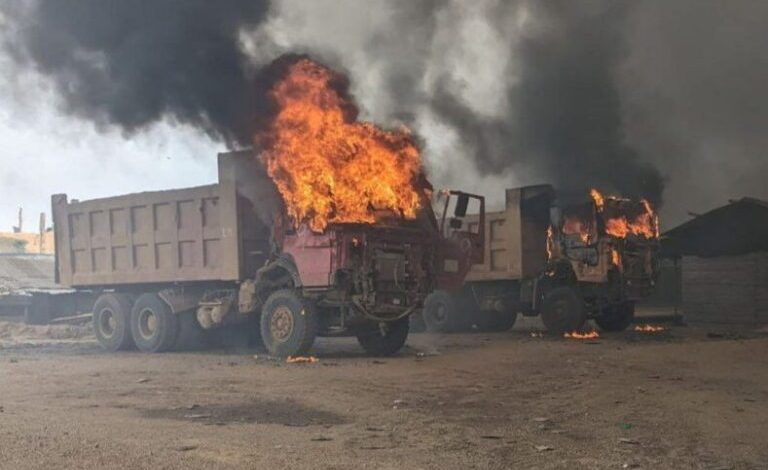
ISCAP fighters first struck FARDC positions guarding the mine perimeter, then overran the mining facility itself. Propaganda released by the group showed fighters burning bulldozers, trucks and other heavy equipment inside the complex, entering worker accommodation blocks and looting supplies. Multiple buildings were set alight. The group also burned homes in the nearby village of Muchacha and killed 17 civilians, a figure attributed to FARDC and local accounts. ISCAP’s own propaganda claimed 24 killed in total; that higher figure has not been independently confirmed and should be treated as unverified.
Hundreds of Congolese civilians and dozens of Chinese workers fled the area by boat down the Ituri River. Work at the mine was suspended following the attack. DRC officials had not issued a comprehensive public statement on casualties or a formal response at time of publication.
🟡 FARDC Follow-on Ambush
A reinforcement convoy walked into a second ISCAP ambush three days after the mine strike
On 14 March 2026, a FARDC patrol moving to reinforce the Muchacha area was ambushed by ISCAP fighters near the locale of Penge (35N PB 13470 60294, 1.4500°N, 28.0200°E), situated across the Ituri River from the mine complex. Local accounts indicate at least one Congolese soldier was killed. Photographs released by the Islamic State showed two soldiers killed and one captured, along with a quantity of looted weapons and ammunition. The figures in the Islamic State release are unverified by any wire agency and should be treated with caution.
The ambush at Penge followed a recognisable ISCAP tactical pattern: conduct a primary strike to draw in security forces, then attack the responding column. This layered approach indicates a level of operational planning considerably beyond a simple opportunistic raid, and suggests the assault on Muchacha was a deliberate, pre-planned operation, not an impulsive incursion.
Caleb Weiss and Ryan O'Farrell, Foundation for the Defense of Democracies / Bridgeway Foundation, March 2026
“That ISCAP was able to travel so far out of its normal area of operation undetected and then assault a fortified mining complex protected by FARDC soldiers now potentially puts other large-scale mines, many of which also operate in Ituri Province’s Mambasa territory, within the group’s crosshairs.”
🔵 Technology and Tactics
Commercial drones, satellite navigation and child combatants underpin a documented tactical upgrade across ISCAP’s camp network
The Muchacha operation was possible in part because of what analysts describe as a centralised technological upgrade distributed across ISCAP’s dispersed camp network inside the Okapi Wildlife Reserve. According to Weiss and O’Farrell, the camps are now linked by satellite technology and commercial GPS navigation, and fighters routinely use commercially available drones for pre-attack reconnaissance. The dense forest canopy of the Okapi Reserve renders the camps nearly invisible to government surveillance drones, providing the group with a significant concealment advantage.
Weiss and O’Farrell estimated the technological upgrade likely cost tens of thousands of dollars, suggesting external financing or systematic resource accumulation. Images verified by the Bridgeway Foundation and published by the FDD showed young teenage boys, some armed, others carrying sacks of looted goods, participating in the operation. The use of child combatants, while consistent with ISCAP’s documented past practice, adds a layer of legal and moral complexity to any future FARDC or UPDF counter-operation in the area.
Analyst Lucas Webber, writing for Militant Wire, noted that the Muchacha assault may mark an expansion of the Islamic State’s anti-China campaign from its previous geographic concentration in South and Central Asia into sub-Saharan Africa. That framing adds a geopolitical dimension beyond a simple insurgent resource grab: the Islamic State’s global propaganda apparatus has for years cast China as an oppressor of Muslim populations, and attacks on Chinese economic interests in Africa would fit that broader ideological agenda. This assessment remains analytical inference rather than confirmed intent, and is flagged accordingly.
🔴 Strategic Context: FARDC Overstretched
ISCAP has exploited FARDC’s pivot toward M23 operations in North Kivu, weakening the counter-insurgency front in Ituri
Multiple analysts, including Weiss and O’Farrell, the Critical Threats project at the American Enterprise Institute, and the Euro-Atlantic Council of Slovenia, concur that ISCAP has benefited directly from the reorientation of FARDC forces toward the fight against the Rwanda-backed M23 rebel group in North Kivu and Ituri provinces. The M23 conflict has drawn down military and intelligence resources that were previously available to Operation Shujaa, the joint DRC-Uganda counter-terrorism campaign targeting ISCAP.
Intelligence sharing between the FARDC and the Ugandan People’s Defence Force (UPDF) has also been a persistent problem, according to Weiss and O’Farrell, limiting the operational effectiveness of what is supposed to be a coordinated bilateral campaign. DRC and Uganda had not issued a joint public statement on the Muchacha attack or its implications for Operation Shujaa at time of publication.
Meanwhile, local accounts cited by Congolese media indicated that the ISCAP subgroup that carried out the Muchacha assault may have originated from northern Lubero district in North Kivu, where FARDC-backed local militia fighters had begun a reconnaissance operation into ADF-controlled areas on 5 March 2026, just six days before the mine attack. The Critical Threats assessment noted that the timing was consistent with an ISCAP tactic of conducting retaliatory strikes, or diversion raids, to redirect security force attention from core operational areas under pressure.
⚠ Casualty Figures: Discrepancy and Verification Status
Multiple sources report different casualty figures; the ISCAP propaganda claim is not corroborated by independent wire agency reporting
Civilian casualties at Muchacha village are reported at 17 killed by local and FARDC accounts, cited by DefenceWeb and Africa Defense Forum. ISCAP’s own propaganda claimed 24 total killed and more than 100 Christian civilians abducted, according to the Euro-Atlantic Council of Slovenia citing an independent OSINT analyst. The Gateway Pundit, citing Open Doors UK and Ireland, reported 50 people killed across the 11 and 16 March attacks on Muchacha and Babesua villages combined, a figure that encompasses a broader sequence of violence than the single mine attack.
The ISCAP claim of seven FARDC soldiers killed in the initial mine assault is attributed solely to ISCAP’s own social media statements, per DefenceWeb. The FDD/Long War Journal analysis confirmed at least one FARDC soldier killed in the subsequent 14 March ambush at Penge, based on local accounts, with ISCAP propaganda claiming two killed and one captured there also. Casualty figures from ISCAP are routinely inflated; all figures in this article are presented with full source attribution and assessed confidence levels.
No wire agency report from Reuters, AFP or AP was identified that independently confirmed the specific ISCAP casualty claim of seven FARDC deaths at the mine. That figure must therefore be treated as a single-source claim from a hostile propaganda channel until further corroborated.
⚠ SINGLE-SOURCE FLAG: ISCAP claim of 7 FARDC killed at Muchacha mine. Not confirmed by wire agency at time of publication.
Strategy Battles Assessment
The Muchacha attack is a strategic threshold event: ISCAP has crossed into large-scale economic targeting and is unlikely to retreat from it
The significance of the Muchacha assault extends well beyond the immediate body count and property destruction. ISCAP has previously taxed or extorted artisanal miners as a revenue stream; that is a fundamentally different posture to attacking a Chinese-run, FARDC-defended, semi-industrial complex. The transition from extraction to destruction suggests the group is either sufficiently resourced that it no longer requires that mine’s revenue, sufficiently confident that it can target harder targets with impunity, or sufficiently pressured elsewhere that it needed a demonstrative success to maintain internal cohesion. The most likely explanation is a combination of all three.
The US is actively pursuing a minerals-for-security deal with the DRC, through which Washington would gain access to critical mineral reserves in exchange for security assistance. Muchacha sits squarely in the territory where those minerals lie. ISCAP’s demonstrated ability to reach and destroy the infrastructure of a large-scale mining operation in the heart of that sector must now factor into any US risk calculus for that partnership. An attack of this nature would not need to succeed militarily a second time to deter foreign investment: the threat alone, now proven credible, is enough to suppress development capital and security cooperation frameworks that depend on a stable operating environment.
From a counter-insurgency perspective, the FARDC faces a structurally difficult problem. Its most capable formations are committed to holding the M23 front in North Kivu, a high-intensity, externally backed conflict that demands conventional military resources. Redeploying those resources to reinforce the Okapi Reserve would expose positions in the east. Reinforcing the east without drawing down from M23 would require additional financing, training, and force generation that the DRC currently lacks at scale. ISCAP understands this arithmetic and the Muchacha raid demonstrates that understanding operationally. The international community, and particularly Uganda as the primary partner in Operation Shujaa, will need to revisit whether the current campaign tempo is sufficient given the group’s evident capability to operate more than 50 kilometres outside its known core areas.
Strategy Battles — Related Coverage
- DefenceWeb / Africa Defense Forum, “Islamic State attacks eastern DRC mines,” 4 May 2026
- Africa Defense Forum, “Islamic State Attacks Eastern DRC Mines,” 21 April 2026 (original publication)
- Caleb Weiss and Ryan O’Farrell, Foundation for the Defense of Democracies, “The Islamic State’s targeting of a Chinese mine in Congo proves the group is a resilient threat,” 24 March 2026
- Caleb Weiss and Ryan O’Farrell, FDD Long War Journal, same analysis, 24 March 2026
- Lucas Webber, Militant Wire, “Islamic State Expands China-Targeted Campaign from Asia to Africa with New DRC Mine Camp Attack,” 19 March 2026
- Critical Threats (AEI), Africa File, “Sudan War Continues Despite Iran War, Peace Efforts,” 19 March 2026
- Euro-Atlantic Council of Slovenia, “Situation Room: Africa, March 2026”
Editorial Verification
Core facts of the Muchacha attack are verified across four independent analytical sources: DefenceWeb/Africa Defense Forum, the Foundation for the Defense of Democracies (via Long War Journal), Critical Threats (AEI Africa File), and Militant Wire. All four draw on geolocated imagery, local accounts and ISCAP propaganda reviewed by named analysts. The attack date of 11-12 March 2026 is consistent across all sources. The civilian death toll of 17 is attributed to FARDC and local accounts; this figure appears in multiple independent reports. ISCAP’s claim of 7 FARDC killed at the mine site is single-source, originating from ISCAP’s own propaganda channel, and is flagged as unverified throughout. ISCAP propaganda images (trucks burning, fighters inside the mine) were circulated via X and reviewed by the Bridgeway Foundation analysts; they have not been independently authenticated by a wire agency and are noted as unverified social media content. No wire agency report (Reuters, AFP, AP) was found at time of publication independently confirming casualty figures or the mine attack details. The follow-on FARDC ambush at Penge on 14 March is confirmed by local reports cited in the FDD analysis and by Critical Threats. The child combatant detail is sourced from the FDD/Bridgeway Foundation analysis, which states photographs are on file with the authors. MGRS datum: WGS84. UTM zone: Zone 35N. Cross-check reference: Kisangani, 35N KA 99301 56962. No satellite imagery acquisition was used directly in this article; Bridgeway Foundation geolocation analysis cited where relevant. The ISCAP anti-China campaign framing by Militant Wire is presented as analytical inference, not confirmed intent.
All claims independently attributed and verified to open sources where possible.
Approved for Publication
Marcus V. Thorne
Lead Editor, Strategy Battles
©StrategyBattles.net 2026
This article is for news and analysis purposes only. Based on publicly available news sources and military updates. All rights reserved. Not for commercial reuse without permission.