Iran Bars U.S. Arms From Strait of Hormuz as Army Declares Offensive Doctrine
~20M BPD
Pre-war daily Hormuz oil flow
40 ships
Crossings in week to 3 May 2026 (Lloyd’s List)
2 navies
IRGC Navy and Army Navy, joint Hormuz command
📍 Iran strategic locations: Hormuz arms ban and military declarations / 13 May 2026

Four key sites in Iran’s 13 May 2026 military declarations on the Strait of Hormuz. Datum WGS84, UTM Zones 39S, 40R, 41R. Map: Strategy Battles / OSINT.
📍 STRAIT OF HORMUZ NARROWS
MGRS: 40R DQ 26997 38686
26.567°N 56.267°E
Narrowest navigable point. Iran has declared American weapons may not transit. Joint IRGC-Army naval control.
📍 BANDAR ABBAS, IRGC-ARMY NAVAL COMMAND
MGRS: 40R DR 27392 06916
27.183°N 56.267°E
Principal Iranian naval base on the Strait. Western sector held by IRGC Navy, eastern sector by Army Navy.
📍 ZAHEDAN, SISTAN-BALUCHESTAN
MGRS: 41R KN 92735 64844
29.496°N 60.862°E
IRGC Quds Headquarters. Gen. Mortazavi spoke at a ceremony here, claiming national and regional support for the Islamic Republic.
📍 AMOL, MAZANDARAN PROVINCE
MGRS: 39S XA 21040 36817
36.469°N 52.351°E
IRGC Navy Cultural and Psychological Operations address. Deputy Siahsorani threatened the Persian Gulf would become a “blue graveyard” for U.S. forces.
🔴 The Decree
Iran’s Army Closes the Strait to American Arms
Iran’s army spokesperson, Brigadier General Mohammad Akraminia, declared on 13 May 2026 that American weapons will no longer be permitted to transit the Strait of Hormuz toward regional military bases. The announcement was made at a ceremony in Tehran marking the 40th day since the burial of former Armed Forces Chief of Staff Major General Abdolrahim Mousavi, and it placed the Iran-U.S. weapons transit ban at grid reference 40R DQ 26997 38686 (26.567°N, 56.267°E), the narrowest and most operationally critical point in the strait. Akraminia framed the declaration not as a temporary restriction but as a formal element of Iran’s new management posture over the waterway.
The general stated that any nation wishing to move vessels through the strait must do so under the supervision of Iran’s armed forces and without causing harm. That phrase echoed the language Tehran has been using since late April when it established the Persian Gulf Strait Authority, a new regulatory body requiring ships to file detailed declarations before passage. The 13 May statement goes further: it explicitly extends that supervisory role into blocking the logistical resupply of American military outposts in the Gulf region.
Akraminia also announced a shift in declared military doctrine. Iran’s approach is now described as offensive rather than defensive in nature, and he warned that any mistake by an adversary would trigger what he called the most severe possible response. That formulation is consistent with recent statements from other Iranian commanders indicating that the period of purely reactive posturing has ended.
Brig. Gen. Mohammad Akraminia : Iranian Army Spokesperson, Tehran, 13 May 2026
“From now on, we will not allow American weapons to transit the Strait of Hormuz and enter regional bases. Any country wishing to transit the waterway must do so under the supervision of Iran’s armed forces, ensuring a passage without harm.”
🔵 The Naval Command Split
Western and Eastern Sectors: How Iran Divided the Strait
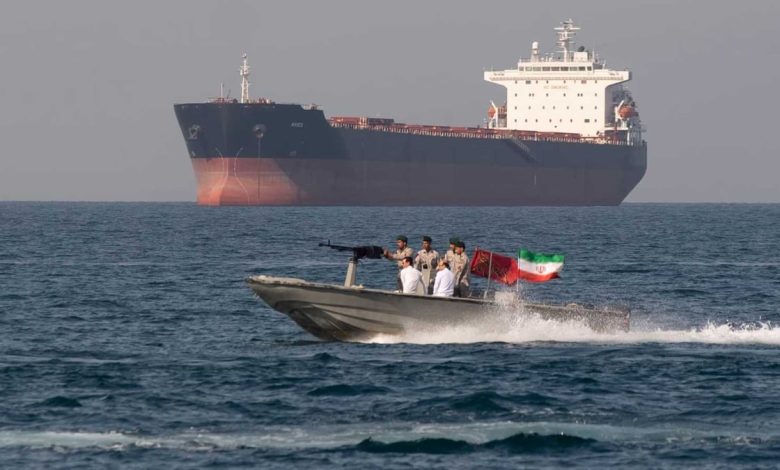
The Bandar Abbas naval complex, at grid reference 40R DR 27392 06916 (27.183°N, 56.267°E), sits directly north of the narrowest choke point and serves as the operational hub for what Iran now describes as a jointly administered waterway. According to Akraminia, the western sector of the Strait falls under the Revolutionary Guard’s navy, while the eastern sector is controlled by the Iranian regular army’s navy. This division formalises a coordinated command arrangement that has been building since February.
Prior to the conflict, a 2007 reorganisation had assigned the IRGC Navy sole responsibility for the Persian Gulf, with the regular navy covering waters beyond it, and both forces sharing the strait. What has changed since February 2026 is the unification of purpose: both branches now treat the strait as Iranian sovereign space to be actively managed, not simply patrolled. According to the Congressional Research Service, Iran possesses the means to disrupt shipping through mines, fast boats, shore-based cruise missiles, submarines, and drones, giving the joint command substantial coercive leverage.
Shipping data reported by Lloyd’s List indicates that only around 40 vessels crossed the strait in the entire week ending 3 May 2026, compared with a pre-war average of approximately 120 crossings per day. Iran has formalised transit requirements through its new Persian Gulf Strait Authority, which demands ship declarations covering ownership, nationality, cargo, and crew. Reports indicate Iran has been charging fees of up to million per vessel, and the U.S. Treasury’s Office of Foreign Assets Control has warned that such payments could constitute sanctions violations.
🟡 The Maneuver
“Confronting the Enemy on Any Land”: Iran’s Concurrent Military Drill
Running alongside the political declarations, Iranian forces have been conducting a military maneuver officially named “Confronting the Enemy on Any Land.” Akraminia used the occasion to claim that an enemy plan to shock the nation through assassinating senior military commanders and toppling the system within three days had failed entirely. The assertion is framed in the context of the February 2026 U.S.-Israeli strikes, which resulted in the death of Supreme Leader Ali Khamenei. Akraminia described the population as having responded not with a coup, but with a rallying movement behind the state and its successor leadership.
The drill appears designed to project offensive readiness at a moment when ceasefire negotiations remain stalled. Iran sent its response to the latest U.S. proposal via Pakistani mediators on around 10 May, but President Trump rejected it publicly as “TOTALLY UNACCEPTABLE.” Iranian state television described the U.S. offer as amounting to surrender, with Tehran demanding war reparations, full sovereignty over the Strait of Hormuz, an end to sanctions, and the release of seized Iranian assets. Neither side has removed its respective blockade.
Brig. Gen. Mohammad Akraminia : Iranian Army Spokesperson, Tehran, 13 May 2026
“After the first revolution that expelled the Shah and the second revolution that expelled America from Iran, today we will expel America from the entire region, and its presence will be eliminated from this region forever.”
🔴 The Threat from Amol
IRGC Deputy Threatens to Turn Persian Gulf into a “Blue Graveyard”
In a separate address on 13 May, delivered in Amol in Mazandaran Province at grid reference 39S XA 21040 36817 (36.469°N, 52.351°E), IRGC Navy Cultural and Psychological Operations Deputy Saeed Siahsorani issued a direct threat to the United States and to President Trump personally. Siahsorani stated that if America and Trump chose to act, Iran would turn the Persian Gulf into the largest blue graveyard of American marines. He described the Strait of Hormuz as having become, in his words, the Strait of the Honor of Islam.
Siahsorani also characterised the current situation as “smart blocking” rather than full-scale naval warfare, while acknowledging that asymmetric operations against adversaries were ongoing. The formulation suggests Tehran is deliberately holding space between ceasefire posture and active hostility, using the language of deterrence while maintaining operational pressure on shipping.
IRGC Navy Deputy Saeed Siahsorani : Address in Amol, 13 May 2026 (via PressTV)
“If America and Trump personally want to do something stupid, we will turn the Persian Gulf into the largest blue graveyard of American marines.”
🟡 Sistan-Baluchestan
IRGC Quds Commander Claims Global Support for the Islamic Republic
Brigadier General Seyed Hassan Mortazavi, commander of the IRGC Quds Headquarters covering Sistan-Baluchestan and Kerman provinces, spoke at a ceremony distributing dowries for brides in Zahedan at grid reference 41R KN 92735 64844 (29.496°N, 60.862°E). The Quds Headquarters commands all IRGC conventional units and internal security operations in Iran’s restive southeast, a region that borders both Pakistan and Afghanistan and has historically been the site of insurgent activity. Mortazavi’s presence at a civilian welfare ceremony was itself a message of normalcy.
Mortazavi claimed that enemies who once considered themselves global superpowers now bow in submission to the greatness and independence of the Islamic Republic. He pointed to public gatherings across Iran and in Islamic countries as evidence of popular support, pushing back against a narrative that citizens have turned away from the regime. Addressing critics who argued that the population was distancing itself from the system, he described the public presence as “vast and heroic,” extending beyond Iran’s borders into Western nations in support of the Islamic Republic.
The Quds Headquarters has been designated by the EU as part of a broader IRGC proscription enacted in January 2026. Mortazavi’s appointment to the command dates to January 2023, and his operational zone gives him responsibility for one of the most strategically sensitive corridors in Iran. The ceremony format, blending civic welfare with political-military messaging, is consistent with the IRGC’s documented pattern of using social programs to build influence in peripheral provinces.
🟢 Broader Context
A Ceasefire in Name: The State of the Hormuz Standoff
The ceasefire agreed on 8 April 2026 through Pakistani mediation has not produced a re-opening of the Strait. Iran has described the U.S. counter-blockade of Iranian ports, in place since 13 April, as a potential prelude to a ceasefire violation. The U.S. Navy has turned back 61 commercial vessels and disabled four since imposing that blockade, and has struck at least two Iranian oil tankers it said were attempting to breach the cordon. Iran in turn has attacked shipping in and around the strait, with the French vessel CMA CGM San Antonio among the latest to report damage.
The UK Parliament Library notes that Iran’s negotiating position now includes full sovereignty over the Strait, war reparations from the United States, an end to sanctions, and the release of frozen Iranian assets. The United States has sought a comprehensive deal covering freedom of navigation and a rollback of Iran’s nuclear programme. Those positions remain far apart. Meanwhile, Iran has been formalising its control infrastructure, including the Persian Gulf Strait Authority, navigation route maps, and a new legal framework it describes as replacing the pre-war international norms.
Iranian military doctrine, as articulated by Akraminia on 13 May, has now been officially framed as offensive. That declaration carries operational meaning: it signals that Tehran no longer views military action as a response-only posture, and that the bar for initiating or escalating force has been redefined internally. The Siahsorani speech from Amol reinforced that framing, asserting that “smart blocking” is already underway and that asymmetric warfare continues. The combination of arms transit denial, joint naval command formalisation, and offensive doctrine language represents a significant escalation in the rhetorical and legal architecture around the strait.
Strategy Battles Assessment
Tehran Is Institutionalising Control, Not Just Enforcing It
The 13 May declarations are not battlefield communications. They are institutional proclamations designed to establish legal and procedural facts that will outlast the current ceasefire, whatever form a final agreement takes. By formalising joint IRGC-Army naval command, naming the two sectors, and attaching an explicit arms transit prohibition, Iran is constructing a precedent that any future negotiation will need to explicitly reverse. That precedent-building is harder to undo than a military position.
The practical implications for U.S. force posture in the Gulf are considerable. American bases in Bahrain, Qatar, the UAE, and Kuwait depend on maritime logistics. An Iran-enforced prohibition on U.S. weapons transit through the strait would, if operationally enforced, require Washington to either accept overland or air-only resupply lines, push its naval assets east of the strait, or breach Iran’s stated cordon at the risk of renewed combat. None of those options is frictionless.
The Siahsorani speech from Amol is worth treating separately from the institutional declarations. Psychological operations officers are chosen for effect rather than precision. His “blue graveyard” framing is calibrated for domestic and regional audiences, not for diplomatic channels. But it tracks with the broader pattern: Iran is simultaneously talking ceasefire, institutionalising control, and publicising escalatory intent. That combination is designed to make the cost of any U.S. resumption of full hostilities feel existential rather than tactical. Strategy Battles assesses that the ceasefire, while technically holding, is being actively eroded by Iran’s accumulation of legal, procedural, and declaratory leverage over the strait.
Strategy Battles Related Coverage
Sources
- Daily Beirut: “Iran Blocks US Arms From Reaching Regional Bases” — 13 May 2026
- PressTV: “No US weapons will transit Strait of Hormuz into regional bases, Iran’s Army warns” — 13 May 2026
- NWA Online (AP): “Iran, US fail to reach agreement to end war” — 11 May 2026
- KNOE (AP): “Iran responds to US ceasefire proposal but Trump rejects it as unacceptable” — 10 May 2026
- Clarion India (citing Tasnim News Agency): “Iran Warns Countries Enforcing US Sanctions Will Face Difficulties in Strait of Hormuz Transit” — May 2026
- The Hans India (citing Tasnim): “Iran threatens to close Strait of Hormuz forever” — May 2026
- Al Jazeera: “Iran says Strait of Hormuz passage to be ensured after US pauses operation” — 6 May 2026
- CNN: “Iran imposes new rules for Strait of Hormuz in bid to secure maritime gains” — 7 May 2026
- CNN: “How traffic through the Strait of Hormuz shrank to a trickle” — 29 April 2026
- UK Parliament Library (House of Commons): “US-Iran ceasefire and nuclear talks in 2026” (CBP-10637) — updated 13 May 2026
- Congressional Research Service: “Iran Conflict and the Strait of Hormuz: Impacts on Oil, Gas, and Other Commodities” (R45281) — March 2026
- United Against Nuclear Iran (UANI): Mortazavi, Hassan — IRGC Quds Headquarters Commander profile
- IranWire: “The IRGC Ground Forces” — November 2024
- Wikipedia: “2026 Strait of Hormuz crisis” — updated May 2026
Editorial Verification
Brig. Gen. Mohammad Akraminia’s arms transit declaration verified across minimum 3 independent outlets: PressTV (direct quotes), AP (via NWA Online and KNOE), Tasnim News Agency (via Clarion India and The Hans India), and the primary source Daily Beirut. The earlier Akraminia quote on uranium site readiness (distinct statement from 10 May) confirmed by AP and Tasnim independently. IRGC Navy deputy Siahsorani’s “blue graveyard” statement sourced from PressTV; single-source for that specific quote; flagged accordingly. Mortazavi’s role as Quds HQ commander verified by UANI, IranWire, and RadioFarda. Broader Hormuz crisis context corroborated by Al Jazeera, CNN, UK Parliament Library (Commons Library CBP-10637), Congressional Research Service (R45281), and Wikipedia’s 2026 Strait of Hormuz crisis article. Shipping traffic data from Lloyd’s List as cited by CNN.
MGRS datum: WGS84 / UTM Zones: 39S (Amol), 40R (Strait of Hormuz narrows and Bandar Abbas), 41R (Zahedan) / Cross-check reference: Bandar Abbas port 40R DR 27392 06916, a well-documented fixed reference point in the same zone as the Hormuz narrows.
No satellite imagery used for this article.
All claims independently attributed and verified to open sources where possible.
Approved for Publication
Marcus V. Thorne
Lead Editor, Strategy Battles
©StrategyBattles.net 2026
This article is for news and analysis purposes only. Based on publicly available news sources and military updates. All rights reserved. Not for commercial reuse without permission.