Five Pakistan soldiers killed in BLA IED ambush in Barkhan District, seven militants dead in firefight
5
FC Soldiers Killed
7
BLA Militants Killed
1
Soldier Critically Wounded
📍 Barkhan District, Balochistan, Pakistan | IED Ambush and Firefight | 13 May 2026

IED ambush and subsequent firefight, Bala Dhaka area, Barkhan District, Balochistan. Datum WGS84, UTM Zone 42R. Map: Strategy Battles / OSINT. Sources: AFP, ISPR, Arab News. 13-14 May 2026.
📍 BALA DHAKA AREA, BARKHAN DISTRICT: ATTACK SITE
MGRS: 42R WU 40516 16643
29.9800°N 69.4200°E
IED detonation point on FC convoy route followed by firefight. 5 soldiers killed, 7 BLA militants killed. BLA responsibility claimed.
📍 BARKHAN TOWN: DISTRICT HEADQUARTERS
MGRS: 42R WU 49884 07816
29.9000°N 69.5167°E
Barkhan district headquarters and cross-check reference. Approx 12 km south of the Bala Dhaka attack corridor. Loralai Garrison is the nearest major military base to the east.
🔴 The Attack
IED Detonates on FC Convoy in Barkhan, Firefight Kills Seven Militants
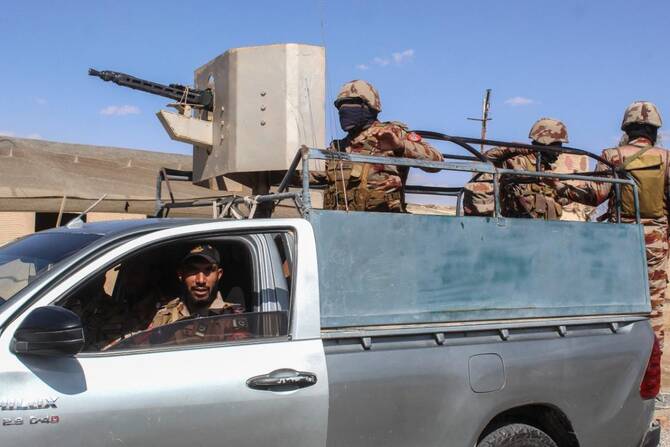
An improvised explosive device struck a Frontier Corps convoy in the Bala Dhaka area of Barkhan District on 13 May 2026, at grid reference 42R WU 40516 16643 (29.9800°N, 69.4200°E), killing five paramilitary soldiers and critically wounding a sixth. The blast triggered an immediate follow-on ground engagement. According to Pakistan’s army media wing, the Inter-Services Public Relations (ISPR), troops located a group of militants and engaged them in the subsequent firefight, killing seven.
The Bala Dhaka area sits within the Sulaiman Mountain range terrain of Barkhan tehsil, a district that straddles the boundary between Balochistan and Punjab and has seen recurring ambushes on security force convoys over the past two years. Arab News Pakistan, citing District Police Officer Barkhan Saad Afridi, confirmed the IED detonated against an artillery unit traveling from Nosham toward the Loralai Garrison at approximately 14:10 local time (UTC+5). One of the five soldiers killed held the rank of major.
The ISPR statement described the operation as a sanitization action against what it termed “Indian-backed Fitna Al Hindustan,” the label Pakistani military authorities now use for Baloch separatist groups, reflecting Islamabad’s long-standing accusation that New Delhi provides external support to the insurgency. India has consistently denied the charge.
🟡 BLA Claim of Responsibility
Baloch Liberation Army Claims the Strike Via AFP Statement
The Baloch Liberation Army issued a statement to AFP claiming responsibility for the Barkhan District attack. The BLA, which the United States, the United Kingdom, Pakistan, China, Iran, and the European Union all designate as a terrorist organisation, described the operation as part of its ongoing campaign targeting military installations, police checkpoints, and civil administration officials across the province.
The group’s statement referenced a broader pattern of simultaneous pressure across multiple districts: it described gun attacks and suicide bombings against state infrastructure, consistent with its documented operational approach. The BLA’s Majeed Brigade, its specialised unit for high-stakes attacks, has been responsible for a number of IED and fedayeen strikes on military convoys in Balochistan over the past three years.
ISPR Statement : Pakistan Army Media Wing, 13 May 2026
“During the operation, a group of terrorists was located and engaged by troops. During fire exchange seven terrorists were killed.”
District Police Officer Barkhan, Saad Afridi : AFP, 13 May 2026
“Five soldiers of the Pakistan Army, including a major rank officer, were killed in the latest targeted blast while one received critical injuries.”
🔵 Escalating Insurgency
Balochistan Violence Reaches Record Tempo as BLA Presses Multi-District Campaign
The 13 May attack is the latest in a sustained wave of BLA operations that have accelerated sharply since January 2026. In the coordinated assault of 30-31 January, BLA fighters struck simultaneously across at least nine Balochistan districts including Quetta, Gwadar, Mastung, Nushki, Pasni, and Kharan, killing 36 civilians and 22 security personnel before Pakistani forces conducted large-scale counter-operations resulting in at least 145 militant deaths. That offensive set the operational tempo for the months that followed.
Between 25 April and 3 May 2026, the BLA claimed 11 separate operations across the province, including four remote-controlled IED attacks on military vehicles, a grenade strike on an army camp in Kalat, and an ambush on troops providing convoy cover in Panjgur. The group stated that 11 security personnel were killed across that period, a figure that Pakistani authorities neither fully confirmed nor denied in public statements. A separate IED strike in Bolan district in a prior month killed all 12 soldiers aboard a targeted vehicle, including two Special Operations commanders.
In April 2025, a major IED attack against a military convoy in the Margat area of Quetta killed 10 soldiers including senior officers. Pakistan’s provincial Chief Minister Sarfraz Bugti stated that approximately 700 insurgents were killed by security forces during 2025 counter-operations in Balochistan alone. The Pakistan Institute for Conflict and Security Studies recorded 2,115 militant and insurgent deaths across all of Pakistan in 2025, along with 664 security personnel and 580 civilian fatalities.
The BLA has also extended its operational reach beyond land. On 12 April 2026, Pakistani Coast Guard personnel were killed in an ambush by BLA fighters on a patrol boat in the Arabian Sea near Gwadar, marking an escalation into maritime operations. The group has continued to attack workers from other Pakistani provinces employed in Balochistan’s resource extraction sector, as well as foreign energy firm employees, in a deliberate strategy of economic disruption targeting the China-Pakistan Economic Corridor (CPEC).
🟢 BLA Profile and International Designation
A Proscribed Organisation With a Decades-Long Insurgency
The Balochistan Liberation Army was designated a Foreign Terrorist Organisation by the United States in 2019, a decision that reflected Washington’s assessment of the group’s targeting of civilians and critical infrastructure. The BLA also holds terrorist designations from Pakistan, China, Iran, the United Kingdom, and the European Union, making it one of the most broadly proscribed separatist groups operating in South Asia.
The group’s stated grievance rests on the claim that the Pakistani state exploits Balochistan’s substantial natural resources, including coal, gas, and copper, while marginalising the indigenous population economically and politically. The Chamalang coal mines, which extend across the districts of Kohlu, Barkhan, and Loralai, are among the resource extraction sites the BLA has historically sought to disrupt. Barkhan District itself lies within the Sulaiman range coalfield corridor, giving it strategic relevance beyond its remote geography.
In August 2023, the BLA’s capacity for high-casualty operations became internationally visible when its fighters attacked a passenger train carrying approximately 450 people, sparking a two-day siege that drew global headlines. That attack demonstrated the group’s willingness and ability to sustain prolonged operations against hardened targets. The May 2026 Barkhan attack, while smaller in scale, confirms the BLA’s continued focus on interdicting military movement along the road network linking Barkhan to the Loralai Garrison.
Strategy Battles Assessment
The BLA Is Running a Sustained Attrition Campaign, and Pakistan’s Counter-Tempo Is Not Yet Closing the Gap
The Barkhan District attack is tactically unremarkable by the standards of 2026 Balochistan. Five soldiers, seven militants killed: a contact engagement that follows the now-established BLA pattern of IED initiation followed by immediate infantry exploitation of the confusion. What matters more than the individual incident is the frequency. The BLA has demonstrated the capacity to mount multiple operations per week across geographically dispersed districts simultaneously, with a tempo that the ISPR’s own statements implicitly confirm by the scale of counter-operations required to respond.
Pakistan’s framing of the insurgency through the “Fitna Al Hindustan” label reflects a political calculation as much as an operational one. By attributing the insurgency to Indian interference, Islamabad can present the conflict as an external threat rather than an internal legitimacy deficit. The military’s stated kill tallies, including the claim of 700 militant deaths in Balochistan in 2025 alone, suggest attrition operations are producing results in volume. But the BLA’s operational tempo in 2026 does not reflect an organisation under existential pressure. It reflects one that has adapted its tactics, dispersed its cells, and maintained its ability to sustain initiative.
The extension of BLA activity into maritime operations near Gwadar in April 2026 is the most strategically significant development of the current cycle. Gwadar is the southern terminus of the China-Pakistan Economic Corridor and the deepwater port China has invested most heavily in. Any sustained BLA threat to maritime approaches or port infrastructure at Gwadar carries implications well beyond the province: it puts Chinese economic interests directly in the crosshairs of the insurgency and increases pressure on Beijing to take a more active interest in Pakistani counter-insurgency outcomes. That dynamic is likely to intensify through the remainder of 2026.
Strategy Battles Related Coverage
Sources
- Arab News / AFP: “Five soldiers, seven militants killed in Pakistan clashes” : 14 May 2026
- Arab News Pakistan / ISPR: “Army says five soldiers killed in counterterror operation in Pakistan’s southwest” : 13 May 2026
- Wikipedia: Terrorist Incidents in Pakistan in 2026 : updated 14 May 2026
- Wikipedia: Balochistan Liberation Army : background and designation history
- Wikipedia: 2026 Balochistan Attacks : January 2026 coordinated offensive and aftermath
- Organiser: “BLA Kills 11 Pakistani Soldiers Over a Week in Multiple Operations” : 5 May 2026
- Al Jazeera: “Pakistani Forces Kill 145 Fighters in Balochistan After Deadly Attacks” : 2 February 2026
Editorial Verification
Casualty figures (5 soldiers killed, 1 critically wounded, 7 militants killed): confirmed by AFP via Arab News (primary), ISPR statement via Arab News Pakistan (second independent source), and Wikipedia Pakistan 2026 incident log (third corroborating record). All three are independent of one another. BLA claim of responsibility: AFP wire only; BLA statement sent directly to AFP, reported without secondary wire corroboration at time of publication. Flagged accordingly. ISPR “Fitna Al Hindustan” framing: confirmed by ISPR statement via Arab News Pakistan and Wikipedia 2026 Balochistan attacks article (two independent sources). District Police Officer Saad Afridi quote: single-source (Arab News Pakistan / AFP only at time of publication).
MGRS datum: WGS84 / UTM Zone: 42R / Cross-check reference: Barkhan town 42R WU 49884 07816 (29.9000N, 69.5167E), district headquarters approximately 12 km south-east of the Bala Dhaka attack corridor. No satellite imagery acquisition used. Coordinates for Bala Dhaka area derived from geographic descriptions in Wikipedia Chamalang Coal Mines article and Barkhan District article placing Bala Dhaka stream in Berg-Sham Mauza of Barkhan tehsil, cross-referenced with Barkhan District latitude-longitude bounds (69.03-70.04 E, 29.37-30.21 N).
All claims independently attributed and verified to open sources where possible.
Approved for Publication
Marcus V. Thorne
Lead Editor, Strategy Battles
©StrategyBattles.net 2026
This article is for news and analysis purposes only. Based on publicly available news sources and military updates. All rights reserved. Not for commercial reuse without permission.