M23 and Rwanda Executed 53 Civilians in Uvira, DR Congo, Human Rights Watch Reports
53
Summary Executions Documented
38 Days
Duration of Uvira Occupation
120+
Survivor Interviews Conducted
📍 M23 / RDF Occupation Zone : Uvira, South Kivu, DR Congo : Dec 2025 to Jan 2026

Uvira (35M QS 37801 24449) and surrounding South Kivu operational area. M23 and RDF captured Uvira Dec 10, 2025; withdrew Jan 17, 2026. Cross-check reference: Bukavu 35M QT 06899 22608. Datum WGS84, UTM Zone 35M. Map: Strategy Battles / OSINT.
📍 UVIRA, SOUTH KIVU (OCCUPATION SITE)
MGRS: 35M QS 37801 24449
3.3953°S 29.1403°E
Second-largest city in South Kivu, pop. approx. 800,000. M23 and RDF occupied Dec 10, 2025 to Jan 17, 2026. Site of 53 documented summary executions.
📍 BUKAVU, SOUTH KIVU (PROVINCIAL CAPITAL)
MGRS: 35M QT 06899 22608
2.5083°S 28.8608°E
South Kivu provincial capital. Captured by M23 and Rwandan forces on February 16, 2025. Cross-check reference for UTM Zone 35M calculations in this article.
🔴 The Occupation of Uvira
Door-to-Door Killings in a City of 800,000
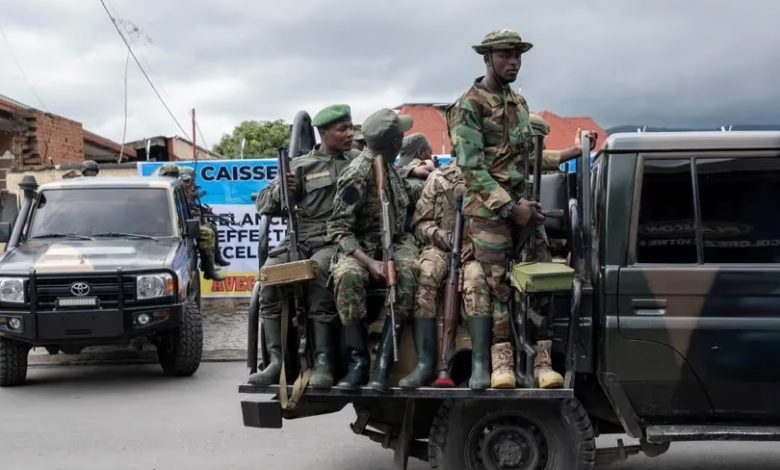
Human Rights Watch released a 23-page investigation on 14 May 2026 documenting systematic war crimes by M23 rebels and Rwandan Defence Force soldiers during their occupation of Uvira at grid reference 35M QS 37801 24449 (3.3953°S, 29.1403°E), the second-largest city in South Kivu province in eastern Democratic Republic of Congo. The findings describe an occupation characterised not by the fog of front-line combat but by deliberate, organised civilian killings once military control was established.
M23 and Rwandan forces entered Uvira on December 10, 2025, just days after the signing of the United States-brokered Washington Accords, which had been intended to de-escalate the broader conflict in eastern Congo. The occupation lasted 38 days, ending with an abrupt withdrawal on January 17, 2026, under sustained pressure from Washington. During those five weeks, the city of nearly 800,000 people was under the effective control of a force that Human Rights Watch now says committed numerous violations of international humanitarian law, many amounting to war crimes.
The report, titled “We Are Civilians!,” is based on more than 120 in-person and remote interviews conducted by HRW researchers during field visits in March and April 2026. It represents the first systematic field investigation into abuses during the Uvira occupation and was compiled after the M23 had withdrawn from the city, allowing researchers to access survivors and witnesses directly.
🔴 The Killings
53 Civilians Executed, Most on a Single Day
Human Rights Watch documented the summary execution of 53 civilians by M23 fighters and Rwandan forces, with the majority of the killings occurring on December 10, 2025, the very day the occupation began. As M23 and Rwandan units moved to consolidate control of the city, they simultaneously opened fire on civilians who attempted to flee. One survivor described seeing four members of his family shot as they ran toward Lake Tanganyika. “It was chaos,” he said. “We had small bags that we threw off and we ran. I wasn’t hit so I just ran to the lake. I saw my brother, his wife, and two of his children fall.”
Once the city was secured, the pattern shifted to targeted searches. M23 and Rwandan forces conducted door-to-door operations, accusing men and boys of affiliations with the Wazalendo, pro-government Congolese militias. Those identified, often without apparent basis, were executed on the spot. The killings were concentrated in the opening days of the occupation, when the occupying forces moved fastest and accountability was most absent. Communal graves have since been identified across the city.
The 53 documented executions should be understood as a floor, not a ceiling. HRW has stated explicitly that its research may have only scratched the surface, given the constraints on access during the occupation and the ongoing difficulty of reaching survivors in post-conflict eastern Congo.
Philippe Bolopion, Executive Director, Human Rights Watch, 14 May 2026
“After taking control of Uvira, M23 fighters and Rwandan forces went door-to-door to summarily kill men and boys and committed rape and abductions. Human Rights Watch documented numerous horrific abuses but may have only scratched the surface. Criminal investigations are needed, including by the International Criminal Court, to ensure these crimes do not go unpunished.”
🟡 Sexual Violence and Abductions
Eight Rapes, Twelve Disappearances, Zero Medical Access
Beyond the executions, Human Rights Watch documented eight cases of rape committed by M23 fighters and Rwandan soldiers against women in and around Uvira. Many of the assaults targeted women who had ventured out to access food on farmland outside the city, where they were isolated and without protection. Survivors reported a near-total absence of healthcare services during the occupation, with no access to post-exposure prophylactic treatment to prevent HIV transmission and no adequate care for injuries or infections resulting from sexual violence.
At least 12 people were forcibly disappeared during the occupation. In each documented case, the individuals were taken during M23 search operations and their whereabouts remain unknown as of the date of this report. The HRW field team noted that conflict-related sexual violence by all parties in eastern Congo has escalated significantly in recent months, while support to survivors has dropped. The combination of rising abuse and shrinking humanitarian access has left many victims without any pathway to justice or medical treatment.
🔵 Rwanda’s Role and the Denial Pattern
Kigali Named Directly, No Response Issued
The HRW report names Rwandan Defence Force troops as direct participants in the Uvira occupation and the abuses committed during it, not merely as advisors or logistical supporters to the M23. This is consistent with prior UN Group of Experts findings and with the assessment that led the United States to impose targeted sanctions. On March 2, 2026, Washington sanctioned the Rwandan army and its commanders specifically for their role in the capture and occupation of Uvira, adding further official weight to the attribution.
Human Rights Watch wrote to Rwanda’s Defence Minister Juvenal Marizamunda on April 13, 2026, and to M23 leader Bertrand Bisimwa on April 14, sharing preliminary findings and requesting meetings. Neither responded. Rwanda’s government and M23 have previously denied all accusations of human rights abuses, with both parties instead accusing the Congolese army and its allied Wazalendo militias of targeting members of the Tutsi minority community. The Wazalendo have themselves faced credible allegations of harassment and abuse in Uvira, including against members of the Banyamulenge Congolese Tutsi community, prior to the M23 takeover.
The mutual accusations underscore the degree to which accountability has been systematically deflected throughout the eastern Congo conflict. Both sets of allegations require independent investigation. The HRW report, which focuses specifically on the occupation of Uvira, does not clear the Wazalendo of their own alleged violations, but the scope of the documented abuses by M23 and Rwandan forces during those 38 days is without parallel in this particular episode.
🟡 The Washington Accords and the Withdrawal
Peace Agreement Signed; City Taken Days Later
The timing of the Uvira assault is analytically significant. The M23 and Rwandan forces moved on the city just days after the United States brokered the Washington Accords between Rwanda and Congo in early December 2025, an agreement framed as an off-ramp from the wider conflict. The HRW report notes that the accords may have acted as a catalyst for the sudden M23 withdrawal in January 2026, once the diplomatic temperature from Washington became impossible to ignore. The withdrawal, however, was not a ceasefire in any operational sense. M23 forces pulled back from Uvira but retained positions to the north of the city in the Ruzizi Plain and in the Hauts Plateaux highlands southwest of Uvira.
Late last week, the rebels withdrew from several additional positions in South Kivu province, retreating approximately 30 kilometres northward. This repositioning does not constitute a genuine disengagement from eastern Congo and should be read in the context of ongoing diplomatic pressure rather than any fundamental shift in M23 strategy or capability. The broader conflict, which has displaced hundreds of thousands across North and South Kivu, continues without resolution.
Philippe Bolopion, Human Rights Watch, 14 May 2026
“The occupation of Uvira shows the abusive methods used by the M23 and Rwandan forces. Victims and their families in Uvira seek justice and an end to the impunity that drives these crimes. Congo’s supporters need to step up to support these efforts.”
🟢 Accountability Demands
ICC Referral Called For; Graves Require Independent Access
Human Rights Watch called on 14 May 2026 for criminal investigations to be opened, specifically naming the International Criminal Court as an appropriate venue. The ICC has jurisdiction over war crimes and crimes against humanity committed in DR Congo, which has been a State Party to the Rome Statute since 2002. The court has previously investigated and prosecuted DRC-linked cases, including the convictions of Thomas Lubanga and Bosco Ntaganda. Whether it will move on M23-related crimes from the current conflict cycle remains to be seen, but the evidentiary base being assembled by HRW and the UN Commission of Inquiry now provides a documentary foundation that did not previously exist.
HRW also urged the Congolese government to facilitate access for independent human rights monitors to the communal graves identified across Uvira, to instruct military and administrative authorities to preserve evidence, and to protect witnesses. The organisation called on international partners of both Congo and Rwanda to support the UN Human Rights Council’s Independent Commission of Inquiry on North and South Kivu, mandated in 2025 but significantly delayed by UN funding cuts. Rwanda’s military and security assistance from Western partners should, HRW argues, be reviewed to ensure it is not indirectly sustaining the very forces responsible for what the organisation is documenting.
Strategy Battles Assessment
Uvira Is Not an Anomaly: It Is the Method
The HRW report on Uvira lands at a moment when the eastern Congo conflict risks becoming normalised in international coverage. That normalisation is itself a strategic asset for the M23 and its Rwandan backers. Each successive atrocity report generates diplomatic noise, a round of sanctions, and then a return to the background hum of “ongoing hostilities.” The Uvira documentation is significant precisely because it shatters any remaining claim that the killings, rapes and abductions were incidental to military operations. They were the operation. Door-to-door searches for men and boys accused of Wazalendo ties, conducted in a city of 800,000 civilians, cannot be attributed to combat confusion.
The timing of the Washington Accords and the Uvira assault requires clear-eyed reading. The accords were signed on approximately December 4, 2025; Uvira fell on December 10. The M23 and Rwandan forces did not pause for diplomacy. They used the window of international attention directed at the negotiating table to consolidate a major southern city. The subsequent withdrawal in January, framed in some reporting as a sign of good faith, was driven by US pressure and self-interest rather than by any genuine compliance with the spirit of the accords. M23 positions remain north of the city and in the highlands.
The March 2026 US sanctions on the Rwandan Defence Force were the most consequential accountability measure taken to date, but they remain reversible and have not been matched by equivalent action from European partners who continue to provide Rwanda with military and economic assistance. Until that asymmetry is addressed, the sanctions function more as a political signal than a structural constraint on RDF behaviour. The ICC call is legally sound; the political will to pursue it is the variable. The communal graves of Uvira will either become a turning point or another file in the long accumulation of eastern Congo atrocity documentation that has produced almost no individual accountability over three decades of conflict.
Strategy Battles Related Coverage
Sources
- Human Rights Watch, “DR Congo: M23 Rebels Commit Atrocities in Eastern City,” 14 May 2026
- Human Rights Watch, “We Are Civilians!” Full Report (23 pages), 14 May 2026
- Reuters / US News, “Rights Group Says M23, Rwandan Army Committed Killings, Rapes in Congo’s Uvira,” 14 May 2026
- Human Rights Watch, “Investigating the M23’s Occupation of Uvira in Eastern DR Congo” (field research dispatch), 1 April 2026
- Human Rights Watch, World Report 2026: Democratic Republic of Congo, February 2026
- Daily Beirut, “53 Summary Executions Documented by Rights Group in DR Congo City,” 14 May 2026 [Note: article incorrectly names the city as “Ofera”; corrected to Uvira per HRW primary source]
Editorial Verification
Core statistics (53 executions, 8 rapes, 12 disappearances, 120+ interviews): verified across HRW primary release (hrw.org, 14 May 2026), HRW full report, and Reuters wire as carried by US News. Three independent sources. Philippe Bolopion quotes: verified against HRW primary press release and confirmed in Reuters wire report. Two independent sources. US sanctions on Rwandan Defence Force (March 2, 2026): verified in HRW news release and HRW world report. Occupation dates (December 10, 2025 to January 17, 2026): confirmed across all three primary sources. M23 withdrawal of approximately 30km north: Reuters wire, single source at time of publication; flagged accordingly. Rwanda and M23 non-response: confirmed in HRW primary release (letters sent April 13-14, 2026; no reply). City name correction: Daily Beirut’s source article incorrectly names the location as “Ofera”; the HRW report, Reuters, and all other independent sources confirm the city is Uvira. This article applies the correct name throughout.
MGRS datum: WGS84 / UTM Zone: 35M / Cross-check reference: Bukavu, South Kivu provincial capital, 35M QT 06899 22608 (2.5083S, 28.8608E). No satellite imagery used in this article. Map generated via Python PIL from verified geographic coordinates.
All claims independently attributed and verified to open sources where possible.
Approved for Publication
Marcus V. Thorne
Lead Editor, Strategy Battles
©StrategyBattles.net 2026
This article is for news and analysis purposes only. Based on publicly available news sources and military updates. All rights reserved. Not for commercial reuse without permission.