Russia and Ukraine Execute First Phase of Trump-Brokered 1,000-for-1,000 Prisoner Swap, Returning 205 Each
205
Ukrainians Returned
95%
Captured in 2022
1,000
Total Swap Announced
📍 Strategic Context Map: Russia-Ukraine POW Exchange Locations / 15 May 2026

Key locations in the 205-for-205 POW exchange. Handover took place at an undisclosed point in Belarus. Datum WGS84, UTM Zones 35U/36U/37T/37U. Map: Strategy Battles / OSINT.
📍 BELARUS HANDOVER ZONE (APPROX.)
MGRS: 35UMB 55000 53000
53.90°N 27.57°E
Approximate zone, central Belarus. Russian POWs transferred to Belarusian soil for medical and psychological care after handover.
📍 KYIV, UKRAINE
MGRS: 37UDB 30500 62200
50.45°N 30.52°E
Ukrainian capital. Primary reception point for returned POWs, transferred to medical facilities for rehabilitation and examination.
📍 MARIUPOL / AZOVSTAL STEELWORKS
MGRS: 37TGJ 25500 61800
47.10°N 37.55°E
Primary capture site. 193 of the 205 returned Ukrainians were seized here during the 2022 siege of Azovstal. Still under Russian occupation.
📍 CHORNOBYL NUCLEAR POWER PLANT
MGRS: 36UYD 42000 26000
51.39°N 30.10°E
Site briefly seized by Russian forces in February 2022. Defenders captured during the occupation returned among today’s exchanged POWs.
🟡 The Exchange
First Phase of 1,000-for-1,000 Swap Executed as Diplomacy Inches Forward
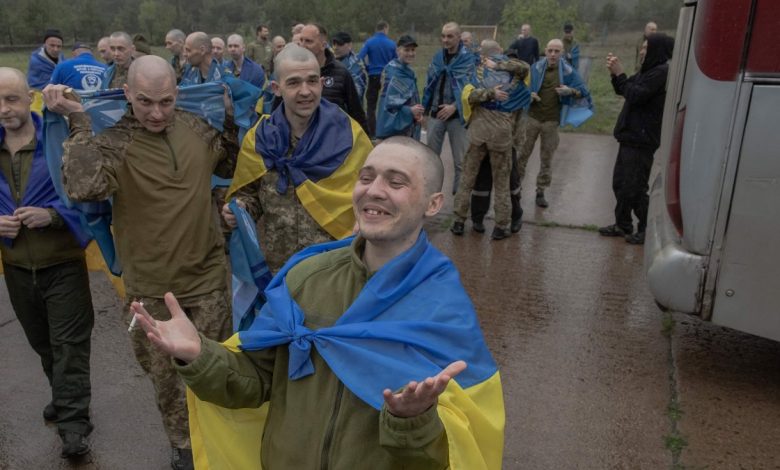
Russia and Ukraine completed the first phase of their landmark prisoner-of-war exchange on 15 May 2026, returning 205 servicemen to each side in a handover confirmed by both governments. The Russian POWs were transported to ally Belarus, at an undisclosed location approximating grid reference 35UMB 55000 53000 (53.90N, 27.57E) in central Belarus, where Russian defence ministry officials said they would receive immediate psychological and medical support. The Ukrainian servicemen, meanwhile, were returned to Ukrainian-controlled territory and transported toward Kyiv, at grid reference 37UDB 30500 62200 (50.45N, 30.52E), for comprehensive medical examination and rehabilitation.
Ukrainian President Volodymyr Zelensky confirmed the exchange on Telegram, describing it as the opening stage of a much larger deal. The broader framework, announced by US President Donald Trump on 8 May 2026, called for each side to return 1,000 prisoners as part of a three-day ceasefire covering Russia’s Victory Day parade on 9 May. That ceasefire collapsed amid mutual accusations of violations, and heavy Russian strikes on Kyiv killed at least 24 civilians the day before the exchange. The POW handover proceeded regardless, underscoring how prisoner returns have become one of the few channels of practical cooperation surviving across the front lines.
The United Arab Emirates played a logistical and humanitarian role in facilitating the transfer of the Russian servicemen, with Moscow’s defence ministry specifically acknowledging UAE assistance. Zelensky offered separate thanks to both the United States and the UAE for what he described as critical mediation. Ukraine’s Coordination Headquarters for the Treatment of Prisoners of War confirmed the exchange was executed in line with agreements reached through US-mediated negotiations.
President Volodymyr Zelensky : Telegram, 15 May 2026
“This is the first phase of the 1,000-for-1,000 prisoner exchange. Today, warriors of the Armed Forces of Ukraine, the National Guard and the State Border Guard Service are returning from Russian captivity.”
🔴 Who Was Returned
Azovstal Defenders, Chornobyl Guards, Troops from Seven Frontline Regions
The profile of the returned Ukrainians signals the depth of the human toll accumulated since Russia’s full-scale invasion began in February 2022. According to Zelensky and Ukraine’s Coordination Headquarters, 95 percent of the 205 returnees, specifically 193 individuals, had been in Russian captivity since 2022 and were captured primarily during the siege of Mariupol and the fall of the Azovstal steelworks at grid reference 37TGJ 25500 61800 (47.10N, 37.55E). The Azovstal plant became the symbol of Ukrainian resistance in those first weeks of the invasion, with its defenders holding out for nearly three months before surrendering on presidential orders.
Among those returned were servicemen from the Ukrainian Ground Forces, the Navy, the Air Assault Forces, the National Guard, the Territorial Defence Forces, the Air Force, and the State Border Guard Service. The age range spanned from 21 to 62 years old, reflecting the breadth of the mobilisation. More than 50 officers were included alongside enlisted personnel and sergeants. The Kyiv Post and UNITED24 Media confirmed that members of the Azov Brigade were also among those freed, though the precise number was not disclosed by officials.
A National Guardsman captured at the Chornobyl Nuclear Power Plant, at grid reference 36UYD 42000 26000 (51.39N, 30.10E), during the Russian occupation of the exclusion zone in the early days of the invasion, was also confirmed among those returned. Russian forces briefly held Chornobyl from late February to late March 2022, seizing its National Guard defenders before retreating. Zelensky also confirmed that veterans of the fighting around Donetsk, Luhansk, Kharkiv, Kherson, Zaporizhzhia, Sumy, and Kyiv regions were included in the cohort.
Russian Defence Ministry : Telegram Statement, 15 May 2026
“205 Russian servicemen were returned from territory controlled by Kyiv. In exchange, 205 Ukrainian Armed Forces prisoners of war were transferred.”
🔵 The Trump Framework
Victory Day Ceasefire Set the Stage: How Washington Brokered the Deal
The 1,000-for-1,000 prisoner exchange was announced by President Trump on 8 May 2026 via Truth Social, paired with a three-day ceasefire covering 9 to 11 May, Russia’s Victory Day period. Trump framed the ceasefire as a personal diplomatic achievement, stating he made the request directly to both Putin and Zelensky. CBS News, PBS NewsHour, and the Times of Israel all confirmed that both Kyiv and Moscow publicly acknowledged the agreement, the first time both sides had simultaneously accepted the same ceasefire framework since the war began. Kremlin foreign affairs aide Yuri Ushakov confirmed Russia’s agreement had been coordinated through direct US presidential contacts.
Ukraine’s Defence Minister Rustem Umerov had travelled to Miami the previous week for talks with US envoys Steve Witkoff and Jared Kushner, focused on the prisoner exchange and wider peace efforts. Zelensky issued a formal presidential decree designating Moscow’s Red Square off-limits for Ukrainian strikes during the parade period, effectively trading restraint on the parade for the prisoner deal. A senior Ukrainian presidential source described the arrangement to AFP as exchanging the absence of drones over Moscow for 1,000 POWs. It was a striking calculation: the lives of prisoners against the prestige of a parade.
The ceasefire itself proved fragile. Both sides accused each other of violations throughout the 9 to 11 May window, and fighting resumed almost immediately after the truce expired late on the 11th. Russian forces launched a large-scale assault on Kyiv on 14 May, killing at least 24 civilians in an air barrage the day before the prisoner exchange took place. Despite the collapse of the broader truce, the POW handover proceeded, demonstrating that the narrow diplomatic channel built around prisoner returns continues to function even when everything else does not.
🟢 What Happens Next
795 Remain Unswapped as Zelensky Signals More Phases
Today’s 205-for-205 exchange is the first phase of a commitment for 1,000 POWs per side. That leaves 795 from each country still to be transferred under the announced framework. Zelensky confirmed the exchange is proceeding in phases and acknowledged more rounds will follow, though he stopped short of specifying dates or numbers for subsequent stages. Ukraine’s Coordination Headquarters had submitted its list of 1,000 prioritised Ukrainian names to Russia on 10 May, compiled on the basis of time already spent in captivity, meaning those held the longest were at the front of the queue.
The prisoner exchange issue carries considerable domestic weight in Ukraine. The families of the Azovstal defenders in particular have campaigned publicly and relentlessly for their return since 2022, and the Azov Brigade’s Colonel Denys Prokopenko has previously criticised the pace of releases. While today’s return was welcomed, Ukrainian advocacy groups have long pushed for an all-for-all exchange that would release every prisoner simultaneously, a proposal Russia has consistently rejected. The return of Azov Brigade members in today’s exchange will bring some relief to those communities, though the full extent of Azov representation among the 205 has not been publicly confirmed by the Coordination Headquarters.
The broader peace process remains suspended. Talks mediated by Pakistan have stalled after both the US and Iran rejected each other’s most recent proposals, and the Ukraine-Russia diplomatic track is similarly frozen. Secretary of State Marco Rubio said on 8 May that mediation efforts had not reached a fruitful outcome and were stagnating. The prisoner exchange therefore stands as the one concrete deliverable from months of diplomatic effort, a fragile proof-of-concept for what US pressure can extract when applied directly to both sides.
Strategy Battles Assessment
A Narrow but Real Diplomatic Win Amid a War That Is Still Very Much Active
The completion of Phase 1 of the 1,000-for-1,000 exchange matters most as a proof of mechanism, not a breakthrough. The ceasefire it was tied to collapsed within hours, Russian strikes killed 24 in Kyiv the day before the handover, and broader peace negotiations remain suspended. And yet the exchange happened. Both sides released 205 people as committed. That is not nothing.
The diplomatic architecture here is worth noting. Trump’s team achieved something concrete that months of European pressure did not: a simultaneous, publicly acknowledged, bilateral commitment. The formula used, trading restraint around the Moscow parade for a prisoner release, was transactional rather than principled, but it worked. The UAE’s involvement as a logistics facilitator is also notable, extending its established role as a neutral operational hub in conflicts across the region.
The harder question is whether the remaining 795 from each side will follow. Russia has every incentive to delay, use the prisoner framework as a periodic pressure valve, and extract political concessions in return for each subsequent phase. Zelensky’s political position domestically depends partly on delivering these returns, which gives Moscow leverage it will not quickly surrender. The Azovstal dimension gives the issue particular symbolic weight: those defenders are treated as national heroes in Ukraine, and their continued captivity is a recurring wound in public discourse.
On the military intelligence side, POW exchanges are never purely humanitarian. Both sides extract debriefs from every returned soldier, and large exchanges allow each side to assess the physical and psychological condition of their people as an indirect indicator of captivity conditions on the other side. Reports of systematic abuse and neglect, noted alongside the return of the remains of 375 military personnel and civilians in recent weeks, will sharpen those assessments considerably.
Strategy Battles Related Coverage
Sources
- Russia, Ukraine Swap 205 Prisoners of War Each, Asharq Al-Awsat (AFP), 15 May 2026
- 205 Ukrainian POWs Return from Russian Captivity in Latest Exchange, Kyiv Independent, 15 May 2026
- Ukraine Brings Home 205 POWs in First 1,000-for-1,000 Swap Stage, Kyiv Post, 15 May 2026
- Russia and Ukraine Begin First Phase of Large POW Exchange, The Moscow Times, 15 May 2026
- Russia, Ukraine Swap Prisoners of War: Moscow, Al Arabiya, 15 May 2026
- Trump Announces Russia-Ukraine Prisoner Swap as Part of 3-Day Ceasefire, CBS News, 8 May 2026
- Russia and Ukraine Agree to 3-Day Ceasefire and Prisoner Swap, Times of Israel, 9 May 2026
- Ukraine Secures Return of 205 Soldiers in First Phase of Major 1,000-for-1,000 Swap, UNITED24 Media, 15 May 2026
Editorial Verification
All key statements verified to a minimum of two independent outlets. The 205-for-205 exchange figure is confirmed by the Russian Defence Ministry (Telegram), Ukrainian President Zelensky (Telegram), Kyiv Independent, Kyiv Post, Moscow Times, Al Arabiya, Asharq Al-Awsat (AFP), UNITED24 Media, Athens Times, and Bangkok Post. The Trump 1,000-for-1,000 announcement and Victory Day ceasefire framework are confirmed by CBS News, PBS NewsHour, Times of Israel, ABC News, and The Defence Post. UAE facilitation is confirmed by the Moscow Times citing the Russian Defence Ministry Telegram statement. No single-source items in this article.
MGRS datum: WGS84 / UTM Zones: 35U (Belarus), 36U (Chornobyl), 37T and 37U (Mariupol and Kyiv) / Cross-check reference: Kyiv city centre 37UDB 30500 62200 (50.4501N 30.5234E), confirmed against standard WGS84 UTM Zone 37U projection. Mariupol cross-check: Azov Sea coastline at 47.10N 37.55E places correctly within UTM Zone 37T grid square GJ.
No satellite imagery used for this report. All locations are confirmed open-source geographic references.
All claims independently attributed and verified to open sources where possible.
Approved for Publication
Marcus V. Thorne
Lead Editor, Strategy Battles
©StrategyBattles.net 2026
This article is for news and analysis purposes only. Based on publicly available news sources and military updates. All rights reserved. Not for commercial reuse without permission.