NATO Commander Says No Hormuz Planning Until Political Decision From All 32 Members
Threat Level Assessment
LEVEL 3 OF 5, DEVELOPING
Bottom Line Up Front
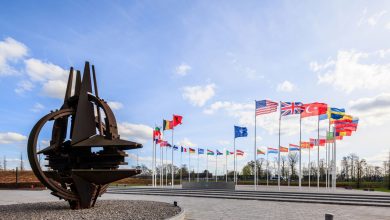
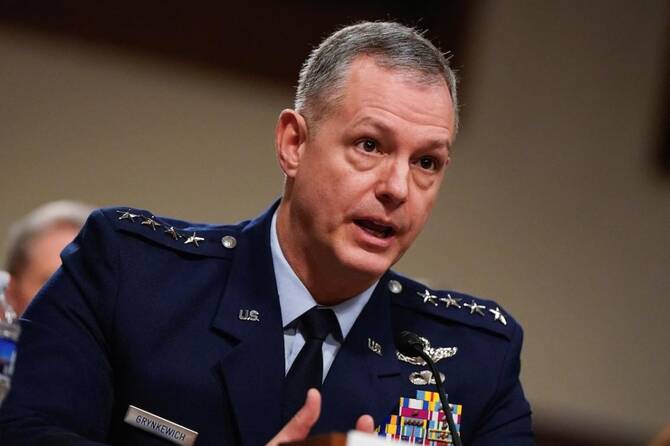
NATO’s Supreme Allied Commander for Europe, US Air Force General Alexus Grynkewich, confirmed on 19 May that the alliance is not drawing up any plans for a mission in the Strait of Hormuz and will not do so until it receives a political mandate from all 32 members. Several allies have already signalled opposition to any NATO Hormuz role. With the alliance paralysed by a requirement for unanimity it cannot currently achieve, France and Britain are advancing a separate multinational coalition of more than 40 nations to escort shipping through the strait once conditions allow, with the Charles de Gaulle carrier strike group now repositioned to the Red Sea and HMS Dragon en route to the Middle East. The divide between NATO inaction and the France-UK coalition track is now the central structural problem for Western maritime strategy in the Gulf, with the NATO Ankara summit on 7-8 July set to force the issue.
Key Judgments
NATO will not have a formal Hormuz mission before the July Ankara summit. The unanimity requirement means any single objector can block a mandate, and multiple allies have already signalled opposition. Grynkewich’s public statement that formal planning has not begun is the clearest signal yet that the alliance is not on a path to operational deployment.
The France-UK coalition is now the operative Western instrument for Hormuz and is advancing independently of NATO. More than 40 nations attended the London planning meeting in late April. The Charles de Gaulle has repositioned to the Red Sea and HMS Dragon is transiting to the Middle East. The coalition has set two activation thresholds: a reduction in the threat level to shipping, and adequate reassurance for commercial insurers. Neither threshold has yet been met.
The Ankara summit is the earliest credible moment at which NATO could agree a political mandate for Hormuz operations, but only if the conflict trajectory changes materially before July. A Rigzone/Bloomberg report citing a senior NATO official indicates some allies are already thinking about the Ankara summit as a deadline, particularly if the strait remains blocked into early July. The Atlantic Council has publicly proposed transitioning the France-UK initiative to a NATO-led operation via Allied Joint Force Command Naples, but this would still require unanimity.
Whether Trump’s announced withdrawal of 5,000 troops from Germany is a one-time punitive signal or the opening move in a sustained campaign to force European compliance on Hormuz. The Council on Foreign Relations analysis notes the immediate military effect is limited but the stockpile depletion and cancelled missile deployments may be the more consequential long-term pressure. Trump’s willingness to deploy this lever again, at greater scale, before or during Ankara remains unresolved.
32
NATO Members, All Must Agree
40+
Nations in France-UK Coalition
5,000
US Troops Pulled from Germany
7-8 JUL
NATO Ankara Summit Date
SITREP Timeline : NATO and Hormuz, Feb to May 2026
🔴 The Grynkewich Statement
The Top Commander Said The Quiet Part Loudly: Political Direction First, Planning Second, And Neither Has Started
Speaking to reporters in Brussels on 19 May 2026, US Air Force General Alexus Grynkewich, NATO’s Supreme Allied Commander for Europe, addressed the question of a possible NATO Hormuz mission with a precision that left little room for interpretive ambiguity. “The conditions under which NATO would consider operating in the Strait of Hormuz are ultimately a political decision,” he said. “The political direction comes first, and then the formal planning happens after that.” Asked whether he was at least thinking about it, Grynkewich confirmed he was. “Am I thinking about it? Absolutely,” he told reporters. “But there’s no planning yet until the political decision is taken.” The statement was confirmed independently by Reuters, the Jerusalem Post, the Japan Times, US News, and Marine Link, all carrying the direct quote.
The significance of the formulation is not simply that planning has not begun. It is that Grynkewich explicitly bracketed the planning question inside a political prerequisite that does not yet exist. NATO operates by consensus. Any decision to launch a mission in the Strait of Hormuz requires the affirmative agreement of all 32 member states. As of 19 May, multiple members have already signalled opposition, and, critically, no formal proposal has yet been tabled. There is nothing yet to vote on, and no agreed process for bringing such a vote to a conclusion before the July summit in Ankara.
Grynkewich met with military chiefs from NATO countries in Brussels on 19 May, which gives his statement an additional layer of authority. He was not speaking from the sidelines. He was speaking as the commander whose staff would be doing the planning, confirming to his counterparts and to reporters simultaneously that no planning order had been issued. The meeting itself produced no announced change in the alliance’s posture.
🟡 The Alliance Divide
Some Allies Want a NATO Role. Others Will Not Sanction One. The Gap Between Them Has Not Narrowed.
The Reuters wire piece underlying this report carries four separate diplomat quotes, all on condition of anonymity to discuss internal deliberations. They do not represent a single position. One European diplomat stated that some allies believe NATO should play a role in Hormuz and noted the alliance’s substantial maritime capabilities. A second diplomat said many allies do not see a role for NATO as such in the mission. A third identified the key obstacle as the reluctance to be seen to become a party to the conflict. A fourth diplomat, drawing on the clearest assessment of the internal arithmetic, concluded that there would not be a formal NATO mission.
The conflict-party concern is not a bureaucratic caveat. Iran began blockading the Strait of Hormuz after the United States and Israel launched military action against the country in February 2026. The war was launched without prior consultation with NATO’s European members. European governments have consistently distinguished between the war itself, which they declined to support, and the consequences of the war for global shipping, which they want to address. Deploying NATO naval forces into the strait while active hostilities remain possible would expose the alliance to the argument that it is participating in the conflict, regardless of whether any such deployment is formally labelled defensive.
Iran has been explicit about how it would read such a deployment. Iranian Deputy Foreign Minister Kazem Gharibabadi warned on 10 May that any French-British or coalition naval presence in the waterway alongside US forces would constitute an escalation and trigger a military response. The warning landed two days after the UK confirmed HMS Dragon’s deployment and France repositioned the Charles de Gaulle strike group south through Suez. The prospect of any NATO label being attached to a Hormuz deployment amplifies that escalation risk further, from Tehran’s perspective, because it would imply the collective defence commitment of 32 states rather than a voluntary multinational coalition.
General Alexus Grynkewich, NATO Supreme Allied Commander Europe : Brussels, 19 May 2026
“The conditions under which NATO would consider operating in the Strait of Hormuz are ultimately a political decision. The political direction comes first, and then the formal planning happens after that. Am I thinking about it? Absolutely. But there’s no planning yet until the political decision is taken.”
🔵 The France-UK Track
While NATO Deliberates, Paris and London Have Built a 40-Nation Coalition That Is Already Moving Hardware Into Position
The France-UK coalition is not a contingency plan for a NATO failure. It was always designed as a separate track. The April 17 Paris summit, co-chaired by Macron and Starmer, brought together the initial group of contributing nations. The London planning conference of 23-24 April produced a decision brief from a dedicated operational planning group, and Healey and Vautrin issued a joint statement saying they were confident real progress could be made. By 10 May, more than 40 nations had attended a subsequent meeting to commit specific military contributions, including demining, escorting, and air policing capabilities. Belgium confirmed its participation in writing, offering mine-clearance expertise under the proviso that a ceasefire must be in place before deployment begins.
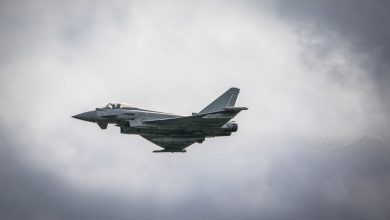
The hardware being positioned is not symbolic. France’s nuclear-powered Charles de Gaulle carrier strike group, with its Rafale aircraft complement and escort frigates, crossed south of Suez into the Red Sea following Macron’s announcement on a date reported by NBC News. HMS Dragon, a Type 45 Daring-class air defence destroyer equipped with the Sea Viper anti-air missile system capable of simultaneously engaging multiple supersonic targets, is transiting to the Middle East. The UK Ministry of Defence confirmed that the force package will also include the Royal Navy’s Beehive modular system deploying autonomous Kraken drone boats, Typhoon jets, and mine-clearance specialists. This is a credible defensive package, not a symbolic signal.
The coalition’s own activation conditions, however, mean that pre-positioning is not the same as deployment. The French armed forces chief of staff spokesman confirmed that the mission will not begin operating until the threat to shipping comes down and commercial shipping insurers are reassured enough to direct vessels through the strait. The blockade and the lingering threat from Iran’s retained missile capabilities, still estimated at roughly 70 percent of pre-war stockpiles by US intelligence sources cited in the New York Times and the Daily Caller, make neither condition trivially achievable. Washington’s absence from the France-UK planning structure, confirmed by NBC News, also limits what the coalition can do in the event of an active Iranian military response to an escort deployment.
⚠ The Ankara Convergence
July 7-8 Is the Earliest Realistic Point at Which the Two Tracks Could Merge, and Only If the Conflict Changes Before Then
The NATO summit in Ankara on 7-8 July 2026 is already being framed by analysts and diplomats as the moment the Hormuz question must be resolved. A Rigzone report citing a senior NATO official, corroborated by Bloomberg, indicated that some allies are treating the summit as a soft deadline: if the strait remains blocked by early July, political pressure for a NATO mandate may become difficult to resist, particularly if the France-UK coalition has been operationally ready but unable to deploy due to the threat level. The Atlantic Council has proposed a specific pathway: transition the France-UK initiative to a NATO-led operation through Allied Joint Force Command Naples, using NATO’s existing standing maritime forces and mine-clearance assets.
That pathway would still require unanimity, and Turkey, as the host of the summit and a NATO member with its own distinct Iran policy, is a complicating variable. Ankara has urged the alliance to reset transatlantic ties and prepare for a reduced US role, according to Foreign Minister Hakan Fidan, which is not obviously consistent with endorsing a NATO Hormuz mission that would align the alliance more closely with US strategic aims. NATO has separately announced it plans to invite Bahrain, Kuwait, Qatar, and the United Arab Emirates to the summit as Istanbul Cooperation Initiative partners. The inclusion of Gulf states is a signal of intent, but the gulf states’ own positions on a NATO Hormuz deployment have not been publicly clarified.
Trump has deployed his most direct pressure tool, the troop withdrawal from Germany, in a dispute rooted partly in Merz’s criticism of the Iran war and partly in the broader European refusal to engage at Hormuz. The withdrawal of 5,000 troops was announced without warning allies and came despite Germany’s strong compliance with other NATO demands, including defence spending approaching 3.5 percent of GDP by 2029 and the deployment of a German minesweeper to the strait once a stable ceasefire is in place. The Council on Foreign Relations analysis concludes the immediate military effect is limited, but the cancellation of missile deployments and the depletion of Patriot interceptor stockpiles carry longer-term structural costs that Germany and other European allies will now be calculating as they decide how far to accommodate Washington’s Hormuz demands.
Source Reliability Matrix
NATO grading: REL A (reliable) to F (unreliable). CRED 1 (confirmed) to 6 (cannot judge).
CRED 1
Primary wire. Grynkewich on-the-record quote confirmed by five independent outlets. Diplomat quotes are anonymous background sourcing only.
CRED 1
Independent corroboration of Grynkewich on-the-record quote. All three carry the same direct attribution without paraphrasing errors.
CRED 2
France-UK coalition detail, Charles de Gaulle positioning, and Washington’s absence from coalition planning. Bloomberg cites anonymous senior NATO official for the Ankara deadline framing.
CRED 2
Background sourcing, identities withheld. Internally consistent with Grynkewich’s on-the-record framing. Four separate voices reduce the risk of single-source distortion.
CRED 2
Analysis and context on Germany troop withdrawal implications and Ankara summit pathway options. Analytical framing, not primary reporting. Used for contextual assessment only.
Strategy Battles Assessment
NATO has produced a top commander willing to think about Hormuz, a coalition of European nations willing to act at Hormuz, and a political process incapable of mandating either. The France-UK track is now the only operative Western instrument, and it cannot fire until Iran’s threat posture allows.
✓ What We Know
Grynkewich confirmed on 19 May that NATO has no planning underway for a Hormuz mission and will not begin until a political mandate is issued by all 32 members. Multiple members have signalled opposition and no formal proposal has been presented. France and Britain have built a separate 40-plus-nation coalition, repositioned the Charles de Gaulle to the Red Sea, and sent HMS Dragon to the Middle East. The coalition will not activate until the threat level falls and commercial insurers are reassured. The Ankara summit on 7-8 July is the next major decision point for the alliance. Trump has withdrawn 5,000 US troops from Germany as leverage. Iran has threatened a military response to any coalition deployment near the strait.
? What We Do Not Know
Which specific NATO members are blocking a mandate and whether their opposition is fixed or conditional on ceasefire progress. Whether Trump’s Germany troop withdrawal is a ceiling or a floor for his pressure campaign. Whether Iran’s retained missile capabilities (estimated at approximately 70 percent of pre-war stockpiles) are sufficient to deter the France-UK coalition from deploying even after a ceasefire. Whether Turkey, as summit host, will use its position to broker a compromise or to complicate one. Whether Washington’s parallel Maritime Freedom Construct and the France-UK coalition will eventually merge into a unified operational framework or remain on separate tracks.
☉ What To Watch
Whether Ankara produces a formal NATO political mandate or merely a restatement of the existing impasse. Whether Iran’s threat posture changes enough before July to clear the France-UK coalition’s activation thresholds. Whether the US-Iran ceasefire extension produces a durable reduction in Hormuz hostilities. Whether Trump orders further troop withdrawals from Europe or revives his threat to pull the United States from the alliance entirely. Whether commercial shipping insurance markets begin pricing in Hormuz transit before the coalition formally deploys, which would reduce the political pressure on NATO to act.
Sources
- NATO not drawing up plans for Hormuz mission, top commander says, Arab News / Reuters, 20 May 2026
- NATO not drawing up plans for Strait of Hormuz mission, top commander says, Jerusalem Post, 20 May 2026
- Potential NATO Mission in Strait of Hormuz Is Political Decision, Top Commander Says, US News / Reuters, 19 May 2026
- NATO Is Starting to Consider Hormuz Mission, Rigzone / Bloomberg, 19 May 2026
- France moves aircraft carrier group toward Strait of Hormuz for possible defensive mission, NBC News, May 2026
- Countries to Meet on Hormuz Naval Mission Led by UK, France, Bloomberg, 10 May 2026
- UK, France push ‘real progress’ in naval mission to secure Hormuz shipping, TRT World, April 2026
- NATO to invite Qatar, UAE, Bahrain, Kuwait to Ankara summit, Al Arabiya, 13 May 2026
- Trump Is Pulling Troops From Germany. The Missiles Are a Bigger Problem, Council on Foreign Relations, 4 May 2026
- No strategy behind Trump’s withdrawal of NATO troops from Germany, sources say, Euronews, 3 May 2026
- Five ideas to make the upcoming NATO Summit in Ankara a success, Atlantic Council, 20 April 2026
Editorial Verification
Grynkewich’s on-the-record quote is confirmed across five independent outlets: Reuters (Arab News), Jerusalem Post, Japan Times, US News, and Marine Link, all carrying identical direct attribution. The four anonymous NATO diplomat quotes are Reuters background sourcing; identities cannot be independently verified and are single-source by definition. This is flagged in the Source Reliability Matrix (REL C / CRED 2). The France-UK coalition formation dates, participant counts, and hardware deployments are cross-confirmed by Bloomberg, NBC News, National Interest, TRT World, and Arab News PK. The NATO Ankara summit date (7-8 July) is confirmed by Al Arabiya, Atlantic Council, Turkish Minute, and Wikipedia. Trump’s Germany troop withdrawal (5,000 troops) is confirmed by Euronews, Council on Foreign Relations, and RedState. Iran’s retained missile capability figure (approximately 70 percent) is attributed to unnamed US intelligence officials via the New York Times as cited in the Daily Caller; this is treated as single-source analytical context, not a primary claim, and is not used as a standalone verified fact. The Gharibabadi warning of 10 May is confirmed by Arab News PK citing Reuters. This is not a geographic strike article; no MGRS coordinates or map are required. No satellite imagery has been used.
All claims independently attributed and verified to open sources where possible.
Approved for Publication
Marcus V. Thorne
Lead Editor, Strategy Battles
FILE SB-2026-0520-001 // CLEARED
©StrategyBattles.net 2026
This article is for news and analysis purposes only. Based on publicly available news sources and military updates. All rights reserved. Not for commercial reuse without permission.