Russian Drones Hit Odesa Homes, Wounding 14 Ukraine Fires Back in Occupied Kherson as Zelenskyy Warns on Patriot Gap
14
Wounded in Odesa
incl. 2 children
1,900+
Attack drones fired
by Russia past week
90%+
Ukrainian drone
intercept rate

🔴 The Strike
Russia hit Odesa before dawn, targeting residential streets
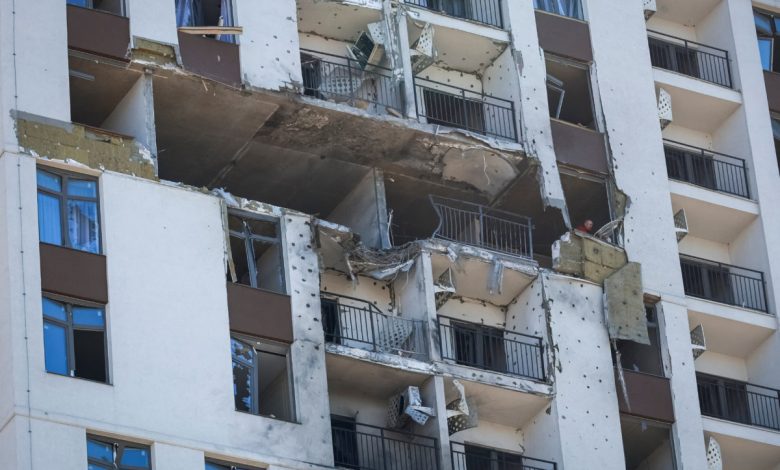
A Russian drone attack struck Odesa in the early hours of Monday, April 27, wounding 14 people including two children. Drones hit residential neighbourhoods and civilian infrastructure across the city, according to Serhii Lysak, the head of Odesa city administration.
Five of the wounded required hospitalisation, most carrying shrapnel injuries. Regional military administration head Oleh Kiper confirmed the casualty breakdown. No military installations were reported among the structures hit.
Odesa is Ukraine’s most strategically vital Black Sea port. Russia has repeatedly targeted the city since launching its full-scale invasion on February 24, 2022, with strikes designed to degrade export capacity, civilian morale and coastal logistics simultaneously.
🟡 Ukrainian Counter-Strike
Two killed in occupied Kherson as Ukrainian drones hit Dnipriany
A Ukrainian drone strike killed two people in the Russian-occupied portion of the Kherson region on the same morning. Moscow-installed governor Vladimir Saldo reported that a man and a woman, both in their 70s, died in the village of Dnipriany. This information originated from Russian-appointed officials and has not been independently verified.
The exchange illustrates the persistent cross-river drone war that has defined operations in Kherson since Russian forces withdrew from the city’s northern bank in late 2022. Both sides continue to conduct near-daily strikes across the Dnipro River line, targeting positions in territory each controls or contests.
President Volodymyr Zelenskyy — X Post, April 27, 2026
“Ukraine is intercepting more than 90% of the drones that Russia launches. However, Ukraine needs more American-made Patriot air defense missiles, which are able to shoot down Russia’s ballistic missiles.”
🔵 Air Defence
Zelenskyy claims 90% intercept rate but warns Patriot stocks are critical
President Zelenskyy stated that Russia fired approximately 1,900 attack drones, nearly 1,400 guided aerial bombs, and around 60 missiles of various types at Ukraine over the past week alone. Despite those volumes, Ukraine’s air defences are now intercepting more than nine in ten incoming drones, a figure Zelenskyy attributed to the nation’s advancing wartime technology.
The shortfall, Zelenskyy made clear, is not with drone interception but with ballistic missile defence. Ukraine requires additional American-made Patriot surface-to-air missile systems and their associated interceptor stocks to counter Russia’s higher-altitude ballistic threat, which current inventories cannot adequately absorb at the current rate of attack.
Ukraine has also been assisting Middle Eastern and Gulf nations in countering attacks by Iranian-manufactured drones, a diplomatic gesture that simultaneously showcases Kyiv’s growing expertise in drone interdiction on the international stage.
🟡 Ground War Technology
Ukraine doubles ground robot order to 25,000 units for 2026
Zelenskyy announced that Ukraine is massively scaling up production of uncrewed ground vehicles capable of carrying supplies, evacuating casualties, and firing automatic weapons autonomously. Ukraine has ordered 25,000 ground robots for 2026, double the procurement of the previous year, with further increases planned.
The programme directly addresses one of Ukraine’s most acute vulnerabilities: infantry shortages along a roughly 1,250-kilometre front line. Uncrewed ground vehicles can sustain battlefield logistics and fire support in contested corridors where human movement is too costly. The scale of the order signals this is no longer an experimental programme but a core pillar of Ukraine’s warfighting doctrine.
🟢 Allied Support
Norway joins drone pact as Poland pledges its own drone armada
Norway confirmed a joint drone manufacturing agreement with Ukraine on Monday, making it the latest European nation to formalise industrial drone cooperation with Kyiv. The agreement follows a pattern of European states seeking to co-produce drone technology domestically rather than simply purchasing finished systems abroad.
Polish Prime Minister Donald Tusk went further, announcing plans for Poland to build what he called a “drone armada” using Ukraine’s technical assistance, intended to defend both Poland and broader European territory. The statement marks a notable shift in European drone policy, moving from consumer to co-producer status with direct Ukrainian knowledge transfer at its core.
Zelenskyy also highlighted a package of allied financial commitments: NATO partners excluding the United States have contributed to a fund for purchasing American weapons; the European Union approved a 90-billion-euro ($106 billion) loan to Ukraine; and further EU sanctions on Russia are in preparation. These financial instruments give Kyiv sustained procurement power independent of US Congressional approval cycles.
🔴 Deep Strike Campaign
ISW confirms at least 10 strikes on Russian oil and gas infrastructure in two weeks
The Institute for the Study of War reported geolocated evidence of at least 10 Ukrainian strikes against Russian oil and gas infrastructure over the preceding two weeks. Ukraine has been employing long-range drones and missiles to target terminals and refineries deep inside Russian territory, pursuing a strategy of economic attrition designed to degrade Moscow’s energy revenue and logistical capacity simultaneously.
This deep-strike campaign represents a calculated strategic inversion: as Russia pounds Ukrainian cities with mass drone barrages, Ukraine returns fire not at Russian cities but at the economic infrastructure financing the war. The approach targets an energy-export-dependent adversary at its most structurally vulnerable point.
Strategy Battles — Related Coverage
Sources
- PBS NewsHour / Associated Press (Hanna Arhirova) — Russian drone attack wounds 14 in Odesa — April 27, 2026
- Institute for the Study of War (ISW) — Ukraine Conflict Updates — April 27, 2026
- President Volodymyr Zelenskyy — Official X Posts on drone intercepts and ground robot programme — April 27, 2026
- Polish Government — Prime Minister Donald Tusk statement on drone armada — April 27, 2026
- Norwegian Defence Ministry — Ukraine drone manufacturing agreement — April 27, 2026
Editorial Verification
Odesa casualty figures (14 wounded, 2 children, 5 hospitalised) are confirmed by two named Ukrainian officials: Serhii Lysak and Oleh Kiper. The Kherson strike casualty report (2 killed, village of Dnipriany) originates solely from Moscow-installed Governor Vladimir Saldo and is single-source; it cannot be independently verified and should be treated accordingly. Zelenskyy’s weekly strike tallies (1,900 drones, 1,400 bombs, 60 missiles) and the 90% intercept rate are from official X posts and are attributed to a single source — the Ukrainian presidency. The ISW deep-strike assessment cites geolocated evidence. Norwegian drone pact and Polish drone armada statements are attributed to respective government sources. No Zelenskyy quotes have been altered. Russian territorial control designations are marked CLAIM UNVERIFIED per editorial policy.
Approved for Publication
Marcus V. Thorne
Lead Editor, Strategy Battles
©StrategyBattles.net 2026
This article is for news and analysis purposes only. Based on publicly available news sources and military updates. All rights reserved. Not for commercial reuse without permission.