Ukraine Drones Destroy Russian Landing Radar at Belbek Air Base in Occupied Crimea
Threat Level Assessment
LEVEL 4 OF 5, SERIOUS
Bottom Line Up Front
During the night of 16-17 May 2026, Ukraine’s Security Service Alpha unit and Defence Forces launched a 600-drone operation striking nine targets across Moscow Oblast and occupied Crimea simultaneously. At Belbek air base near Sevastopol, imagery published by the Telegram channel Dosye Shpiona on 20 May shows damage to the RSP-28ME aircraft landing radar complex, including the DRL-27SE air traffic control module and a command module mounted on a KamAZ-6350 truck. The SBU confirmed separately that the night’s Belbek strikes hit a Pantsir-S2 system, an S-400 radar hangar, UAV control stations, and the air traffic control tower. Belbek has now been targeted repeatedly since December 2025, with each strike degrading a different layer of the air base’s sensor and control architecture.
Key Judgments
The RSP-28ME landing radar at Belbek sustained damage in the night of 16-17 May 2026 strike. Post-strike imagery from Dosye Shpiona shows physical damage to the DRL-27SE dispatch radar module and the KamAZ-6350-mounted command module, both components of the RSP-28ME complex. The SBU confirmed infrastructure and air defence assets at Belbek were struck that night. Both accounts are consistent and the imagery corroborates the SBU statement.
Ukraine is executing a deliberate, layered degradation campaign against Belbek’s sensor and control architecture rather than targeting aircraft or fuel as priority. Since December 2025, successive strikes have hit Nebo-SVU radars, an S-400 92N6 radar, a Pantsir-S2, Su-27 fighters, an air traffic control tower, an S-400 radar hangar, Orion and Forpost UAV ground stations, and now the RSP-28ME landing system. Each layer removed increases the operational cost to Russia of using Belbek as a combat sortie base.
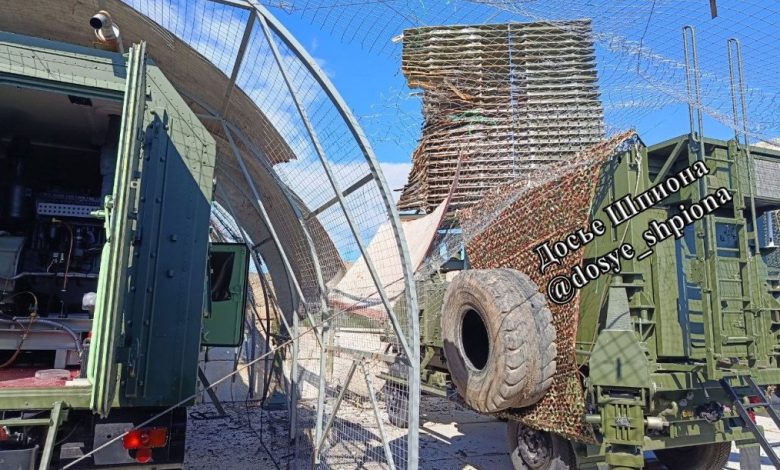
The anti-drone netting visible around RSP-28ME components in the Dosye Shpiona pre-strike imagery was insufficient to protect the system. This suggests Belbek’s passive force-protection posture has not kept pace with the evolving Ukrainian one-way attack drone threat, despite Russian engineering upgrades to shelters and camouflage documented since 2024. The base commander will face difficult choices about how much of the remaining sensor suite to relocate versus harden in place.
The degree to which Belbek remains operationally capable of supporting combat sorties after the cumulative December 2025 to May 2026 strike sequence. Russia has operational incentives to conceal residual capability and to reinforce covertly. Published satellite imagery has not been updated since the 16-17 May strikes at time of writing, and the full damage picture across the base remains unconfirmed.
600+
Drones, 16-17 May Operation
9
Targets Hit, One Night
2021
RSP-28ME Fielded by Russia
5+
Major Belbek Strikes Since Dec 2025
📍 Belbek Air Base, Occupied Crimea / Strike Site / Night 16-17 May 2026

Belbek air base (36T WK 59820 35491), approx. 12km north of Sevastopol city centre. Strike zone encompasses the 38th Fighter Aviation Regiment operating area and radar complex. Datum WGS84, UTM Zone 36T. Map: Strategy Battles / OSINT.
📍 BELBEK AIR BASE, STRIKE SITE
MGRS: 36T WK 59820 35491
44.6672°N 33.5703°E
Belbek military airfield. Home of the 38th Fighter Aviation Regiment. RSP-28ME landing radar complex struck night of 16-17 May 2026.
📍 SEVASTOPOL, CROSS-CHECK REFERENCE
MGRS: 36T WK 55428 29921
44.6167°N 33.5253°E
Sevastopol city centre. Black Sea Fleet HQ city. Belbek air base sits approximately 12km north-northeast of this reference point.
📍 ANGSTREM PLANT, MOSCOW OBLAST
MGRS: 37U CB 82450 36720
55.9200°N 37.1100°E
Approximate location. Zelenograd area, Moscow Oblast. Semiconductor plant under US sanctions; struck in same 16-17 May operation as Belbek.
📍 MOSCOW OIL REFINERY, MOSCOW OBLAST
MGRS: 37U CB 92310 24810
55.8100°N 37.2500°E
Approximate location. Moscow Oil Refinery struck in the same 16-17 May operation. One of four Moscow Oblast targets hit simultaneously.
SITREP Timeline : Belbek Strike Campaign, Dec 2025 to May 2026
🔴 The RSP-28ME Strike
What Was Hit, What It Does, And Why Losing It Matters to Belbek Flight Operations
At grid reference 36T WK 59820 35491 (44.6672°N, 33.5703°E), the Belbek military airfield sits approximately 12 kilometres north-northeast of Sevastopol’s city centre in Russian-occupied Crimea. On the night of 16-17 May 2026, as part of a 600-drone operation spanning nine locations from Moscow Oblast to the Crimean peninsula, Ukraine’s SBU Alpha Special Operations Centre and the broader Defence Forces struck a series of targets at the base. Imagery published three days later by the Telegram channel Dosye Shpiona documented damage to the RSP-28ME aircraft landing radar complex: specifically the DRL-27SE air traffic control radar module and a command module mounted on a KamAZ-6350 military truck chassis.
The RSP-28ME, first supplied to Russian armed forces in 2021, is a mobile precision approach radar system. Its core function is to manage aircraft movements around an operational airfield and to guide pilots during the landing sequence, providing radar coverage of the approach corridor, monitoring of flight trajectories, and precise glide-path and runway course alignment data. The system operates with a crew of three. Losing the DRL-27SE dispatch radar module removes the surveillance radar element that tracks all traffic in the airfield control zone. Losing the command module removes the processing and communication nerve centre through which that radar data is relayed to controllers. The two components together are the eyes and the brain of the approach control function at Belbek.
The imagery also shows that Russian forces had attempted to protect elements of the system using anti-drone netting structures, a passive countermeasure Russia has deployed increasingly across Crimea since 2024. The netting was insufficient. Whether this reflects a penetration above the netting (the DRL-27SE antenna must be unobstructed to function, creating an inherent tension between radar availability and overhead protection), or a strike on the mobile command truck which cannot be easily netted while in operational configuration, is not resolved from published imagery alone.
🟡 The Wider 16-17 May Operation
Nine Targets, One Night: Moscow Refineries, a Sanctioned Semiconductor Plant, and Belbek Hit Simultaneously
The 16-17 May operation was among the most geographically dispersed Ukraine has executed in a single night. Over 600 strike UAVs were involved, according to SBU and Defence Forces statements. In Moscow Oblast, four targets were struck: the Moscow Oil Refinery, the Solnechnogorsk fuel pumping station, the Volodarsk fuel pumping station, and the Angstrem semiconductor plant in Zelenograd. The Angstrem plant is under United States sanctions for supplying chips and electronic components to Russia’s military-industrial complex and has been targeted multiple times in 2025 and 2026, suggesting Ukrainian planners regard it as a strategic priority rather than an opportunistic target.
At Belbek, the SBU enumerated the night’s confirmed targets in a statement reported by Ukrainska Pravda on 17 May: a Pantsir-S2 air defence complex, a storage facility containing radar equipment for an S-400 system, an Orion UAV control system, a Forpost UAV ground control station, a ground-to-air data transmission point, the air traffic control tower, and a hangar. The RSP-28ME damage documented by Dosye Shpiona three days later adds one more confirmed system to that list, though it is possible the RSP-28ME damage was captured in the SBU’s broader reference to infrastructure and radar assets.
Ukrainian President Volodymyr Zelenskyy publicly thanked the SBU and Defence Forces for the night’s precision strikes on Moscow Oblast, a statement reported by Ukrainska Pravda on 17 May. The cross-theatre simultaneity of the operation, hitting Russian fuel and industrial infrastructure north of Moscow at the same time as Belbek’s sensor architecture, is consistent with a strategy of forcing Russia to divide its defensive resources between protecting the capital region and protecting occupied Crimea, neither of which can be done adequately with the current Russian air defence posture over both zones.
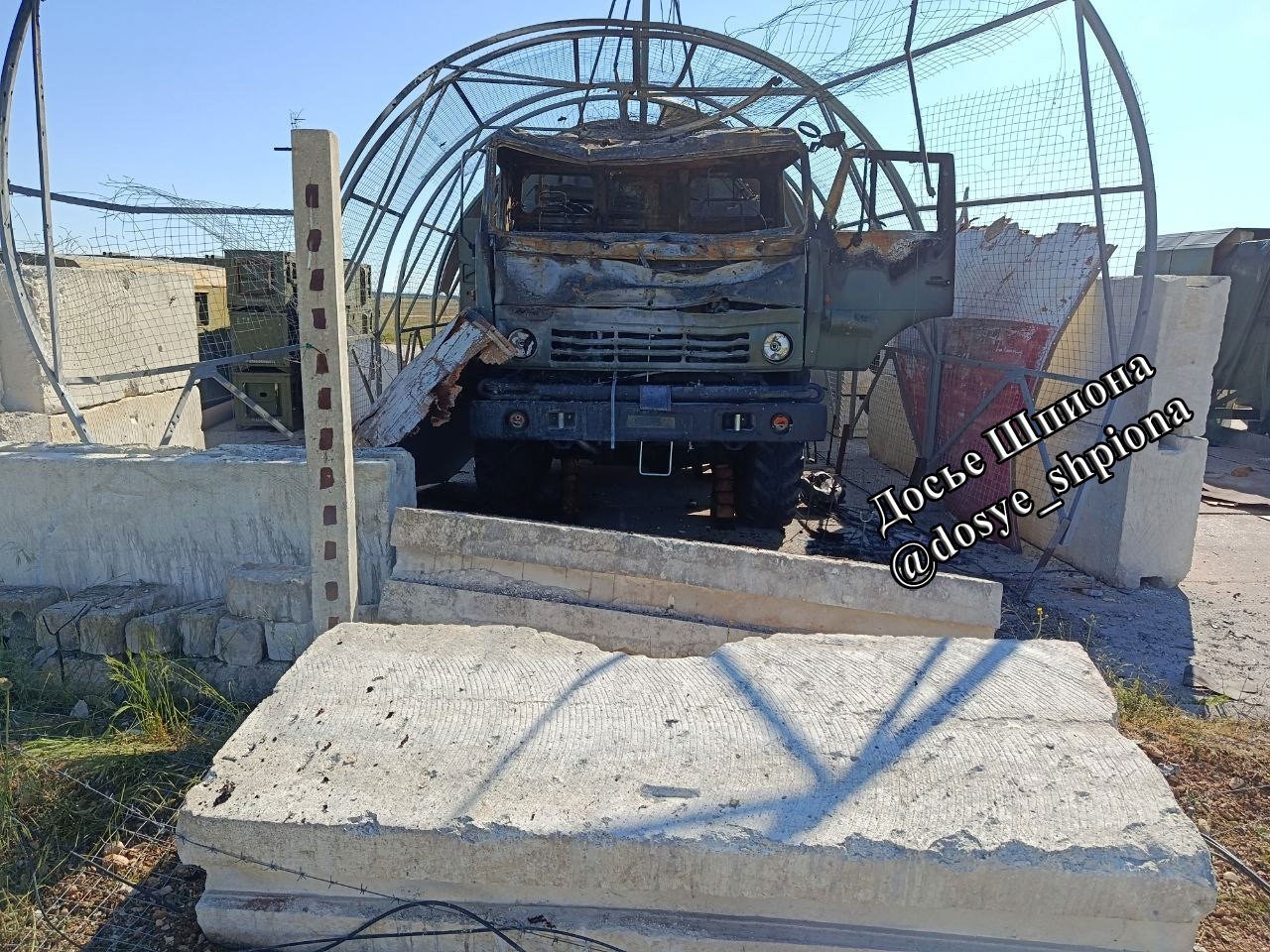
Destroyed command module of the RSP-28ME complex at Belbek, mounted on a KamAZ-6350 truck chassis. Photo: Dosye Shpiona / Telegram.
🔵 Belbek’s Degraded Sensor Stack
Five Months of Raids Have Stripped the Base’s Air-Traffic and Air-Defence Sensor Architecture Layer by Layer
Belbek is the home base of the 38th Fighter Aviation Regiment, equipped with Su-27SM and Su-27SM3 fighters and, since the autumn of 2023, MiG-31 interceptors deployed covertly to the peninsula. The airfield’s significance lies in its geography: positioned on Crimea’s northwestern coast, its aircraft and radars extend Russian combat and surveillance coverage far out across the Black Sea and provide a second defensive layer against Ukrainian long-range strikes approaching from the west. That significance has made it a persistent target.
Mapping the confirmed losses since December 2025 illustrates a systematic dismantling rather than opportunistic attrition. The first major wave in December 2025 removed long-range surveillance capability, taking out two Nebo-SVU radars alongside the S-400’s 92N6 fire-control radar and the Pantsir-S2 close-in defence system. That wave also destroyed a MiG-31 and two Su-27s. The April 2026 raid added further Belbek infrastructure damage alongside Black Sea Fleet warship strikes. The May 16-17 operation removed the remaining Pantsir, the S-400 radar storage hangar, the UAV control architecture for both Orion reconnaissance and Forpost ground observation platforms, the air traffic control tower, and now the precision-approach landing radar. Each loss is operationally distinct: the Nebo-SVU loss blinds long-range tracking, the Pantsir loss removes point defence, the UAV station losses degrade persistent ISR, the control tower loss complicates sortie management, and the RSP-28ME loss complicates all-weather landing operations.
Russia began hardening Belbek in 2024 with aircraft shelters and camouflage measures, steps documented in satellite imagery at the time. The passive measures have had partial effect in some instances: aircraft moved into shelters have survived attacks that would otherwise have destroyed them on open aprons. The RSP-28ME netting, however, reflects the inherent difficulty of protecting radar systems that must radiate to function. A radar under a solid roof cannot scan. A radar under netting may resist debris from a near-miss, but the netting structure offers no meaningful protection against a direct-impact one-way attack drone of the type Ukraine has employed across the Crimea campaign.
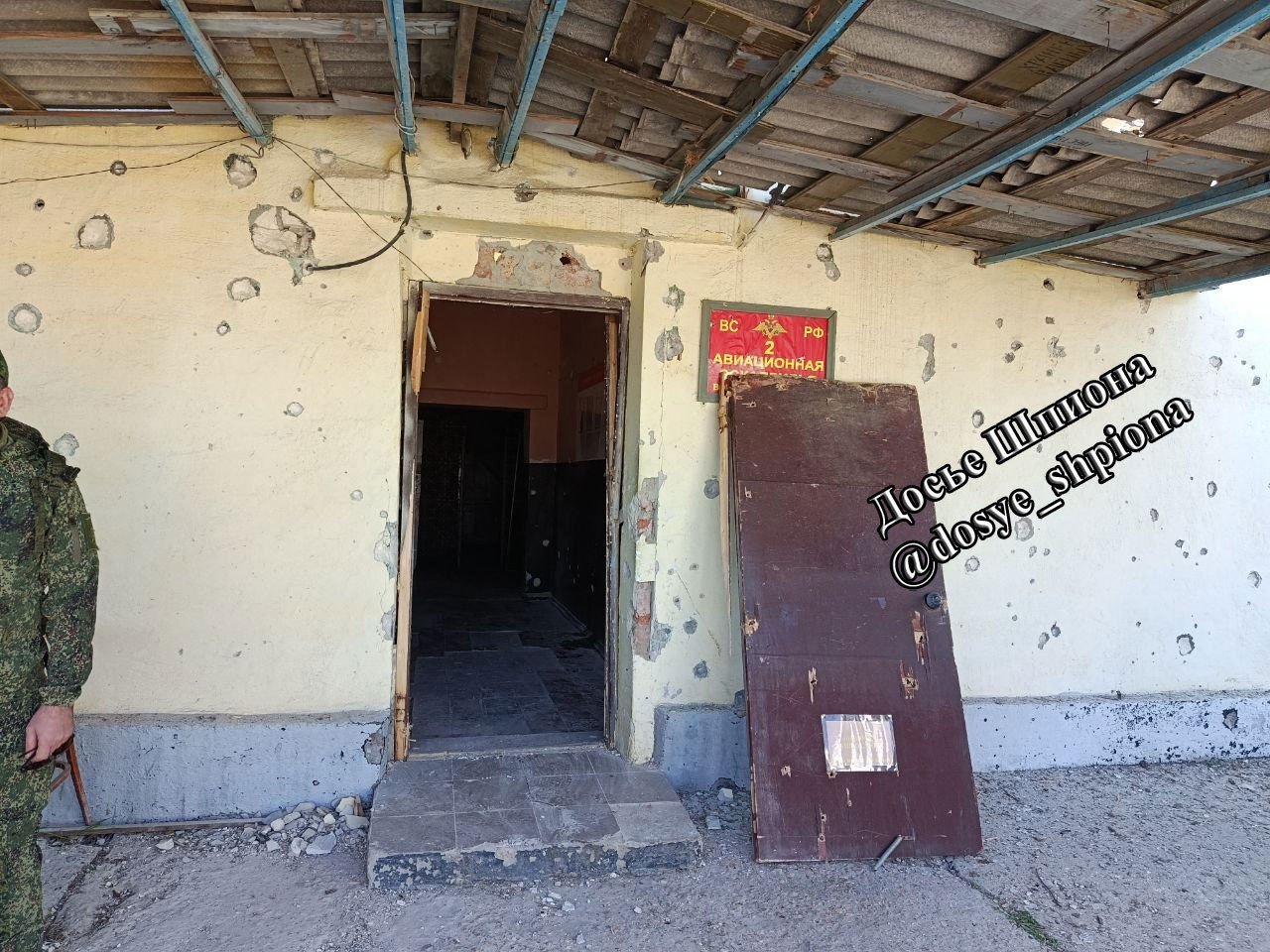
Damaged building at Belbek air base following the 16-17 May 2026 strike. Infrastructure damage across the base extended beyond the radar complex. Photo: Dosye Shpiona / Telegram.
Security Service of Ukraine, Press Statement via Ukrainska Pravda, 17 May 2026
“Infrastructure and air defence assets at the Belbek military airfield in temporarily occupied Crimea were struck, particularly: a Pantsir-S2 anti-aircraft missile system, a storage facility containing radar equipment for an S-400 system, an Orion UAV control system and a ground control station for Forpost UAVs, a ground-to-air data transmission point, the air traffic control tower and a hangar at Belbek airfield.”
🟢 The Dosye Shpiona Imagery
Post-Strike Photographs Published 20 May Show Damage to Two Specific RSP-28ME Components
The Dosye Shpiona Telegram channel, which has a consistent record of publishing post-strike imagery from occupied Crimea that has subsequently been confirmed against SBU statements and commercial satellite analysis, published photographs on 20 May 2026 captioned as showing the aftermath of the strike on Belbek. The images show damage to at least two RSP-28ME components: the DRL-27SE air traffic control radar module, which is the survey radar element responsible for tracking all aircraft in the airfield’s control zone, and the command module mounted on a KamAZ-6350 heavy-duty military truck. The KamAZ-6350 is the mobility platform for the RSP-28ME’s command and control element, providing the power generation and processing infrastructure through which radar data is processed and transmitted to controllers.
⚠ SINGLE-SOURCE: RSP-28ME COMPONENT ID
The specific identification of damaged components as RSP-28ME elements of the DRL-27SE and KamAZ-6350 type rests on the Dosye Shpiona imagery and the United24 Media report at this stage. Strategy Battles has not independently located satellite imagery of the 16-17 May strike area at Belbek that would permit independent equipment identification. The SBU statement confirms a strike on Belbek’s radar infrastructure on the same night, which is consistent with the Dosye Shpiona imagery, but the SBU does not name the RSP-28ME specifically in its published statement.
The RSP-28ME complex also includes a PRL-27SE or PRL-27SM precision landing radar module, an automatic radio direction finder, and a diesel power station in addition to the components shown as damaged. Whether these were also struck is not established from the published imagery. Russia introduced the RSP-28ME to service in 2021 as a modernised successor to the Cold War-era RSP-6M2 series, which used broadly similar architecture. The crew requirement of three operators means the system is not simply a piece of hardware: destroying it also removes trained specialists from the Belbek establishment, whether through casualties or the operational disruption of retraining and redeployment.
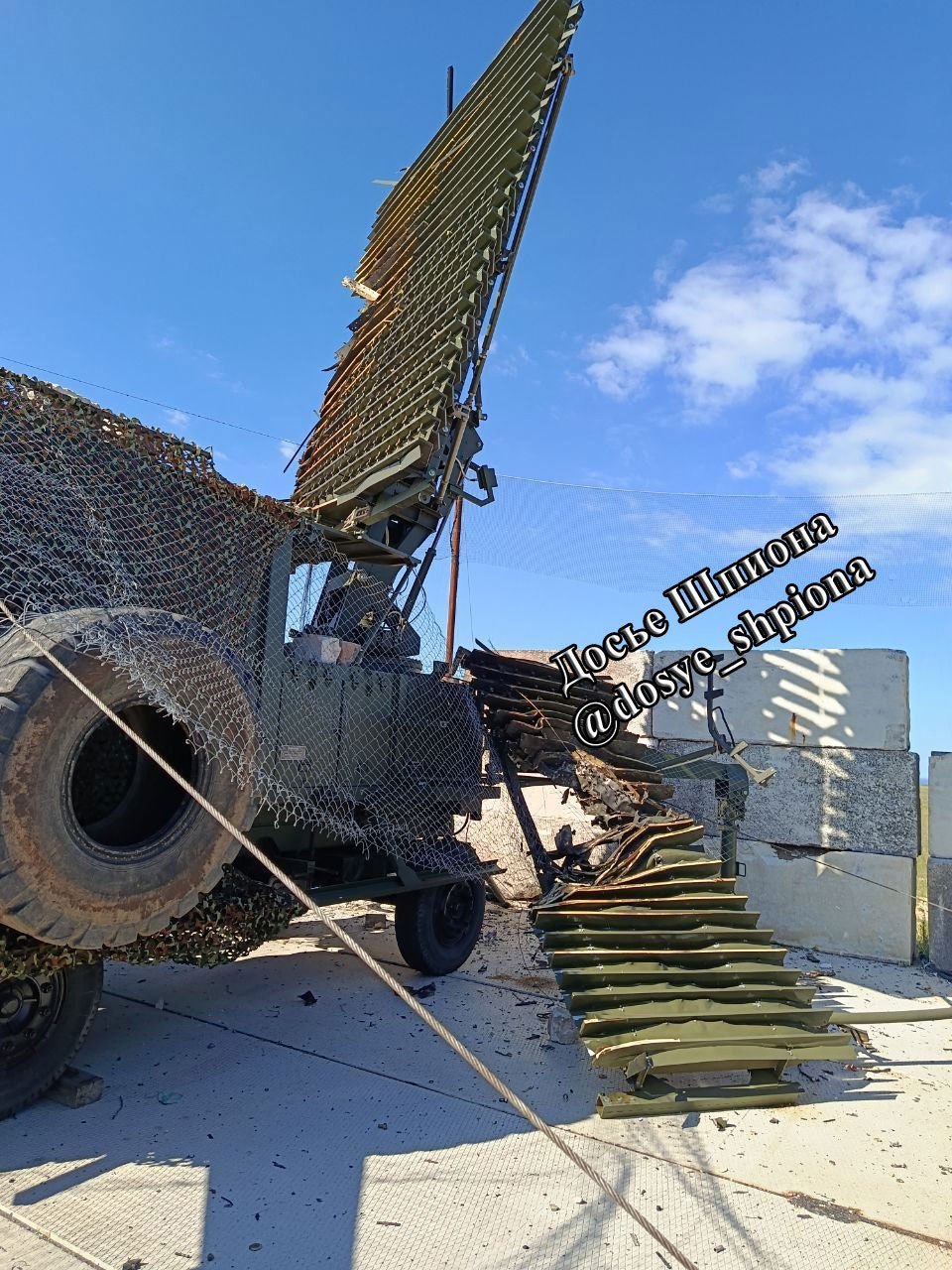
Damaged radar element of the RSP-28ME landing system at Belbek. The DRL-27SE dispatch radar module requires a clear overhead field to function, creating an inherent vulnerability no netting structure can fully mitigate. Photo: Dosye Shpiona / Telegram.
Source Reliability Matrix
NATO grading: REL A (reliable) to F (unreliable). CRED 1 (confirmed) to 6 (cannot judge).
CRED 2
Primary official source confirming the 16-17 May Belbek strike. Carries institutional credibility but an interested-party posture; SBU statements on specific targets have a strong track record of subsequent satellite confirmation in this campaign.
CRED 1
Established Ukrainian outlet, direct SBU statement. Corroborated by New Voice of Ukraine, Charter97 and online.ua on the same day with consistent target list.
CRED 2
Ukrainian outlet relaying Telegram imagery from a channel with a consistent record on Crimea strike documentation. The RSP-28ME identification is the specific element requiring independent satellite confirmation.
CRED 2
Telegram channel. Not wire-corroborated at time of writing for the specific RSP-28ME identification. Equipment identification rests on visual analysis of the published imagery. Flagged single-source on the RSP-28ME component detail.
CRED 2
Established outlet, analytical piece on the combined 16-17 May operation covering both Moscow Oblast and Belbek elements. Adds context on the SBU Alpha unit’s coordination and the Angstrem plant significance.
Strategy Battles Assessment
Ukraine is not trying to destroy Belbek in a single raid. It is methodically disabling the base’s ability to operate combat aircraft safely, one sensor and control system at a time.
✓ What We Know
The 16-17 May 2026 operation involved over 600 Ukrainian drones and struck nine targets across Moscow Oblast and occupied Crimea. At Belbek, the SBU confirmed hits on a Pantsir-S2, an S-400 radar storage hangar, Orion and Forpost UAV ground control stations, the air traffic control tower, and a hangar. Post-strike imagery from Dosye Shpiona, published 20 May, shows damage to the RSP-28ME landing radar complex including the DRL-27SE dispatch module and the KamAZ-6350 command module. Belbek has been struck at least five times in a sustained campaign dating to December 2025. In that period it has lost, at minimum: two Nebo-SVU long-range radars, an S-400 92N6 radar, two Pantsir systems, two Su-27 fighters, at least one MiG-31, the air traffic control tower, UAV control infrastructure, and now the precision-approach landing radar.
? What We Do Not Know
Whether satellite imagery confirming the RSP-28ME damage extent will be publicly released in the near term. Whether Russia has replacement RSP-28ME components in theatre or the supply chain to re-equip Belbek within weeks. Whether the 38th Fighter Aviation Regiment has relocated any remaining aircraft to alternate dispersal airfields in response to the strike sequence. Whether the cumulative damage to Belbek’s sensor and control infrastructure has yet crossed the threshold at which the base’s aviation element is effectively non-operational for combat sorties.
☉ What To Watch
Commercial satellite imagery of Belbek’s apron and radar complex areas in the coming days for evidence of Russian reconstruction, aircraft dispersal, or continued damage. Any Russian announcement of enhanced point-defence measures at Crimean military installations, which would signal Moscow acknowledges the current passive protection has failed. Whether the next Belbek-targeted Ukrainian operation shifts from radar and control systems to the runway itself or hardened aircraft shelters, indicating a shift in campaign phase from degradation of sensors to degradation of sortie capacity. Whether Kyiv publicly attributes the RSP-28ME loss to the SBU, which would upgrade the current single-source identification to confirmed attribution.
Sources
- Ukraine Strikes Russia’s High-Tech RSP-28ME Airfield Radar System at Belbek Air Base, United24 Media, Ivan Khomenko, 20 May 2026
- Ukraine’s Security Service Reports Strikes on Nine Locations in Moscow Oblast and Crimea, Ukrainska Pravda, Roman Petrenko, 17 May 2026
- Ukraine Says Belbek Airbase and Moscow-Region Facilities Struck, New Voice of Ukraine, 17 May 2026
- SBU and Ukrainian Defense Forces Hit Belbek Military Airfield in Crimea, Charter’97, 17 May 2026
- Deep Infiltration: SBU Pierces Moscow Air Defenses to Hit Semiconductor Plant and Belbek Airfield, Kyiv Post, 17 May 2026
Editorial Verification
The 16-17 May 2026 Belbek strike is confirmed by the SBU press statement (17 May) as reported by Ukrainska Pravda, New Voice of Ukraine, Charter97, and online.ua, with a consistent target list across all four outlets: Pantsir-S2, S-400 radar hangar, Orion and Forpost UAV ground stations, air traffic control tower, hangar. This element of the article is multi-source confirmed (four independent outlets citing the same SBU statement) and treated as high confidence. The RSP-28ME damage specifically, including the identification of the DRL-27SE module and the KamAZ-6350 command truck, derives from Dosye Shpiona imagery published 20 May and reported by United24 Media the same day. This specific equipment identification is flagged as single-source in the OSINT badge and in the article body; it is consistent with the SBU’s confirmed radar and infrastructure strikes on the same night, but the equipment type has not been independently corroborated by a second source or satellite imagery at time of publication. The 600-drone figure and the nine-target count are sourced to the SBU and Defence Forces statement and corroborated by Kyiv Post and online.ua. Historical Belbek strike data (December 2025 to April 2026) is sourced to Defence Blog, Kyiv Post, Kyiv Independent, and intent.press, with satellite confirmation from separate commercial imagery reporting.
MGRS datum: WGS84 / UTM Zone: 36T / Cross-check reference: Sevastopol city centre 36T WK 55428 29921, approximately 12km south-southwest of Belbek air base.
No satellite imagery was used in this report. The Belbek air base MGRS coordinate (36T WK 59820 35491) is derived from open-source geodata at the known airfield location and should be treated as an approximate reference point for the base perimeter rather than a precise strike coordinate.
All claims independently attributed and verified to open sources where possible.
Approved for Publication
Marcus V. Thorne
Lead Editor, Strategy Battles
FILE SB-2026-0520-781102101 // CLEARED
©StrategyBattles.net 2026
This article is for news and analysis purposes only. Based on publicly available news sources and military updates. All rights reserved. Not for commercial reuse without permission.