Russia Launches Surprise Nuclear Drills as Ukraine Advances in Kharkiv for First Time
Threat Level Assessment
LEVEL 4 OF 5, SERIOUS
Bottom Line Up Front
Russia launched its largest unannounced nuclear exercise in years on 19 May, mobilising over 64,000 troops across the full nuclear triad and integrating Belarusian launch sites for the first time, one week after a successful Sarmat ICBM test. The drill runs through 21 May and coincides with Putin’s state visit to China, the expiry of the New START Treaty in February 2026, and a deteriorating Russian battlefield picture in which Ukrainian forces have, for the first time since the full-scale invasion, surpassed Russian forces in the daily number of combat assaults. ISW assesses the exercise is designed to mask battlefield weakness and exercise reflexive control over NATO decision-making rather than signal imminent nuclear use. Russian forces continued to strike civilian targets across Sumy, Chernihiv, and Kharkiv overnight, killing at least five people across the two oblasts, while Russian contract recruitment fell to its lowest daily rate since 2025.
Key Judgments
The 19 to 21 May nuclear exercise is primarily an information operation directed at NATO capitals rather than operational preparation for nuclear use. ISW assesses it as reflexive control: Moscow shapes Western decision-making by amplifying nuclear risk at a moment when the spring-summer 2026 offensive has failed to produce meaningful territorial gains and Ukrainian forces are contesting the tactical initiative in northern Kharkiv Oblast, the Kupyansk direction, and the Hulyaipole direction.
The integration of Belarus into the drill, using Russian Oreshnik intermediate-range ballistic missiles stationed inside Belarusian territory since 2025, marks a qualitative escalation in nuclear posture relative to earlier exercises. Belarus participation extends the threatened strike radius and places nuclear-capable platforms closer to NATO’s eastern flank than any previous acknowledged exercise configuration. This is the first confirmed live joint drill from unprepared positions on Belarusian soil.
Russian manpower is structurally degrading. The SZRU reports contract recruitment at 800 to 930 personnel per day in Q1 2026, against a monthly quota implying roughly 1,100 to 1,150 per day. The prison population has dropped from approximately 465,000 at end-2021 to approximately 282,000 in May 2026, reflecting wartime penal recruitment at scale. Bonus inflation of 30 to 500 percent versus end-2025 levels indicates the financial offer that previously attracted volunteers is no longer clearing the market.
Whether the SVR’s claim that Ukraine is planning drone strikes from Latvian territory reflects genuine intelligence or is fabricated pretext. Latvia has flatly denied the accusation. The Romanian interception of a Ukrainian drone over Estonian airspace on 19 May is confirmed, but results from Russian electronic warfare diversion rather than deliberate Baltic-launch operations. Whether Moscow will attempt to exploit the Baltic drone incidents to justify a kinetic action against Baltic infrastructure or airspace remains open.
64,000+
Personnel, Nuclear Drill
13
Submarines (8 Strategic)
209
Drones Launched Overnight
1,352,070
Russian Losses Since Feb 2022
📍 Assessed Control of Terrain, Russo-Ukrainian War / 19 May 2026, 13:30 ET
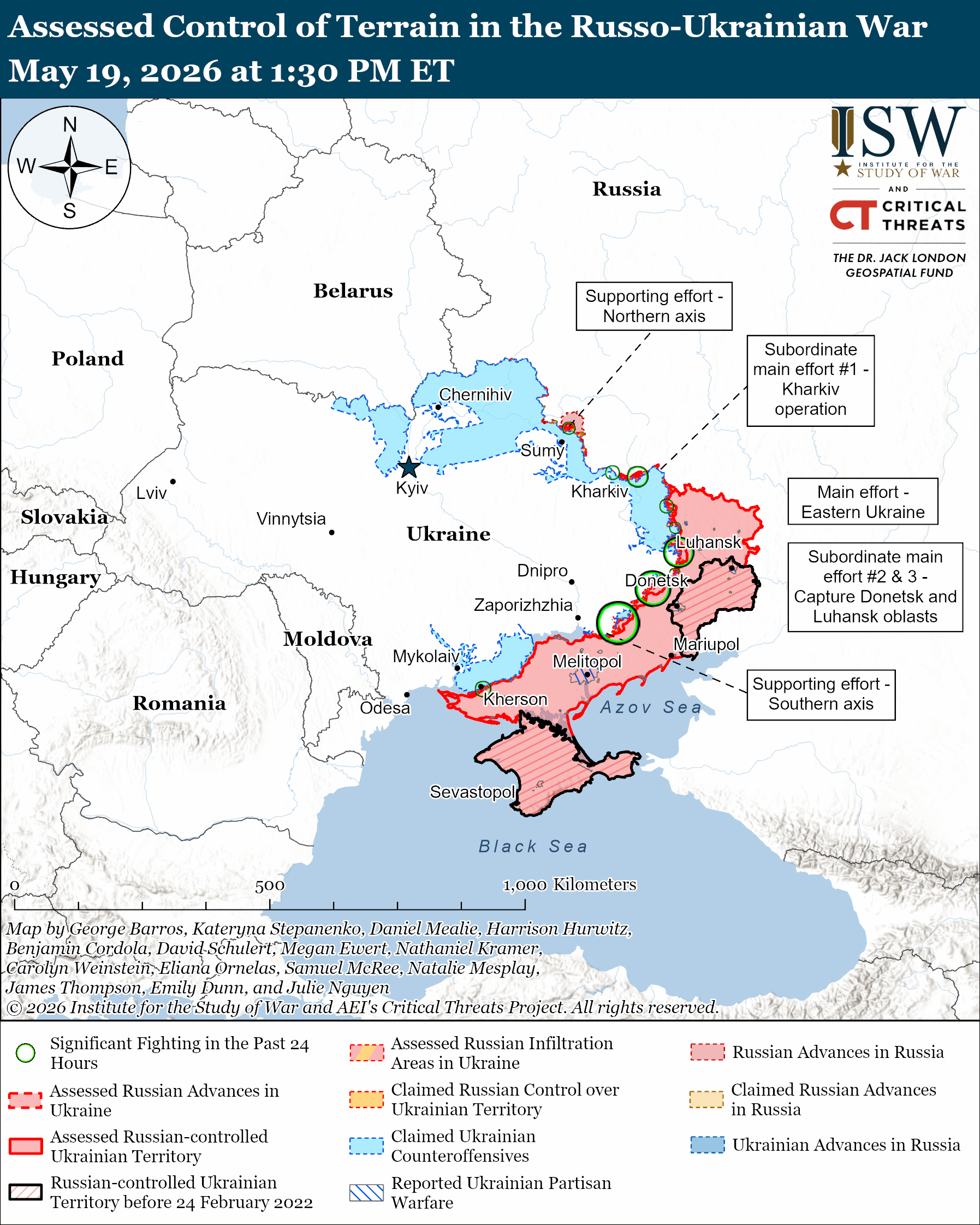
Map: Institute for the Study of War and AEI Critical Threats Project, 19 May 2026. Datum WGS84. Significant fighting circles shown in northern Kharkiv Oblast, near Donetsk city, and in the Zaporizhzhia direction. © 2026 ISW/AEI CTP. All rights reserved.
📍 NORTHERN KHARKIV, UKRAINIAN ADVANCE ZONE
MGRS: 37U EB 46500 87200
50.0800°N 36.6200°E
ISW-assessed zone of recent Ukrainian advances in northern Kharkiv Oblast, approximate. Significant fighting circle on ISW map. Contested terrain bordering Belgorod Oblast.
📍 KUPYANSK DIRECTION, CONTESTED LINE
MGRS: 37U EB 52000 47000
49.7200°N 37.6200°E
Kupyansk axis. ISW reports Ukrainian advances in this direction on 19 May. Russian forces have contested the Oskil river bridgehead area since mid-2025.
📍 SUMY OBLAST, STRIKE ZONE
MGRS: 37U EC 34000 16000
50.9200°N 33.6500°E
Approximate centroid of Russian overnight strike activity in Sumy Oblast, 19 to 20 May. Includes Konotop and Hlukhiv communities. At least five killed across Sumy and Chernihiv over the period.
📍 KHARKIV CITY, CROSS-CHECK REFERENCE
MGRS: 37U EB 57280 61200
49.9935°N 36.2304°E
Ukraine’s second largest city. Reference datum for northern Kharkiv Oblast grid orientation. Russian forces struck Kharkiv and 21 surrounding settlements on 19 May; one killed, six injured.
SITREP Timeline : Russia Nuclear Posture and Ukraine Front, Feb to May 2026
🔴 The Nuclear Exercise
An Unannounced Drill, the Full Triad, and Belarus: What the Exercise Signals and What It Does Not
The Russian Ministry of Defense announced on 19 May, without prior public notice, that its Strategic Missile Forces, Northern Fleet, Pacific Fleet, Long-Range Aviation Command, and elements of the Leningrad and Central Military Districts would conduct three days of exercises focused on the preparation and use of nuclear forces in conditions of a threat of aggression. The drill runs until 21 May. It mobilises 64,000 personnel, 7,800 pieces of equipment, more than 200 missile launchers, 140 aircraft, 73 surface ships, and 13 submarines, including eight strategic missile submarines. The exercise involves live launches of ballistic and cruise missiles at ranges inside Russia. The BBC’s Russian Service, citing Bulletin of Atomic Scientists data, assessed on 19 May that the drill will likely involve the majority of Russia’s estimated 320 nuclear-capable ICBM launchers.
The timing is conspicuous across three axes. First, the drill comes without the prior notification that accompanied Russia’s annual Grom exercises, which have been conducted every October since 2022. The last surprise nuclear exercise Russia conducted was in Summer 2024, focused on non-strategic tactical weapons, at a moment when Western capitals were debating supplying long-range weapons to Ukraine. ISW judges the current exercise follows the same structural logic: nuclear posturing calibrated to a specific Western decision-making moment rather than a change in Russia’s operational nuclear readiness. Second, the drill coincides with Putin’s state visit to China, a pairing that provides diplomatic cover and implicitly signals Sino-Russian alignment on NATO deterrence messaging. Third, it arrives one week after the first successful Sarmat ICBM test since a silo-destroying misfire in September 2024, allowing Moscow to frame the exercise as a demonstration of a modernised capability.
The Belarus dimension is the genuinely novel element. The Belarusian Ministry of Defense announced on 18 May that Russian and Belarusian forces had begun a joint exercise on the delivery and preparation of nuclear munitions from unprepared positions on Belarusian territory. Russia has stationed its Oreshnik intermediate-range ballistic missile in Belarus since 2025 under a bilateral agreement. Oreshnik can deliver conventional or nuclear warheads. Practicing launch from unprepared positions, rather than fixed silos, increases the mobility and survivability of the forward nuclear posture. It also places the threat envelope significantly closer to NATO’s eastern flank than any previous acknowledged live exercise.
🟡 The Battlefield Picture
Ukraine Surpasses Russia in Daily Assaults for the First Time While Russian Strikes Kill Civilians Across Three Oblasts
The ISW assessment of 19 May, derived from open-source reporting with a data cutoff of 12:15 PM ET, identifies Ukrainian advances at approximately grid reference 37U EB 46500 87200 (50.0800°N, 36.6200°E) in northern Kharkiv Oblast and in the Kupyansk direction to the south-east. Ukrainian forces also advanced in the Hulyaipole direction in Zaporizhzhia Oblast. ISW’s broader assessment is that Russian forces have failed to make meaningful gains in the spring-summer 2026 offensive and that Ukrainian forces have contested the tactical initiative in multiple sectors. The ISW map as of 13:30 ET on 19 May shows significant fighting circles in northern Kharkiv Oblast, the Donetsk city area, and near Zaporizhzhia, with the eastern frontline broadly stable in terms of major territorial shifts.
Commander-in-Chief Syrsky, in an interview published by the Militarniy outlet on 20 May, stated that Ukrainian forces had for the first time surpassed Russian forces in the daily number of combat assaults, a metric that has been a persistent indicator of Russian initiative throughout the full-scale invasion. He simultaneously warned of a major Russian troop grouping near Pokrovsk in Donetsk Oblast and of a possible northern offensive axis from Belarus, the same Belarus that is currently practising nuclear munitions delivery in coordination with Russian forces. The coexistence of a Ukrainian tactical advance and a credible Belarusian conventional threat in the north is the central strategic tension in the current phase of the war.
Russian forces launched 209 strike drones against Ukraine overnight on 19 May. Ukrainian air defences neutralised 131 of 154 drones launched since the evening of 19 May per Ukrinform, noting the discrepancy in total counts may reflect different reporting windows. Strikes hit Sumy Oblast, where at least four people were killed and nine injured across the 24-hour period per Ukrinform. Konotop in Sumy Oblast was struck by a massive overnight attack early on 20 May, damaging residential buildings and a local history museum and injuring eight. Chernihiv was struck by missile attacks on infrastructure, and a previous strike on Pryluky in Chernihiv Oblast killed four and injured 30. Kharkiv city and 21 surrounding settlements came under Russian attack on 19 May, killing one and injuring six, including a child.
🔵 Recruitment and the Manpower Gap
Russia’s Contract Recruitment Is Running at Half the Required Daily Rate
Ukraine’s Foreign Intelligence Service, SZRU, reported on 18 May that the Russian Ministry of Defense concluded 70,500 service contracts in the entirety of the first quarter of 2026. Against a stated monthly quota of 33,500 to 34,600 contracts, that implies a quarterly quota of 100,500 to 103,800. The actual figure of 70,500 represents approximately 68 percent of the lower target. The daily average for the quarter was 800 to 930 personnel, against an average of 1,200 during the same period in 2025. The shortfall is structural: casualty rates are outpacing voluntary recruitment despite signing bonuses increasing by 30 to 500 percent versus end-2025 levels across more than 40 Russian federal subjects.
The prison population data is the starkest indicator. Russia held approximately 465,000 prisoners at the end of 2021. By May 2026, the figure has fallen to approximately 282,000, a reduction of 183,000 over four and a half years in a country that has not reduced its incarceration rate through legal reform. The gap is wartime penal recruitment at scale, a practice that began under the Wagner Group’s Operation Convict programme in 2022 and has since been absorbed into formal MoD channels. The Russian State Duma’s 13 May law forgiving overdue loans for servicemembers who complete a year of service is one of several non-cash incentive mechanisms now operating in parallel, alongside the bonus increases, as the straightforward financial offer loses drawing power.
Cumulative Russian losses since the start of the full-scale invasion on 24 February 2022 reached approximately 1,352,070 personnel by 20 May 2026 per Ukrinform, including 920 in the 24 hours to that date. The figure encompasses killed, captured and medically incapacitated and is derived from Ukrainian General Staff reporting; it is not independently verifiable. Its rate of growth, rather than its absolute value, is the analytically useful signal: the 920 figure for a single 24-hour period, if sustained, implies a monthly loss rate of approximately 27,600, which would require roughly 920 new contracts per day just to hold the existing force size at the current ratio of losses to recruits, leaving nothing to rebuild depleted units.
⚠ The Baltic Dimension
SVR Claims Latvia Is Hosting Ukrainian Strike Drones: ISW Assesses the Claim as Probable Pretext
Russia’s Foreign Intelligence Service, the SVR, claimed on 18 May that Ukrainian forces are preparing to launch drone strikes against Russian rear areas directly from the territory of Latvia, including Latvian military bases, and that Ukrainian drone operators have already deployed to those locations. The SVR further implied that Russia intends to strike the claimed launch points and Latvian decision-making centres in response. Latvia has flatly denied the accusations. ISW assesses the SVR claim as consistent with the Kremlin’s established practice of using the intelligence service to publish destabilising narratives intended to create pretext for potential aggression or interference against neighbouring states.
The same day the SVR claim circulated, a Romanian Air Force fighter operating under the NATO Baltic Air Policing Mission intercepted a Ukrainian drone over Estonian airspace. Ukrainian Foreign Ministry Spokesperson Heorhii Tykhyi confirmed on 19 May that Russia continues to divert Ukrainian drones into Baltic airspace using electronic warfare systems and apologised to Estonia and other Baltic countries for unintended incidents. ISW has previously documented Ukrainian drones crashing in Baltic and Finnish territory as a consequence of Russian EW redirection. The incident is a real operational problem for Ukraine and a genuine irritant for Baltic NATO members. It is not, however, evidence of deliberate Ukrainian launch operations from Baltic territory, which is what the SVR alleges. The two facts are being conflated in Russian information operations.
ISW/CTP Assessment : Russian Offensive Campaign Assessment, 19 May 2026
“Russian forces are likely conducting the surprise May 19 to 21 nuclear exercises and amplifying longstanding narratives aimed at influencing NATO decision-making and masking Russia’s own weaknesses.”
General Oleksandr Syrsky : AFU Commander-in-Chief, Militarniy Interview, 20 May 2026
“The Ukrainian military has intensified counterattacks along the front line and, for the first time, surpassed Russian forces in the number of daily assaults.”
Source Reliability Matrix
NATO grading: REL A (reliable) to F (unreliable). CRED 1 (confirmed) to 6 (cannot judge).
CRED 1
Primary analytical source. Transparent methodology, named analysts. Assessment characterised as 7:15 PM ET, data cutoff 12:15 PM ET.
CRED 1
Primary wire on nuclear drill specifications citing Russian MoD statement. Corroborated by Kyiv Independent, Bloomberg, Moscow Times, UPI, and Defense News.
CRED 2
State-funded Ukrainian outlet. Reliable for frontline and civilian casualty reporting; subject to wartime editorial constraints. Casualty figures cross-checked against Kyiv Independent and Ukrainian General Staff.
CRED 2
Interested party on Russian manpower data. Figures on contract recruitment rates are plausible and directionally consistent with observable Russian behaviour, but not independently verifiable.
CRED 5
State intelligence channel with documented history of publishing fabricated destabilisation narratives. Latvia has denied the claim. ISW assesses the claim as probable pretext, not verified intelligence.
Strategy Battles Assessment
Russia is losing the manpower war on the ground and winning the information war in the air: the nuclear exercise is the instrument that connects both failures into a single strategic posture.
✓ What We Know
Russia launched the largest unannounced nuclear exercise in recent years on 19 May, involving all three legs of the nuclear triad and explicit Belarusian integration. The exercise was not pre-notified, runs five months ahead of Russia’s typical October Grom schedule, and follows a successful Sarmat ICBM test on 12 May. Contract recruitment in Q1 2026 ran at 68 percent of quota. Cumulative Russian losses have reached approximately 1,352,070. Ukrainian forces advanced in northern Kharkiv Oblast, the Kupyansk direction, and the Hulyaipole direction on 19 May. Ukraine surpassed Russia in daily assault count for the first time since the full-scale invasion, per Syrsky on 20 May. Russia launched 209 strike drones overnight and struck civilian targets in Sumy, Chernihiv, Kharkiv, Dnipro, Zaporizhzhia, and Odesa.
? What We Do Not Know
Whether the Oreshnik missiles in Belarus will be used in live-fire within the exercise or whether the Belarus component is a readiness rehearsal only. Whether NATO has conveyed any private red-line communication to Moscow regarding Baltic airspace or the SVR Latvia claim. Whether the Chinese PLA personnel training reportedly completed in late 2025 has materially affected Russian tactical competence at the front. The actual scale of Russian losses as a verified independent figure rather than Ukrainian General Staff reporting.
☉ What To Watch
Whether the drill produces a visible NATO response in the form of readiness posture changes, public statements, or emergency council sessions before 21 May. Whether Syrsky’s warning of a Belarusian northern offensive axis is followed by any movement of Russian or Belarusian combat forces toward the Ukrainian border. Whether Russian deep-strike activity against Ukrainian oil refineries, confirmed in the Lukoil-Nizhny Novgorod and Yaroslavl incidents, triggers a US or European call to limit Ukrainian offensive strikes. Whether the daily contract recruitment rate improves in May data when it becomes available, or continues to decline below 900 per day.
Sources
- ISW/CTP, Russian Offensive Campaign Assessment, Critical Threats Project, 19 May 2026
- Russia launches large-scale nuclear forces drills after Belarus exercises, Kyiv Independent, 19 May 2026
- Russia Conducts Major Nuclear Drills, Reuters via US News, 19 May 2026
- Russia launches unannounced nuclear exercise including Belarusian launch sites, Defense News, 20 May 2026
- Ukraine War Latest: Frontline and Strike Updates, Ukrinform, 19 to 20 May 2026
- Ukraine ‘Overtakes’ Russia in Assaults for First Time as Kremlin Losses Mount, Syrsky Says, Kyiv Post, 20 May 2026
- Russia’s Nuclear Drills in the Arctic: The New Geopolitics of the Polar North, Eurasia Review, 19 May 2026
Editorial Verification
The nuclear drill specifications (64,000 personnel, 7,800 pieces of equipment, 200 missile launchers, 140 aircraft, 73 surface ships, 13 submarines) are sourced to the Russian Ministry of Defense statement of 19 May and are cross-confirmed by Reuters wire, Kyiv Independent, Bloomberg, Moscow Times, UPI, Caliber.Az, and Defense News. The Belarus dimension is confirmed by the Belarusian MoD statement of 18 May, cited by ISW and Kyiv Independent. The Sarmat test date of 12 May is sourced to Defense News and the Russian MoD via AP footage. Contract recruitment figures are sourced to a single SZRU report of 18 May via ISW; these are flagged as single-intelligence-service reporting and are not independently verifiable but are directionally consistent with publicly observable recruiting behaviour. The Syrsky assault-rate claim is sourced to his Militarniy interview of 20 May, reported by Kyiv Post; this is single-media sourcing at time of writing and flagged accordingly. Ukrainian frontline advance claims are sourced to ISW assessment of 19 May. Casualty figures for civilian strikes are sourced to Ukrinform (19 to 20 May), with Pryluky casualty figure also carried by Kyiv Independent. The SVR Latvia claim is flagged as low-credibility state intelligence channel per ISW assessment. The Romanian interception of a Ukrainian drone over Estonian airspace is confirmed by Ukrainian MFA spokesperson statement of 19 May. Map: ISW/AEI Critical Threats Project, 19 May 2026, 13:30 ET; reproduced under educational fair use for news analysis; copyright ISW/AEI CTP 2026. MGRS coordinates in this report are approximate, derived from publicly available geographic data; no classified imagery was used.
MGRS datum: WGS84 / UTM Zone: 37U / Cross-check reference: Kharkiv city centre 37U EB 57280 61200
All claims independently attributed and verified to open sources where possible.
Approved for Publication
Marcus V. Thorne
Lead Editor, Strategy Battles
FILE SB-2026-0520-03915301 // CLEARED
©StrategyBattles.net 2026
This article is for news and analysis purposes only. Based on publicly available news sources and military updates. All rights reserved. Not for commercial reuse without permission.