Car Bomb Kills Syrian Soldier Outside Damascus Armament Headquarters; No Group Claims Attack
Threat Level Assessment
LEVEL 3 OF 5, DEVELOPING
Bottom Line Up Front
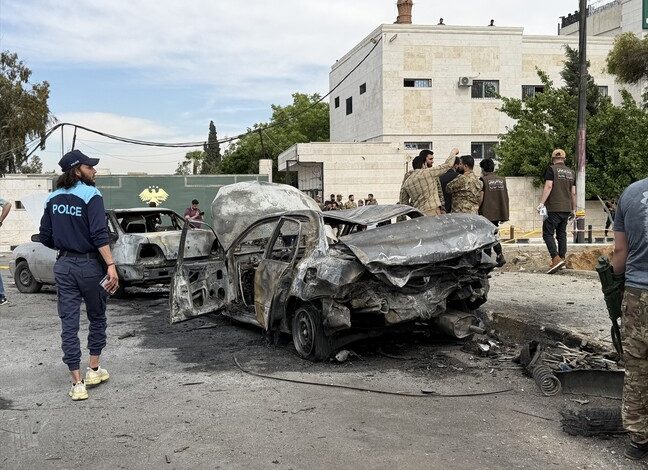
A car bomb detonated outside the Armament Administration headquarters in the Bab Sharqi district of Damascus on Tuesday 19 May, killing one Syrian soldier and wounding between 18 and 21 others according to diverging official figures. The attack involved a double-device tactic: soldiers had found and were attempting to disarm a separately planted improvised explosive device at the same site when the vehicle bomb detonated near the front gate. No group has claimed responsibility. The strike on a Syrian Defense Ministry facility in central Damascus follows a car bomb that killed five soldiers in Mayadin, eastern Syria, the previous day, and fits a broader pattern of targeted attacks on the new government that implicates at minimum three distinct threat actors currently operating in Syria.
Key Judgments
The double-device methodology indicates a cell with prior surveillance of the facility, not a lone-actor or opportunistic attack. Detonating a vehicle bomb while an EOD unit is responding to a separately planted IED is a deliberate tactic designed to kill first-responders and maximise confusion at the site. This requires pre-positioned personnel and knowledge of security patrol patterns at the Armament Administration compound.
A Hezbollah-linked network or Assad loyalist remnant cell is a more probable actor in central Damascus than Islamic State. Syrian authorities dismantled multiple Hezbollah-linked cells between February and April 2026 that were specifically planning explosive device attacks in and around the capital. ISIS has been concentrating its 2026 operations in eastern Syria: Deir ez-Zor, Raqqa, and Mayadin. A simultaneous ISIS operation in both Mayadin and central Damascus on consecutive days cannot be ruled out, but the profile difference is notable.
Whether the timing of this attack relative to the recent Trump-Sharaa meeting in Riyadh is operationally significant. External actors seeking to destabilise the new Syrian government have motive to strike shortly after a high-profile diplomatic gain by Damascus. Iranian-aligned networks have been assessed by Syrian analysts as potentially mobilising dormant cells to portray the Sharaa government as incapable of maintaining security. This remains speculative without a claim or forensic evidence.
1
Soldier Killed
18-21
Wounded (Sources Vary)
2
Devices Deployed
0
Claims of Responsibility
📍 Damascus, Syria / Car Bomb Site and Context Locations / 19 May 2026

Car bomb detonation site (red), cross-check reference Umayyad Mosque (blue), prior security incident Sayyida Zaynab shrine May 2026 (amber). Datum WGS84, UTM Zone 37S. Map: Strategy Battles / OSINT.
📍 CAR BOMB SITE, BAB SHARQI, DAMASCUS
MGRS: 37S BT 50550 11112
33.5105°N 36.3145°E
Approximate point. Armament Administration (Weapons Directorate) headquarters, eastern Damascus. Car bomb detonated at front gate, 19 May 2026. One soldier killed, up to 21 wounded. Exact coordinates not disclosed.
📍 UMAYYAD MOSQUE, DAMASCUS OLD CITY
MGRS: 37S BT 49781 11232
33.5114°N 36.3062°E
Cross-check reference landmark, Damascus city centre. Approximately 750m west of the car bomb site. Used for MGRS grid orientation and spatial verification.
📍 SAYYIDA ZAYNAB SHRINE, SOUTH DAMASCUS
MGRS: 37S BT 50115 04020
33.4465°N 36.3118°E
Site of prior security incident, May 2026. Syrian Shiite cleric Farhan al-Mansour killed by grenade blast. Approximately 7km south of the 19 May car bomb site.
📍 DAMASCUS INTERNATIONAL AIRPORT
MGRS: 37S BS 68962 99655
33.4114°N 36.5155°E
Wider context reference. Site of Mezzeh-area cell arrests February 2026. Approximately 19km southeast of the 19 May car bomb site. Referenced in prior Damascus security operations.
SITREP Timeline : Damascus and Syria Internal Security, Dec 2024 to May 2026
🔴 The Attack
A Car Bomb at the Armament Headquarters Gate, and a Second Device Already on the Ground
At grid reference 37S BT 50550 11112 (33.5105°N, 36.3145°E), in the Bab Sharqi district of eastern Damascus near the edge of the Old City, a car bomb detonated outside the Armament Administration headquarters on the afternoon of Tuesday 19 May. The Syrian Defense Ministry confirmed the strike in a statement carried by the state news agency SANA, saying one soldier was killed. Syria’s Health Ministry official Dr. Najib al-Naasan told SANA that 21 people had been transferred to nearby hospitals. Reuters, reporting separately through security sources and carried by Arab News, put the wounded figure at 18. The discrepancy likely reflects a reporting lag between the initial Defense Ministry statement and subsequent Health Ministry tally updates.
The sequence of events, as reported by multiple outlets, reveals a deliberate compound attack. A Syrian army unit had discovered an improvised explosive device planted near the building and was in the process of dismantling it when a separately planted vehicle bomb detonated nearby. A Reuters military source described the car bomb as having been planted inside the vehicle and detonated near the front gate of the facility. This is a find-fix-finish inversion: the planted IED functions as bait, drawing security personnel to a known point, and the vehicle bomb detonates against the cluster of responders. An AFP correspondent present near the scene reported seeing a vehicle on fire and security forces cordon off the area.
The Syrian Observatory for Human Rights, reporting from London, independently confirmed the explosion occurred near the entrance of the Armament Administration headquarters in eastern Damascus, a detail corroborated by Al Ekhbariya state television and Xinhua correspondents who quoted eyewitnesses describing a blast heard across several districts. Gunfire was reported in the vicinity of Bab Sharqi following the explosion, per Xinhua. No group had claimed responsibility for the attack at the time of writing.
🟡 The Threat Landscape
Three Distinct Actor Categories, One Unclaimed Strike, and a Government Tracking All of Them Simultaneously
Since the fall of the Assad government in December 2024, Syrian authorities have been managing at least three distinct categories of threat against the new state. Islamic State retains sleeper cells concentrated in eastern Syria and the central desert, which it has used to conduct ambushes, checkpoint attacks, and now, per the 18 May Mayadin strike, car bombings in government-held territory east of the Euphrates. Assad loyalist networks, particularly the shadowy “Saraya al-Jawad” group operating along the Latakia coast, have attacked security positions in the Alawite-majority west. And Hezbollah-linked cells, described by Syrian authorities in successive statements from February through April 2026, have been planning explosive device attacks and assassination attempts specifically inside Damascus.
It is the Hezbollah-linked threat profile that most closely matches the geographic signature of the 19 May attack. The cells arrested in April were specifically documented planning to place explosives near religious sites in the capital and to fire rockets across the Lebanese border: activities concentrated in and around Damascus, not in the eastern desert. The Armament Administration headquarters is a central government military facility, and the double-device tactic implies operational planning capacity and prior reconnaissance that a low-tier sleeper cell would struggle to execute reliably.
ISIS cannot be excluded. The Washington Institute’s Aaron Zelin noted, writing on the Mayadin attack, that IS is now striking in government-held territory, having previously concentrated on SDF-controlled zones. An IS propaganda newsletter circulating in recent days urged fighters inside Syria to open a “new phase of fighting” against the state. A coordinated escalation on two fronts on consecutive days, Mayadin on 18 May and Damascus on 19 May, would represent a meaningful capability demonstration. The absence of any IS claim within hours of the Damascus attack is, however, atypical: IS habitually claims successful capital strikes rapidly to extract maximum propaganda value.
Syrian Defense Ministry, Media and Communication Directorate : Statement via SANA, 19 May 2026
“A unit of the Syrian Arab Army had discovered an improvised explosive device planted near the site and moved to dismantle it before the blast occurred.”
🔵 The Mayadin Parallel
Back-to-Back Car Bombs in Two Governorates Raise the Question of Coordination
The Mayadin car bomb of 18 May killed five Syrian soldiers in Deir ez-Zor province, eastern Syria. The Washington Institute for Near East Policy described it as the first IS strike on the new Syrian government in government-held territory beyond the Euphrates, representing a deliberate geographic escalation by a group that had until recently concentrated its attacks on SDF-controlled zones or isolated desert positions. The institute noted the attack coincided with broader IS activity: Syrian forces clashed with an IS cell in Aleppo the previous day, and the strike followed by less than a week the public announcement that Damascus had formally joined the US-led anti-IS coalition during President Sharaa’s visit to meet President Trump in Riyadh.
The Damascus strike on 19 May follows a different profile. Mayadin is a former IS stronghold territory where the group has known networks and can operate with reduced exposure. Central Damascus, by contrast, is densely surveilled by the new government’s internal security apparatus, which has been running targeted cell-dismantlement operations for months. Getting a vehicle bomb and a separately planted IED into position at a Ministry of Defense compound in the capital requires a level of local intelligence that suggests either long-established pre-positioned infrastructure or a source inside or adjacent to the facility.
Whether the two attacks are coordinated by a single actor, conducted by distinct actors exploiting a moment of elevated security strain, or coincidental in timing is not determinable from current open-source reporting. The Interior Minister’s earlier framing of Syria’s threat environment as comprising both “remnants of the previous regime and ISIL” simultaneously was intended to describe a two-front challenge. The 18 and 19 May attacks suggest the ministry’s framing may be understating the number of fronts.
⚠ The Attribution Problem
No Claim, No Wreckage Catalogue, and a Government With Institutional Reasons to Manage the Narrative
The Syrian Defense Ministry statement on the 19 May attack is notably terse. It confirms the discovery of the IED, confirms the car bomb detonation, and confirms one soldier killed. It does not characterise the attack as terrorism, does not name a suspected group, and does not announce an investigation. SANA’s follow-up reporting through the Health Ministry focuses on the wounded count and hospital transfers. For a government that has, in previous incidents, moved quickly to attribute attacks to Hezbollah-linked cells or Assad loyalist remnants, the absence of even a preliminary framing is significant.
There are structural reasons for caution in the immediate aftermath of a car bomb in a capital city. A premature attribution that later proves wrong carries diplomatic costs, particularly in the current environment where Syria is rebuilding international legitimacy through the Sharaa government’s engagement with Washington, Riyadh, and Ankara. An attribution to IS could be read as underscoring Syria’s counter-terrorism partnership value. An attribution to Hezbollah could complicate the delicate management of Lebanon’s border dynamics. An attribution to Assad loyalists would highlight the continued internal fragility of the new state.
What the Syrian government has not said, as of the time of writing, is as informative as what it has. Open-source post-blast imagery from the site, when it surfaces and is independently verified, may provide indicator data on the vehicle type and explosive signature. A claim of responsibility, if it comes, will arrive through the standard channels: a formal IS communique in al-Naba, a Hezbollah denial, or a SANA attribution statement citing security source findings. Until one of those arrives, the most defensible analytical position is that this is an act of deliberate, pre-planned violence against a Syrian government military facility in the capital, conducted by an unidentified cell with demonstrated technical competence.
Source Reliability Matrix
NATO grading: REL A (reliable) to F (unreliable). CRED 1 (confirmed) to 6 (cannot judge).
CRED 1
Syrian state agency. Reliable on confirmed government statements and official casualty figures; graded B as editorial framing reflects government messaging priorities. Casualty figure (21 wounded) is the most recent and specific.
CRED 2
Primary international wire. Military source on device placement at front gate. Wounded figure (18) is earlier than SANA’s updated 21 and may reflect a pre-update hospital count.
CRED 1
Eyewitness reporter on scene. Confirmed burning vehicle adjacent to Defense Ministry-affiliated building. Single-source for the direct visual observation, but highest physical credibility.
CRED 2
London-based monitoring group with network of in-country sources. Independently confirmed location as Armament Administration headquarters entrance. Useful for geographic corroboration.
CRED 2
Analytical context on IS threat evolution in Syria, Mayadin car bomb, and historical cell patterns. Used for background assessment only, not for primary event facts.
Strategy Battles Assessment
Syria’s capital has now become an active target, and the double-device tactic used on 19 May signals a cell with planning capability that exceeds opportunistic or low-sophistication threat actors.
✓ What We Know
A car bomb detonated at the front gate of the Armament Administration headquarters in the Bab Sharqi district of Damascus on 19 May 2026, killing one Syrian soldier and wounding between 18 and 21 others per official figures. The attack involved a separately planted IED that soldiers were attempting to dismantle at the same site when the vehicle bomb went off. AFP confirmed the scene. SOHR confirmed the facility as the Armament Administration headquarters. No group has claimed the attack. A car bomb in Mayadin, eastern Syria, killed five soldiers the previous day.
? What We Do Not Know
Which actor or cell conducted the attack. Whether the Mayadin and Damascus strikes are coordinated or coincidental. Whether the post-blast gunfire reported by Xinhua reflects a secondary contact engagement or an anxious security response. The final confirmed casualty count: figures range from 18 to 21 wounded across sources. Whether any forensic or intelligence evidence recovered at the scene has been shared with partner services or will produce a rapid attribution by Damascus.
☉ What To Watch
Whether the Syrian Interior Ministry issues an attribution statement or announces arrests in the days following the strike. Whether IS publishes a claim in al-Naba: its absence at the 24-hour mark would meaningfully lower IS probability. Whether Syrian authorities announce further cell dismantlement operations in Damascus, as they did in the weeks following the February and April arrests. Whether the US-Syrian counter-terrorism coordination that reportedly contributed to the January 2025 foiled Sayyida Zaynab plot is activated in response to the 19 May strike. And whether the attack rate in Damascus accelerates: a second capital strike within 30 days would indicate an active, undetected cell rather than a one-off operation.
Sources
- Syrian soldier killed, 18 people wounded by car bomb in Damascus, Reuters / Arab News, 19 May 2026
- Soldier martyred, 21 wounded in car bomb near Defense Ministry building in Damascus, SANA, 19 May 2026
- Car bomb blast in Damascus kills Syrian soldier, The National, 19 May 2026
- Suspected car bomb explodes in Syrian capital Damascus, Al Jazeera, 19 May 2026
- Blast outside a Syrian defense ministry building kills a soldier, wounds 12 people, Washington Post, 19 May 2026
- The Islamic State Attacks the New Syrian Government, Aaron Zelin, Washington Institute for Near East Policy, 2026
- Syria Accuses Hezbollah-Linked Cells of Plotting Attacks, The Media Line, April 2026
Editorial Verification
The car bomb event of 19 May is confirmed by four independent outlets: Reuters (via Arab News and Al Bawaba), SANA (primary government source), The National, and Al Jazeera. An AFP correspondent was physically present near the scene and observed the burning vehicle and security cordon: this is the strongest independent visual confirmation. SOHR independently identified the location as the Armament Administration headquarters entrance in eastern Damascus, corroborated by Al Ekhbariya and Xinhua. The wounded figure discrepancy (18 per Reuters/Arab News versus 21 per SANA Health Ministry official Dr. Najib al-Naasan) is noted explicitly. The 21 figure is used as the most recently reported and most specifically attributed. The 12 figure appearing in Washington Post and some early Reuters versions is assessed as an earlier hospital-count snapshot. Attack attribution remains entirely unresolved: no claim has been published and no forensic evidence has entered open sources. Assessment of threat actor probability is explicitly inferential, based on pattern analysis of prior documented cells and geographic fit. It is flagged purple throughout.
MGRS datum: WGS84 / UTM Zone: 37S / Cross-check reference: Umayyad Mosque, Damascus Old City, 37S BT 49781 11232
No satellite imagery has been used in this report. Coordinates for the Armament Administration HQ are approximate, derived from public reporting of the Bab Sharqi district location and SOHR confirmation of the headquarters site. Exact GPS coordinates have not been disclosed in any open source.
All claims independently attributed and verified to open sources where possible.
Approved for Publication
Marcus V. Thorne
Lead Editor, Strategy Battles
FILE SB-2026-0519-0041646541 // CLEARED
©StrategyBattles.net 2026
This article is for news and analysis purposes only. Based on publicly available news sources and military updates. All rights reserved. Not for commercial reuse without permission.