13
Australians Returning
4 + 9
Women and Children
~7 yrs
Detained at Roj
📍 Roj Camp to Damascus : Australian ISIS-linked families transfer route, 24 April to 6 May 2026

Roj camp departure point and Damascus transit airport. Datum WGS84, UTM Zones 37S and 38S. Map: Strategy Battles / OSINT.
📍 ROJ CAMP, HASAKAH
MGRS: 38S KF 36249 81984
36.8470°N 42.0420°E
Detention facility near Derik in northeast Syria. Departure point for the 13 Australians on 24 to 25 April 2026.
📍 DAMASCUS INTERNATIONAL AIRPORT
MGRS: 37S BS 68972 99655
33.4114°N 36.5156°E
First confirmed transit point. Reuters and AP report onward flights to Australia were booked from here on 6 May 2026.
🔴 The Announcement
Australia confirms 13 ISIS-linked nationals returning without state assistance
Australia announced on 6 May 2026 that 13 of its citizens detained in northeast Syria over alleged ties to the Islamic State group are travelling home with no support from Canberra. The cohort departed Roj camp at grid reference 38S KF 36249 81984 (36.8470°N, 42.0420°E) in Hasakah governorate on 24 to 25 April and was transported by Syrian interior forces to Damascus International Airport, where flights to Australia have now been booked according to Reuters, AP, and Australia’s national broadcaster.
Home Affairs Minister Tony Burke, addressing reporters in Canberra, said the federal government would not facilitate the return and acknowledged that constitutional limits constrain its ability to block citizens at the border. Burke said the cohort had made an appalling and disgraceful decision and added that any returnee suspected of criminal conduct would face the full force of the law without exception, language consistent across coverage by Reuters, AP, the Jerusalem Post and Al Arabiya.
Australian Federal Police Commissioner Krissy Barrett confirmed that the AFP has been preparing for these scenarios since 2015 under standing investigations into Australians who travelled to the Islamic State so-called caliphate. Barrett indicated some individuals will be arrested on arrival, others will remain under active investigation, and children will be referred to community reintegration and welfare programmes. SBS News reports that AFP investigations into the cohort include potential terrorism offences and crimes against humanity, including allegations of slave trading.
Tony Burke : Australian Home Affairs Minister, Canberra, 6 May 2026
“There are very serious limits on what can be done with respect to preventing a citizen of a country returning to their country.”
🟡 Roj Camp and the Departure
From al-Hasakah detention to Damascus tarmac
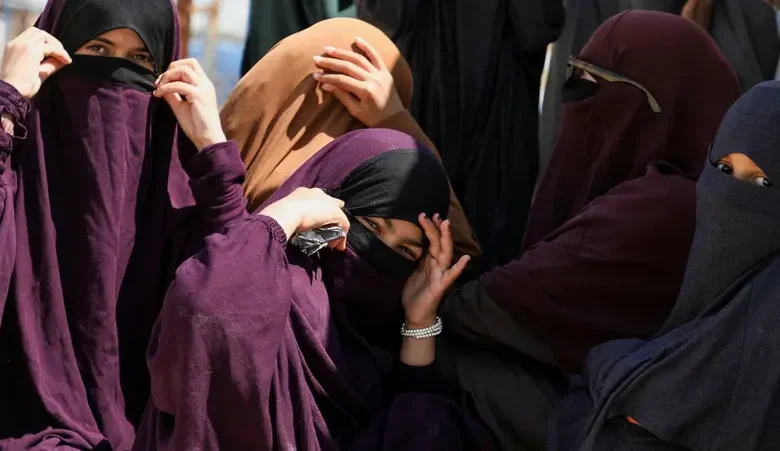
Roj camp sits in al-Hasakah governorate at grid reference 38S KF 36249 81984 (36.8470°N, 42.0420°E), inside territory administered by the Autonomous Administration of North and East Syria. The facility holds thousands of foreign women and children with alleged links to the Islamic State group, including the cohort of Australian families that has lived inside the wire for roughly seven years.
Camp director Hekmiyah Ibrahim, whose name is also rendered as Hakamiyeh Ibrahim in North Press Agency reporting, told SBS Kurdish that the women had hoped to leave for years and described the cohort as overjoyed at the prospect of starting a new life. North Press Agency reported the same day that the camp administration confirmed coordination with the Syrian transitional government to escort the families directly to Damascus, and noted there were no immediate plans for other Australians to follow.
After Syrian interior forces moved the group out of Roj in late April, the families were briefly stranded in Damascus while Australian authorities, the Syrian interim government and the Kurdish-led Autonomous Administration worked through what SBS News described as a coordination breakdown. The Syrian government told the Associated Press during that interval that Canberra had refused to receive them. As of 6 May, the Reuters report carried by Al-Monitor confirms flights have been booked, with arrival expected within days.
🔵 The February Failure
A larger transfer collapsed three months ago
The current departure follows a failed attempt in mid-February 2026, when 34 women and children from 11 Australian families were turned back from the same camp on the same route. Associated Press reporting at the time, carried by NPR, attributed the reversal to procedural problems flagged by Syrian authorities during the road journey toward Damascus. The 34 had also intended to fly out of Damascus airport at grid reference 37S BS 68972 99655 (33.4114°N, 36.5156°E) before the transfer collapsed.
Prime Minister Anthony Albanese reiterated at the time that Canberra would not repatriate the group. AP reporting noted that Australia issued a temporary exclusion order against one woman in the February cohort, using powers introduced in 2019 to prevent high-risk returnees from re-entering for up to two years. The same legal architecture is now in play for the 13 currently in motion, although Burke has not confirmed any active TEO against members of the new group.
Wider context for both the failed February transfer and the May departure includes the transition of camp control from Kurdish-led Syrian Democratic Forces toward the Damascus-based interim government. SBS News reports the United States announced earlier this year it would pull back support for the Kurds, accelerating the handover. The April departure was the first major movement under the new arrangement and offers a baseline for how future transfers will be coordinated between Damascus, the Autonomous Administration and foreign governments whose nationals remain held in the camps.
⚠ Returnee Profile and Investigations
AFP signals charges where evidence supports them
Public reporting describes the cohort as women who travelled to Syria between 2012 and 2016 to join husbands who allegedly became Islamic State members, plus children who in many cases were born inside the camps or arrived as infants. Hekmiyah Ibrahim’s account to SBS Kurdish stresses that several of the children were one, four or five years old when first detained, and have known little of life outside the wire.
On the prosecution side, Commissioner Barrett’s statement points to charges that may include terrorism offences under the Foreign Incursions and Recruitment regime in force from 2014 to 2017. That law made unauthorised travel to areas controlled by the Islamic State group, notably al-Raqqa province, an offence carrying a maximum penalty of ten years. The AFP framing suggests case-by-case assessment rather than blanket arrest, with intelligence files dating back more than a decade now being matched to faces stepping off the plane.
Two earlier government-assisted repatriations form the precedent set against this self-funded return. In October 2022, four mothers and 13 children were brought back. In 2019, eight children of two Australians killed inside the caliphate were repatriated under the previous Coalition government. The new departure is therefore the first significant Australian movement out of Roj since the 2022 operation and the first to occur without any Canberra-led extraction, with the families effectively buying their own seats on commercial flights.
Strategy Battles Assessment
A test case for the post-AANES handover, with Damascus airport now the gravity well for ISIS detainee transit.
The 6 May announcement matters less for the headline number, which is small, than for what it says about who controls foreign-detainee logistics in post-Assad Syria. The fact that Syrian interior forces, not the Kurdish-led Asayish, were the ones to drive the families to Damascus signals that Roj’s outflow is now routed through the transitional government rather than the Autonomous Administration that has run the camps since 2019. That is a structural shift, and it places Damascus airport at a coordinate, 37S BS 68972 99655, that other foreign capitals will study closely as their own nationals queue for the same exit.
For Canberra, the political calculus is sharper than the legal one. Burke’s framing, that there are very serious limits on preventing citizens from returning home, concedes the point that temporary exclusion orders are at best a delay mechanism. The Albanese government has chosen the public position of disowning the cohort while quietly accepting that the AFP, immigration and child-welfare systems will absorb them on landing. The political risk lies less in the four women than in what evidence the AFP can build against them inside Australian courts, and that is a question the public will not see answered for years.
For the broader detention picture, watch what follows. Roj’s camp director told North Press Agency there are no immediate plans for further Australian departures, but the same logistical pathway, Hasakah to Damascus to commercial flight, can be reused for nationals of other Western states whose governments have likewise refused state-led repatriation. With US support for the SDF tapering and Damascus consolidating control over former AANES territory, the next twelve months are likely to see this Roj-to-Damascus corridor become the default route for ISIS-linked foreign families, regardless of which capital is willing to send a plane.
Strategy Battles Related Coverage
Sources
- North Press Agency, “Australia says ISIS-linked citizens in Syria plan to return home”, 6 May 2026
- Reuters via Al-Monitor, “Australia says Islamic State-linked citizens in Syria camp plan to return home”, 6 May 2026
- Associated Press via NPR, “Police say Australian women with alleged IS ties face charges on return from Syria”, 6 May 2026
- SBS News, “Overjoyed: Al-Roj camp official describes Australian IS-linked families’ last days in Syria”, 6 May 2026
- Jerusalem Post, “Australia says Islamic State-linked citizens in Syria camp plan to return home”, 6 May 2026
- Al Arabiya English, “Australia says ISIS-linked citizens in Syria camp plan to return home”, 6 May 2026
- Associated Press via KPBS, “Police say Australian women with alleged IS ties face charges on return from Syria”, 5 to 6 May 2026
- Associated Press via NPR, “Australia won’t repatriate 34 women and children from Syria”, 17 February 2026
- Associated Press via Washington Times, “Australian women with alleged ties face charges on return from Syria”, 6 May 2026
Editorial Verification
Tony Burke statements verified across 7 independent sources: Reuters via Al-Monitor and Jerusalem Post and Al Arabiya, Associated Press via NPR and KPBS and Washington Times, and SBS News. AFP Commissioner Krissy Barrett comments verified across AP and SBS. Roj camp director quotation attributed to SBS Kurdish; the same individual is named Hekmiyah Ibrahim in SBS coverage and Hakamiyeh Ibrahim in North Press Agency coverage, treated here as one person with transliteration variance. February 2026 failed transfer of 34 nationals verified via AP/NPR archive and current AP wire. The cohort number of 13, broken down as 4 women plus 9 children, appears in primary North Press Agency text and is corroborated by Reuters, AP and Al Arabiya. No Australian Federal Police press release on individual named charges has been issued at time of publication and the AFP has not specified offences against named individuals; this is noted explicitly.
MGRS datum: WGS84 / UTM Zones: 37S (Damascus) and 38S (Roj camp) / Cross-check reference: Qamishli 37S FB 98383 03013.
No satellite imagery used in this report; map polygons derived from public country outline data and rendered in Python PIL.
All claims independently attributed and verified to open sources where possible.
Approved for Publication
Marcus V. Thorne
Lead Editor, Strategy Battles
©StrategyBattles.net 2026
This article is for news and analysis purposes only. Based on publicly available news sources and military updates. All rights reserved. Not for commercial reuse without permission.