Syria Kills 2 Militants in Homs Raid, Seizes Anti-Tank Missiles in Latest Sleeper Cell Bust
2
Militants Neutralised
0
Raiding Force Casualties
6+
Weapon Types Seized
📍 Syria — Homs Province Operation Area

Map: Syria with Homs Province operation boundary and key locations. Sources: SANA / Syrian Interior Ministry / OSINT. Map: Strategy Battles.
🔴 The Operation
Precision Raid Kills Two, Captures Full Arsenal
Syrian Internal Security Forces, operating in close coordination with the General Intelligence Directorate, dismantled an armed cell in Homs province on April 27, 2026. The Syrian Ministry of Interior confirmed the operation in an official statement issued the same day, describing it as the result of intensive intelligence monitoring and precise field reconnaissance.
Specialised tactical units conducted a direct-action raid on the cell’s concealed position. The confrontation ended with two militants killed and full control established over the site. According to the ministry, no members of the raiding force were wounded or killed in the engagement.
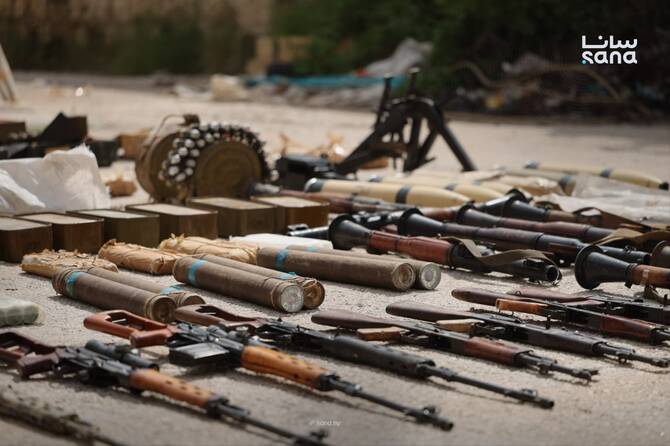
The weapons cache recovered from the hideout was substantial. Security forces seized anti-tank missile launchers and associated missiles, sniper rifles, modern automatic weapons, RPG launchers with live warheads, quantities of ammunition, hand grenades, and additional logistical equipment assessed as prepared for use in criminal operations including assassinations and bombings.
🟡 The Security Context
Homs Remains a Battleground for Syria’s Post-Assad Government
Homs is not incidental to this operation. The province is Syria’s geographic centre and a critical land corridor linking Damascus to the coast, the north, and the Iraqi border. Under the Assad era, it was also a centre of intense conflict and a corridor for Iranian-aligned militia movement. The transitional government in Damascus has prioritised asserting control here precisely because losing Homs means losing the country’s strategic spine.
The April 27 operation is not an isolated event. In December 2024, a joint patrol near Palmyra in Homs governorate was struck in an attack that killed two US soldiers and a civilian interpreter, wounding three additional US personnel and two Syrian security members. That attack demonstrated the province’s continued vulnerability to entrenched armed networks even after regime change.
The Interior Ministry has described the current campaign as targeting sleeper cell hideouts and disrupting funding and logistics networks across multiple Syrian governorates. Operations in April 2026 alone include a dismantled cell in Tartous, a foiled plot near a church in Damascus, and now the Homs engagement.
Syrian Interior Ministry — Official Statement, April 27, 2026
“The operation is an extension of a series of security efforts aimed at dismantling sleeper cells and drying up the sources of terrorism in various Syrian governorates. The armed forces and security forces stand in complete readiness to resolutely confront any threats to the security of citizens or the integrity of Syrian territory.”
🔵 The Weapons Profile
Anti-Tank Missiles Signal a Cell Built for Hard Targets
The weapons profile of this cell is significant. Anti-tank guided missile systems are not weapons used for petty criminality or random violence. They are purpose-built for destroying armoured vehicles, fortified positions, and hardened military hardware. Their presence in a hidden urban or peri-urban cache points to a group with specific military-grade targets in mind and access to supply chains capable of moving such systems.
Combined with sniper rifles for standoff precision killing, RPG launchers for mass-casualty attacks, and hand grenades for close-contact ambushes, the seized arsenal represents a multi-role attack capability. This is not a group preparing opportunistic strikes. This is a cell configured to execute coordinated operations across different attack vectors simultaneously.
The Interior Ministry has not publicly attributed the cell to a specific organisation. The group is described only as a terrorist cell planning to disrupt security and stability. Attribution remains an open question.
🟢 Syria’s Broader Counter-Terrorism Posture
Damascus Joins Global Coalition as Domestic Operations Intensify
In November 2025, Syria formally joined the Global Coalition against Daesh as its 90th member state. The move signalled the transitional government’s intention to align with international counter-terrorism frameworks and shed the Assad-era reputation as a state that tolerated and occasionally instrumentalised jihadist groups. The Homs operation is consistent with that posture.
In April alone, Syrian security forces have reported multiple separate counter-terrorism successes: a cell dismantled in Tartous linked to regime remnants, a foiled bombing plot near a Damascus church attributed to a network tied to Hezbollah-supplied weapons, and now the Homs weapons cache operation. The pace of publicly announced operations suggests either a genuine acceleration in activity or a deliberate communications campaign to project governmental authority and competence.
Both explanations may be true simultaneously. The transitional government has strong political incentives to demonstrate control. At the same time, the Palmyra attack and the consistent flow of weapons into Syrian territory indicate that the threat environment is real and active.
Strategy Battles Assessment
A Weapons Profile That Points Beyond Homs
The Homs operation is tactically clean by the numbers: two killed, zero friendly casualties, a large weapons cache off the street. But the strategic weight here lies not in the body count but in what was seized. Anti-tank guided missiles are a force-multiplier weapon system. They do not belong to groups interested in assassinating individuals or planting roadside bombs. They belong to cells preparing to stop armoured columns, destroy checkpoints, or execute ambushes on military convoys.
The fact that such a cache existed in Homs tells us three things. First, there are networks inside Syria still capable of sourcing and moving heavy military equipment. Second, Homs remains a logistics node for armed groups who know its geography matters. Third, whoever supplied this cell has not yet been disrupted. Neutralising two fighters and their weapons is a tactical win. Tracing the supply chain that put those anti-tank missiles in Homs is the strategic objective that will determine whether this kind of operation becomes a permanent feature of Syrian governance or a temporary holding action.
The transitional government’s institutional challenge is that it is conducting counter-terrorism operations while simultaneously building the institutions needed to conduct them sustainably. That is a race against degradation, and Homs is one of the most contested legs of that race.
Strategy Battles — Related Coverage
Sources
- Arab News — Syrian authorities dismantle ‘terrorist cell’ in Homs, April 27, 2026
- SANA (Syrian Arab News Agency) — Syrian Interior Ministry statement on Homs operation, April 27, 2026
- Voice of Emirates — Syrian Interior Ministry dismantles terrorist cell and seizes weapons cache in Homs, April 27, 2026
- Jordan News — Syrian Security Forces Dismantle Terrorist Cell in Homs, April 27, 2026
- Yeni Safak — Syrian security forces dismantle terrorist cell in Homs province, April 27, 2026
- Foundation for Defense of Democracies — Syria Thwarts Hezbollah Plot, Vows at UN to Fight Terrorist Groups, April 24, 2026
Editorial Verification
The core facts of this operation, including the killing of two militants, the seizure of anti-tank missiles, sniper rifles, RPG launchers, and ammunition, and the Interior Ministry’s authorship of the operation, are confirmed across five independent outlets citing SANA and the official ministry statement. The cell’s affiliation has not been publicly confirmed by Syrian authorities; affiliation remains unverified. The December 2024 Palmyra attack reference is sourced to Arab News. Syria’s membership of the Global Coalition against Daesh is drawn from open reporting on the November 2025 accession. Strategic assessment and analysis are original editorial content from Strategy Battles.
Approved for Publication
Marcus V. Thorne
Lead Editor, Strategy Battles
©StrategyBattles.net 2026
This article is for news and analysis purposes only. Based on publicly available news sources and military updates. All rights reserved. Not for commercial reuse without permission.