Iran Cannot Find Its Own Mines in the Strait of Hormuz — and That Is Now the Biggest Threat to the Ceasefire
20%
Of World’s Oil Flows Through Hormuz
230
Loaded Oil Tankers Stranded in Gulf — ADNOC
10
Ships Crossed Since Ceasefire (Apr 7–11)
6M
Barrels Per Day Global Supply Deficit — Kpler

Sea mines — the type deployed by the IRGC using small, fast boats in March 2026 to close the Strait of Hormuz. U.S. officials confirmed the mining was conducted without precise mapping or central coordination, leaving Iran unable to account for all locations. Photo: Associated Press.
🔴 Breaking Development
Iran’s Mines Are Now Everyone’s Problem — Including Iran’s
Iran cannot locate all of the naval mines it laid in the Strait of Hormuz — and cannot remove the ones it has found. That is the central finding of a New York Times report published April 10, citing senior U.S. officials, which has been independently corroborated by multiple international outlets and has fundamentally changed the character of the Islamabad peace talks currently underway between Vice President JD Vance and Iranian Foreign Minister Abbas Araghchi.
The IRGC deployed mines in the strait in early March 2026 — shortly after the launch of Operation Epic Fury on February 28 — using hundreds of small, fast boats operating without central coordination or precise mapping, according to Investing.com’s conflict analysis. The rapid, decentralised deployment that made the mining operation tactically effective has now made it operationally irreversible. Many of the devices were laid in a manner that allowed them to drift, rendering previous “safe route” charts published by Tehran unreliable.
“Iran cannot locate all of the mines it placed in the Strait of Hormuz and cannot remove them — a critical complication that has prevented Tehran from quickly reopening the waterway despite U.S. demands.” — The New York Times, April 10, 2026, citing senior U.S. officials.
The disclosure transforms what was understood as a political standoff into a physical one. Trump’s demand for “complete, immediate, and safe” reopening of the strait as a condition of the two-week ceasefire cannot be satisfied by diplomatic language alone — it now requires a mine-clearing operation that neither side is currently capable of rapidly executing.

The IRGC published alternative maritime routes through the Strait of Hormuz for vessels willing to coordinate with Iran — but U.S. intelligence assessed that drifting mines had rendered these designated corridors unreliable. Source: IRGC / Iranian National Security Commission.
🟡 The Diplomatic Signal
“Technical Limitations” — What Araghchi Was Really Saying
When Iranian Foreign Minister Abbas Araghchi announced following the ceasefire that the strait would remain open “with due consideration of technical limitations,” U.S. officials interpreted this not as diplomatic hedging — but as a direct, if veiled, acknowledgment of the mine problem. Türkiye Today confirmed that U.S. officials explicitly told reporters the phrase was a reference to Iran’s inability to quickly locate or clear the mines.
The IRGC Navy compounded the problem on April 5 by declaring through PressTV that the Strait “will never return to its previous status, especially for the United States and Israel.” Read alongside Araghchi’s language and the mine-clearing reality, House of Saud’s conflict analysis assessed that the IRGC intended the mines as a permanent alteration of the maritime environment — and succeeded beyond its own ability to reverse.
Mine Crisis — Key Facts
- How they were laid: IRGC used hundreds of small boats without central coordination or precise mapping in early March 2026.
- Why they can’t find them: No systematic mapping was conducted. Many mines were laid to drift, meaning their original positions are no longer their current positions.
- Why they can’t remove them: Even mines whose locations are known cannot be quickly removed. Mine clearance is significantly more difficult than mine laying and requires specialist vessels and trained personnel operating in a hazardous maritime environment.
- U.S. MCM capability gap: All four U.S. Navy Avenger-class mine countermeasures ships stationed in Bahrain — USS Devastator, USS Sentry, USS Dextrous and USS Gladiator — were decommissioned on September 25, 2025 and departed the theatre in January 2026 — five weeks before the conflict began, per House of Saud’s assessment. The Navy has stated no plans to recommission any Avenger-class vessel.
- Allied MCM assets: The UK Royal Navy operates Hunt-class and Sandown-class mine countermeasures vessels. No allied MCM deployment to Hormuz has been proposed or authorized as of April 11, 2026.
- Ships through since ceasefire: Only 10 vessels have crossed the strait since the ceasefire took effect April 7–8, versus 138 ships per day before February 28.
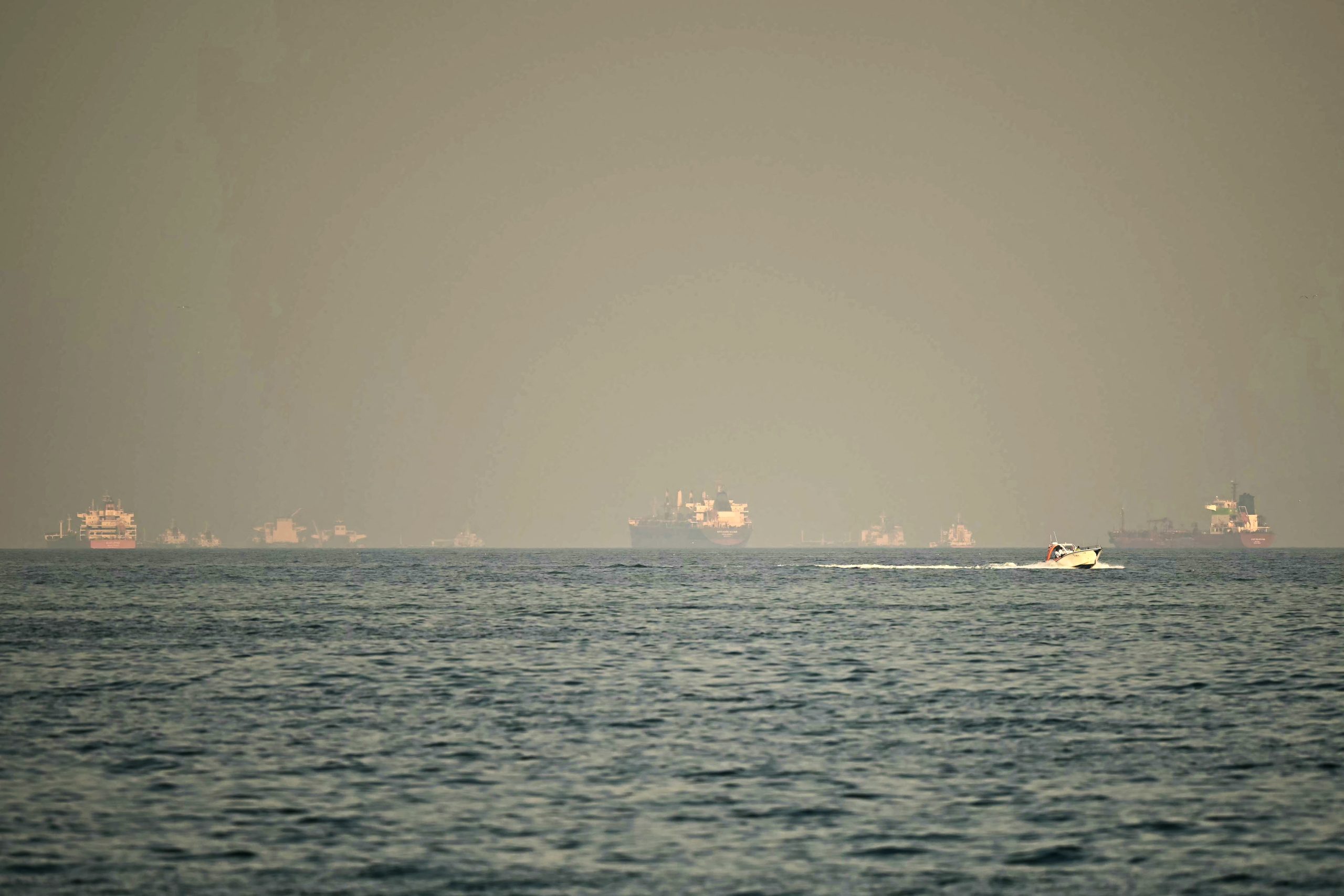
- 230 tankers stranded: Abu Dhabi National Oil Company CEO Sultan Al Jaber confirmed on April 9 that 230 loaded oil tankers are waiting inside the Gulf unable to depart.
🔵 Global Energy Impact
Markets, Insurance and the Long Road Back to Normal
The physical reality of uncharted mines in the strait carries consequences that extend far beyond the Islamabad negotiating rooms. Wikipedia’s 2026 Strait of Hormuz crisis page confirmed that shipment restrictions reduced flows by more than 90% — approximately 10 million barrels per day — raising energy and agricultural input costs worldwide. Kpler estimated the global supply deficit at 6 million barrels per day as of April 7. On March 19, Dubai crude reached a record $166 per barrel. Brent was trading at $109 per barrel as of Strategy Battles’ last confirmed figure.
The insurance dimension is equally severe. Lloyd’s of London’s Joint War Committee listed the Persian Gulf as a high-risk zone in March 2026. War-risk premiums for Hormuz transit have risen to 5–10% of hull value per voyage — effectively prohibitive for most commercial operators, regardless of whether the mines are eventually mapped. Major Saudi Aramco terminals — Ras Tanura, Ju’aymah and the King Fahd Industrial Port at Jubail — remain offline not because of ceasefire violations but because the maritime approach through Hormuz is not certified safe for tanker traffic, per the House of Saud conflict brief.
Investing.com’s market analysis assessed that even market participants now view Araghchi’s “technical limitations” language as confirmation that the 15% of global oil supply currently sidelined will not return in a single wave — rather, any reopening will be a protracted, multi-month process, keeping energy prices volatile and supply chains under stress well into mid-2026. The U.S. Energy Information Administration projected flows returning “close to pre-conflict levels in late 2026” — an assumption requiring both a successful mine clearance operation and no conflict resumption.
Strategy Battles Assessment
The Hormuz mine crisis represents a strategic backfire of the first order. What began as Iran’s most effective single move in the conflict — closing the world’s most critical oil chokepoint in 48 hours using small boats and cheap ordnance — has become an uncontrollable liability that now constrains Iran’s own negotiating position in Islamabad. Iran cannot credibly promise what the ceasefire requires of it. The U.S. cannot enforce what it has demanded. And the allied mine-clearing capability that would normally resolve this — the Avenger-class MCM fleet — was decommissioned and removed from the Gulf two months before the war began. The strait will not reopen quickly. The ceasefire’s central condition is physically undeliverable in any short-term timeframe. That makes the two-week window expiring April 22 extremely fragile — not primarily because of political will, but because of unexploded ordnance on the seafloor that no one can map.
Strategy Battles — Related Coverage
Sources
- Militarnyi.com — NYT: Iran Cannot Locate Its Own Mines in Strait of Hormuz, Hindering Peace Talks (April 11, 2026)
- Türkiye Today — Iran Can’t Find or Remove Its Own Mines in Strait of Hormuz (April 11, 2026)
- House of Saud Conflict Pulse — Iran Can’t Find Its Own Hormuz Mines, U.S. Says (April 11, 2026)
- Investing.com — Lost Mines in Strait of Hormuz Block Safe Reopening Ceasefire Terms (April 10, 2026)
- Mediaite — Iran Forgot Where It Placed Mines, U.S. Officials Claim (April 11, 2026)
- The Tribune India — Did Iran Forget the Mines It Planted in Strait of Hormuz? (April 11, 2026)
- Business Today — Strategic Backfire: Iran’s Own Mines Turn Into Barrier in Hormuz Reopening (April 11, 2026)
- Wikipedia — 2026 Strait of Hormuz Crisis (continuously updated)
- Haaretz — Report: Iran Can’t Find or Remove Hormuz Mines (April 10, 2026)
Editorial Verification
This report has been reviewed for factual accuracy and OSINT compliance. The core finding — Iran cannot locate or remove all its own mines in the Strait of Hormuz — is confirmed across multiple independent sources citing the same New York Times report and U.S. intelligence briefings. All market and shipping data is attributed to named sources. The MCM capability assessment citing the decommissioning of all four Avenger-class mine countermeasures ships is sourced to the House of Saud conflict analysis and Navy Times. The assessment box is editorial analysis by Strategy Battles and is clearly labelled as such.
Approved for Publication
Marcus V. Thorne
Lead Editor, Strategy Battles
©StrategyBattles.net 2026
This article is for news and analysis purposes only. It is based on publicly available news sources and military updates. All rights reserved. Original reporting may come from various open sources. Not for commercial reuse without permission.