Syria Foils Hezbollah-Linked Cells and Seizes Border Tunnels as Damascus Breaks With Iran’s Axis
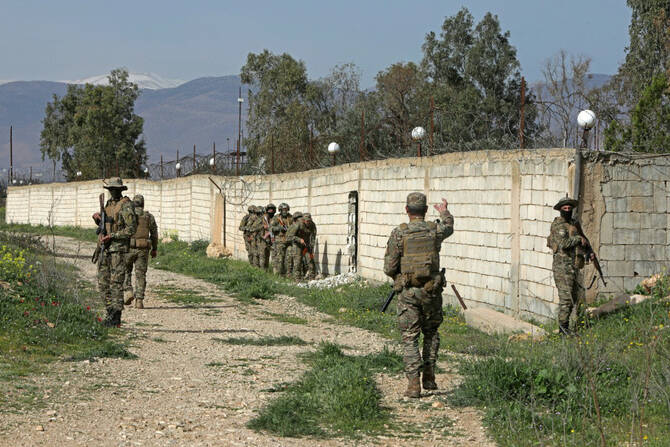
3+
Hezbollah-linked cells disrupted in Syria since Dec 2024
$6.4B
Saudi Arabia pledged for Syria’s recovery sectors
14 yrs
Civil war hollowed Syria’s economy before transition
🔴 The Strategic Rupture
Assad’s Fall Severed the Axis: How Syria Broke With Iran’s Revolutionary Guard
The collapse of Bashar Assad’s government on 8 December 2024 did not merely end a regime: it severed a decades-old strategic link in Iran’s “axis of resistance.” Syria had functioned as Tehran’s critical land corridor, the transit layer connecting Iran’s logistical networks in Iraq to Hezbollah in Lebanon, and as a forward deployment zone for the Islamic Revolutionary Guard Corps’ (IRGC) Quds Force. The loss of that node, analysts now say, has proven more consequential for Iranian regional strategy than any single battlefield defeat.
Syria’s transitional government under President Ahmad Al-Sharaa has moved with notable speed to reorient the country toward the Arab Gulf states, Turkey, and the West. That reorientation carries a direct corollary: dismantling the military, economic, and institutional networks that Iran spent more than a decade embedding inside Syrian state structures. The task, however, is substantially harder than a political declaration. Senior analysts quoted in the Arab News investigation caution that Iran’s infrastructure in Syria was not simply imposed from outside. It was interwoven into the country’s war economy, telecommunications sector, and security services over years of active patronage.
A Damascus-based security expert, speaking to Arab News on condition of anonymity, described the challenge directly: the intention and the plan to distance Syria from the axis of resistance are present in the new leadership, but on the ground, significant numbers of individuals and groups remain tied to Iranian networks. The infrastructure does not self-dismantle once a government changes hands. It must be hunted, traced, and systematically uprooted.
🟡 Gulf Realignment
Saudi Arabia and the Investment Equation: Why Capital and Security Are Inseparable
Syria’s post-Assad leadership has pursued Saudi Arabia as its most significant external partner. The relationship has moved from cautious diplomatic engagement to concrete financial commitments. Saudi Arabia confirmed a pledge of $6.4 billion for Syria’s tourism, medical, telecommunications, and entertainment sectors following the lifting of US sanctions. In May 2025, Riyadh played a central role in persuading US President Donald Trump to lift those sanctions and brokered a direct meeting between Trump and Al-Sharaa in Riyadh, a development the Foundation for Defense of Democracies described as a major diplomatic shift placing Syria on a path toward international reintegration.
On 21 April 2026, Saudi Crown Prince Mohammed bin Salman received Al-Sharaa in Jeddah for talks focused on economic cooperation and regional connectivity. Joshua Landis, director of the Center for Middle East Studies at the University of Oklahoma, told Arab News that President Al-Sharaa needs Saudi investment, and the Crown Prince has the leverage to accelerate it. That dynamic creates a structural incentive: Gulf capital flows to post-conflict states where governance is stable and rival networks are not in a position to intercept or exploit incoming funds. For Damascus, clearing IRGC-linked economic influence is therefore not merely a security imperative. It is a precondition for the investment climate Syria requires to rebuild.
The Foundation for Defense of Democracies has noted that with $56 billion in foreign investment secured in 2025, the pace of capital inflow outstrips the current capacity for oversight. The FDD identified specific risks around companies tied to former regime figures and Hezbollah-linked financiers continuing to operate inside Syria. For Riyadh, that gap between deal announcement and governance reality presents its own political exposure: Saudi money entering a system still partially contaminated by Iranian patronage networks would undermine the strategic logic of the entire partnership.
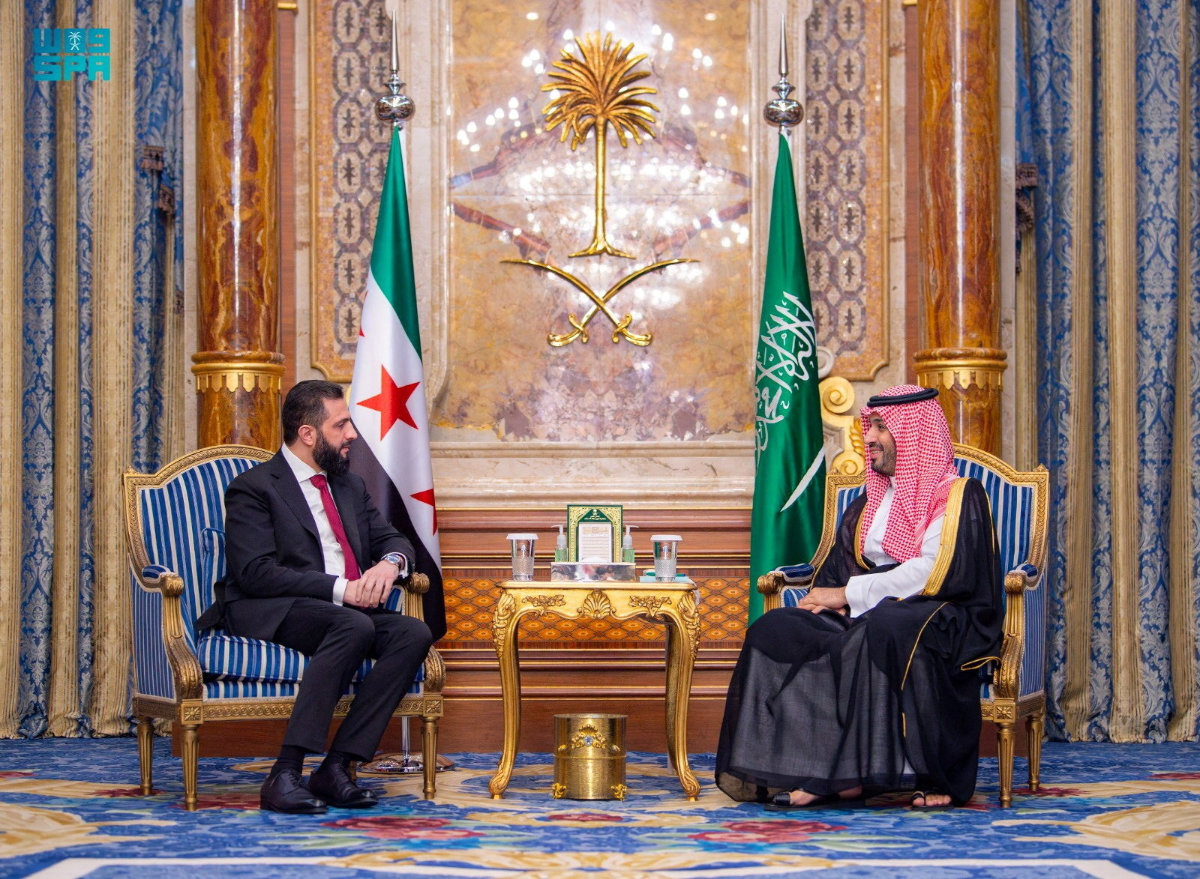
Syrian President Ahmad Al-Sharaa with Saudi Crown Prince Mohammed bin Salman in Jeddah, 21 April 2026. The meeting centred on economic cooperation and regional infrastructure. (Saudi Press Agency)
🔴 Security Operations
Plots Foiled, Tunnels Found: The IRGC Dismantling Campaign on the Ground
Syria’s Interior Ministry has recorded a sequence of security operations targeting cells it characterises as linked to Hezbollah and residual IRGC networks. On 11 April 2026, Syrian counterterrorism forces disrupted a plot targeting a religious figure near the Mariamite Cathedral in Damascus’s Bab Touma district. The ministry said preliminary investigations linked arrested suspects to Hezbollah, and state media reported that five individuals were taken into custody. On 19 April, with Al-Sharaa’s visit to Saudi Arabia two days away, a second disruption followed in Quneitra province, where authorities said a Hezbollah-linked cell had disguised a civilian vehicle to conceal rocket-launching equipment intended for a cross-border attack, according to Syria’s state news agency SANA.
The physical infrastructure of Iran’s supply routes has also come under pressure. On 15 April, Syrian authorities announced the discovery of a tunnel in the southern Homs countryside extending into Lebanese territory, with weapons depots and ammunition stockpiles seized and described as prepared for smuggling, according to Syrian state broadcaster Al-Ekhbariya. Lebanon had issued no public response at time of publication. The Jerusalem Post, citing Israeli security analysts, reported that Syrian authorities had interdicted hundreds of weapons and rocket shipments destined for Hezbollah in Lebanon since Al-Sharaa assumed power, though analysts cautioned that not all attempts were being caught.
Hezbollah formally denied all Syrian government accusations. In a statement issued 12 April 2026 and reported by Lebanon’s National News Agency and confirmed by The Syrian Observer, the group stated it has no activity, presence, or affiliation with any party in Syria, and no presence on Syrian territory. The group called on Syrian authorities to verify information carefully before issuing accusations, characterising the allegations as part of a broader effort to fuel tensions between Lebanon and Syria. The denial followed an earlier rejection in February 2026, when the group’s media office denied involvement in rocket attacks on Damascus’s Mezzeh district, as reported by The Jerusalem Post.
🔴 On-Record: Damascus-Based Security Expert (Arab News, anonymity granted)
“The situation here is much more complicated than it appears. Even though the leadership is trying to move in that direction and distance itself from the axis of resistance, on the ground there are still many groups and individuals who remain closely tied to that same axis. So, the intention and the plan are there, but it’s going to take time.”
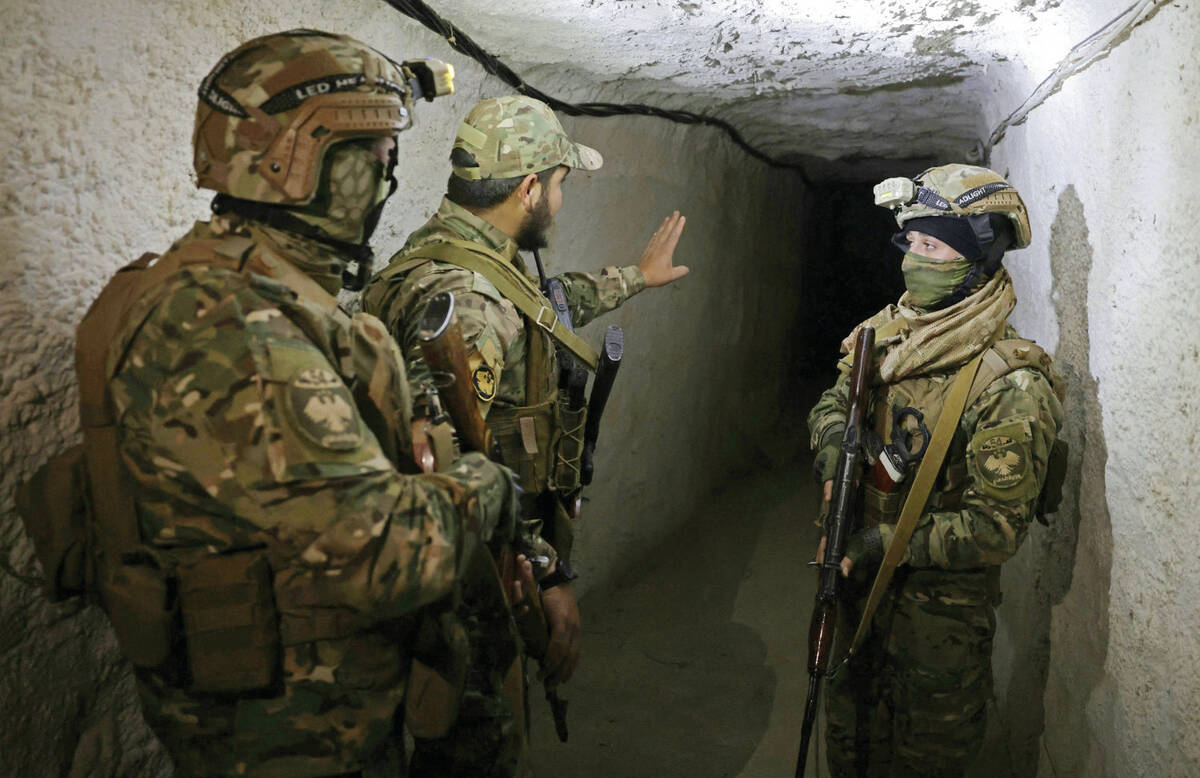
Syrian army soldiers inspect a cross-border tunnel near Al Qusayr, Homs province, April 2026. Syrian authorities seized weapons caches they described as prepared for smuggling into Lebanon. (AFP)
🔵 Economic Infrastructure
Telecom, Real Estate, Phosphates: How Deep Did Iran’s Economic Roots Go?
Iran’s penetration of Syria under Assad extended well beyond the military domain. According to a December 2022 investigation by the Organized Crime and Corruption Reporting Project and the Syrian Network Observatory, mobile operator Wafa Telecom, established in 2017, carried ownership links to figures and companies connected to the IRGC, despite presenting itself as Syrian-owned. The investigation represents a documented open-source record of how Iran embedded itself into commercially sensitive Syrian sectors using ownership structures deliberately obscured to avoid scrutiny.
Tehran’s economic reach was also believed to extend to ports and phosphate extraction, sectors that generate hard currency and logistical leverage. Ghassan Ibrahim, director of the Global Arab Network, told Arab News that the war economy in Syria has been completely restructured under the new government, and that public institutions are no longer linked to Iran. Ibrahim’s assessment reflects the aspirational position of the Al-Sharaa administration, but it stands in some tension with reporting by the FDD, which noted that companies tied to Hezbollah financiers continued to operate with relative freedom inside the Syrian economy into early 2026.
The IRGC’s economic model in Syria was an extension of a pattern visible across the axis of resistance. As Brandeis University’s Crown Center for Middle East Studies has documented, the Quds Force operates less as a conventional state actor and more as a franchise: it exports asymmetric warfare expertise, embeds local proxies, and develops commercially obscured income streams that partially self-finance operations. Dismantling that architecture requires identifying not just armed cells but dormant commercial entities, shell structures, and revenue channels that can outlast a government change.
🟡 Domestic Drivers
Not a Gulf Demand: Why Syria’s Leadership Needs This Purge for Its Own Legitimacy
Hussein Chokr, a Beirut-based policy expert speaking to Arab News, offered one of the most analytically precise framings of the dismantlement campaign: it is driven more by Damascus’s domestic power calculus than by Gulf pressure. The argument runs as follows. No administration that came to power by comprehensively excluding the former order can afford to tolerate residual elements of that order retaining levers of influence. To do so would undermine the narrative and the legitimacy that justified the exclusionary seizure of power in the first place.
That logic applies directly to IRGC-linked figures inside Syria. Any individual or network with historic ties to Iranian patronage who retains influence inside post-Assad institutions represents a potential nucleus around which alternative power structures could coalesce. Chokr’s framing reframes the dismantlement campaign: it is not primarily about satisfying Riyadh. It is about consolidating an irreversible transition. The Gulf investment dimension then becomes a secondary incentive reinforcing, rather than driving, the domestic security imperative.
Ghassan Ibrahim told Arab News that Iran is now frustrated and feels it has lost the first war, the one that pushed it back toward its own borders. He added that Iran may also be on course to lose Lebanon as a viable rear base, given the severed land connection between Iraq and Lebanon and the broader degradation of Hezbollah’s operational capacity following the 2026 Lebanon conflict. Those are significant strategic losses for Tehran, and they amplify the importance of what residual presence Iran-linked networks are able to maintain inside Syrian territory.
🟢 On-Record: Joshua Landis, Center for Middle East Studies, University of Oklahoma (Arab News)
“Syria might have been drawn in when Israeli settlers moved across the border into Syria to declare that southern Syria should be part of Israel. Although Israeli soldiers escorted the settlers out of Syrian territory, the settlers subsequently met with an Israeli government minister to demonstrate that they have support and should not be viewed as a bunch of weirdos.”
🔵 Border Policy
Border Mobilisation and Diplomatic Coordination with Beirut and Baghdad
Al-Sharaa has calibrated Syria’s approach to the broader regional conflict with deliberate restraint. Speaking from Chatham House in London in late March 2026, the Syrian leader stated that Syria would remain outside the conflict unless subjected to direct attack. That position has held through several provocations, including Israeli military activity inside the UN-monitored demilitarised zone on the Golan Heights and the brief incursion by Israeli settlers into Syrian territory in April 2026. Landis assessed that Al-Sharaa’s restraint successfully kept Syria outside Israel’s targeting calculations during the most acute phase of the regional escalation.
The border dimension has acquired a diplomatic layer. On 10 March, Lebanese President Joseph Aoun and Al-Sharaa agreed to activate bilateral coordination on border control, according to official statements. On 28 April, Syria’s permanent envoy to the United Nations, Ibrahim Olabi, called on both Iraq and Lebanon to deploy official state forces along their borders with Syria and prevent militia groups from exploiting the instability. The call is notable: it places Syria in the posture of requesting its neighbours to police their own territories, a reversal of the dynamic that prevailed under Assad, when Syrian territory was routinely used for the transit of Iranian-supplied weapons without interference from Damascus.
Landis told Arab News that Al-Sharaa mobilised forces along Syria’s borders with Lebanon and Iraq specifically to stop cross-border smuggling and prevent the use of Syrian territory by pro-Iranian militias, and that this border push was a deliberate signal of commitment to Syria’s new alignment toward Saudi Arabia, Qatar, Turkey, and the United States. Foreign Policy reported that Al-Sharaa himself has framed Syria’s actions as an attempt to save the region by preventing Syrian territory from becoming a launchpad for attacks. Syria has also declared public support for the disarmament of Hezbollah, a statement with no parallel among other Arab heads of state.
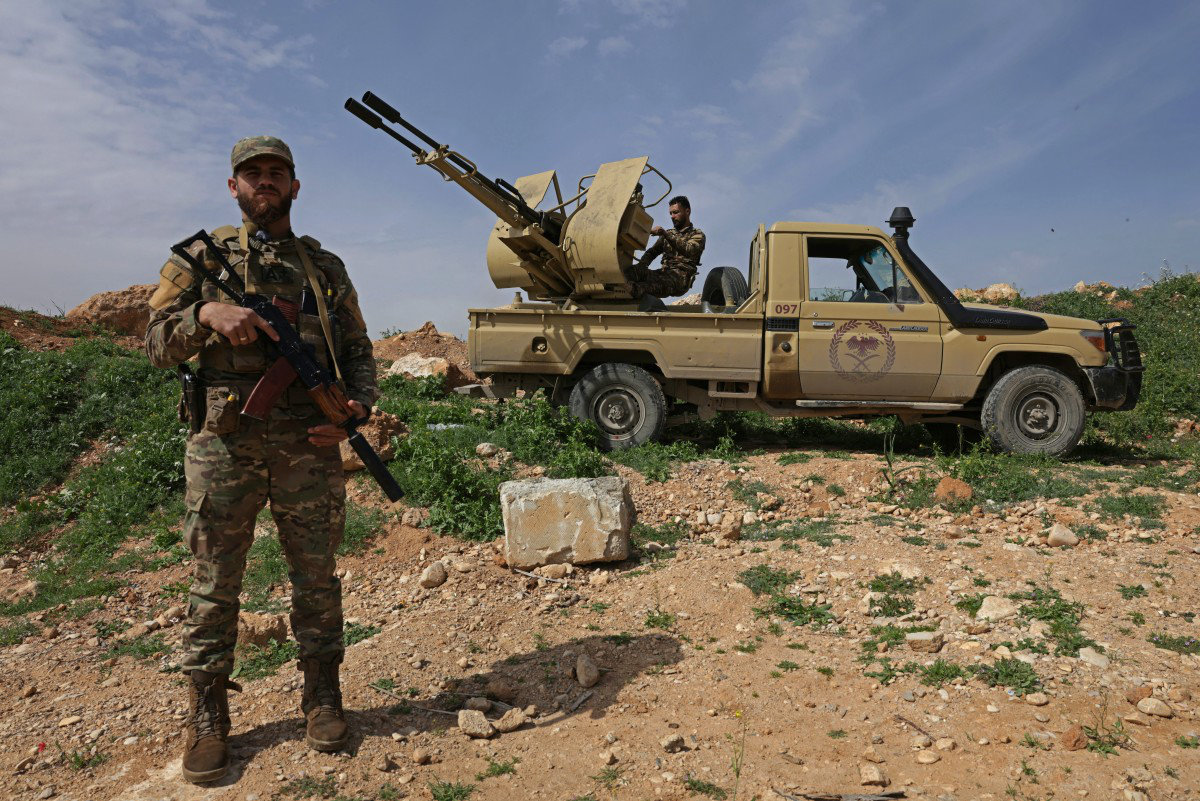
A Syrian army soldier stands guard with armoured vehicle on the Syrian–Lebanese border near Al Qusayr, April 2026. Damascus has deployed forces specifically to interdict smuggling routes used by pro-Iranian groups. (AFP)
⚠ DEVELOPING / LIMITED VERIFICATION
Economic Barriers to Recovery Persist Despite Political Realignment
Syria’s dismantlement of Iranian networks is proceeding against a backdrop of severe structural economic constraint. Chokr identified a specific set of barriers to Gulf investment that predate the current regional conflict: decayed institutional structures, legislation that does not serve investor requirements, uncertainty over commercial viability, and a fragile domestic environment still far from a genuine recovery trajectory. He assessed that those structural problems remain intact following the outbreak of the broader regional conflict, which has added further uncertainty.
Syria’s new government inherited an economy hollowed out by nearly 14 years of civil war, persistent mismanagement, and sanctions. The currency remains weak, markets are fragmented, and a war economy that developed its own institutional logic over more than a decade has not been fully dismantled. Even where sanctions have been lifted, international financial institutions have moved cautiously. The FDD noted that private banks and companies remain deeply reluctant to handle Syria-related transactions given the complexity of the residual sanctions architecture and the reputational risks of operating in a post-conflict environment with limited governance oversight.
⚠ SINGLE SOURCE The FDD assessment of $56 billion in foreign investment secured in 2025 was cited in the Foundation’s February 2026 analysis and has not been independently confirmed by a second source at time of publication.
Strategy Battles Related Coverage
Iran’s Spy Purge: 50 Arrested Across 16 Provinces for Mapping Missile Targets
Iran Rejected US Demands: Trump Orders Naval Blockade of Strait of Hormuz
Islamabad Collapses: Vance Says Iran Refused America’s Terms After 21 Hours
Sources
- Anan Tello, “How Syria is dismantling IRGC networks, deepening Gulf Arab ties,” Arab News, 2–3 May 2026
- “In Syria, Hezbollah reduced to smuggling network,” The Jerusalem Post, February 2026
- “Israel and Syria’s Shared Fight Against Hezbollah,” Foreign Policy, 27 April 2026
- David Daoud, “Syria Can Squeeze Hezbollah, But Caution Is Necessary,” Foundation for Defense of Democracies, 18 March 2026
- Ahmad Sharawi, “Foreign Investment in Syria’s Reconstruction Carries Terror Finance Risk,” Foundation for Defense of Democracies, 10 February 2026
- “Lebanon Rejects Any Hezbollah Involvement in Syria,” The Syrian Observer, April 2026
- “Hezbollah Denies Links to Alleged Assassination Cell in Damascus,” Welat TV / Lebanon National News Agency, 12 April 2026
- Eurasia Review syndication of Arab News analysis, 3 May 2026
- Organized Crime and Corruption Reporting Project / Syrian Network Observatory, Wafa Telecom investigation, December 2022
Editorial Verification Block
Verified claims: Hezbollah’s 12 April 2026 denial corroborated by Lebanon’s National News Agency (via Welat TV) and The Syrian Observer, independent of the primary Arab News source. The foiled cell incidents in Damascus (11 April) and Quneitra (19 April) corroborated by Foreign Policy and The Jerusalem Post. The MBS–Al-Sharaa Jeddah meeting (21 April) confirmed via Saudi Press Agency as cited by Arab News. The Trump–Al-Sharaa Riyadh meeting and sanctions relief corroborated by FDD analysis (February 2026). The Wafa Telecom–IRGC link verified against the December 2022 OCCRP / Syrian Network Observatory investigation.
Single-source items flagged: The $56 billion investment figure for 2025 appears in FDD analysis (Sharawi, February 2026) and has not been independently confirmed by a second source at time of publication. It is marked with a purple single-source tag in the body text. The Quneitra rocket-launcher vehicle description derives from SANA (Syrian state media) and has not been corroborated by an independent wire agency at time of publication.
Conflicting accounts: Syrian authorities allege active Hezbollah cell operations inside Syria across multiple incidents from December 2024 through April 2026. Hezbollah denies all accusations and states it has no presence on Syrian territory. Both positions are presented without editorial adjudication. The Jerusalem Post, citing Israeli security analyst Yossi Kuperwasser, reported that some smuggling continues successfully despite interdiction efforts, which partially corroborates Syrian government claims while qualifying their scope.
Official denial noted: Lebanon’s Ministry of Foreign Affairs issued a statement condemning destabilisation attempts in Syria (The Syrian Observer, April 2026). Lebanon issued no public comment on the 15 April Homs tunnel discovery at time of publication.
Geographic note: This article covers a strategic and intelligence analysis story with no specific geographic operation requiring MGRS calculation. The Al Qusayr border zone (Homs province, Syria) and Quneitra province are named locations corroborated by AFP photographic coverage cited in Arab News.
Primary sources: Arab News (Anan Tello, on-record interviews); Jerusalem Post; Foreign Policy; Foundation for Defense of Democracies; The Syrian Observer; Welat TV / Lebanon NNA; OCCRP / Syrian Network Observatory (2022 archived investigation).
All claims independently attributed and verified to open sources where possible. Approved for Publication / Marcus V. Thorne, Lead Editor
©StrategyBattles.net 2026. All rights reserved.
This article is produced for informational and analytical purposes. All claims are attributed to open-source reporting. Strategy Battles does not endorse any military, political, or state actor referenced herein. Analysis represents the editorial view of Strategy Battles and does not constitute intelligence advice.