Trump CENTCOM Iran Military Options Briefing Strikes, Hormuz Seizure, HEU Raid on Table
3
Strike Options on the Table
3 Weeks
Ceasefire Duration — Fragile
~20%
Global Oil/LNG Through Hormuz
📍 Strategic Overview — CENTCOM Iran War Operations Zone, April 2026

Three operational theaters under review: Isfahan nuclear site, Strait of Hormuz control zone, and Iranian infrastructure targets. Briefing location: The Pentagon, Washington DC. Map: Strategy Battles / OSINT. Datum: WGS84.
📍 THE PENTAGON — BRIEFING LOCATION
MGRS: 18SUJ21612 04570
38.8719°N 77.0563°W
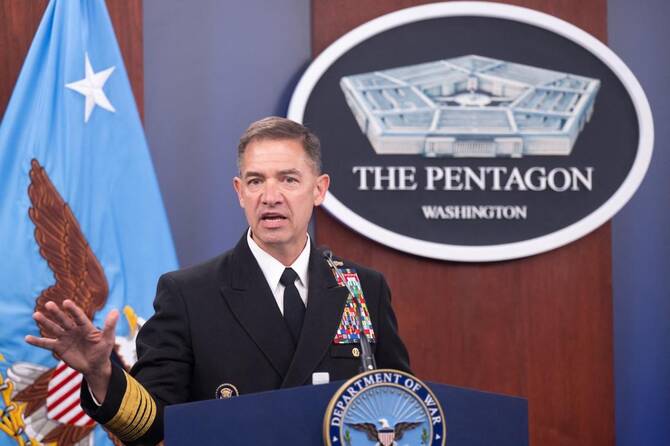
Pentagon / White House complex, Washington DC. CENTCOM Commander Adm. Brad Cooper and Joint Chiefs Chairman Gen. Dan Caine to brief President Trump on new Iran military options, April 30, 2026.
📍 STRAIT OF HORMUZ — SEIZURE OPTION
MGRS: 40RDQ26317 41703
26.5942°N 56.2600°E
Central Strait of Hormuz navigational chokepoint. Second operational option would see US forces seize part of the strait to reopen commercial shipping; may involve ground forces. ~20% of global oil/LNG transits this point.
📍 ISFAHAN — HEU STOCKPILE SITE
MGRS: 39SWS62644 13193
32.6546°N 51.6680°E
Isfahan nuclear facility complex, central Iran. IAEA Director General confirmed on April 30, 2026 that Iran’s highly enriched uranium stockpile is likely still held at this site. Third briefing option involves a special forces operation to secure the stockpile.
📍 TEHRAN — IRANIAN COMMAND CENTRE
MGRS: 39SWV35196 49546
35.6892°N 51.3890°E
Iranian capital and seat of government and military command. Infrastructure in and around Tehran forms part of the potential strike package under the first briefing option. Trump has previously threatened destruction of Iranian civilian infrastructure.
🔴 The Briefing
Cooper and Caine Set to Present Three Escalation Paths to Trump
President Donald Trump is scheduled to receive a classified military options briefing on Thursday at the Pentagon, grid reference 18SUJ21612 04570 (38.8719°N, 77.0563°W), Washington DC, from CENTCOM Commander Admiral Brad Cooper, according to a report by Axios citing two anonymous sources with knowledge of the matter. The Chairman of the Joint Chiefs of Staff, General Dan Caine, is also expected to attend. Neither the White House nor CENTCOM had responded to requests for comment at the time of publication.
The timing is significant. A fragile ceasefire in the Iran war has now held for three weeks, but negotiations over Iran’s nuclear program have stalled. The Axios report characterises the briefing as a signal that Trump is seriously considering resuming major combat operations, either to break the logjam in talks or to deliver a decisive blow before attempting to end the war.
Cooper gave Trump a similar briefing on February 26, two days before the United States and Israel launched the war against Iran on February 28. The precedent set by that briefing is not lost on analysts. On that occasion, the presentation was followed within 48 hours by the opening of hostilities.
🔴 Option One
A Short and Powerful Wave of Strikes — Infrastructure Targets Included
CENTCOM has prepared a plan for what Axios describes as a concentrated strike campaign against Iranian targets, likely incorporating infrastructure. The reported intent is to increase pressure on Tehran to shift its negotiating position on nuclear issues. Washington views coercive military action as a lever to generate diplomatic flexibility rather than as a terminal military solution.
Trump has previously made public threats to destroy Iran’s civilian infrastructure if talks failed. International law experts have warned that strikes on sites essential to the civilian population could constitute violations of the 1949 Geneva Conventions, which prohibit attacks on such infrastructure. The status of any specific target list has not been confirmed by the White House or CENTCOM.
The war, which began when the United States and Israel struck Iran on February 28, has already killed thousands and displaced millions. US-Israeli strikes on Iranian territory combined with Israeli operations in Lebanon have generated severe civilian displacement. The war remains broadly unpopular domestically within the United States, a political constraint that shapes the appetite for renewed large-scale action.
🔵 Option Two
Seizing the Strait of Hormuz — Ground Forces Potentially Involved
A second plan to be presented to Trump would involve US forces taking physical control of part of the Strait of Hormuz, located at grid reference 40RDQ26317 41703 (26.5942°N, 56.2600°E), in order to reopen it to commercial shipping. The Axios report notes this operation may involve ground forces, representing a significant escalation beyond the current naval blockade posture.
The strait is the chokepoint through which approximately 20 percent of global oil and liquefied natural gas shipments normally pass. Since the outbreak of the war, Iranian activity has brought traffic through the strait close to a standstill. The economic impact has shaken global commodity markets and pushed oil prices sharply higher. Disruptions to sugar supply chains, shipping insurance markets, and LNG delivery schedules have cascaded globally.
The naval blockade that Trump currently maintains on Iran represents, in the assessment of his advisers per the Axios report, his primary source of leverage in the negotiations. A kinetic seizure of the strait would represent a transformation of that posture from economic coercion to direct territorial control, carrying substantially higher escalatory risk.
🟡 Option Three
Special Forces Raid to Secure Iran’s Highly Enriched Uranium Stockpile
The third option Axios reports may feature in the briefing is a special forces operation aimed at seizing or securing Iran’s stockpile of highly enriched uranium. On April 30, the IAEA Director General confirmed to the Associated Press that Iran’s highly enriched uranium is likely still located at the Isfahan nuclear site at grid reference 39SWS62644 13193 (32.6546°N, 51.6680°E), in central Iran.
Trump has repeatedly cited Iran’s nuclear program as an imminent threat and has framed the war partly in terms of preventing Iranian nuclear weapons capability. Tehran denies seeking nuclear weapons and asserts its right to enrichment as a signatory to the Nuclear Non-Proliferation Treaty. The question of the enriched uranium stockpile has been a central sticking point in nuclear negotiations.
A special forces raid to physically secure a nuclear stockpile would be among the most complex and high-risk special operations ever attempted. The logistical, radiological, and diplomatic complications of such a mission are without modern precedent. Whether this option is being treated as a serious operational proposal or as a pressure signal to Iran through deliberate leaking remains unclear.
Axios — Original Report, April 29-30, 2026 (Two Anonymous Sources)
“The briefing signals that Trump is seriously considering resuming major combat operations either to try to break the logjam in negotiations or to deliver a final blow before ending the war.”
🔴 Context
A Ceasefire in Name Only — The Negotiating Deadlock and What Breaks It
The Iran war began on February 28, 2026, when the United States and Israel launched coordinated strikes on Iranian territory. Iran responded with its own strikes against Israel and Gulf states hosting US military bases. The ceasefire that followed, now three weeks old, halted large-scale exchanges but has produced no durable diplomatic framework. Negotiations on nuclear issues remain deadlocked, with Washington seeking verifiable restrictions on enrichment and Tehran refusing to concede what it describes as sovereign rights under the NPT.
Axios reports that Washington’s working theory is that renewed military pressure can make Iran more flexible at the negotiating table. This calculus mirrors the logic applied before the war began, when coercive signals failed to produce an agreement. The Islamabad talks, which collapsed in mid-April after 21 hours of negotiations, demonstrated that Iran’s core positions have not materially shifted under existing military and economic pressure.
Iran’s currency has simultaneously fallen to a record low as the war and blockade take their economic toll. Domestic pressure on the Tehran government is real, but whether it translates into negotiating flexibility on the nuclear dossier is a separate question. Iran’s leadership has historically treated the nuclear program as a strategic redline impervious to external economic pressure.
★ Strategy Battles Assessment
Briefing as Leverage: The Strategic Logic of Deliberate Leaking
There is a meaningful distinction between a military briefing and military action. What is striking about this report is not that CENTCOM has prepared contingency plans — that is routine institutional function — but that the existence of those plans, with specific operational details including the Hormuz seizure and the HEU raid option, has been allowed to reach Axios via named sources describing an imminent briefing to the president.
This reads as deliberate strategic signalling. The Trump administration has used the media environment to telegraph intentions to Tehran before, and the February 26 precedent — Cooper briefing Trump two days before the war opened — will not be lost on Iranian analysts. If Tehran reads this report as a genuine countdown, that is precisely the intended effect. The question is whether the shock value is diminishing after several rounds of escalatory rhetoric that has not always resolved into action.
The HEU special forces option deserves particular analytical attention. Operationally, securing a nuclear stockpile under contested conditions in central Iran at Isfahan — deep inside a country with substantial air defence layers still functioning — would represent an extraordinary logistical and tactical challenge. Its inclusion in the briefing may signal that it is intended less as an executable plan and more as a demonstration of the administration’s willingness to consider the most extreme options, for consumption by both Iranian intelligence and domestic audiences who have been told the nuclear threat is existential.
Strategy Battles — Related Coverage
- Axios — “Scoop: Commanders to brief Trump on new Iran military options Thursday,” April 30, 2026
- Arab News / Reuters — “US military commander to brief Trump on new military options against Iran,” April 30, 2026
- Iran International — “Trump to receive briefing on new Iran military options,” April 30, 2026
- Times of Israel — “CENTCOM chief to brief Trump on new plans for US military action against Iran,” April 30, 2026
- Al Arabiya English — “Trump will reportedly be briefed on new military options against Iran,” April 30, 2026
- Jerusalem Post — “CENTCOM prepares ‘short and powerful’ wave of strikes on Iran, Trump to be briefed,” April 30, 2026
- Arab News / AP — “Iran’s highly enriched uranium likely still at the Isfahan site, UN nuclear chief tells AP,” April 30, 2026
Editorial Verification
The existence of Thursday’s military briefing and the identity of participants (CENTCOM Commander Adm. Brad Cooper, Joint Chiefs Chairman Gen. Dan Caine) are confirmed across multiple independent outlets citing separate sources, including Reuters, Arab News, Iran International, Al Arabiya, Times of Israel, Jerusalem Post, and ANI. The core structure of the three options (infrastructure strikes, Hormuz seizure, HEU special forces raid) originates with Axios and is single-source on operational specifics; these are labelled as reported claims throughout the article. No specific strike targets have been confirmed. The IAEA HEU-at-Isfahan confirmation is sourced from the IAEA Director General’s public statements to the Associated Press, April 30, 2026, and is multi-source confirmed. White House and CENTCOM had not responded to comment requests at publication time. The February 26 precedent (Cooper briefing Trump two days before war) is established historical record confirmed by multiple outlets. MGRS coordinates calculated using WGS84 datum, UTM Zones 18S (Washington DC), 39S (Isfahan and Tehran), and 40R (Strait of Hormuz). All calculations cross-checked against Tehran (UTM Zone 39S reference point: MGRS 39SWV35196 49546, 35.6892°N, 51.3890°E) as the named verification reference for Zone 39S, and against the UAE capital Abu Dhabi (MGRS 40RBQ13826 55143, 24.4539°N, 54.3773°E) for Zone 40R.
Approved for Publication
Marcus V. Thorne
Lead Editor, Strategy Battles
©StrategyBattles.net 2026
This article is for news and analysis purposes only. Based on publicly available news sources and military updates. All rights reserved. Not for commercial reuse without permission.