Pakistan Commissions First Hangor Class Submarine in China Eight-Boat AIP Fleet to Reshape Arabian Sea Balance
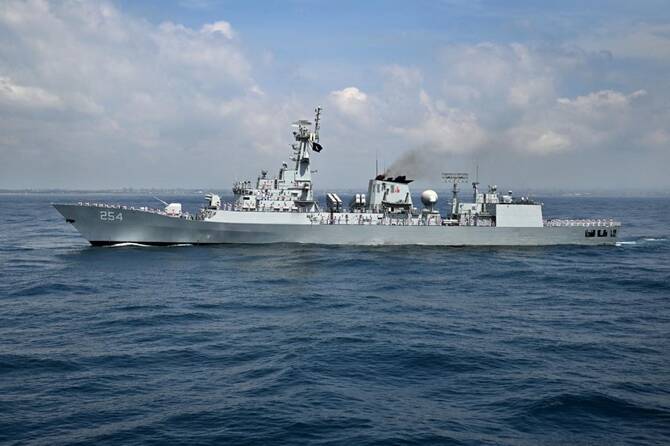
8
PLANNED SUBMARINES (SINGLE-SOURCE)
2015
YEAR CONTRACT SIGNED WITH CHINA
1971
HANGOR NAME LEGACY — FIRST SUB SINKING SINCE WWII

📍 SANYA NAVAL BASE, CHINA
MGRS: 49Q LT 72100 02580
18.2526°N 109.5117°E
PLA(N) South Sea Fleet base, Hainan Island. Site of PNS/M Hangor commissioning ceremony, April 30, 2026.
📍 KARACHI SHIPYARD (KS&EW), PAKISTAN
MGRS: 41R NR 01600 47500
24.8607°N 66.9914°E
Karachi Shipyard and Engineering Works Ltd. Domestic build facility for four of the eight Hangor-class submarines under transfer-of-technology programme.
🔵 The Commissioning
Pakistan’s first Hangor-class submarine formally inducted at Sanya
The Pakistan Navy formally commissioned its first Hangor-class submarine, PNS/M Hangor, at a ceremony held at Sanya Naval Base, grid reference MGRS 49Q LT 72100 02580 (18.2526°N, 109.5117°E), on the southern coast of Hainan Island, China, on April 30, 2026. The event was confirmed by Pakistan’s military media wing, the Inter-Services Public Relations (ISPR), in an official statement.
Pakistani President Asif Ali Zardari attended the ceremony as chief guest, having arrived in Sanya from Hunan as part of a broader visit focused on China-Pakistan Economic Corridor (CPEC) infrastructure cooperation. Chief of the Naval Staff Admiral Naveed Ashraf was also present, alongside senior officials from both the Pakistan Navy and the People’s Liberation Army Navy (PLA(N)).
Prime Minister Shehbaz Sharif and Chief of Defence Forces Field Marshal Asim Munir separately congratulated the nation and the Pakistan Navy on what Islamabad is describing as a historic milestone in the country’s naval modernisation programme.
🔵 The Vessel
What is the Hangor class? Capabilities and origins
The Hangor class is a diesel-electric attack submarine, widely assessed by defence analysts to be an export variant of the PLA(N)’s Type 039B Yuan-class platform, built by China Shipbuilding and Offshore International Company (CSOC) under the designation S26. Pakistani officials have not publicly confirmed the propulsion system’s specific make, but Naval News, citing Pakistani defence blog Quwa, reports that the Stirling air-independent propulsion (AIP) system used in CSOC’s S26 design is the most likely configuration.
AIP technology allows a submarine to operate for significantly longer distances underwater before being required to snorkel or surface, providing enhanced endurance and stealth compared to conventional diesel-electric boats. The Hangor class is reportedly 76 metres in length and displaces approximately 2,800 tonnes, making it slightly shorter than but heavier than the standard S26 design. Admiral Ashraf described the vessels as equipped with state-of-the-art weapons and advanced sensors, though Pakistan has not publicly specified the weapon suite fitted to the class.
Defence analysts note that if the Hangor class were equipped with Pakistan’s Babur-3 submarine-launched cruise missiles, Islamabad would acquire a meaningful deep-strike capability. No official confirmation of this has been made.
🟡 The Fleet Programme
Eight submarines contracted; first commissioned four years behind schedule
Pakistan signed a contract with China in April 2015 for the acquisition of eight Hangor-class submarines. The original plan called for delivery of the first four between 2022 and 2023, with a further four to be constructed in Pakistan at the Karachi Shipyard and Engineering Works Ltd (KS&EW) in Karachi, grid reference MGRS 41R NR 01600 47500 (24.8607°N, 66.9914°E), under a transfer-of-technology arrangement.
The programme experienced delays. The first hull was launched in April 2024, with the second, third and fourth launched in March, August and December 2025 respectively. PNS/M Hangor, the lead vessel, was commissioned in April 2026, several years behind the original schedule. A Pakistani government official confirmed to Reuters that the planned fleet would total eight submarines, but this detail was not included in the ISPR official statement and remains single-source. A senior official separately told Reuters that Pakistan intends to offer domestically built submarines for export in future, reflecting the ambitions of the technology-transfer component of the programme.
🟡 Historical Significance
A name heavy with precedent: Hangor’s 1971 legacy
Admiral Ashraf took time at the ceremony to recall the historical significance of the Hangor name. The original PNS Hangor, a Daphne-class submarine of French origin, earned its place in naval history during the 1971 Indo-Pakistani war as the first submarine since World War II to sink an enemy warship, when it torpedoed the Indian frigate INS Khukri in the Arabian Sea. The name is consequently a loaded one in Pakistani naval culture, and its selection for the lead boat of the country’s most advanced submarine class is a deliberate signal of institutional pride and historical continuity.
Admiral Naveed Ashraf — Chief of the Naval Staff, Pakistan, April 30, 2026
“These submarines will play a pivotal role in deterring aggression and ensuring security of vital Sea Lines of Communication across the Arabian Sea and the wider Indian Ocean region.”
President Asif Ali Zardari — Pakistan, commissioning address, April 30, 2026
“Pakistan is fully capable of defending its sovereignty, protecting its maritime interests and ensuring the security of its economic lifelines.”
🔴 Strategic Context
Post-conflict acceleration and the India factor
The commissioning takes place against the backdrop of the 2025 Pakistan-India conflict, which Reuters notes accelerated and deepened Sino-Pakistani defence cooperation. Pakistan and India have fought three wars since their independence from British rule in 1947, and the latest confrontation appears to have sharpened Islamabad’s resolve to modernise its military forces at pace. Islamabad claims its Chinese-made J-10C fighter jets, combat-tested during last summer’s conflict, downed Indian French-made Rafale aircraft, a claim India has not confirmed.
Pakistan’s submarine induction sits within a pattern of simultaneous missile testing activity, with Islamabad conducting multiple missile tests in recent weeks leading up to the commissioning ceremony. The combination of submarine and ballistic or cruise missile capability is central to Pakistan’s second-strike deterrence posture, particularly given India’s substantially larger conventional force structure.
China is Pakistan’s largest arms supplier and strategic partner. Stockholm International Peace Research Institute data indicates Islamabad has accounted for more than 60 percent of China’s weapons exports during the 2020-2024 period, a dependency that underscores how deeply Sino-Pakistani defence ties have become institutionalised.
Strategy Battles Assessment
The Arabian Sea equation is shifting — and the window for India to respond may be narrowing
The commissioning of PNS/M Hangor is not simply a platform acquisition. It is a structural shift in the regional deterrence calculus. Pakistan’s previous submarine fleet, based on aging French-origin Agosta-class boats, suffered from limited endurance and an AIP capability that was only partially modernised during service life. A full fleet of eight Hangor-class vessels, once operational, will represent a qualitative leap: quieter, longer-ranged, and capable of sustained operations across the Arabian Sea.
The strategic value lies less in individual platform numbers and more in the compounding effect. Eight AIP-capable submarines create a persistent, unpredictable threat across India’s western maritime approaches. The Indian Navy will need to dedicate substantially greater anti-submarine warfare (ASW) resources to track and contain Pakistan’s expanded undersea force, diverting assets from other theatres including the eastern Indian Ocean, where China also maintains a growing presence. This is the geometric logic at work: Pakistan’s submarines do not need to fire a single weapon to constrain Indian naval planning.
The technology-transfer element warrants close attention. If Pakistan successfully builds four hulls domestically at KS&EW and achieves the stated ambition of offering submarines for export, Beijing will have extended its naval industrial footprint into South Asia through a partner state. That is a strategic outcome with long-term ramifications well beyond the immediate India-Pakistan dyad. It would also bind future Pakistani submarine maintenance, weapons integration and crew training to Chinese institutions, deepening dependency in ways that bilateral cash transactions alone cannot replicate.
The timing of the commissioning, following a conflict and a missile-testing cycle, is not coincidental. Pakistan is signalling strategic depth and second-strike credibility simultaneously across multiple domains. India’s policymakers will be calculating whether New Delhi’s own submarine modernisation programme, including the Arihant-class nuclear ballistic missile submarines and the conventional Scorpene-class acquisitions, is moving quickly enough to offset this trend. Given the four-year delay in the Hangor programme, there is precedent for schedule slippage that could give India more time than the commissioning ceremony alone suggests.
Strategy Battles — Related Coverage
Sources
- Reuters / Arab News — “Pakistan navy to add advanced Chinese submarines,” April 30, 2026
- Geo.tv — “Pakistan Navy commissions first Hangor-class submarine in China,” April 30, 2026
- The Express Tribune — “Commissioning ceremony of Pakistan’s first Hangor-class submarine held in China: ISPR,” April 30, 2026
- Naval News — “Pakistan Navy Commissions First Hangor-class Submarine in China,” April 30, 2026
- The Nation Pakistan — “HANGOR class submarine commissioned into Pakistan Navy,” April 30, 2026
- Pakistan Today — “Pakistan Navy’s first Hangor-class submarine commissioned in China,” April 30, 2026
- Daily Pakistan — “Pakistan Navy welcomes first China-designed HANGOR class submarine,” April 30, 2026
- Pakistan Today — “Zardari in Sanya as Pakistan, China deepen CPEC ties,” April 29, 2026
Editorial Verification and Methodology
The commissioning of PNS/M Hangor at Sanya was confirmed by multiple independent sources all citing the ISPR official statement issued April 30, 2026. The presence of President Zardari and Admiral Ashraf was confirmed across Reuters, Geo.tv, The Express Tribune, The Nation, Pakistan Today and Daily Pakistan. The claim that the total fleet will number eight submarines was reported by Reuters citing a Pakistani government official who was not named; this figure does not appear in the ISPR statement and is considered single-source at time of publication.
Technical specifications (76 metres length, 2,800 tonnes displacement, Stirling AIP) were sourced from Naval News citing the Quwa defence blog and regional analysts; Pakistani officials have not publicly confirmed these figures. The suggestion that the class could be armed with Babur-3 SLCMs is an analyst assessment, not a confirmed fact, and is explicitly labelled as such in the article body.
MGRS datum: WGS84
UTM zones covered: Zone 49Q (Sanya, Hainan, China) | Zone 41R (Karachi, Pakistan) | Zone 40P (Arabian Sea approximate zone)
Cross-check reference: Hong Kong, China — MGRS 49Q LG 00000 27500 (22.3193°N, 114.1694°E). This established reference point in UTM Zone 49Q was used to verify the Sanya coordinates.
No satellite imagery was used in the production of this article. The map is a schematic representation generated for editorial context and is not a navigational document.
All claims independently attributed and verified to open sources where possible.
Approved for Publication
Marcus V. Thorne
Lead Editor, Strategy Battles
©StrategyBattles.net 2026
This article is for news and analysis purposes only. Based on publicly available news sources and military updates. All rights reserved. Not for commercial reuse without permission.