Russia Unleashes Largest Drone and Missile Barrage of 2026 as Peace Talks Collapse and Frontlines Shift
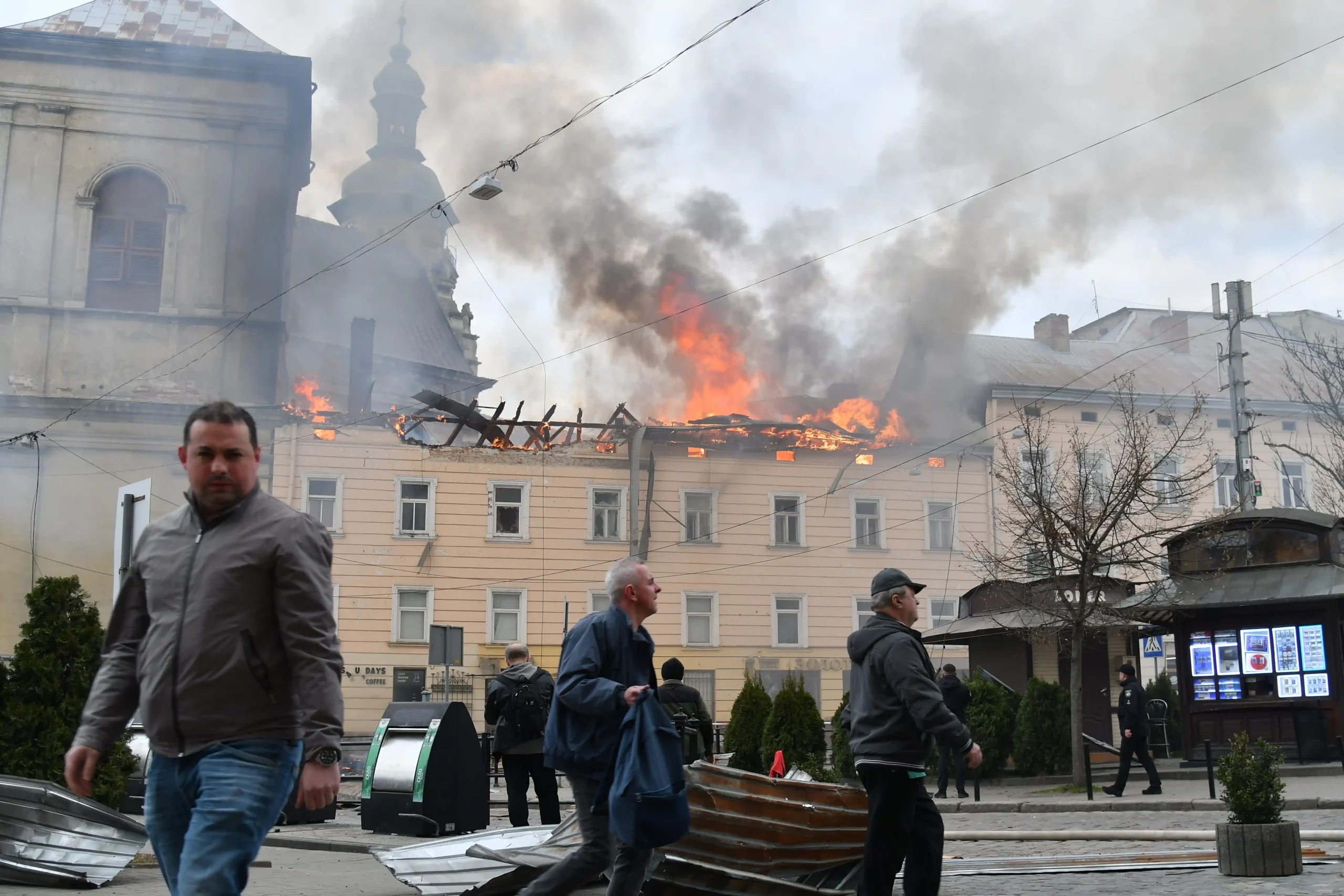
‘Easter Escalation’: Ukrainian Homes Decimated on Good Friday by Russian Attack
As Ukrainian families marked Good Friday, Russian missiles and Shahed drones tore through residential neighborhoods across the country in what Kyiv described as a deliberate attempt to maximize civilian suffering during the Easter holiday period. High-rise apartment buildings were struck in Kharkiv — Ukraine’s second-largest city and the closest major urban center to the Russian border — with the city’s mayor reporting that 25 residential buildings and three non-residential structures were damaged in a single day. Russia used jet-powered drones against Kharkiv for the first time, exploiting their higher speed to reduce the time available for air defenses and residents to reach shelters. In Sumy, a drone struck a shopping center in the city center, injuring three people. In Obukhiv near Kyiv, a drone smashed directly into a residential building.
‘Easter Escalation’: Ukrainian Homes DECIMATED on Good Friday by Russian Attack. Source: New York Post / YouTube.
Why This Moment Matters
Friday’s mass strike lands at a moment of acute strategic uncertainty. Peace negotiations mediated by the United States have been effectively suspended since the outbreak of the U.S.-Israel war against Iran on February 28. The Trump administration’s diplomatic bandwidth has been consumed by the Middle East, and Zelensky has repeatedly warned that Russia is exploiting the distraction to press its military advantage, stockpile weapons, and pocket the windfall of surging oil revenues driven by Iran’s closure of the Strait of Hormuz.
“Terrorist Russia strikes in broad daylight deliberately — to maximise civilian casualties and damage. This is how Moscow responds to Ukraine’s Easter ceasefire proposals — with brutal attacks.”
— Ukrainian Foreign Minister Andriy Sybiha, April 3, 2026
British intelligence assessments describe the current frontline situation as the most favorable for Ukraine in the past ten months — a notable development given the relentless Russian pressure of recent months. Yet that tactical improvement has not translated into diplomatic leverage, and the gap between battlefield reality and the negotiating table remains wide.
Ukraine’s Last Remaining Artery Swarmed by Russian Drones
Beyond the mass civilian strikes, Friday brought another critical dimension of the war into sharp focus: Russia’s sustained drone campaign against Ukraine’s remaining supply and logistics corridors. With so much of Ukraine’s infrastructure already degraded by years of sustained attack — every power plant in the country damaged, 70 percent of generating capacity destroyed or occupied — the integrity of Ukraine’s last functioning supply arteries has become a defining strategic question. Russian drone swarms have been targeting these routes with increasing frequency and sophistication, deploying kamikaze UAVs in coordinated waves designed to overwhelm Ukrainian air defenses and interdict the flow of weapons, ammunition, fuel, and humanitarian supplies to frontline units and civilian populations alike.
Ukraine’s Unmanned Systems Forces and military intelligence have responded by accelerating their own drone campaign deep inside Russian territory — striking logistics hubs, oil export terminals, and weapons production facilities to disrupt Russia’s ability to sustain its offensive tempo. In March 2026 alone, Ukrainian drones struck targets in 27 Russian regions, with long-range strike operations doubling in frequency compared to late 2025 according to Kyiv Post analysis.
Ukraine’s Last Remaining Artery Swarmed By Russian Drones | Ukraine Front Line Update. Source: Radio Free Europe/Radio Liberty / YouTube.
The Frontlines: Where Things Stand
Track live conflict events, missile strikes, and territorial changes via these real-time maps:
- ISW Interactive Ukraine War Map — Daily Institute for the Study of War terrain assessments
- LiveUAMap — Real-time Ukraine conflict events and frontline news
- ACLED Ukraine Conflict Monitor — Weekly verified conflict data and situation updates
As of April 3, Russian forces control approximately 20 percent of Ukrainian territory, including Crimea and large sections of the Donbas. Russia’s Defense Ministry declared on April 1 that it had “completed the liberation” of Luhansk Oblast — though Ukraine controlled only a fraction of a percent of the region, and Kyiv did not confirm the claim. In Donetsk Oblast, Ukraine still holds approximately 19.5 percent of the region, with the Kremlin demanding full Ukrainian withdrawal as a precondition for any peace talks.
The heaviest fighting on April 3 was concentrated in the Pokrovsk sector in Donetsk, where Russian forces carried out nearly 50 attacks on Ukrainian positions in a single day, losing more than 130 troops in the process. Across the entire frontline, 213 combat engagements were recorded. In the Oleksandrivka direction in the south, Ukrainian Air Assault Forces have liberated 11 settlements in recent weeks. Ukrainian forces also struck the Kirovske airfield in occupied Crimea overnight on April 2, destroying an An-72 aircraft and an Orion drone base.
The rate of Russian advance has slowed sharply in 2026. According to ISW data analyzed by Russia Matters, Russian forces actually lost 12 square miles of Ukrainian territory in the period from March 3 to March 31 — compared to gaining 46 square miles in the preceding four weeks. February 2026 was the first month since 2024 in which Ukraine regained more territory than it lost, with ISW estimating Ukrainian forces liberated over 154 square miles in the Oleksandrivka and Huliaipole directions between January and mid-March.
Ukraine Strikes Back Deep Inside Russia
Ukraine’s response to Russia’s bombardment has not been passive. On the night of April 3, Ukrainian drones struck targets in Moscow and the Leningrad Region. Over the preceding month, Ukraine’s drone forces repeatedly struck Russia’s Baltic oil export infrastructure — hitting the port of Ust-Luga five times in ten days and forcing Russia to ban refined petrol exports between April 1 and July 31 to stabilize domestic prices. Ukraine also struck the Promsintez explosives plant in the Samara region, a facility that produces 30,000 tonnes of military explosives annually. The head of Ukraine’s Center for Countering Disinformation estimated that Russia has lost 45 percent of its missile production capacity through such strikes.
Zelensky has also secured defense agreements with Gulf states during a recent Middle East tour, signing air defense deals with the UAE and Qatar and reporting active discussions with Saudi Arabia, Jordan, Kuwait, Iraq, and Bahrain — exporting Ukraine’s drone warfare expertise in exchange for joint production agreements and giving Kyiv new strategic relevance in a region focused on the Iran conflict.
Related Coverage
For in-depth background on the Kharkiv strikes, the stalled U.S.-mediated peace process, and the broader context of how the Iran war is reshaping Ukraine’s position, read our full earlier report: Russia Hammers Kharkiv as Peace Talks Stall and Ukraine Battles in the Shadow of the Iran War.
Key Facts
- 579 — total projectiles fired at Ukraine on April 3: 37 missiles + 542 Shahed drones (Kyiv Post / Ukrainian Air Force)
- 25 — residential high-rise buildings damaged in Kharkiv alone in a single day
- 213 — combat engagements recorded across the frontline on April 3 (Ukrainian General Staff)
- ~50 — Russian attacks in the Pokrovsk sector alone in 24 hours
- 1,301,260 — estimated total Russian military casualties since February 24, 2022, as of April 3
- 1,230 — Russian soldiers killed or wounded in the past 24 hours alone
- 12 sq miles — Ukrainian territory Russia lost in March 2026, reversing prior gains (ISW)
- 45% — estimated share of Russia’s missile production capacity destroyed by Ukrainian strikes
- 20% — share of Ukrainian territory under Russian occupation as of April 2026
The Diplomatic Deadlock
U.S.-brokered peace talks between Russia and Ukraine have been on hold since the Iran war began. Zelensky has invited an American delegation to Kyiv to restart negotiations, proposing a sequential format: “The American group can come to us and, after us, go to Moscow. If it does not work out with three parties, let’s do it this way.” The Kremlin rejected the Easter ceasefire proposal outright, reiterating that Ukraine must withdraw from all of Donetsk Oblast — a demand Kyiv describes as tantamount to surrender. Russia has simultaneously issued what Zelensky described as an ultimatum to Washington: Ukraine must withdraw from the Donbas within two months or Russia will harden its peace terms further.
Analysis
Striking Ukrainian homes on Good Friday while rejecting an Easter ceasefire proposal is not a miscalculation on Moscow’s part — it is a message. Russia is telling Kyiv, Washington, and European capitals that it does not recognize Ukraine’s peace gestures as worthy of reciprocation, and that no holiday, no diplomatic overture, and no humanitarian consideration will interrupt its military campaign. The timing is designed to demoralize, to demonstrate impunity, and to signal to a Trump administration distracted by the Iran war that Russia intends to press its advantage for as long as the window remains open.
Ukraine’s position is difficult but not without strength. The slowing of Russian territorial advances, the unprecedented gains in the south, and the escalating drone campaign against Russian infrastructure all point to a military that has adapted and hardened rather than collapsed under pressure. But adaptation under fire is not the same as winning. Without sustained military aid, renewed U.S. diplomatic engagement, and security guarantees with real teeth, Ukraine faces the grim prospect of fighting indefinitely against a larger adversary that has made clear it sees time as its greatest ally.
Friday’s 579-projectile strike — the largest of 2026 — delivered on Good Friday against civilian homes — is Russia’s clearest statement yet of where it stands. The question now is whether the world is still listening.
Sources
- Kyiv Post — Russia Launches Major Drone, Missile Assault Across Ukraine Amid Easter Ceasefire Push
- Euronews — Kyiv Region Under Massive Daytime Drone and Missile Attack
- Al Jazeera — Ukraine Slows Enemy Advances, Liberates Land, Drains Russia’s War Chest
- Russia Matters — Russia-Ukraine War Report Card, April 1, 2026