Russia Su-57 Plant Fire Satellite Images Confirm Damage at KnAAZ
1
Russia’s Only Serial Su-57 Production Facility
300
Composite Part Types Made in Workshop 46
20–25
Total Su-57s Built Including Prototypes
2025
Last Year Only 2 Su-57s Delivered to VKS

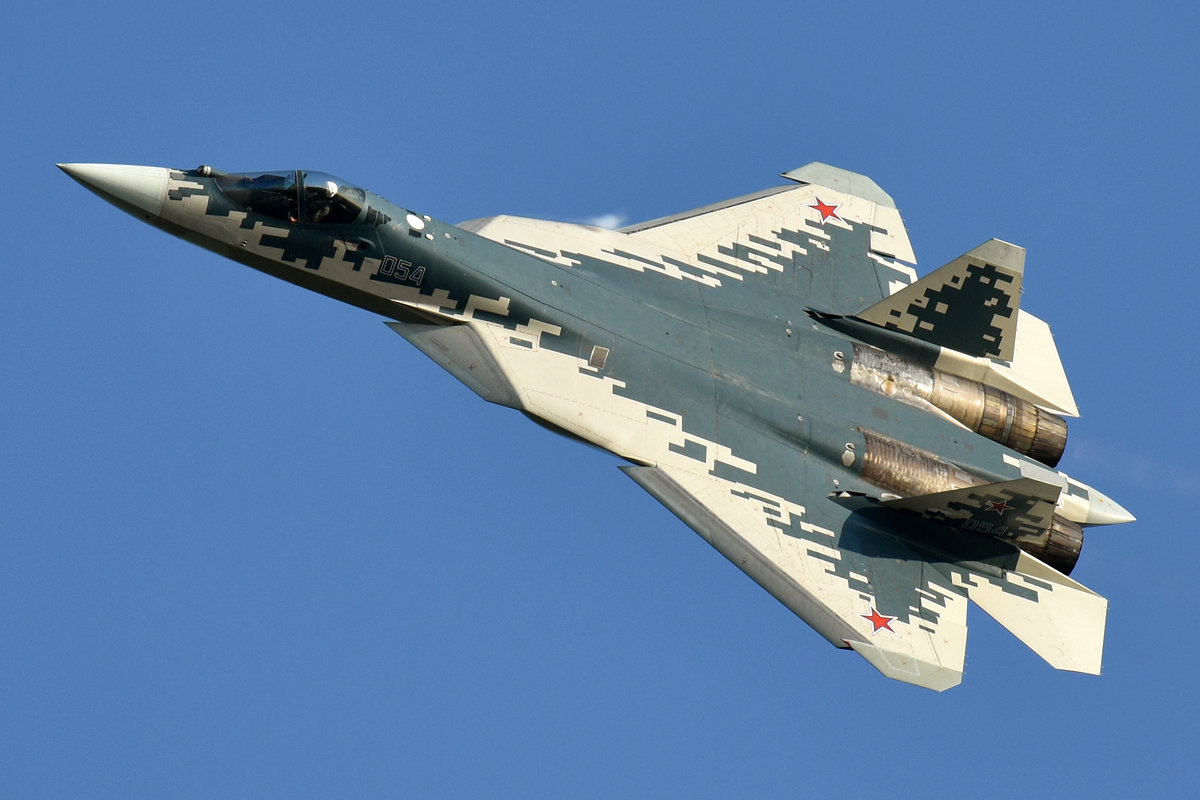
The Sukhoi Su-57 Felon — Russia’s fifth-generation stealth multirole fighter and the sole product of the KnAAZ plant’s advanced composite manufacturing programme. Only 20–25 have been built in total including prototypes. A fire in Workshop 46, which produces approximately 300 composite component types for the Su-57 airframe, was confirmed on April 11, 2026. Source: Wikimedia Commons.
🔴 What Happened
Fire Breaks Out at Russia’s Only Su-57 Production Plant
On April 11, 2026, a fire broke out inside the Komsomolsk-on-Amur Aviation Plant — known by its Russian abbreviation KnAAZ — the sole facility in Russia certified for the serial production of the Su-57 Felon fifth-generation fighter. The fire was first recorded on video by the Telegram channel Exilenova+ and subsequently confirmed through geolocation analysis by the OSINT community CyberBoroshno, which identified the burning structure as Workshop No. 46 — the plant’s dedicated polymer composite manufacturing facility.
Satellite imagery published in the hours following the incident confirmed visible damage to the workshop structure. As of publication, neither KnAAZ, the Sukhoi Company, the United Aircraft Corporation nor Russian emergency services had issued any official statement on the cause of the fire or the extent of damage to the workshop or its equipment. The cause remains officially unknown and Strategy Battles will not speculate on origin.
Workshop No. 46 is not a peripheral structure. It is the dedicated production facility for polymer composite material components used in the Su-57 airframe — approximately 300 distinct part designations, of which roughly 100 are large-format structural elements. — Global Defense Corp OSINT assessment, April 12, 2026.
🟡 Why It Matters
Workshop 46 — The Irreplaceable Heart of Su-57 Manufacturing
To understand why this fire is strategically significant, it is necessary to understand what Workshop 46 actually produces. According to the CyberBoroshno assessment, the facility manufactures approximately 300 types of polymer composite material components for the Su-57 airframe — including around 100 large structural elements. The specific parts produced there include aileron panels, air intakes, flaperon panels, floor sections and outer wing tip fairings.
These are not interchangeable parts. The Su-57’s airframe relies heavily on polymer composite materials to reduce radar cross-section and minimise structural weight — the two characteristics that define its claim to fifth-generation performance. Composite components of this type cannot simply be sourced from an alternative domestic supplier on short notice. There is no secondary facility in Russia certified to produce them at the required precision and scale. Any meaningful disruption to Workshop 46’s output cascades directly into Su-57 airframe assembly further down the production line.
Workshop 46 — What It Produces (OSINT Assessed)
- Total component types: ~300 polymer composite material (PCM) parts for the Su-57 airframe
- Large structural elements: ~100 — including aileron panels, air intakes, flaperon panels, floor sections and wing tip fairings
- Why PCM matters: Composite materials reduce the Su-57’s radar cross-section and structural weight — core fifth-generation characteristics that cannot be replicated using metal alternatives
- Alternative suppliers: ONPP Technologiya cited as partial alternative — analysts assess it could only partially compensate and would introduce significant scheduling delays
- Western sanctions impact: KnAAZ was sanctioned by the U.S. in March 2022 and the EU thereafter — replacement of any specialised manufacturing equipment through legal channels is impossible, requiring domestic substitutes already under strain
🔵 Programme Context
Russia’s Su-57 Programme — Already Running Far Behind Schedule
The Su-57 Felon is Russia’s answer to the American F-22 Raptor and F-35 Lightning II. The programme entered flight testing in 2010. Sixteen years later, the total number of Su-57s produced — including all prototypes — is estimated at between 20 and 25 aircraft, according to multiple open-source assessments. The Russian Aerospace Forces (VKS) received just two Su-57s in 2025. In the same year, the plant delivered seven batches of Su-35S fighters, suggesting production capacity is being consumed primarily by the older fourth-generation platform.
A 2019 state contract committed Russia to deliver 76 Su-57 airframes to the VKS by 2027–2028. At the current delivery rate of approximately two per year, that target is entirely unachievable. Technological bottlenecks, the post-2022 sanctions environment and the diversion of industrial capacity to support ongoing wartime production of older platforms have all been cited in open-source analysis as factors driving the programme’s chronic underperformance.
Satellite imagery from February 9, 2026 published by the AviVector project and reported by Militarnyi showed Russia had concentrated nearly its entire Su-57 fleet — approximately 15 to 20 aircraft — at the Dzyomgi air base in the Far East, located adjacent to the KnAAZ production plant. This positioning was assessed at the time as serving two purposes: protecting the limited fleet from Ukrainian drone strikes, and keeping aircraft close to technical staff for ongoing flight trials and staged upgrades. The proximity of that concentrated fleet to the now-damaged workshop adds a further dimension to the strategic picture.
🔴 OSINT Pattern Analysis
A Programme Under Pressure — Previous Damage and Supply Chain Strikes
The KnAAZ fire is not an isolated event in the context of the Su-57 programme’s difficulties. In June 2024, two Su-57 aircraft were reportedly damaged in a Ukrainian drone strike at the Akhtubinsk air base in Russia’s Astrakhan region — 589 kilometres from the front line. Satellite imagery from Maxar Technologies published by The War Zone confirmed burn marks and a small crater adjacent to one of the aircraft. Whether either aircraft has been repaired and returned to service has not been publicly confirmed.
Earlier in 2026, Ukraine targeted the SKIF-M tool factory — identified by the Royal United Services Institute as a vulnerable link in Sukhoi aircraft production. SKIF-M manufactures specialised drills, cutters and inserts with 70% of its products designed specifically for processing aerospace materials. Its subsidiary, SKIF-M DV, is registered two blocks from KnAAZ in Komsomolsk-on-Amur. Low-resolution Copernicus satellite imagery from January 5, 2026 showed roof repairs at the SKIF-M plant had not yet been completed, indicating significant internal damage remained unresolved months after the strike.
The cumulative picture — an already delayed programme, an airframe fleet damaged at its operating base, a key tool supplier struck and not yet repaired, and now a fire in the sole composite materials workshop — places the Su-57’s near-term production timeline under serious pressure, independent of the as-yet-unknown extent of damage from the April 11 fire.
Strategy Battles Assessment
The fire at Workshop 46 is significant precisely because of how little slack exists in the Su-57 programme. Russia has one plant. One composite workshop within that plant. A fleet of fewer than 25 aircraft in total. A contract it was already failing to fulfil. And a sanctions environment that makes replacing specialised manufacturing equipment through legal channels impossible.
Until the extent of damage to Workshop 46’s equipment — not just its structure — is confirmed by satellite imagery or official statement, the strategic impact cannot be fully quantified. What is clear is that any meaningful disruption to composite component output will be felt in Su-57 delivery schedules months down the line. Russia’s only fifth-generation fighter programme has almost no redundancy built into its supply chain. The margin for error was already zero. It may now be negative.
Strategy Battles — Related Coverage
Sources
- Defence Blog — Fire Catches Russia’s Only Su-57 Production Plant in Komsomolsk-on-Amur (April 12, 2026)
- Militarnyi — Fire Reported at Russian Plant Producing Su-35S, Su-57 (April 12, 2026)
- Global Defense Corp — Fire at Russia’s Only Su-57 Serial Production Factory (April 12, 2026)
- The Defense News — Fire at KnAAZ Aviation Plant Disrupts Su-57 and Su-35S Production (April 12, 2026)
- 19FortyFive — Russia Massing Su-57 Fleet at Dzyomgi Base Near KnAAZ Plant (February 2026)
- Militarnyi — Flamingo Cruise Missiles Hit Tool Factory Critical to Russian Aircraft Production (January 2026)
- The War Zone — Su-57 Felon Struck Deep Inside Russia — Satellite Images (June 2024)
Editorial Verification
This report has been reviewed for technological accuracy and cross-referenced against open-source military technology reporting. The fire at Workshop 46 is confirmed via social media footage and OSINT geolocation by CyberBoroshno. Satellite imagery confirmation of structural damage is referenced from Defence Blog and Global Defense Corp analysis. The cause of the fire has not been officially confirmed and Strategy Battles makes no claims regarding its origin. Production and programme figures are drawn from multiple open-source defence analysis outlets and are consistent across sources.
Approved for Publication
Marcus V. Thorne
Lead Editor, Strategy Battles
©StrategyBattles.net 2026
This article is for news and analysis purposes only. It is based on publicly available news sources and military updates. All rights reserved. Original reporting may come from various open sources. Not for commercial reuse without permission.