U.S. B-52 Bombers Now Flying Over Iran, Signalling Air Dominance as War Enters Sixth Week
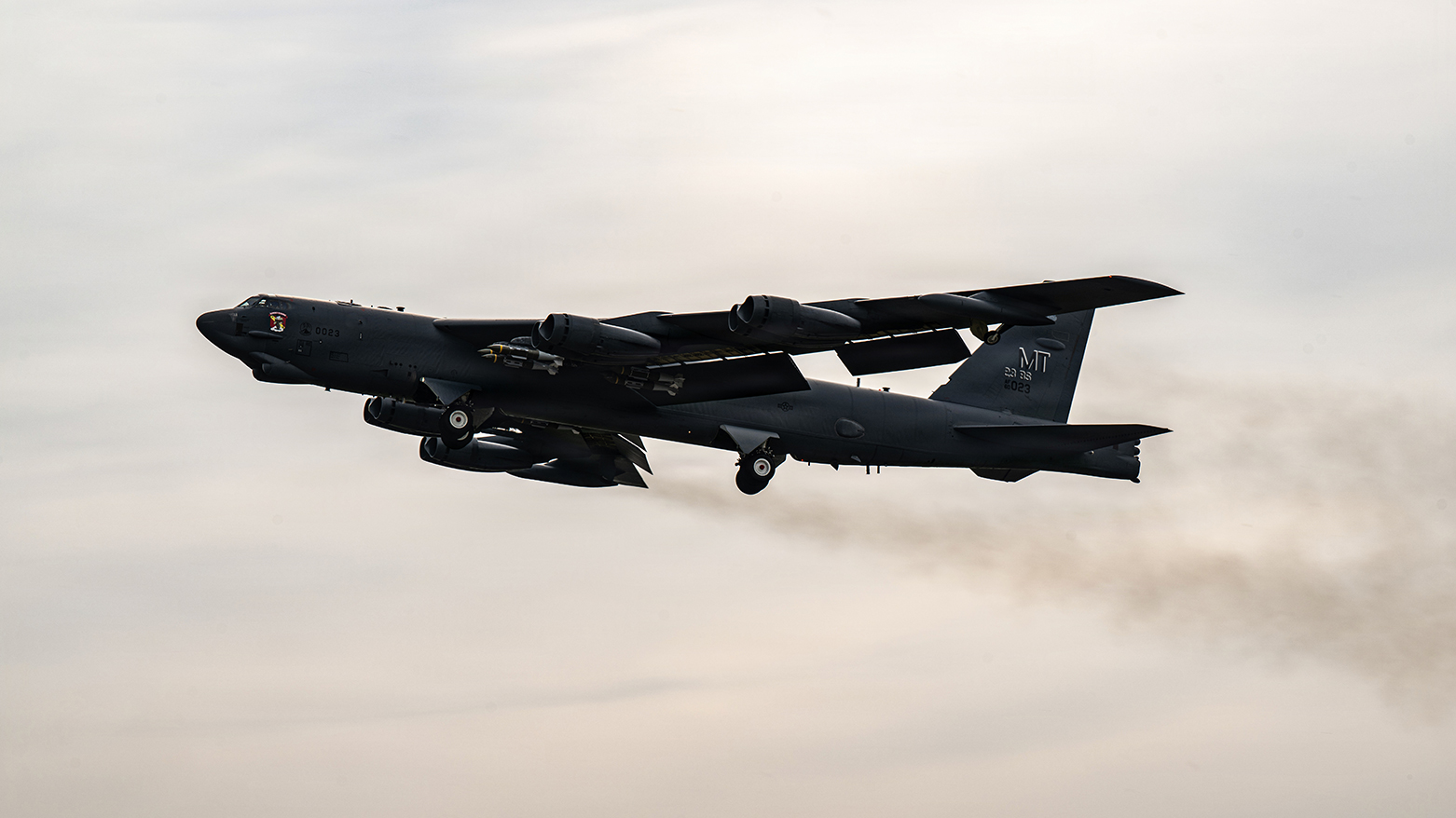
Watch: U.S. B-52 Bombers Signal Air Dominance Over Iran
Video: U.S. B-52 Stratofortress bombers operating during Operation Epic Fury as the war with Iran enters its sixth week. Source: YouTube.
Why This Moment Matters
The deployment of B-52s over Iranian territory is not merely a logistical footnote — it is a strategic statement. The B-52 is slower than modern combat aircraft and carries no stealth characteristics, making it acutely vulnerable to functional air defense systems. The fact that it is now operating directly over Iran means that the air defense umbrella Tehran spent decades building has been reduced to a point where it can no longer credibly threaten one of America’s most recognizable and least stealthy aircraft. Military analyst Rebecca Grant told Fox News Digital that B-52s flying over Iran show “America’s complete air dominance,” adding that the bombers are escorted at high altitude by F-22 and F-35 fighters and bring large bomb payloads for direct attacks on Iran’s drone and missile factories as well as underground targets.
“The fact that these B-52s are now flying over Iran is clear evidence that we have air superiority — and even air dominance over parts of Iran.”
— Mark Gunzinger, retired U.S. Air Force Colonel and former B-52 command pilot, speaking to Fox News Digital, April 3, 2026
Background and Chronology
The U.S. bomber fleet has been integral to Operation Epic Fury since its opening hours on February 28, but the aircraft used and how they were deployed has evolved significantly over the five weeks since. On the first night of the war, four stealthy B-2 Spirit bombers flew nonstop roundtrips from the continental United States to strike Iran’s hardened ballistic missile facilities — the same aircraft type used in the June 2025 strikes on Fordow and Natanz. B-1B Lancer bombers and B-52s followed in subsequent days, initially firing stand-off cruise missiles and Joint Air-to-Surface Standoff Missiles from outside Iranian airspace, where they faced less risk from Iran’s still-functioning surface-to-air missile batteries.
As the weeks progressed and U.S. and Israeli strikes systematically dismantled Iranian air defenses — taking out more than 100 air defense systems and approximately 120 detection systems by IDF count — the operational risk calculus shifted. Open-source flight trackers and aircraft spotters at RAF Fairford in England, where the U.S. has based 15 B-1B Lancers and eight B-52s according to the Military Air Tracking Alliance, began photographing the aircraft departing with JDAM-guided gravity bombs rather than the longer-range missiles used earlier. Two specific B-52H Stratofortresses, callsigns “Witches Brew” and “The Big Stick,” were tracked departing on overland missions. The transition from cruise missiles fired at standoff range to gravity bombs dropped directly over targets is the operational signature of a force that believes the skies are now its own.
By March 31, General Caine made the shift official at the Pentagon podium. U.S. forces had by that point conducted more than 11,000 strikes against targets in Iran since the war began, according to CENTCOM. The pace of Iranian ballistic missile launches had dropped by more than 90 percent compared to the conflict’s opening days, attributed by the IDF to the destruction of approximately 70 percent of Iran’s estimated 500 missile launchers. Defense Secretary Pete Hegseth stated at the same briefing that reopening the Strait of Hormuz — still the war’s most consequential unresolved issue — is not a core objective of Operation Epic Fury, which he defined as eliminating Iran’s nuclear capabilities, crippling its ballistic missile manufacturing, and destroying its navy.
What the B-52 Brings to the Fight
The B-52H Stratofortress, in service since 1955 and expected to remain operational into the 2050s, offers something no other aircraft in the U.S. inventory can match at scale: volume. The aircraft can carry up to 70,000 pounds of ordnance — more than any other bomber in the U.S. arsenal — and deliver a combination of 2,000-pound JDAMs, 5,000-pound GBU-72 Advanced Penetrators, cruise missiles, and standoff weapons in a single mission. A single B-52 can carry 20 two-thousand-pound JDAMs, or 30 one-thousand-pound variants. Retired Air Force Colonel Mark Gunzinger told Fox News Digital that the bomber’s ability to remain over the battlefield and strike multiple targets as they emerge — including mobile missile launchers that are only briefly exposed — marks a fundamental difference from the earlier phase of pre-planned strikes on fixed targets. “If you really want to devastate Iran’s ability to continue to launch missiles and drones, you would want to use bombers to do that,” Gunzinger said.
The Air Force and Space Force have now conducted more than 10,000 combat flights over Iran since February 28, according to CENTCOM, employing every type of operational fighter, bomber, and aerial tanker in the U.S. inventory. The bomber armada currently engaged in the campaign — approximately two dozen aircraft — is more varied and more active than Operation Midnight Hammer, the June 2025 one-night strike on Iranian nuclear facilities that used seven B-2s on a single roundtrip mission. That operation, however intense, was a surgical intervention. Operation Epic Fury is a sustained campaign of industrial-scale destruction, and the B-52 — built for exactly that kind of prolonged, high-volume warfare — is now its central instrument.
Key Facts
- March 31, 2026 — date General Dan Caine officially confirmed B-52 overland missions over Iran had begun
- 11,000+ — total U.S. strikes conducted against targets in Iran since February 28 (CENTCOM)
- 10,000+ — combat flights by U.S. Air Force and Space Force as of March 23 (CENTCOM)
- 70,000 lbs — maximum ordnance payload of a single B-52H Stratofortress
- 15 B-1Bs and 8 B-52s — U.S. bombers based at RAF Fairford, England for Operation Epic Fury (Military Air Tracking Alliance)
- 70% — estimated share of Iran’s ballistic missile launchers destroyed or disabled (IDF)
- 90%+ — reduction in Iranian missile launches compared to the conflict’s opening days
- 70 years — the B-52’s continuous service life, with the aircraft expected to serve until the 2050s
Iran Strikes U.S.-Linked Sites in Jordan, Kuwait and Bahrain
While U.S. B-52s pressed their campaign over Iran from above, Tehran simultaneously launched its 53rd operational communiqué of the conflict on Friday, announcing fresh strikes on strategic sites linked to U.S. forces in Jordan, Kuwait and Bahrain. In Kuwait, Iran claimed to have struck Camp Arifjan — one of the most significant U.S. Army logistical hubs in the Middle East. In Bahrain, it targeted the Alba aluminium plant, the world’s largest aluminium smelter. In Jordan, it struck locations used to store equipment and house American personnel.
Iran warned that any further attacks on its territory would be met with a “compound response” exceeding adversarial expectations — a threat issued at the precise moment B-52s were flying overhead dropping precision-guided bombs. The strikes on Alba are part of Iran’s deliberate strategy of targeting Gulf industrial infrastructure, with aluminium prices already at four-year highs following weeks of Iranian strikes on the region’s heavy industry. For a full breakdown of Iran’s Gulf strike campaign, see our report: Iran Strikes U.S.-Linked Sites in Jordan, Kuwait and Bahrain.
Analysis
The B-52’s arrival over Iranian skies is the clearest operational marker yet that the air campaign has crossed a threshold. When the war began, only stealth aircraft — B-2s, F-35s, and possibly classified platforms — could safely penetrate Iranian airspace. That was five weeks and more than 11,000 strikes ago. The systematic destruction of Iran’s integrated air defense network has now opened corridors wide enough for the Cold War-era Stratofortress to operate, and with it comes a qualitative shift in strike capacity: more bombs per sortie, more flexible targeting, less reliance on expensive cruise missiles, and the ability to loiter and re-engage mobile targets that fixed-strike weapons cannot easily pursue.
Yet the political horizon remains as unclear as the skies over Tehran are open. The Pentagon has confirmed that reopening the Strait of Hormuz is not a defined military objective of Epic Fury — a striking admission given that the strait’s closure is inflicting the war’s most severe global economic damage. The B-52 can destroy a missile factory, but it cannot reopen a shipping lane. It can crater a command bunker, but it cannot produce a government in Tehran willing to negotiate on terms acceptable to Washington. As the bombers circle overhead and the bombs fall with increasing volume, the central unanswered question of this war remains unchanged: what end state, exactly, is all of this destruction meant to produce?
Sources
- Kurdistan 24 — U.S. B-52 Bomber Flights Signal Air Dominance as War in Iran Enters Sixth Week
- Fox News — What B-52 Bombers Bring to the Iran Fight and What It Means for the War Now
- Air & Space Forces Magazine — B-52s Carrying JDAMs over Iran as U.S. Bombers Play Growing Role in Air War
- Air & Space Forces Magazine — USAF and USSF Lead in Biggest Air Campaign Since 2003