Russian Drone Hits Chinese Cargo Ship Near Odesa Hours Before Putin’s Beijing Visit, Ukraine Says
Threat Level Assessment
LEVEL 4 OF 5, SERIOUS
Bottom Line Up Front
A Russian Shahed one-way attack drone struck the Chinese-owned bulk carrier KSL Deyang in the Black Sea near Odesa overnight on 18 May 2026, in an attack the Ukrainian Navy says also hit a second civilian vessel flying the flag of Guinea-Bissau. All crew members were Chinese nationals; none were injured and both ships continued toward port. The strike occurred fewer than 24 hours before Russian President Vladimir Putin was scheduled to arrive in Beijing for talks with Chinese President Xi Jinping, prompting Ukrainian President Volodymyr Zelensky to assert publicly that Moscow was aware of the nationality of the vessel it targeted. Russia has not commented.
Key Judgments
The KSL Deyang was struck by a Russian Shahed-type one-way attack drone. This is confirmed by the Ukrainian Navy’s Telegram statement with accompanying photographs of the damaged vessel, independently corroborated by Ukrainian Navy spokesperson Dmytro Pletenchuk’s public Facebook post naming the platform explicitly, and carried by AFP, Al Jazeera, and the Kyiv Independent. Russia has not denied the attack. The ship’s ownership is Chinese and its crew are Chinese nationals, confirmed by Ukraine’s Navy and a source cited by Reuters.
The timing relative to Putin’s Beijing visit is diplomatically significant but does not by itself indicate intentionality. Russian Shahed strikes on the Greater Odesa maritime corridor have been a consistent pattern since Moscow withdrew from the Black Sea Grain Initiative in 2023. The strike zone sits in a waiting area used by all vessels approaching Odesa-region ports; a Chinese-flagged ship in that anchorage is not an unusual presence. Whether the targeting was deliberate, indiscriminate within a known-active zone, or an error within a mass-drone attack of 524 UAVs launched that same night cannot be established from open sources alone.
Whether Beijing will raise the incident formally before or during Putin’s visit. China’s public posture across the war has been to absorb friction with Moscow quietly while maintaining rhetorical neutrality. The KSL Deyang incident is the most direct physical harm Russia has inflicted on Chinese-linked assets in the Black Sea to date, but a diplomatic rupture or public protest from Beijing in the current climate would be a significant departure from established pattern.
1
Chinese Vessel Struck
2
Total Vessels Hit, 18 May
524
Russian Drones, Overnight
0
Crew Casualties, Both Vessels
📍 Black Sea, Greater Odesa Region / KSL Deyang Strike Zone / 18 May 2026

Greater Odesa maritime corridor with approximate strike zone for the KSL Deyang. Datum WGS84, UTM Zone 36T. Map: Strategy Battles / OSINT.
📍 KSL DEYANG STRIKE ZONE
MGRS: 36TUS 25117 54351
46.5200°N 30.7200°E
Approximate point. Chinese-owned bulk carrier KSL Deyang struck by Shahed drone overnight 18 May. Vessel was in waiting area approaching ports of Greater Odesa. No crew casualties.
📍 PIVDENNYI PORT (DESTINATION)
MGRS: 36TUS 46819 62658
46.6000°N 31.0000°E
KSL Deyang was proceeding here to load iron ore concentrate, per a Reuters source. Vessel continued to port after the strike despite sustaining damage.
📍 CHORNOMORSK PORT AREA
MGRS: 36TUS 26723 29840
46.3000°N 30.7500°E
Greater Odesa port zone. Guinea-Bissau-flagged second vessel also struck by Russian drone in same attack sequence; small fire extinguished by crew. No casualties.
📍 ODESA CITY, CROSS-CHECK REFERENCE
MGRS: 36TUS 25250 50177
46.4825°N 30.7233°E
Odesa city centre. Cross-check reference for MGRS grid orientation. Strike zone sits approximately 4km north-northwest of city centre, in the offshore waiting area.
SITREP Timeline : Russian Attacks on Black Sea Shipping, 2023 to May 2026
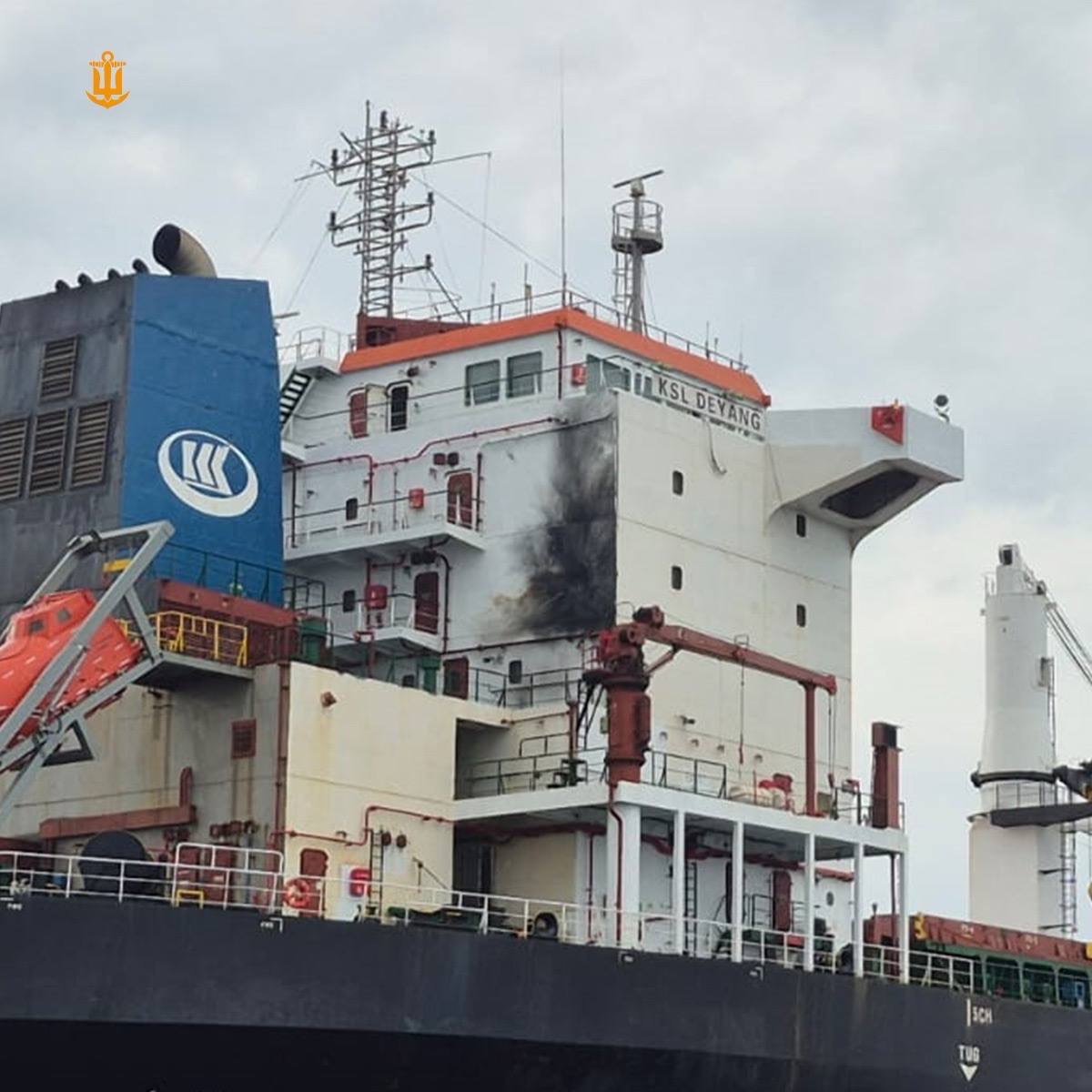
KSL Deyang after the Shahed strike: black scorch marks are visible on the bridge superstructure. The vessel name is legible on the bridge face. The lifeboat davit is undamaged. Photo: Ukrainian Navy / Official Telegram Channel, 18 May 2026.
🔴 The Strike
One Shahed, One Chinese Bulk Carrier, And A Night Ukraine’s Navy Called Something New
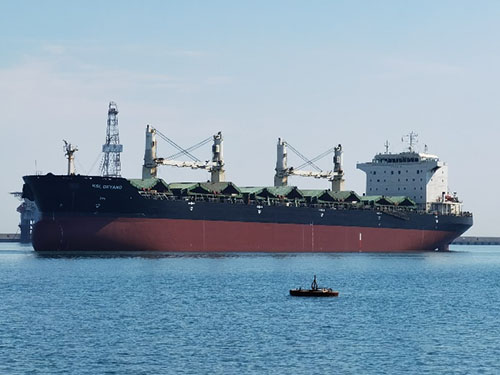
At approximately grid reference 36TUS 25117 54351 (46.5200°N, 30.7200°E), in the offshore waiting area north of Odesa city, a Russian one-way attack drone struck the bulk carrier KSL Deyang in the early hours of 18 May 2026. The Ukrainian Navy confirmed the incident via its official Telegram channel, publishing photographs of the damaged vessel. The ship, designed to carry unpackaged bulk cargoes such as grains and coal, was flying the flag of the Marshall Islands, is owned by a company based in China, and carried an all-Chinese crew.
Ukrainian Navy spokesperson Dmytro Pletenchuk confirmed in a public Facebook post that the platform was a Shahed drone, the Iranian-designed kamikaze UAV that Russia has deployed by the thousands across the war. None of the crew members were injured, Pletenchuk told AFP, and the vessel continued toward its destination after the crew managed the post-strike damage independently. A source cited by Reuters separately confirmed the ship had been proceeding to Pivdennyi port, at approximately 36TUS 46819 62658 (46.6000°N, 31.0000°E), where it was to load iron ore concentrate.
The same overnight attack sequence also struck a second civilian vessel flying under the flag of Guinea-Bissau, Odesa Oblast Governor Oleh Kiper reported via Telegram. Both ships were in the waiting area and moving through Ukraine’s established maritime corridor toward the ports of Greater Odesa. Small fires broke out on both vessels and were extinguished by their respective crews. No crew members on either ship reported injuries.
🟡 The Timing
Putin Was Airborne for Beijing Within Hours. Kyiv Says That Cannot Be a Coincidence.
The strike occurred fewer than 24 hours before Russian President Vladimir Putin was scheduled to arrive in Beijing for a two-day visit to meet Chinese President Xi Jinping. The visit is framed by Moscow as a deepening of the bilateral strategic partnership that has been a central feature of Russian foreign policy since the full-scale invasion of Ukraine in February 2022. The timing was not lost on Kyiv. Ukrainian President Volodymyr Zelensky stated in a social media post that the Russians could not have been unaware of what vessel was at sea.
Pletenchuk was more pointed. In his Facebook post, he asked what motivated the Russians when they decided to hit a Chinese commercial vessel in Ukraine’s sea with a Shahed drone, calling it something new and asking sarcastically whether the attack had been a terrible mistake. The Ukrainian Navy’s official statement went further, asserting that Russia had demonstrated its attacks threaten not only Ukraine but now even the ships of its closest partners operating in the Black Sea.
Russia did not comment on the strike at the time of publication. Kremlin spokesperson Dmitry Peskov, speaking the same day on a separate topic, said Russia was calling for Ukraine peace talks to resume, but gave no statement on the maritime incident. The absence of a denial is itself notable: Moscow typically contests or contextualises Ukrainian strike reports when it believes the framing is inaccurate.
Volodymyr Zelensky, President of Ukraine : Social Media Statement, 18 May 2026
“Drones struck Odesa and one of the UAVs hit a vessel owned by China. The Russians could not have been unaware of what vessel was at sea.”
🔵 The Ship And The Corridor
KSL Deyang Was Not a Random Target in an Empty Sea
The KSL Deyang (IMO 9457725) is a bulk carrier built to carry unpackaged commodities including grain and coal. It was carrying no cargo at the time of the strike, proceeding in ballast toward Pivdennyi port to load iron ore concentrate. The vessel was in the offshore waiting area that ships routinely use when approaching the ports of Greater Odesa, a zone Ukraine maintains as an active maritime corridor. Waiting area designation does not appear to have deterred Russian strikes in the past; the Odesa maritime zone has been struck repeatedly since 2023.
China’s role in Russia’s war economy creates the diplomatic context that makes the incident awkward for Moscow. Researchers reported that Chinese firms transferred at least $61 million in components to sanctioned Russian companies between 2023 and 2024, with a significant share linked to production of Iranian-designed Shahed drones at the Alabuga special economic zone in Tatarstan, the very weapon type used against the KSL Deyang. Beijing supplies industrial inputs; Russia uses derivative systems to strike ships carrying Chinese crews. The irony was the direct subtext of Pletenchuk’s public statement.
China has attempted throughout the war to position itself as a neutral party while deepening economic and diplomatic coordination with Russia. That posture has drawn repeated Western criticism but has been a stable feature of Beijing’s foreign policy since the invasion. Whether the KSL Deyang incident forces any public adjustment to that posture, particularly given the Putin-Xi meeting scheduled to follow within hours, is the question that neither Kyiv’s press releases nor Moscow’s silence can answer.
⚠ Intent vs. Pattern
524 Drones in One Night: What the Mass-Attack Model Means for Establishing Intent
The overnight attack of 17 to 18 May was, by Ukrainian Air Force accounting, a mass assault: 524 attack drones and 22 missiles, including 14 ballistic ones. Ukrainian air defences downed 503 drones and four missiles; direct hits by 18 missiles and 16 drones were recorded at 34 separate locations across the country. Odesa Oblast was among the primary target zones, with two people injured in the broader attack, including an 11-year-old child. In this context, a Shahed finding a bulk carrier in a known active shipping corridor is consistent with the pattern of indiscriminate mass-launch operations rather than a precisely ordered maritime interdiction.
Zelensky’s assertion that Russia knew what vessel was at sea is politically powerful but analytically complex. Modern commercial shipping operates on internationally published passage notices, Automatic Identification System transponders, and port authority scheduling. The KSL Deyang’s position in the waiting area would have been visible to anyone monitoring AIS traffic. Whether that constitutes deliberate targeting of a Chinese-crewed vessel or awareness that a Chinese-crewed vessel was among targets in an active strike zone is a distinction that open sources cannot resolve. Pletenchuk’s framing was ironic, not conclusive.
What is not ambiguous is the structural message the Ukrainian Navy chose to emphasise: Russia’s Black Sea campaign now demonstrably endangers vessels belonging to states that Moscow considers partners. The KSL Deyang is the most visible instance of that dynamic to date, and its timing, whatever Moscow’s actual intent, makes it a diplomatic event as well as a maritime one.
Dmytro Pletenchuk, Ukrainian Navy Spokesperson : Facebook, 18 May 2026
“The ship was entering for loading. After it was hit at night by a Shahed, the crew coped with the consequences on their own. Fortunately, no one was injured, and the vessel continued on its way to its port of destination.”
Source Reliability Matrix
NATO grading: REL A (reliable) to F (unreliable). CRED 1 (confirmed) to 6 (cannot judge).
CRED 1
Primary source. Official Ukrainian Navy channel with photographs of damaged vessel. Carries institutional authority and has a consistent track record on Black Sea maritime reporting.
CRED 2
Wire agency corroborating primary. AFP carried direct quotes from Pletenchuk. CRED 2 reflects partial attribution through a naval spokesperson rather than independent first-hand confirmation of weapon type.
CRED 2
Independent Ukrainian outlet with a strong war-reporting track record. Adds detail on the Guinea-Bissau second vessel, the Odesa Oblast Governor’s Telegram statement, and broader overnight attack figures. Same sourcing as AFP on the Pletenchuk quotes.
CRED 2
Official regional government source for the Guinea-Bissau vessel and fire reports. Interested party with strong institutional reason to report attacks accurately; confirmed on broader attack figures by independent outlets.
CRED 2
Single anonymous source for the vessel’s destination (Pivdennyi port, iron ore concentrate). Not independently corroborated in this report. Flagged as single-source in the editorial verification block.
Strategy Battles Assessment
Russia struck a Chinese ship hours before Putin landed in Beijing. Whether that was intentional, indiscriminate, or simply inevitable given the scale of the overnight attack, the diplomatic damage has already been created by the timing alone.
✓ What We Know
A Russian Shahed-type drone struck the Chinese-owned bulk carrier KSL Deyang in the Black Sea maritime corridor near Odesa on 18 May 2026, confirmed by the Ukrainian Navy with photographic evidence and corroborated by AFP, the Kyiv Independent, and multiple regional outlets. The vessel carried an all-Chinese crew; none were injured. A second ship flying the Guinea-Bissau flag was also struck in the same attack sequence; no casualties. Russia launched 524 drones and 22 missiles in the broader overnight assault. The KSL Deyang continued to its destination after the strike. Russia has not commented.
? What We Do Not Know
Whether the targeting was deliberate, within the framework of a mass-drone assault across 34 identified impact sites that same night, or an error. The exact coordinates of the strike point beyond the approximate waiting-area zone. Whether Beijing raised the incident in Putin’s subsequent meetings with Xi and, if so, with what degree of formality. Whether this represents a turning point in Chinese tolerance of Russian Black Sea strikes or will be absorbed quietly into the existing bilateral relationship, as prior friction has been.
☉ What To Watch
Any formal Chinese government statement on the KSL Deyang strike, either before or following the Putin-Xi summit. Whether the summit’s joint communique contains any reference to Black Sea maritime safety or civilian shipping, which would signal Beijing applied private pressure. Whether post-summit joint statements repeat standard language about China’s neutral position or shift framing. Whether Russian Black Sea drone operations modify the timing, density, or geographic scope of future strikes in the Odesa corridor in the days following the diplomatic meeting.
Sources
- Russian drone hits China-linked cargo ship near Odesa ahead of Putin’s Beijing visit, Kyiv Independent, 18 May 2026
- Russian drone hits Chinese ship off Ukraine before Putin meets Xi Jinping, Al Jazeera / AFP, 18 May 2026
- Russian Drone Hits Chinese Cargo Ship in Black Sea, Ukraine Says, Kurdistan 24, 18 May 2026
- Russia Hits Chinese Merchant Ship With Shahed Drone in Black Sea Ahead of Putin’s Visit, United24 Media, 18 May 2026
- Russian Drone Hit Chinese Cargo Ship Overnight In Black Sea, Channels Television / AFP, 18 May 2026
Editorial Verification
The strike on the KSL Deyang is confirmed by the Ukrainian Navy’s official Telegram channel (primary, with photographs), Dmytro Pletenchuk’s Facebook post (naming the Shahed platform directly), AFP wire carried by Al Jazeera and Channels Television, and the Kyiv Independent. Five independent sources corroborate the core event. The second vessel (Guinea-Bissau flag) is confirmed by Odesa Oblast Governor Oleh Kiper’s Telegram statement, carried by the Kyiv Independent. The KSL Deyang’s intended destination (Pivdennyi port, iron ore concentrate) is single-source, attributed to an anonymous Reuters source; flagged as single-source in the Source Reliability Matrix and not relied upon for the main thrust of this report. Zelensky’s statement is confirmed across multiple wire services and the Ukrainian presidential press office. The 524-drone overnight figure is from Ukraine’s Air Force via the Kyiv Independent and is not independently corroborated in this report. Russia has issued no comment; noted as a factual observation not attributed to any source. No satellite imagery was used. Coordinates are approximate per available open-source geolocation; the exact offshore strike position was not published by Ukrainian authorities. The photograph of the KSL Deyang embedded in this article is sourced from the Ukrainian Navy’s official Telegram channel (18 May 2026) and provided to Strategy Battles for publication; the institutional watermark (Ukrainian Navy trident) is visible in the original image and confirms provenance.
MGRS datum: WGS84 / UTM Zone: 36T / Cross-check reference: Odesa city centre 36TUS 25250 50177
All claims independently attributed and verified to open sources where possible.
Approved for Publication
Marcus V. Thorne
Lead Editor, Strategy Battles
©StrategyBattles.net 2026
This article is for news and analysis purposes only. Based on publicly available news sources and military updates. All rights reserved. Not for commercial reuse without permission.