Pakistan Secretly Deploys 8,000 Troops and JF-17 Jets to Saudi Arabia Under Mutual Defence Pact
Threat Level Assessment
LEVEL 4 OF 5, SERIOUS
Bottom Line Up Front
Pakistan has quietly deployed 8,000 troops, a squadron of approximately 16 JF-17 fighter jets, two drone squadrons, and a Chinese-built HQ-9 air defence system to Saudi Arabia under a mutual defence pact signed in September 2025, a Reuters investigation published 18 to 19 May has revealed for the first time at full scale. The force is financed by Riyadh, operated by Pakistani personnel, and was confirmed by three security officials and two government sources. The deployment places Islamabad in the position of simultaneously reinforcing one party to a regional conflict while serving as the principal mediator between Washington and Tehran, a contradiction that neither government has publicly addressed. A single government source states the pact permits the deployment of up to 80,000 Pakistani troops to Saudi Arabia, raising the possibility of substantial further reinforcement.
Key Judgments
The deployment is real and substantial. Five independent sources, three of them security officials with access to deployment documents, confirm the troop figure, aircraft type, drone squadrons, and the HQ-9. The deployment is too large and too specific to be fabricated or inflated. Reuters’ track record in breaking Saudi-Pakistan military cooperation stories this cycle has been accurate.
Pakistan’s dual role as Saudi military reinforcer and US-Iran mediator is structurally contradictory but deliberately managed. Islamabad has exercised this balancing position since the 1960s when Pakistani troops first protected Saudi frontiers. The 2025 pact formalises a relationship that already existed. Pakistan’s mediation value to Iran lies precisely in Islamabad not being perceived as a Western proxy, yet the current deployment complicates that neutrality in Iranian eyes.
The 80,000-troop ceiling in the pact is a deterrence ceiling, not an operational plan. The figure was confirmed by a single source with access to the pact text. It signals the depth of the mutual commitment without necessarily reflecting an imminent intent to deploy at that scale. The HQ-9 deployment is the more operationally significant detail: it adds a Chinese-origin, long-range surface-to-air missile layer to Saudi air defence that the kingdom’s existing Patriot and THAAD coverage does not fully duplicate.
Whether Pakistani warships have reached Saudi Arabia. Reuters confirmed the agreement includes naval deployment provisions but was unable to verify whether ships physically arrived. This remains a single-source assertion without corroboration.
8,000
Pakistani Troops Deployed
~16
JF-17 Fighters, 1 Squadron
80,000
Pact Ceiling, Max Troops
5
Sources Confirming Deployment
📍 Pakistan to Saudi Arabia Deployment Route / Iran War Context / 19 May 2026

Datum WGS84, UTM Zones 38R (Saudi Arabia) and 43S (Pakistan). Map: Strategy Battles / OSINT.
📍 RIYADH, SAUDI ARABIA
MGRS: 38R PH 26340 46880
24.6877°N 46.7219°E
Saudi capital and primary deployment destination. 8,000 Pakistani troops, JF-17 squadron, two drone squadrons, and HQ-9 system currently stationed here under the mutual defence pact.
📍 ISLAMABAD, PAKISTAN
MGRS: 43S CB 36680 31160
33.7294°N 73.0931°E
Pakistani capital and deployment origin. Also the location of the only known round of US-Iran peace talks. Pakistan sits simultaneously as force provider to Saudi Arabia and principal war mediator.
📍 EASTERN PROVINCE, KSA
MGRS: 38R NH 00000 32000
26.4328°N 50.1057°E
Approximate centre of the Eastern Province. Key concentration of Saudi energy infrastructure. Iranian strikes on this region were the trigger for the deployment activation under the mutual defence pact.
📍 PACT SIGNING: RIYADH
MGRS: 38R PH 26340 46880
24.6877°N 46.7219°E
Strategic Mutual Defence Agreement signed 17 September 2025 in Riyadh by PM Shehbaz Sharif and Crown Prince Mohammed bin Salman. Full pact terms remain confidential.
SITREP Timeline : Pakistan-Saudi Defence Pact, Sept 2025 to May 2026
🔴 The Deployment
8,000 Troops, A JF-17 Squadron, And A Chinese Air Defence System Now On Saudi Soil
The deployment is headquartered in Riyadh at approximately grid reference 38R PH 26340 46880 (24.6877°N, 46.7219°E), with additional assets likely distributed to airbases and air defence positions across the Kingdom, including installations near the Eastern Province energy concentration zone at approximately 38R NH 00000 32000 (26.4328°N, 50.1057°E). Pakistan dispatched the full troop contingent under the mutual defence pact signed in Riyadh on 17 September 2025, with the JF-17 squadron arriving in early April following Iranian strikes on Saudi infrastructure. All equipment is operated by Pakistani personnel and financed by the Kingdom of Saudi Arabia.
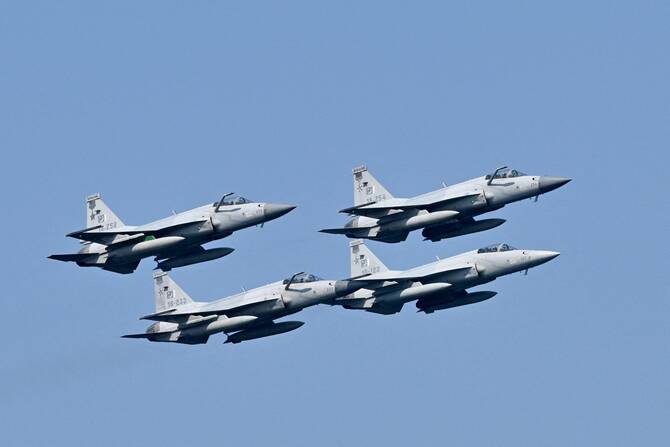
The JF-17 Thunder is a light multi-role combat aircraft produced jointly by Pakistan Aeronautical Complex and China’s Chengdu Aircraft Corporation. A full squadron of approximately 16 aircraft represents a meaningful combat-capable increment in Saudi Arabia’s fighter inventory, which already includes F-15SA Eagles and Typhoon Eurofighters. The JF-17 brings a different operational and maintenance chain from Saudi Air Force standard equipment, which implies Pakistani crews are managing all aspects of the aircraft independently rather than integrating into RSAF structures.
The HQ-9 is the more strategically consequential element. China’s long-range surface-to-air missile system covers targets at ranges of up to 200 kilometres and altitudes up to 27 kilometres, making it capable of engaging ballistic missiles in their terminal phase as well as aircraft and cruise missiles. Saudi Arabia already fields the US-made Patriot PAC-2 and PAC-3 systems, and the Kingdom has a Terminal High Altitude Area Defense battery under US-operated cover. Adding a Chinese-origin HQ-9 layer introduces a fourth-vendor air defence chain to a network already under significant stress from Iranian ballistic and drone saturation attacks since February.
🟡 The Pact
A Defence Agreement With A 80,000-Troop Ceiling And A Nuclear Shadow It Does Not Name
The Strategic Mutual Defence Agreement was signed at the Royal Palace in Riyadh at approximately 38R PH 26340 46880 on 17 September 2025, with Pakistani Prime Minister Shehbaz Sharif and Saudi Crown Prince and Prime Minister Mohammed bin Salman presiding, alongside Defence Minister Khalid bin Salman and Army Chief Field Marshal Syed Asim Munir. The pact’s public text states that “any aggression against either country shall be considered an aggression against both.” Its full terms remain confidential. A single government source with access to the document told Reuters that it allows for deployment of up to 80,000 Pakistani troops to help secure Saudi Arabia’s borders alongside Saudi forces.
The nuclear dimension of the pact was established immediately after signing. Defence Minister Khawaja Asif, in an interview with Geo TV on 18 September 2025, stated that Pakistan’s capabilities “will be made available” under the agreement. He described the arrangement as an “umbrella” pact: “If either country is attacked, we will respond jointly.” Asif separately noted that Pakistan’s nuclear forces are battlefield-ready and have been since testing. The Chatham House think-tank characterised the statement as setting “a precedent for extended deterrence” by a nuclear-armed state outside the Nuclear Non-Proliferation Treaty. No nuclear warhead transfer is implied, but the deterrence signal is clear and has not been formally walked back by either government.
Pakistan has a history of military presence in Saudi Arabia stretching to the 1960s, when Pakistani troops first deployed to protect Saudi frontiers during regional conflicts. The Belfer Center’s analysis of the September 2025 agreement notes that Pakistan has trained between 8,000 and 10,000 Saudi military personnel over the decades, and has periodically stationed units in the Kingdom under earlier agreements. The current 8,000-troop combat-deployment therefore sits at the upper end of a well-established pattern, not outside it. What is new is the scale, the formal pact architecture, and the explicit nuclear signalling accompanying it.
Khawaja Mohammad Asif : Pakistan Defence Minister, Geo TV Interview, 18 September 2025
“What we have, and the capabilities we possess, will be made available under this agreement. If either country is attacked, we will respond jointly.”
🔵 The Contradiction
A Mediator Reinforcing One Side Is Not Neutral. Iran Knows This.
Pakistan’s position in the 2026 Iran war is structurally unique. Islamabad hosted the only known round of direct US-Iran talks, brokered the 8 April ceasefire that has held for six weeks, and has served as the primary back-channel between Washington and Tehran throughout the conflict. That mediation role carries value precisely because Pakistan is perceived, particularly in Tehran, as not being a Western instrument. The two countries share a border, a history of pragmatic engagement, and a common acknowledgment that destabilisation on Pakistan’s western flank is contrary to Islamabad’s interests.
The deployment revealed by Reuters complicates that perception. Tehran does not view Saudi Arabia as a neutral party. Riyadh launched undisclosed retaliatory strikes against Iran after Iranian attacks inside the kingdom, a fact Reuters has previously reported. From the Iranian perspective, Pakistan has now placed 8,000 troops, a fighter squadron, and an air defence battery in the territory of a state actively engaged in military operations against Iran. The nuclear umbrella language adds a further layer. Pakistani mediation’s credibility depends on Iran believing Islamabad is not simply organising the ceasefire to buy Riyadh time to build its defences.
That credibility, by this disclosure, has been structurally tested. Islamabad’s counter-argument, implied but not stated publicly, is that the defence pact predates the mediation role, that the deployment was legally required under the agreement once Iranian strikes hit Saudi soil, and that the two commitments are categorically distinct. That argument has precedent: Pakistan deployed troops to Saudi Arabia for decades before hosting any US-Iranian dialogue. The question is whether Iran’s foreign ministry and IRGC accept that framing, or whether they use the disclosure as justification to walk away from further Islamabad-mediated talks.
⚠ What Is Not Confirmed
No Official Confirmation, Unresolved Warship Question, And A Troop Ceiling That Dwarfs Current Deployment
Neither Pakistan’s military, its foreign office, nor Saudi Arabia’s government media office has confirmed the deployment. All five sources spoke anonymously. Reuters’ sourcing methodology has been consistent through this conflict’s coverage, and the corroborating detail across three independently briefed security officials, including two who specifically described having seen deployment documents, is substantial. However, the absence of official confirmation means both governments retain the option of public deniability, which has its own strategic utility: Islamabad can continue presenting itself as a neutral mediator while operationally functioning as a Saudi defence partner.
The warship clause of the pact is confirmed by two security officials but the physical presence of Pakistani naval vessels in Saudi waters remains unverified by Reuters. This is flagged as single-source status in this report. The Pakistani Navy operates frigates including the PNS Babur and MILGEM-class vessels acquired from Turkey; deployment of a frigate or destroyer to Saudi Red Sea or Gulf ports would add a naval dimension to a deployment that currently reads as primarily air-defence and ground-force oriented.
The 80,000-troop ceiling, confirmed by one source with access to the pact text, is the number that will draw the most analysis. For comparison, 80,000 troops represents approximately 40% of the Pakistani Army’s estimated active deployable ground combat strength. Deploying even half that number to Saudi Arabia would constitute the largest Pakistani military operation outside its own borders since independence. The figure should be read as a deterrence ceiling designed to signal commitment rather than a deployment order awaiting execution, but its existence clarifies why Iran has reason to view the pact as a structural threat, not merely a bilateral training arrangement.
Source Reliability Matrix
NATO grading: REL A (reliable) to F (unreliable). CRED 1 (confirmed) to 6 (cannot judge).
CRED 2
Primary wire. Five anonymous sources (three security officials, two government). Strong corroboration across source types. No official confirmation from either government. Warship element unverified.
CRED 1
On-record ministerial statement confirmed by Washington Post, Kurdistan24, and Turkiye Today. Nuclear umbrella language is direct attribution from a named official in a broadcast interview.
CRED 2
Independent academic analysis of the September 2025 pact and its nuclear implications. Belfer Center (Harvard) and International Campaign to Abolish Nuclear Weapons. Analysis-level, not news-breaking.
CRED 3
Neither Pakistan’s military nor its foreign office responded to Reuters’ requests for comment. Non-response is itself informative: a flat denial would be expected if the figures were inaccurate.
Strategy Battles Assessment
Pakistan is not a neutral mediator. It is a nuclear-armed state that has placed a combat-capable force in Saudi Arabia, whose government is actively retaliating against Iran. That is the correct strategic description of Islamabad’s current position in this war.
✓ What We Know
Pakistan has deployed 8,000 troops, approximately 16 JF-17 fighters, two drone squadrons, and a Chinese HQ-9 air defence system to Saudi Arabia under the September 2025 mutual defence pact. The force is financed by Saudi Arabia and operated by Pakistani personnel. It arrived partly in early April 2026, following Iranian strikes on Saudi energy infrastructure. Pakistan simultaneously brokered the 8 April US-Iran ceasefire and hosted the only known direct talks between the two sides. Defence Minister Asif has stated publicly that Pakistan’s nuclear capabilities are available to Saudi Arabia under the pact.
? What We Do Not Know
Whether Pakistani warships have physically reached Saudi ports. Whether the 80,000-troop ceiling is a deterrence figure or an operational contingency plan with trigger conditions. How Iran’s leadership has privately received the deployment disclosure and whether it will affect Tehran’s willingness to engage in further Islamabad-mediated talks. Whether the HQ-9 system is operationally integrated into Saudi Patriot and THAAD networks or run as a fully independent Pakistani-manned layer. The precise locations of Pakistani assets within Saudi Arabia beyond the Riyadh area.
☉ What To Watch
Whether Iran’s foreign ministry issues a formal reaction to the deployment disclosure and whether that reaction references Pakistan’s mediation role. Whether further Pakistani troop increments are announced or leaked, signalling movement toward the 80,000-troop ceiling. Whether the deployment produces a visible Iranian recalibration in its targeting posture toward Saudi infrastructure. Whether either the US or Iran requests a new mediation round through Islamabad, which would indicate Tehran still values Pakistan’s intermediary role despite the deployment. Whether Pakistani naval vessels are confirmed in Saudi waters, completing the tri-service deployment picture.
Sources
- Reuters via Arab News: Pakistan deploys jets, thousands of troops to Saudi Arabia, 19 May 2026
- Jerusalem Post: Pakistan sends troops, jets to Saudi Arabia during Iran war, 19 May 2026
- i24NEWS: Pakistan deploys 8,000 troops, fighter jets, and an air defense system to Saudi Arabia, 19 May 2026
- Belfer Center, Harvard: Beyond the Hype: Pakistan-Saudi Defense Pact, 18 September 2025
- ICAN: Pakistan-Saudi Arabia: A mutual defence pact with nuclear shadows, February 2026
- Kurdistan24: Pakistan Pledges Nuclear Availability to Saudi Arabia Under New Defense Pact, September 2025
Editorial Verification
The 8,000-troop deployment figure, JF-17 squadron count (~16 aircraft), two drone squadron details, HQ-9 system, and Saudi financing arrangement are all confirmed by Reuters wire (18 to 19 May 2026) across five anonymous sources (three security officials, two government sources with access to deployment documents). Independently corroborated by Jerusalem Post, i24NEWS, Haaretz, and Arab News wire relay. The 80,000-troop ceiling is single-source (one government official with pact text access) and has not been independently corroborated; it is treated as low-confidence in this report. The warship deployment clause is confirmed by two security officials but physical arrival of naval vessels in Saudi waters was not confirmed by Reuters and is flagged single-source. Defence Minister Asif’s nuclear umbrella statement is on-record, made on Geo TV 18 September 2025, and confirmed by Washington Post, Kurdistan24, and Turkiye Today; it is treated as verified. Neither Pakistan’s military nor foreign office, nor Saudi Arabia’s government media office, responded to Reuters comment requests. No satellite imagery has been used in this report. Strike coordinates for the Eastern Province are approximate central-province references; precise deployment installation coordinates have not been disclosed in any open source.
MGRS datum: WGS84 / UTM Zone: 38R (Saudi Arabia) and 43S (Pakistan) / Cross-check reference: Riyadh city centre 38R PH 26340 46880
All claims independently attributed and verified to open sources where possible.
Approved for Publication
Marcus V. Thorne
Lead Editor, Strategy Battles
FILE SB-2026-0519-9810001 // CLEARED
©StrategyBattles.net 2026
This article is for news and analysis purposes only. Based on publicly available news sources and military updates. All rights reserved. Not for commercial reuse without permission.