Russia’s new Su-57D Felon fighter development
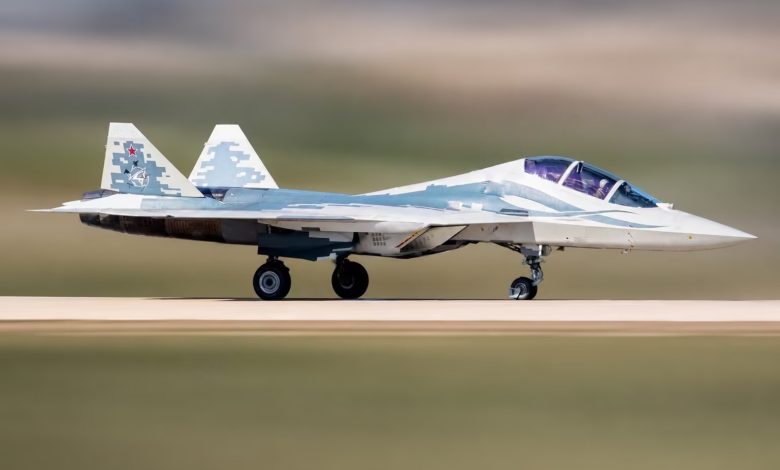
Operational Maturity : Su-57D Two-Seat Variant
LEVEL 2 OF 5, PROTOTYPE
Operational Maturity : Su-57 (Single-Seat, Baseline)
LEVEL 4 OF 5, OPERATIONAL
Su-57D At a Glance
Tandem two-seat derivative of Russia’s Su-57 fifth-generation stealth multirole fighter, first observed conducting ground taxi trials in May 2026; intended role as dedicated manned-unmanned teaming command platform. Formal designation unconfirmed.
Originated from
Russia / Sukhoi Design Bureau (UAC)
Operated by
Russian Aerospace Forces (baseline Su-57 only; two-seat variant not yet fielded)
Class
Fifth-Generation Stealth Multirole Fighter (two-seat derivative)
Crew
2 (pilot + mission commander / drone operator)
Length
~20.1 m (65.9 ft) — baseline; two-seat canopy extends forward fuselage (unconfirmed)
Wingspan
~14.2 m (46.6 ft)
Powerplant
2 x Saturn AL-41F1 (117S); Izdeliye 177 / AL-51F1 planned for Su-57M series
Max speed
Mach 2.0 (approx. 2,135 km/h) at altitude — baseline (claimed)
Combat radius
~1,500 km on internal fuel (claimed by manufacturer; independently unverified)
Radar
N036 Byelka AESA (1,514 T/R modules, nose-mounted; plus cheek arrays)
Primary role (2-seat)
Manned-unmanned teaming command node; S-70 Okhotnik-B drone control
Status
PROTOTYPE (two-seat); OPERATIONAL (single-seat baseline)
In service since
2020 (single-seat Su-57 IOC); two-seat variant: first flight anticipated 2026
Su-57 / Su-57D : Hero Gallery

⚠ Export Compliance
The Su-57E export variant is controlled by the Russian Federal Service for Military-Technical Cooperation (FSMTC). Any transfer to a third country requires FSMTC approval and is subject to end-user certificate requirements. The platform falls under MTCR Category II restrictions where extended-range variants are concerned. Western sanctions regimes (US CAATSA, EU Common Position 2008/944/CFSP) create legal risks for any state purchasing Su-57 derivatives while maintaining significant US or EU defence cooperation, directly constraining Indian procurement calculations. Algeria has been confirmed as the first export customer for the Su-57E, receiving an initial two aircraft with a 14-aircraft contract signed in 2019. The two-seat Su-57D variant has not been formally offered under any confirmed export contract as of May 2026.
Bottom Line Up Front
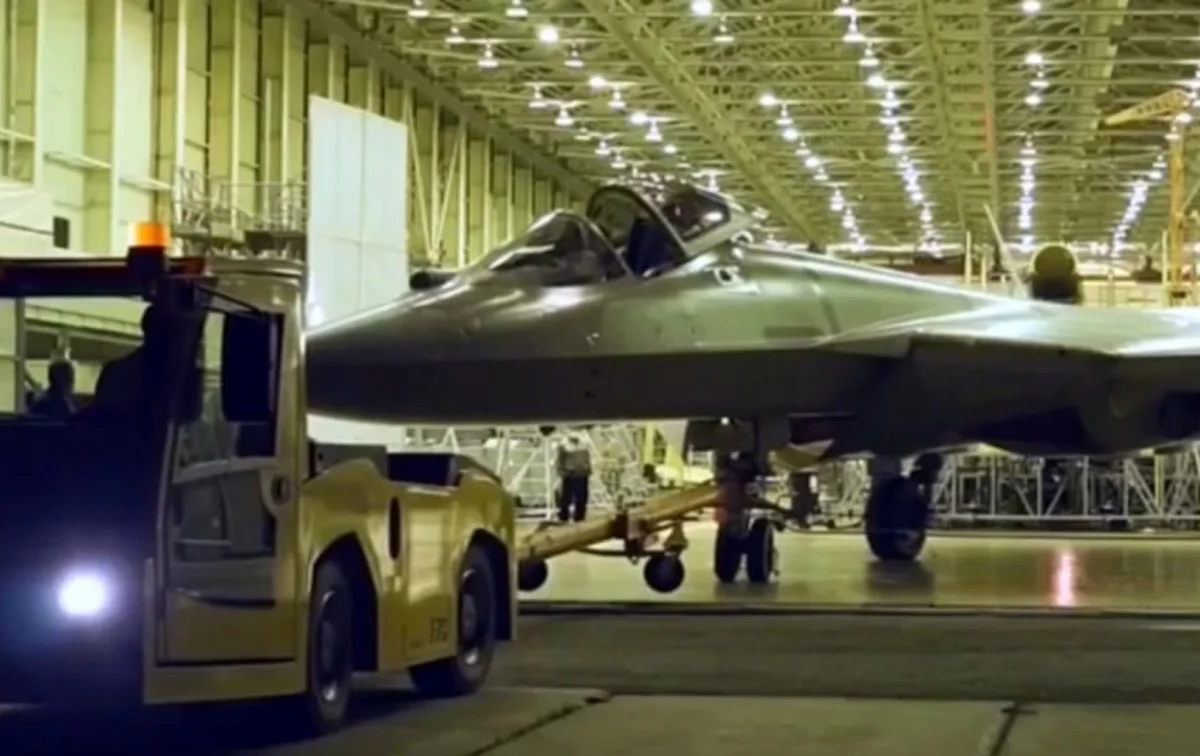
A tandem two-seat variant of Russia’s Su-57 (NATO: Felon) conducted ground taxi trials at the Komsomolsk-on-Amur Aircraft Plant in mid-May 2026, with the Fighterbomber Telegram channel as the sole primary source. Designation remains unconfirmed, with Su-57D, Su-57UB, and Su-57ED each proposed in open-source discussion. The variant has not completed a verified first flight as of the publication date of this article. Its intended role is as an airborne command node for manned-unmanned teaming with S-70 Okhotnik-B UCAVs, extending the operational reach of the existing Su-57 ecosystem. Russia is simultaneously marketing a two-seat Su-57 package to India, leveraging the development signal as both a programme milestone and a diplomatic instrument intended to revive the dormant FGFA collaboration. The baseline single-seat Su-57 fleet stands at approximately 26 confirmed airframes delivered to the Russian Aerospace Forces as of early 2026, far below the 76-aircraft state contract target.
Key Judgments
The two-seat Su-57 variant is a real hardware programme, not a rendering or export proposal. Ground taxi imagery from Fighterbomber and corroborating analysis by The Aviationist and multiple defence researchers confirm a physical aircraft with a tandem cockpit and extended canopy was observed at KnAAZ in May 2026. The bort number “055 Blue” is consistent with a modified T-50-series prototype airframe rather than a new-build production aircraft.[1]
The timing of the programme’s public emergence is, at minimum, partly shaped by Russia’s ongoing sales pitch to India. Russia presented a two-seat Su-57 package at Wings India 2026 and has been refining the FGFA revival offer since early 2026. The convergence of taxi-trial imagery appearing publicly on Fighterbomber on 16 May 2026 with active export diplomacy is a pattern consistent with Moscow’s established practice of using controlled information releases through military-adjacent Telegram channels to generate interest ahead of formal programme announcements.[2]
Manufacturer and Russian-aligned sources claim the two-seat configuration can control up to four S-70 Okhotnik-B drones simultaneously, and that the tandem modification adds approximately 10% to mission endurance. Neither figure has been independently verified. The S-70 itself suffered a publicly acknowledged crash in Ukraine in October 2024 when it was reportedly shot down by a Russian Su-57 in a friendly-fire incident, raising questions about the maturity of existing single-seat MUM-T integration before the two-seat variant compounds it.[3]
Specifications : Su-57 (Baseline Single-Seat)
CREW
1 (single-seat baseline); 2 (two-seat variant)
LENGTH / WINGSPAN
20.1 m / 14.2 m (65.9 ft / 46.6 ft)
EMPTY WEIGHT
~18,500 kg (40,785 lb)
POWERPLANT
2x Saturn AL-41F1 (142.2 kN with afterburner each)
MAX SPEED
Mach 2.0 / ~2,135 km/h at altitude (claimed)
SERVICE CEILING
~20,000 m (65,600 ft) (claimed)
COMBAT RADIUS
~1,500 km internal fuel (claimed; unverified)
RADAR
N036 Byelka AESA: 1,514 T/R modules; 2x cheek arrays; 2x L-band wing leading-edge arrays; 270° coverage (claimed)
EW SUITE
L402 Himalayas ECM; 101KS Atoll IRST / DIRCM / MAWS
UNIT COST (FY2024)
~$50–67M flyaway (estimated; FY2024 basis; no confirmed official figure)
IOC (SINGLE-SEAT)
December 2020
STATE CONTRACT
76 production aircraft (2019 contract); ~26 delivered as of Feb 2026
Speed, combat radius, and ceiling figures are manufacturer-claimed and have not been independently measured. N036 radar specification cross-referenced against NIIP / Tikhomirov public disclosures and open-source analysis (Army Recognition, War Wings Daily). Unit cost is an industry estimate; no official Russian procurement unit cost is publicly available. Two-seat variant specifications are not yet publicly released.
~26
Su-57 Delivered (Feb 2026)
76
State Contract Target
14
Algeria Export Contract
1
Two-Seat Prototype (taxi trials)
Variant Comparison : Su-57 Family
The Su-57 family spans the single-seat baseline, the export Su-57E, the in-development Su-57M with a new engine series, and the newly observed two-seat Su-57D (designation unconfirmed).
SU-57
Baseline (Single-Seat)
IOC: December 2020
Delivered: ~26 (Feb 2026)
Engine: AL-41F1 (117S)
Role: Air superiority / multirole
The operational baseline assigned to the 23rd Guards Fighter Aviation Regiment. Has operated in a standoff role over Ukraine; no confirmed air-to-air kills against a peer opponent.
SU-57E
Export Variant
Debut: MAKS-2019
First sale: Algeria (14 aircraft, 2019 contract)
Engine: AL-41F1 / AL-51F1 (planned)
Role: Export multirole
Publicly marketed with FSMTC-approved capabilities; Algeria confirmed as first recipient, with first two aircraft reportedly delivered and accepted into combat duty by November 2025 per UAC CEO statement (customer unspecified, Algeria assessed as likely).
SU-57M
Upgraded Variant (in development)
Engine first flight: December 2025
New engine: Izdeliye 177 / AL-51F1
Role: Enhanced multirole, supercruise
The Izdeliye 177 engine, a hybrid of AL-41F-1 and AL-51F1 technology, completed its first flight on a Su-57 airframe in December 2025. Designed to deliver higher thrust and improved fuel efficiency, enabling genuine supercruise. Upgrade timeline for the production fleet is not confirmed.
⚠ SU-57D / UB / ED
Two-Seat MUM-T Variant (prototype, unconfirmed designation)
Status: Taxi trials, May 2026
First flight: Projected 2026 (unconfirmed)
Role: Drone command node / two-seat trainer
Single prototype observed during taxi trials. Bort number “055 Blue” suggests it may be a modified T-50-5R airframe. Designation, production intent, and performance changes versus the single-seat baseline remain unconfirmed in open sources.
Peer System Comparison
Fifth-generation fighters with confirmed or emerging two-seat variants: Su-57 (Russia), J-20S (China), F-35B/C (US, no two-seat variant), and KAAN (Turkey, two-seat prototype planned).
| Parameter | SU-57D (RUSSIA) | J-20S (CHINA) | F-35A (USA) |
|---|---|---|---|
| Origin | Russia | China | USA |
| Two-Seat Status | Taxi trials (May 2026) | First flight observed ~2021; operational status unclear | No two-seat variant (single-seat programme) |
| Primary Radar | N036 Byelka AESA | AESA (designation classified) | AN/APG-81 AESA |
| Max Speed (claimed) | Mach 2.0 | Mach 2.0+ (claimed) | Mach 1.6 |
| Fleet Size (approx.) | ~26 (Feb 2026) | 200+ (IISS est. 2025) | 1,000+ (all variants) |
| Drone Teaming | S-70 Okhotnik-B (integration tested; combat-ready status contested) | GJ-11 Sharp Sword UCAV (integration reported, unverified) | CCA (YFQ-42A / YFQ-44A in development) |
| Unit Cost (USD) | ~$50-67M (estimated, FY2024) | Not disclosed | ~$82M flyaway (FY2024) |
J-20S fleet status and radar specifications are not officially disclosed; figures represent open-source estimates. F-35A unit cost per DSCA FY2024 congressional notifications. Su-57 unit cost is an industry estimate with no confirmed official Russian procurement figure.
Operators & Inventory
As of February 2026, the Su-57 (single-seat) has two confirmed operators: Russia (primary user) and Algeria (first export recipient). The two-seat variant has no confirmed operator. India remains the most-discussed potential future customer; no government-level commitment exists.
🏴 Russia / Russian Aerospace Forces
PRIMARY USER
Fleet: ~26 units (Feb 2026, per UAC deliveries)[4]
Variant: Su-57 (baseline production)
In service: 2020 to present
Assigned primarily to the 23rd Guards Fighter Aviation Regiment at Dzemgi Air Base, Khabarovsk Krai. Has conducted operational sorties in the Ukraine war in a standoff strike profile, launching Kh-59 and Kh-69 cruise missiles from outside Ukrainian air defence range.
🏴 Algeria / Al Quwwat al-Jawwiya al-Jaza’iriyya
EXPORT
Contract: 14 aircraft (2019); first 2 delivered ~Nov 2025
Variant: Su-57E
In service: 2025 to present (assessed)
Algeria’s contract was part of a broader procurement package signed in December 2019. Visual confirmation of the first two aircraft transfer emerged in February 2026. Algerian pilots were undergoing training in Russia. Full 14-aircraft delivery projected by end of 2026.
🏴 India / Indian Air Force
UNCONFIRMED
Fleet: 0 (no order placed)
Variant discussed: Su-57MKI / two-seat variant
In service: Not applicable
Russia has proposed a two-seat Su-57MKI package, including S-70 technology transfer and up to 40-60% local production at HAL Nashik. India’s government has not confirmed entry into formal procurement discussions. IAF squadron shortfalls provide the strategic rationale Russia is exploiting. CAATSA sanctions risk is a material constraint.
Su-57 fleet figure sourced from The Aviationist / Guy Plopsky analysis and UAC delivery statements. IISS Military Balance 2025 lists the Russian Aerospace Forces Su-57 inventory. Algeria customer identity sourced from Algerian national television announcement (February 2025) and UAC CEO statement (November 2025).
Combat Record
Covering confirmed Su-57 (single-seat) combat use in the Russia-Ukraine war, 2022 to 2026. The two-seat variant has no combat record. S-70 Okhotnik-B operational incidents are included where they bear on MUM-T assessment.
0
Confirmed Air-to-Air Kills
0
Confirmed Su-57 Combat Losses
1
S-70 Loss (Friendly Fire, Oct 2024)
Standoff
Su-57 Operational Profile in Ukraine
CONFIRMED
Su-57 aircraft have been used in standoff operations over Ukraine, launching Kh-59 and Kh-69 cruise missiles from within Russian airspace to avoid Ukrainian air defences. This operational profile demonstrates the platform’s use as a strike launcher rather than an air-to-air combatant, and has been independently reported by Ukrainian sources and Western defence analysts. No Su-57 has engaged a Ukrainian aircraft in air-to-air combat; the platform has been kept well beyond Ukrainian SAM reach.
CONFIRMED
An S-70 Okhotnik-B UCAV operating over Ukraine was destroyed in October 2024 by a Russian Su-57 in a confirmed friendly-fire incident, reported by Defence Express (Ukraine) and corroborated by multiple Western analysts. The aircraft reportedly became uncontrollable after an apparent MUM-T communications failure, necessitating its deliberate shootdown. The incident exposed technical immaturity in single-seat MUM-T integration and provided Ukrainian and Western intelligence services with S-70 wreckage data.
UNVERIFIED
Russian media and state-aligned sources have periodically claimed Su-57 air-to-air kills in the Ukraine war. No such kill has been independently confirmed through Oryx, Ukrainian government acknowledgement, or two independent Western-source reports. These claims are treated as unverified operator self-reports.
Combat record sourced from Defence Express (Ukraine), open-source OSINT analysts, and The Aviationist. No Oryx-confirmed Su-57 combat losses as of May 2026. S-70 friendly-fire incident independently confirmed by multiple defence outlets.
Sustainment
Production, readiness, and supply chain constraints that define the Su-57’s real operational significance relative to its nominal specification.
Production Rate
~4-7 per year
KnAAZ delivered approximately six aircraft in 2024 per open-source analysis, below the rate needed to reach 76 aircraft by any near-term deadline. The 2019 state contract for 76 aircraft by 2027 is not achievable at the current pace.
Sanctions Impact
Significant
Post-2022 Western sanctions have constrained access to foreign microelectronics previously used in Su-57 avionics. Russian industry has pursued domestic substitutes, but these are generally assessed as less capable and less reliable than the components they replace.
Engine Programme
Transition in progress
The Izdeliye 177 engine first flew on a Su-57 airframe in December 2025. It is positioned as a production alternative to both the AL-41F1 and the delayed AL-51F1 (Izdeliye 30), combining elements of both. Timeline for fitting to production aircraft is not confirmed.
Readiness
Not officially disclosed
No Russian readiness rate for the Su-57 has been published. The standoff profile used in Ukraine suggests the aircraft is being conserved, consistent with limited spares inventory and a small fleet that cannot absorb attrition.
Survivability
Su-57 survivability depends on a combination of low-observable shaping, active EW, supermaneuverability, and operational concept; none of these are uncontested.
Radar Cross Section
Russia claims a frontal RCS of 0.1 m² (claimed); US and Western assessments consistently rate it as less stealthy than the F-22 or F-35, particularly in side-aspect geometry where the engine nozzle arrangement and conventional canopy frame increase signature. Independent verification of any specific figure is not possible from open sources.
EW Self-Protection
The L402 Himalayas ECM suite is integrated with the N036 radar arrays for passive and active electronic attack. The 101KS Atoll system provides UV and IR missile approach warning. These are more capable than fourth-generation Russian equivalents, but their effectiveness against peer-state emitters has not been operationally tested.
Two-Seat Stealth Concern
Adding a tandem cockpit changes the forward fuselage cross-section, canopy geometry, and cockpit framing, all of which affect RCS. Russia has claimed the two-seat variant retains “enhanced stealth” versus the baseline, but this claim is single-source and unverified. The engineering challenge is significant; no fifth-generation two-seater has been demonstrated to maintain RCS parity with its single-seat counterpart.
Supermaneuverability
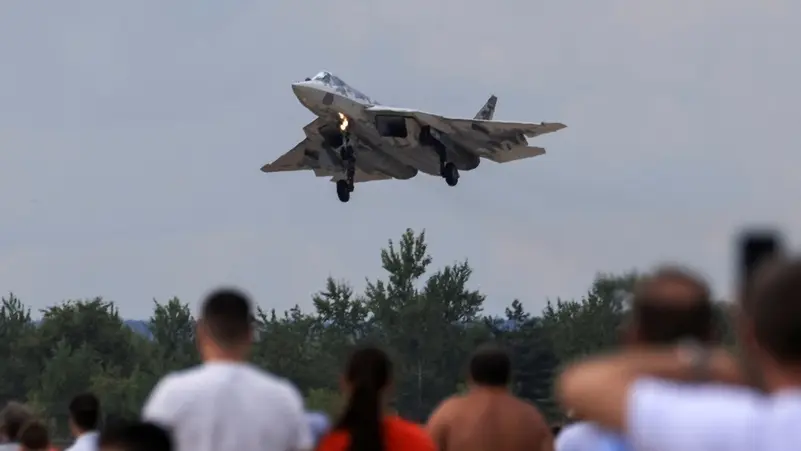
The Su-57 features 3D thrust-vectoring nozzles enabling post-stall manoeuvres including cobra and tail-slide. This provides a within-visual-range combat advantage that Western fifth-generation platforms optimised for beyond-visual-range engagements do not emphasise. Its practical value in a modern high-BVR-missile environment is debated among analysts.
System Anatomy
Key structural and avionics features of the Su-57 that distinguish it from fourth-generation Russian predecessors, with notes on where the two-seat variant introduces modifications.
1 · N036 Byelka Radar Suite
The nose-mounted X-band AESA array has 1,514 T/R modules. Two cheek arrays add 404 modules each, achieving 270-degree angular coverage. Two L-band arrays in the wing leading edges serve IFF and low-observable target detection functions. The nose antenna is tilted to reduce its own radar return.
2 · Internal Weapons Bays
Four internal bays accommodate air-to-air and air-to-surface munitions, including R-77-1 active-radar AAMs, R-74M short-range AAMs, Kh-38 air-to-surface missiles, and Kh-59MK2 cruise missiles. Internal carriage maintains the low-observable profile during ingress; external pylons are available for ferry or non-stealthy strike missions.
3 · L402 Himalayas ECM Suite
The L402 system uses dedicated arrays as well as sharing apertures with the N036 radar. Its dorsal sting between the engine nozzles houses a primary ECM array. The system performs radar warning, jamming, and electronic intelligence gathering, and is integrated with the 101KS Atoll electro-optical suite for multi-spectral situational awareness.
4 · 3D Thrust-Vectoring Nozzles
Each AL-41F1 engine is fitted with an axisymmetric thrust-vectoring nozzle enabling full three-dimensional control-plane deflection. Combined with the aircraft’s advanced fly-by-wire system, these provide post-stall manoeuvre capability. The closely spaced nozzle arrangement is a noted signature penalty in the rear aspect.
5 · Two-Seat Cockpit Modification (Su-57D)
The two-seat variant extends the forward fuselage with a tandem rear cockpit and a longer canopy. This modification changes the fuselage cross-section and canopy geometry, both of which affect frontal and side-aspect RCS. The engineering changes required to preserve low-observable characteristics around the second cockpit are significant and have not been publicly described.
Production & Procurement
The Su-57 programme has a total known order of 76 domestic aircraft plus 14 for Algeria. Approximately 26 have been delivered to the Russian Aerospace Forces and 2 to Algeria as of February 2026, leaving a combined backlog of approximately 62 aircraft against confirmed contracts.
| Customer | Order Year | Ordered | Delivered | Backlog | Unit Cost (USD, est.) |
|---|---|---|---|---|---|
| Russia (RuAF) | 2019 | 76 | ~26 | ~50 | ~$50-67M (FY2024 est.) |
| Algeria (Su-57E) | 2019 | 14 | ~2 | ~12 | Not disclosed |
| Total | 90 | ~28 | ~62 |
Russian delivery figures sourced from open-source analysis by Guy Plopsky / The Aviationist and UAC official statements; exact delivery numbers are not officially published. Algeria contract sourced from Algerian national television (February 2025) and UAC CEO statement (November 2025). Unit costs are estimates; no official Russian procurement unit cost figures are publicly available for FY2024 or any other year. World Air Forces 2026 report cited 24 airframes delivered as of December 2025; UAC reported additional deliveries in February 2026, bringing the assessed total to approximately 26.
Development Timeline : Su-57 Programme, 1999 to 2026
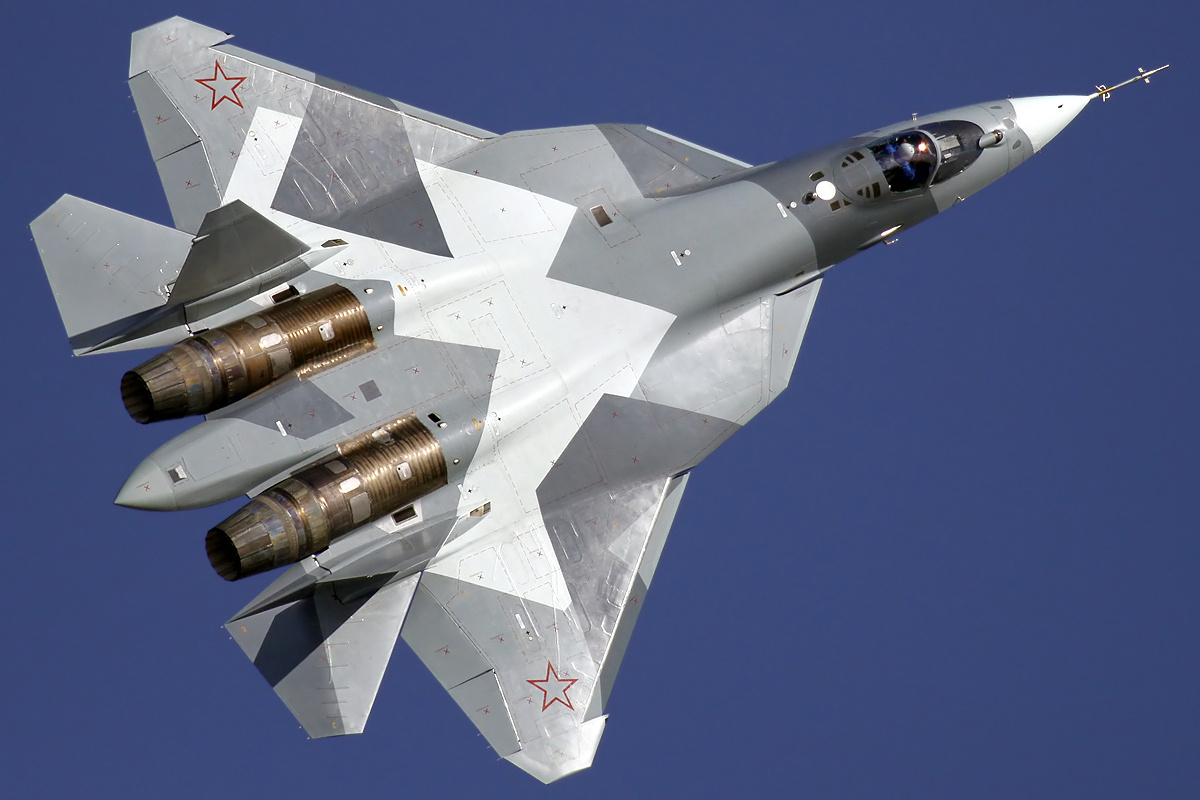
Su-57 demonstrating high angle-of-attack manoeuvring during MAKS-2017. The aircraft’s 3D thrust-vectoring nozzles enable post-stall capability that Western fifth-generation platforms do not emphasise, though its practical value in a modern BVR-dominated environment is contested. Photo: Dmitry Terekhov / Wikimedia Commons CC-BY-SA.
🔵 Programme Origins
The FGFA Shadow: How India’s Exit Shaped the Two-Seat Concept
The conceptual roots of the Su-57’s two-seat variant predate the current MUM-T framing by more than a decade. When Russia and India signed the FGFA agreement in 2007, both sides anticipated producing a tandem two-seat fifth-generation fighter drawing on T-50 hardware with significant Indian systems integration. HAL was assigned responsibility for the onboard computer, navigation system, cockpit displays, and self-defence suite, while Sukhoi led airframe development. The two-seat layout was central to India’s requirement, reflecting the IAF’s operational preference for a co-pilot capable of managing complex sensor and weapons tasks during strike missions, a doctrine embedded in the IAF’s large Su-30MKI fleet.[5]
India’s formal withdrawal from FGFA in 2018 left the two-seat architecture without a programme home. IAF and Indian MoD objections centred on the Su-57’s stealth performance, which Indian engineers assessed as falling short of genuine fifth-generation standards, particularly in the frontal radar cross-section and in the integration quality of the avionics suite. Additional concerns about technology transfer terms, workshare equity, and long-term supply chain sovereignty contributed to the political decision to exit. With India gone, Russia’s immediate priority became delivering the single-seat Su-57 to its own Aerospace Forces under the 2019 state contract, and the two-seat design was set aside.
The programme is now returning, reframed around a different rationale. Where the FGFA two-seater was justified primarily as a crew-workload solution for complex strike missions, the Su-57D is being positioned primarily as a drone command node. That distinction matters because it connects the aircraft to a global doctrinal trend toward manned-unmanned teaming rather than situating it as a legacy twin-seat requirement from an earlier era of air warfare thinking.
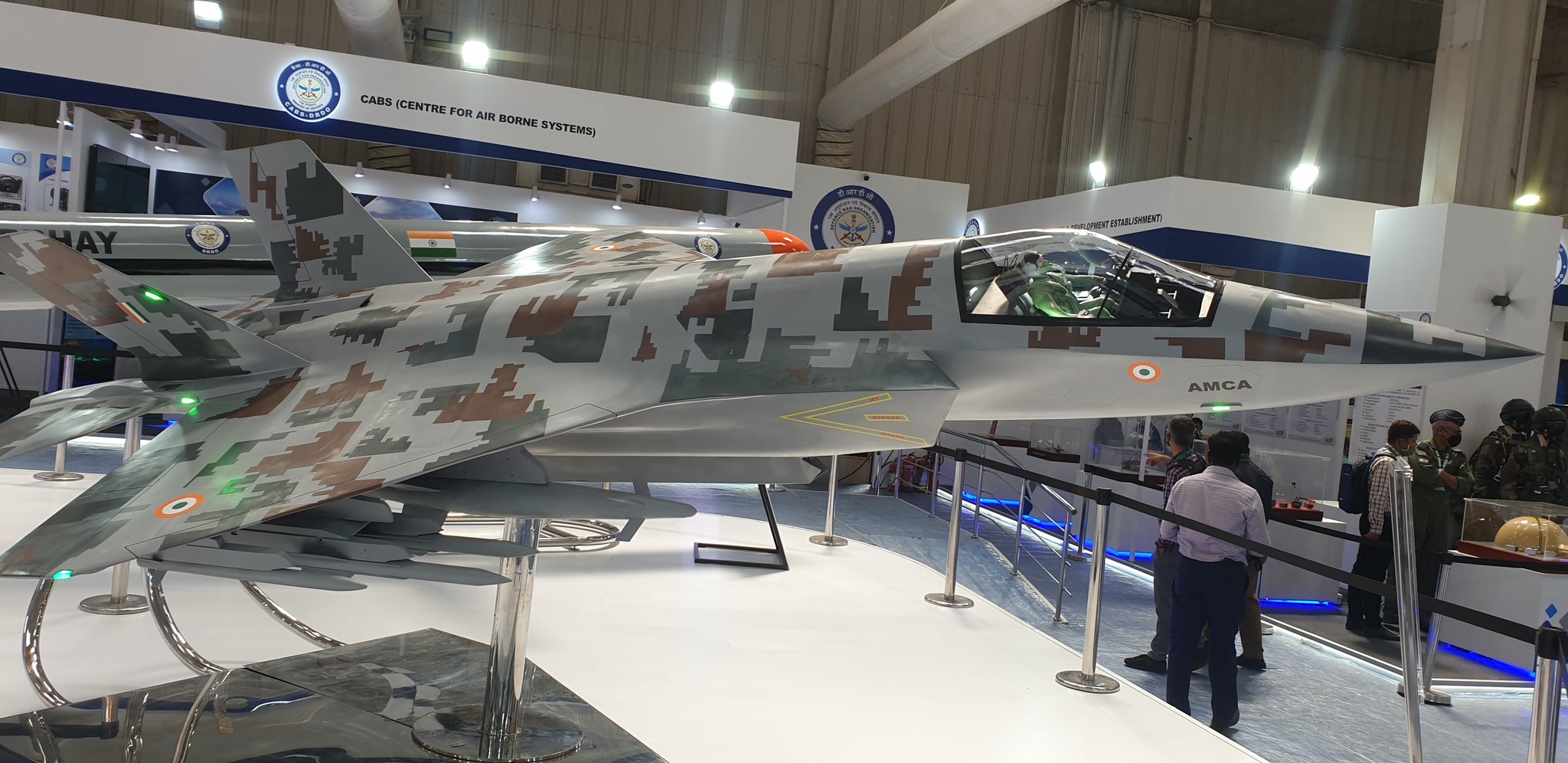
A model of India’s HAL AMCA (Advanced Medium Combat Aircraft) at Aero India 2021. The AMCA programme is the primary indigenous alternative to the Su-57 for India’s fifth-generation requirement, but remains years from operational maturity. Russia’s two-seat Su-57 pitch is partly an attempt to fill that gap. Photo: Wikimedia Commons CC-BY-SA.
🟡 Designation and Configuration
Su-57D, UB, or ED: What the Designation Uncertainty Reveals
The absence of a confirmed designation is itself informative. In Russian military aviation nomenclature, UB (Uchebno-Boyevoy, or training-combat) is the standard suffix for two-seat combat-capable trainers, as used on the Su-27UB, MiG-29UB, and Su-34 (originally designated Su-27IB). The suffix D in Russian can denote a doubled crew (“dvoyka”) or a long-range variant. ED would suggest an export-oriented two-seater, a designation that would position the aircraft explicitly for the India sales pitch. That three candidate designations are circulating publicly without any official Russian statement is consistent with a programme that has not yet resolved its own purpose: is this a combat-variant, a trainer, or an export product?[1]
The aircraft observed in taxi trials at KnAAZ carries bort number “055 Blue,” which has significance in the Su-57 prototype lineage. The original T-50-5 (bort 055) was the aircraft damaged in the June 2014 engine fire. Its salvageable components were reportedly incorporated into T-50-5R, a rebuilt sixth-prototype. If the two-seat aircraft observed in May 2026 is indeed a conversion of that airframe rather than a new-build prototype, this suggests the programme is at a relatively early developmental stage and that a new-build two-seat production standard remains some distance away.
The physical modifications visible in Fighterbomber’s imagery include a visibly extended forward fuselage section and a longer canopy housing the tandem rear cockpit. The canopy geometry change is the most consequential element from a stealth perspective, as the canopy frame, its radar-absorbing coating, and the framing angle all contribute to frontal and off-angle RCS. Russia has claimed, through aligned sources, that the two-seat variant preserves or improves stealth characteristics relative to the baseline. This claim has no independent verification and should be treated with appropriate caution.[6]
🟢 MUM-T Doctrine
The Second Seat as Command Node: Russia’s MUM-T Architecture
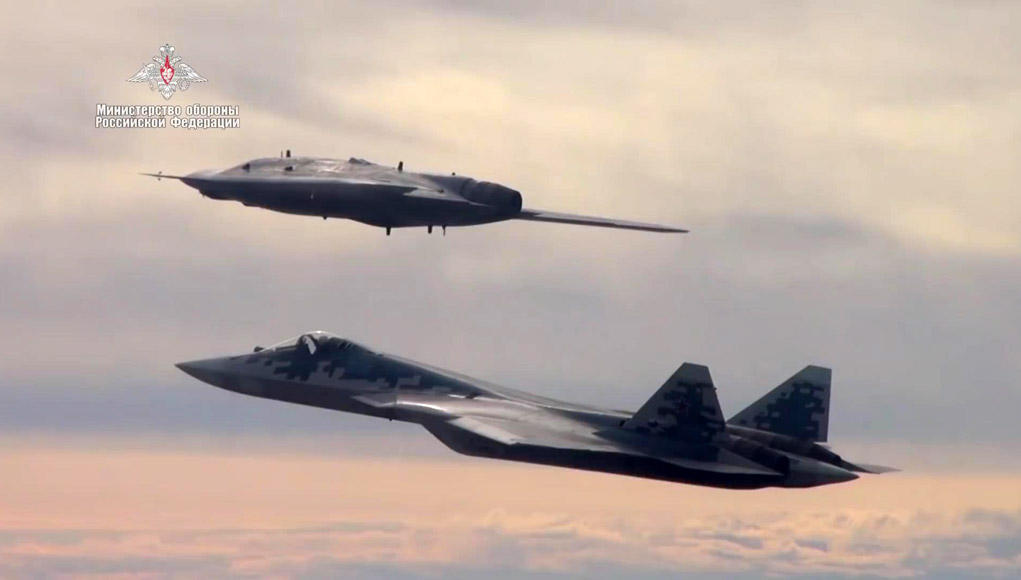
The doctrinal case for the two-seat Su-57 rests on Russia’s existing MUM-T concept built around the S-70 Okhotnik-B UCAV. The Okhotnik first flew in August 2019 and has been paired with a single-seat Su-57 in publicly released footage since September that year. Under the single-seat MUM-T concept, the Su-57 pilot manages both the fighter’s own weapons and sensors and the datalink commands to the accompanying Okhotnik, a workload that Russian analysts and Rostec officials have acknowledged is excessive for one person in a high-tempo engagement environment. The two-seat variant addresses this by assigning a dedicated mission commander to drone coordination, freeing the pilot to focus on flying and self-defence.[7]
Russian-aligned sources have stated that the two-seat configuration is intended to enable simultaneous control of up to four Okhotnik-B drones, creating a small integrated strike formation with the Su-57D at the centre. In this model, the drones would advance into contested airspace ahead of the crewed aircraft to conduct radar probing, electronic jamming, and weapons employment against defended targets, while the Su-57D remains at a safer standoff distance coordinating their operations and managing the overall mission picture. This is conceptually similar to the US Air Force’s Collaborative Combat Aircraft programme, though the CCA effort is further advanced in both hardware and software maturity.
The October 2024 S-70 loss over Ukraine complicates this picture in two ways. First, it confirmed that the Okhotnik was being operated operationally, which is significant in itself. Second, the loss occurred because the drone’s datalink with its Su-57 command aircraft failed, and the drone became uncontrollable to the point where its own operator deliberately destroyed it. That failure in single-seat MUM-T operations, where the pilot had one drone to manage, raises a natural question about the reliability of the architecture that the two-seat variant is supposed to extend to four drones simultaneously. The datalink hardening, latency management, and autonomy architecture required to make multi-drone coordination reliable in a contested electronic environment are engineering challenges that neither the Su-57 nor the Okhotnik has demonstrably solved.[3]
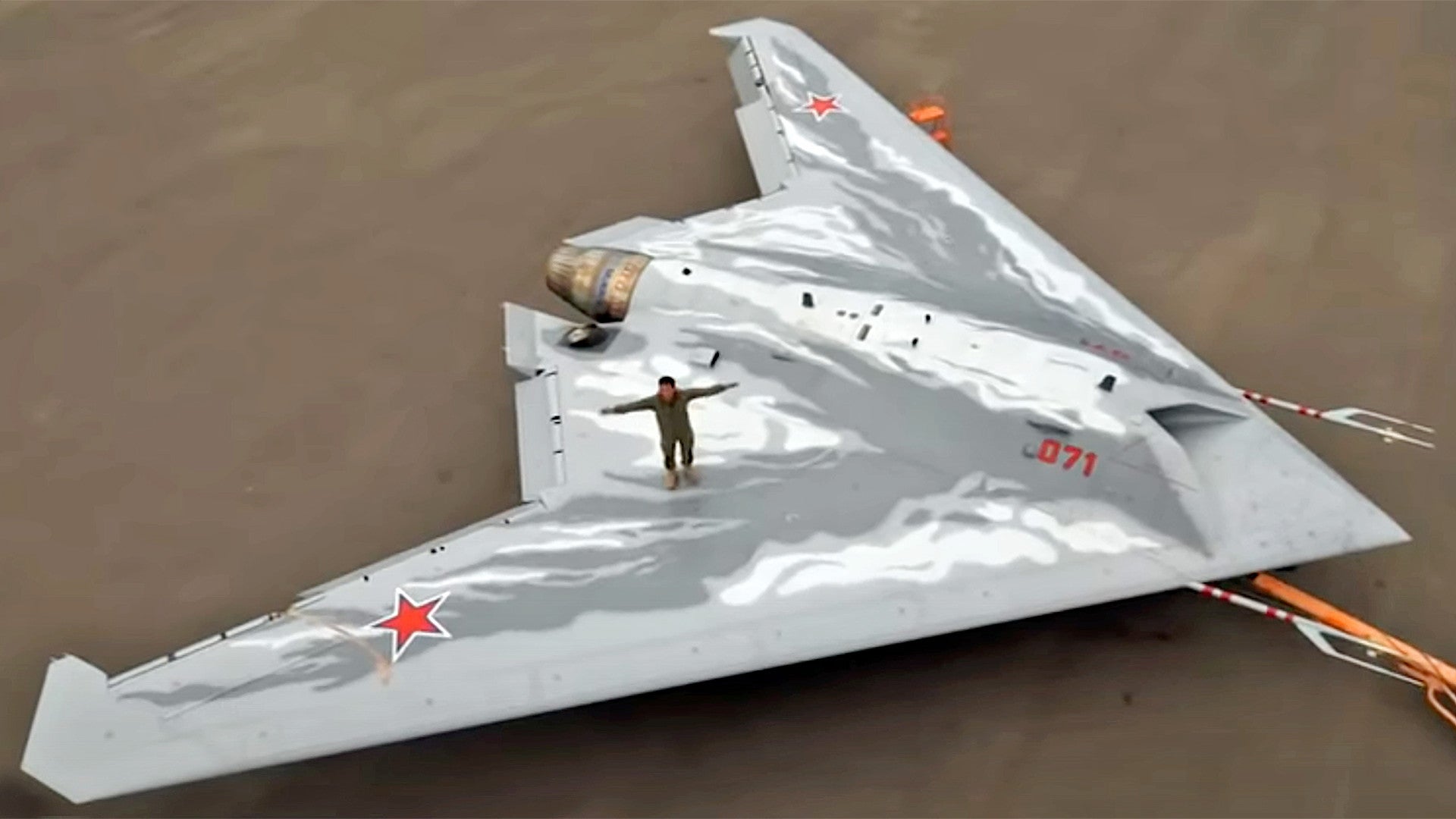
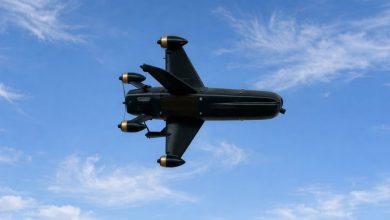
S-70 Okhotnik-B (“Hunter”) UCAV in the flying-wing configuration. Weighing approximately 20 tonnes with a ~20m wingspan, it is designed to carry internal payloads of up to 2 tonnes and operate at speeds up to 1,000 km/h. A confirmed loss over Ukraine in October 2024 exposed maturity gaps in the MUM-T datalink architecture the two-seat Su-57D is meant to command. Photo: Russian MoD / Public domain.
🔴 The India Question
A Developmental Signal as Diplomatic Instrument
The geopolitical narrative surrounding the Su-57D’s taxi trials has been dominated by its intersection with India’s fighter modernisation calculus. The Indian Air Force currently operates significantly fewer combat squadrons than its sanctioned strength requires. The AMCA programme, while advancing, remains years from IOC. The Rafale F-4 and planned F-5 upgrades address part of the capability gap but not the quantity problem. Russia has identified this gap as its commercial lever, presenting the two-seat Su-57 at Wings India 2026 and subsequent bilateral consultations with a package that includes technology transfer, local production at HAL Nashik, source code access, and the option to integrate indigenous Indian weapons including BrahMos and Astra.[8]
India’s strategic position makes a simple decision impossible. The IAF’s existing Russian fleet, which includes the Su-30MKI as its primary heavy fighter, creates genuine industrial commonality arguments for an Su-57 acquisition. Russia’s offer of 40 to 60 per cent local production content speaks directly to India’s Make in India policy. At the same time, CAATSA sanctions risk is a material constraint: any Indian government that formally commits to an Su-57 purchase faces the prospect of US sanctions triggering restrictions on its growing defence relationships with American suppliers, including F-35 discussions that remain in play at the diplomatic level. The IAF itself is known to prefer indigenous long-term solutions, and the AMCA trajectory, while slow, exists.
No Indian government statement has acknowledged formal procurement discussions for the Su-57 in any configuration. Senior IAF officers have noted publicly that the service’s interest in the platform centres primarily on its large internal weapons payload and strike reach rather than its stealth performance, which is a realistic assessment of the platform’s relative strengths. The two-seat variant’s MUM-T doctrine adds a capability that the IAF is also developing through other programmes, including a future pairing of the AMCA with the Ghatak UCAV and the Rafale’s own developing MUM-T features. Russia’s pitch is therefore competing not only against Western alternatives but against an Indian programme trajectory that would eventually deliver comparable capabilities without the CAATSA exposure.
⚠ Fleet Context
Production Reality: The Gap Between Contract and Capability
Any assessment of the Su-57D’s strategic significance must be placed against the baseline production numbers. The Russian Aerospace Forces’ 2019 state contract called for 76 aircraft by 2027. As of February 2026, approximately 26 have been delivered, with KnAAZ producing roughly four to seven aircraft per year depending on the methodology used to count deliveries.[4] At six aircraft per year, the contract target of 76 would require approximately another eight years from the current delivery count, placing full delivery in the mid-2030s at best. Wartime demands on Russian industry, sanction-induced component substitution, and competing priorities across the MiG-35, Su-34, and Su-35 programmes all constrain the throughput available at KnAAZ.
This production reality shapes the two-seat variant’s near-term military significance. Even if the Su-57D completes its maiden flight in 2026 as projected and moves into LRIP, it would join a single-seat production queue that already cannot meet its schedule. Russia is not in a position to rapidly field squadrons of two-seat drone-command fighters while simultaneously delivering single-seat aircraft to its own Aerospace Forces and meeting the Algeria export contract. The fleet numbers required to make distributed MUM-T formations a genuine operational capability across multiple theatres are not achievable within any near-term planning horizon given current industrial output.
The more immediate significance of the Su-57D taxi trials lies therefore in the realm of export signaling and doctrinal positioning. A programme in taxi trials is a programme that can be presented to potential customers as real, hardware-backed, and deliverable in a plausible timeframe. It is materially more credible than a rendering or a proposal. For Moscow’s sales diplomacy with New Delhi, the timing of the taxi-trial imagery’s public emergence, bracketed by Wings India 2026 and ongoing FGFA revival discussions, is not coincidental.
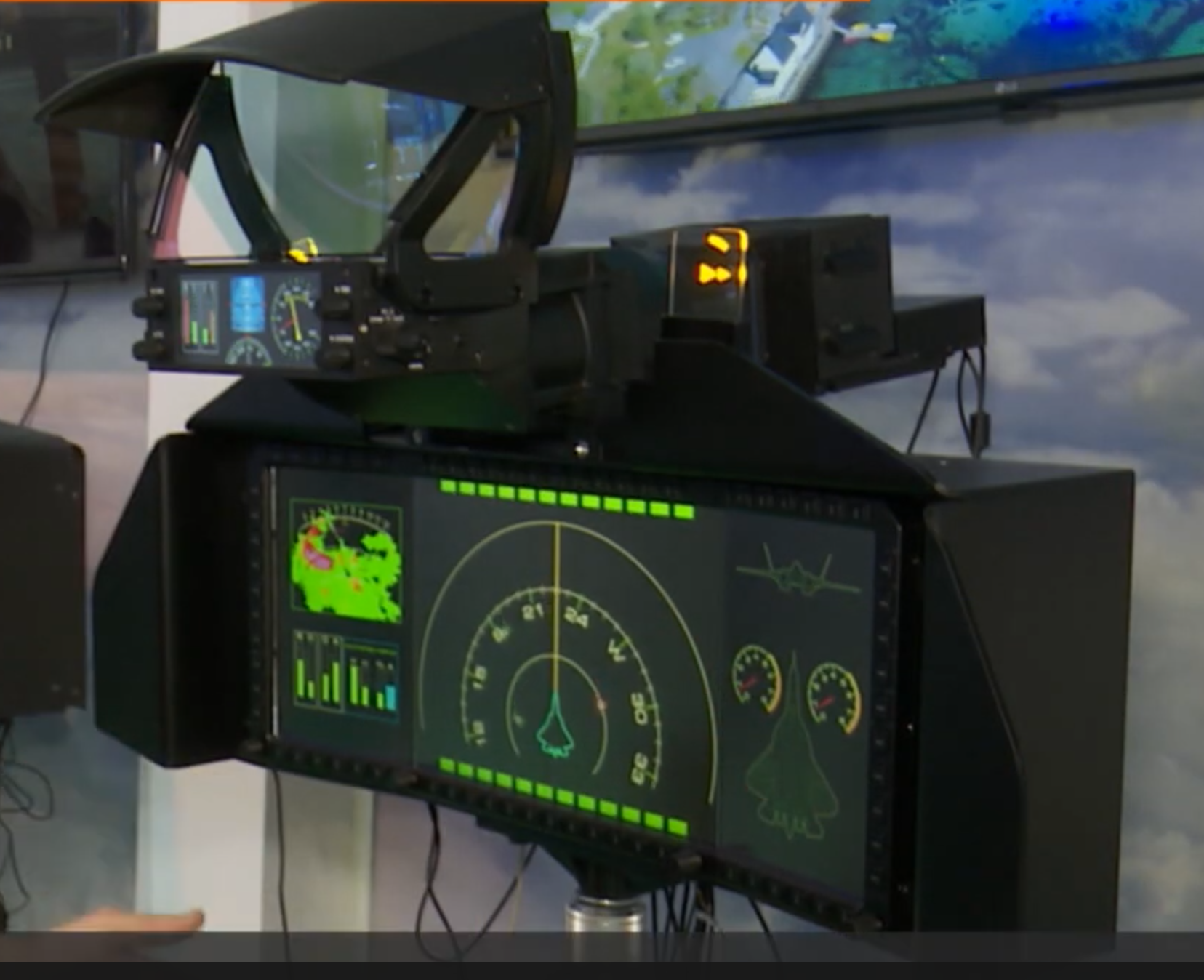
Su-57 single-seat cockpit at MAKS-2019, showing the multifunction displays, HOTAS controls, and wide-angle HUD. The two-seat variant adds a tandem rear cockpit; the mission commander’s workstation would replicate the sensor and MUM-T control interfaces without a primary flight control responsibility. Photo: Wikimedia Commons CC-BY-SA.
Fighterbomber Telegram Channel (Ilya Tumanov) : 16 May 2026
“Today, as part of the tests, the new two-seater modification of the Su-57 performed a rollover. We’ll see if it will be called Su-57D or Su-57UB. Alternatively, it could be called Su-57ED.”
Source Reliability Matrix
NATO grading: REL A (reliable) to F (unreliable). CRED 1 (confirmed) to 6 (cannot judge).
CRED 2
Established independent aviation journalism. Reporting on the Su-57D taxi trials is based on the Fighterbomber imagery and corroborating analysis from researcher Andreas Rupprecht. Reliable source, but the underlying primary material (imagery) cannot be fully independently verified for the bort number or location.
CRED 3
Generally credible on factual technical reporting about Russian aviation; has an established track record within the Russian military aviation information space. However, it operates within the Russian military media ecosystem and its publication of imagery at this particular moment, aligned with Russian export diplomacy, requires contextual awareness. Images cannot be independently geolocated from available metadata.
CRED 2
The Su-57 Wikipedia article is extensively referenced and generally reflects the open-source consensus across aviation journals, defence press, and analyst publications. Used for delivery figures and programme history, cross-referenced against The Aviationist and Army Recognition. Not used for performance claims.
CRED 3
Used for contextual framing of the India sales pitch and MUM-T export narrative. These outlets frequently republish manufacturer-aligned content without independent verification; all capability claims from these sources have been treated as manufacturer-claimed and flagged accordingly. No performance specifications from these sources are cited as independent verification.
Strategy Battles Assessment
The Su-57D is a real hardware milestone in a programme where production numbers remain severely constrained, and its primary near-term significance is as a diplomatic signal rather than an operational capability shift.
✓ Strengths
The two-seat concept addresses a genuine operational problem: single-seat MUM-T management is cognitively overloaded in realistic combat conditions. The Su-57 baseline has established operational relevance in standoff strike roles over Ukraine, demonstrating internal weapons bay use and stealth-profile mission execution in a real conflict environment. The N036 Byelka radar suite represents a genuine generational advance over Russian fourth-generation fire-control radars, with wide-angle multi-antenna coverage that provides superior situational awareness in the beyond-visual-range engagement band. Russia’s proposal to India includes technology-transfer terms that go substantially further than most Western offers, creating a genuine commercial argument for a customer with “strategic autonomy” requirements.
✗ Limitations
Production throughput at approximately four to seven aircraft per year cannot support the fleet scale required to make MUM-T formations an operationally significant capability. The Su-57 fleet has been conserved in Ukraine rather than committed to air-to-air engagements, suggesting Russia itself does not consider current numbers sufficient to absorb attrition. The S-70 MUM-T architecture suffered a publicly confirmed failure in combat conditions in October 2024, with a datalink loss causing an operational loss of the drone; the two-seat variant cannot address this problem without first solving the underlying command-and-control architecture. The stealth performance claims for the two-seat variant are single-source, unverified, and inherently suspect given the engineering compromises introduced by a tandem cockpit. Sanctions-driven component substitution has reduced avionics quality relative to the design intent. CAATSA exposure makes any Indian acquisition politically and legally complex.
☉ Strategic Implication
The Su-57D taxi trials represent a genuine but incremental development in Russia’s fifth-generation ecosystem. The platform’s strategic weight is primarily in the export market and the doctrinal signaling domain rather than the near-term Russian Aerospace Forces order of battle. For India, the two-seat Su-57 offer presents a genuine dilemma: it addresses real capability gaps, offers industrial sovereignty terms that matter politically, and is now backed by hardware rather than marketing. Against it sit sanctions risk, stealth performance doubts, MUM-T immaturity, and a production base that cannot guarantee timely delivery. The trajectory of Russian-Indian negotiations will be shaped by whether New Delhi assesses the interim capability value of the Su-57 as sufficient to accept these risks while waiting for AMCA. The aircraft’s emergence also accelerates pressure on the US and European partners to clarify what they can credibly offer India in the fifth-generation space, including whether any F-35 pathway is politically realistic.
Sources
- Parth Satam, “Russia Starts Testing Twin-Seat Variant of Su-57 Felon,” The Aviationist, 17 May 2026
- Defence Security Asia, “Russia Offers India Dual-Seat Su-57 With Full Technology Transfer,” 24 March 2026
- Kris Osborn, “Russia’s S-70 Okhotnik Has a Problem No One Saw Coming,” 19FortyFive / Warrior Maven, 27 May 2025 (covering October 2024 incident)
- Guy Plopsky / The Aviationist, Su-57 delivery tracking (ongoing); World Air Forces 2026 report, citing 24 airframes as of December 2025; UAC additional deliveries statement, February 2026
- Wikipedia, “Sukhoi Su-57,” programme history section covering PAK FA and FGFA partnership (cross-referenced against multiple defence press sources)
- Militarnyi.com, “Russia Shows Su-57D Two-Seat Fighter Jet for First Time,” 17 May 2026
- Army Recognition, “Russia Ready To Deploy Okhotnik Stealth Drone with Su-57 in New Manned-Unmanned Strike Strategy,” 2025
- IDRW.org, “Russia Ready to Share Technology for S-70 UCAV and Su-57MKI Fighter Combo with India,” 5 February 2026
Editorial Verification
Su-57 fleet delivery figures are sourced from The Aviationist’s ongoing open-source delivery tracking by Guy Plopsky (corroborated by World Air Forces 2026 report, citing 24 airframes as of December 2025, plus UAC February 2026 batch statement). No official Russian government figure for total Su-57 deliveries is publicly available. All Su-57 performance specifications (speed, combat radius, service ceiling) are manufacturer-claimed; no independently verified measurements are publicly available. The Su-57D two-seat variant has no published specifications; all two-seat capability claims (four-drone control, 10% endurance increase, stealth retention) are single-source, originating in Russian-aligned reporting, and are flagged accordingly. The S-70 Okhotnik-B friendly-fire loss in October 2024 is independently confirmed by Defence Express (Ukraine) and corroborated by multiple Western defence analysts. Algeria customer identity is assessed as confirmed based on Algerian national television announcement (February 2025) and UAC CEO statement (November 2025). Unit cost figures for the Su-57 are industry estimates with no official procurement baseline; FY2024 basis noted throughout. IISS Military Balance 2025 referenced for fleet context. SIPRI Arms Transfers Database accessed for export contract data.
All specifications, fleet figures, and capability claims independently attributed and cross-checked to open sources where possible. Manufacturer-claimed performance figures noted with “(claimed)” suffix inline. Single-source claims flagged with purple status tag or low-confidence Key Judgment.
Approved for Publication
Marcus V. Thorne
Lead Editor, Strategy Battles
FILE SB-TECH-2026-0518-001 // CLEARED
©StrategyBattles.net 2026
This article is for news and analysis purposes only. Based on publicly available technical documentation, manufacturer fact sheets, and defence industry reporting. All rights reserved. Not for commercial reuse without permission.