Syria’s Uzbek Fighters Surround Idlib Security Building After Arrest, President Intervenes
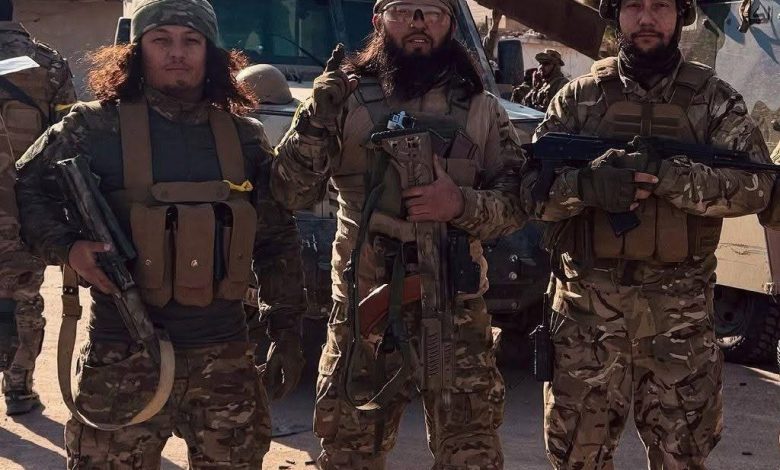
Threat Level Assessment
LEVEL 3 OF 5, DEVELOPING
Bottom Line Up Front
The arrest of an Uzbek fighter in Idlib city triggered a standoff in which armed Uzbek fighters surrounded the Criminal Security Branch demanding his release; President Ahmed Al-Sharaa personally intervened, dispatching a senior military commander to negotiate. Syrian security forces subsequently arrested 16 Uzbeks in a sweep of the towns of Kafiriya and Al-Foua. The incident is the second armed confrontation in months between the Syrian government and foreign fighter contingents in Idlib, following clashes with the French-led Firqat Al-Ghuraba in October 2025, and it lays bare an unresolved structural problem: Damascus has integrated thousands of muhajirin into its military architecture but has not resolved their legal status, their political expectations, or what happens when their interests diverge from those of the state.
Key Judgments
The Idlib standoff is a symptom of a structural governance failure, not an isolated disciplinary incident. The Syrian government has formalised the military role of foreign fighters through the 84th Division while leaving their citizenship claims, legal status, and political grievances unaddressed. That combination produces exactly the conditions visible in Idlib: fighters with loyalty to the state in combat but no institutional stake in its civilian order.
The Uzbek community’s mobilisation in Idlib is increasingly operating as a cross-factional solidarity bloc rather than a faction-loyal formation. The spontaneous character of the protest, not organised by a specific group, reflects a community that perceives itself collectively vulnerable and is developing informal mutual-defence instincts. That dynamic is harder for Damascus to manage than a named faction with identifiable leadership.
Whether Al-Sharaa’s personal intervention in the standoff reflects genuine political capital with muhajirin communities or reflects his diminishing options. The pattern, two armed confrontations in eight months, suggests that the government’s authority over Idlib’s foreign fighter camps is shallower than the formal integration narrative implies. Whether a third incident escalates rather than subsides is the key near-term indicator.
16
Uzbeks Arrested, May 2026
~1,500
Uzbek Fighters in Syria
~3,500
Foreign Fighters, 84th Div.
2
Armed Confrontations, 8 Months
SITREP Timeline : Foreign Fighter File, Syria, Dec 2024 to May 2026
🔴 The Idlib Standoff
One Fighter, One Weapon Discharge, And a Crowd That Surrounded a Government Building
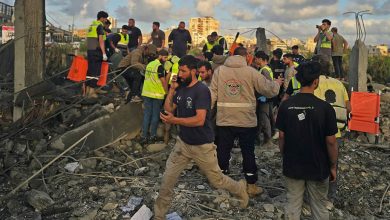
In the town of Kafiriya, Idlib Governorate (approximately 36.4700°N, 36.6400°E, grid reference 37S CB 64000 07000), in the countryside north-east of Idlib city, the latest crisis in Syria’s foreign fighter file began with a single Uzbek fighter discharging his weapon in the city. Syrian Internal Security Forces arrested him. Dozens of armed Uzbek fighters then surrounded the Criminal Security Branch in Idlib city, pressing for his immediate release. Military reinforcements were deployed. Sporadic gunfire was heard in the vicinity of Kafiriya and Al-Foua, where the arrested fighter lived among a dense concentration of Uzbek residents.
The situation reached a level where President Ahmed Al-Sharaa personally intervened. He dispatched a senior military commander, identified by the Syrian Observer as Abdul Hamid Sahari, known as Abu Abdo Taoum, to meet with Uzbek community elders. According to the Syrian Observer, the confrontation ended after the detained fighter was released and the crowd dispersed following an agreement mediated through elders who pledged loyalty to the Syrian state. In the days that followed, Syrian security forces conducted a broader sweep of the Kafiriya and Al-Foua area, arresting 16 Uzbek fighters who had participated in the original protest outside the security branch.
The pattern is important. This was not the first time. In October 2025, armed clashes erupted in Harem, Idlib, between government forces and Firqat Al-Ghuraba, the brigade of foreign jihadists led by the French national Omar Diaby, known as Omar Omsen. On that occasion the trigger was an alleged kidnapping involving a child inside Al-Fardan camp. Uzbek fighters mobilised in solidarity with the French contingent during those clashes, and a ceasefire was ultimately negotiated with Uzbek commanders serving as partial intermediaries. Two incidents in eight months; the third will matter more.
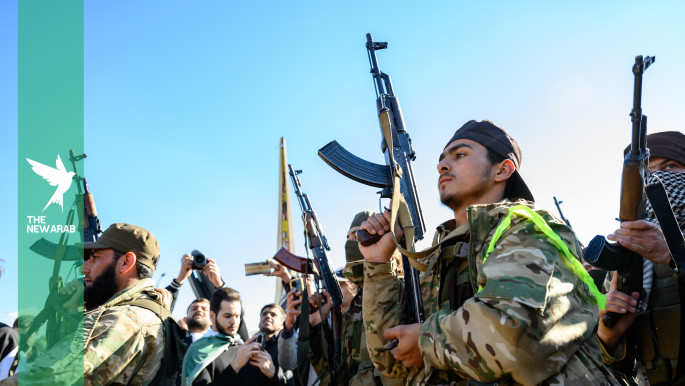
Foreign fighter contingents in northwest Syria. The muhajirin remain an influential armed presence in Idlib Governorate 17 months after Assad’s fall. Photo: Getty Images.
🟡 Who the Muhajirin Are
A Decade of War, Tens of Thousands of Foreign Fighters, And a Government That Owes Them a Debt It Has Not Paid
The word muhajirin, migrants in Arabic, was adopted by foreign fighters who came to Syria after 2011 to distinguish themselves from local Syrian combatants. Tens of thousands arrived over the course of the civil war, joining a range of Islamist factions including the Islamic State, groups aligned with Hayat Tahrir Al-Sham (HTS), and smaller independent formations. The Uyghur-majority Turkistan Islamic Party represented the largest single contingent, with approximately 3,500 fighters and their families by the time of the Assad regime’s collapse in December 2024. Uzbeks represent the second largest national grouping in northwest Syria, with Reuters citing a Syrian security source’s estimate of around 1,500 fighters, some accompanied by families.
These were not peripheral actors. They were, in the assessment of Issam Al-Reis, a military researcher with ETANA, integral to HTS’s ability to hold out through the long years of international isolation and then acted as a vital pillar of support as Al-Sharaa’s forces consolidated control over Syria. The TIP’s integration into the Syrian Army’s 84th Division on 18 May 2025 formalised what had been operationally true for years. Several muhajirin commanders received senior ranks: Khodabardi of the TIP was promoted to brigadier general in December 2024, with a Jordanian commander receiving command of the elite Republican Guard and an Australian national of Lebanese descent heading a sovereign asset oversight body.
Unlike the Uyghurs, who cohere around the TIP as a centralised organisation, the Uzbeks are distributed across several armed groups with varying degrees of loyalty to Damascus. Some are formal HTS loyalists. Others maintain an arm’s-length relationship with the government. That fragmentation makes the Uzbek community harder to manage through a single command channel, which is exactly why the May 2026 standoff was handled through elder mediation rather than through an institutional chain of command.
🔵 The Ideological Fault Line
Al-Sharaa Has Made a Nationalist Turn. His Foreign Fighters Have Not All Followed
The political transformation at the core of Syria’s government since December 2024 has been Al-Sharaa’s pivot from transnational jihadism toward Syrian nationalism. That pivot is strategic and externally legible: it is what allowed Trump to lift US sanctions in May 2025 and what makes the new Damascus government viable as an interlocutor with Gulf states and Turkey. The problem is that many of the foreign fighters who brought Al-Sharaa to power have not made the same journey. Independent analyst Aymenn al-Tamimi, speaking to The New Arab, described a disconnect driven by differing visions, with foreign fighters broadly supporting the application of Islamic law rather than a nationalist state-building project.
That divergence has produced visible friction. Prominent foreign figures who criticised the Al-Sharaa government’s direction were arrested without explanation in 2025: the American journalist and commentator Bilal Abdul Kareem and the Uzbek critic Abu Dujana Al-Turkistani were both detained. Al-Tamimi described the government as having taken a hard line on such critics within the camps. The arrests confirm a pattern: public dissent from named foreign fighters is treated as a security problem rather than a political one. That approach may suppress visible opposition while producing the kind of ambient grievance that feeds spontaneous solidarity mobilisations, of the sort seen in Idlib in May 2026.
Al-Tamimi also notes, however, that many muhajirin are genuine loyalists who have undergone a political transformation that mirrors Al-Sharaa’s own. The community is not monolithic. Firqat Al-Ghuraba and its refusal to integrate its own police and court system into the state is one extreme. TIP’s full incorporation into the 84th Division is the other. The Uzbek community in May 2026 sits somewhere in the middle, which is precisely what makes predicting the trajectory of its relationship with Damascus difficult.
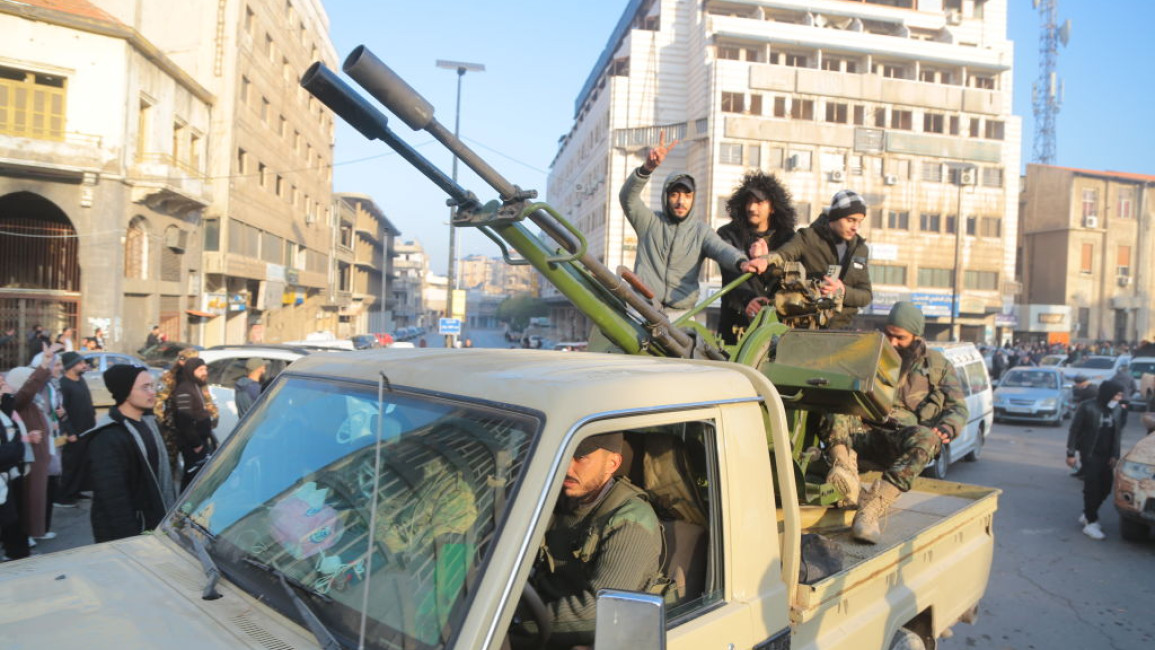
Concerns among some muhajirin that Damascus may seek to sideline them have grown as international pressure on the foreign fighter file increases. Photo: Getty Images.
⚠ External Pressure
China Wants the TIP Gone. The US Settled for Integration. Both Positions Create Pressure Damascus Is Absorbing
The foreign fighter file is not only an internal Syrian political problem. Multiple foreign governments have expressed concerns about the presence and future of their respective nationals in Syria, many of whom face terror charges in their home jurisdictions. China’s ambassador to the UN has warned Damascus that it must prevent terrorist forces from using Syrian territory to attack third countries, a thinly framed reference to the TIP’s stated objective of securing independence for Xinjiang. Beijing’s position generated direct tension when Khodabardi, whose organisation explicitly seeks the liberation of East Turkistan from Chinese control, was formally incorporated into the Syrian Army as a brigadier general.
The United States took a different approach. Washington’s initial position, formalised in a March 2025 letter to Damascus, demanded the expulsion of foreign fighters as a condition of sanctions relief. Al-Sharaa’s government stalled. By June 2025, shortly after Trump’s Middle East tour and the lifting of sanctions, the US envoy Thomas Barrack publicly endorsed the integration plan for the 84th Division, describing an understanding with transparency. The calculation behind that shift was that fighters inside a formal command structure were less dangerous than the same fighters outside one, with an alternative exit toward the Islamic State. The Soufan Center’s analysis of the same period made exactly that case.
At home, Syrian ethnic minorities, particularly Alawites, Kurds, Christians, and Druze, regard the presence of foreign jihadists with open hostility. The participation of foreign elements in the coastal massacres targeting Alawite communities in March 2025 deepened that fear. Al-Sharaa’s strategy has been to keep the foreign fighter presence as invisible as possible in public life, which is part of the reason incidents like the May 2026 Idlib standoff are politically costly: they are precisely the kind of visible, televised proof of the government’s limited writ that Damascus most wants to avoid.
Issam Al-Reis, Military Researcher, ETANA : Quoted in The New Arab, 18 May 2026
“They fought to overthrow the regime, but they now feel like something that the government would prefer not to talk about. Their concern is that they are vulnerable without citizenship, and they believe they are eligible for Syrian citizenship since most of them have been in Syria for over a decade.”
🟢 The Integration Path
The 84th Division Is the Government’s Answer. It Is Not Yet a Complete One
The government’s formal mechanism for managing the muhajirin is the 84th Division, designated as the unit for non-Syrian servicemen and placed under the direct oversight of the Syrian presidency. Aaron Zelin of the Washington Institute for Near East Policy describes the objective: folding fighters into the Ministry of Defence creates a proper command and control above them, giving Damascus administrative authority over formations that previously operated under their own chains. Several muhajirin commanders have received senior positions in the formal military hierarchy. Citizenship has also been extended to previously stateless Kurdish populations in recent months, creating a visible precedent that foreign fighters have noted and not yet benefited from.
The integration path has limits. Zelin notes that some foreign fighters resist integration on ideological grounds, though he assesses this group as a relatively small contingent unlikely to directly threaten the government. The more significant resistance comes from formations like Firqat Al-Ghuraba, which operates its own parallel police and court system inside Harem and has declined to subordinate itself to the state’s legal architecture. Omar Omsen’s group is the clearest case of a formation that has resisted integration and demonstrated in October 2025 that it is willing to confront state forces directly when it perceives an incursion into its camp’s autonomy.
Tam Hussein, a journalist with extensive reporting experience on transnational jihadist networks, offers a longer frame: many of these fighters own businesses, are known in their local communities, and are structurally integrated into northwest Syrian life in ways that predate the political question of their formal status. Syria’s history of different migration waves, he argues, makes this one less exceptional than it appears. That view does not resolve the tension visible in Idlib in May 2026, but it contextualises what the government is actually managing: not a discrete foreign element to be expelled or absorbed, but a population that has, over 15 years, become part of the region’s social fabric.
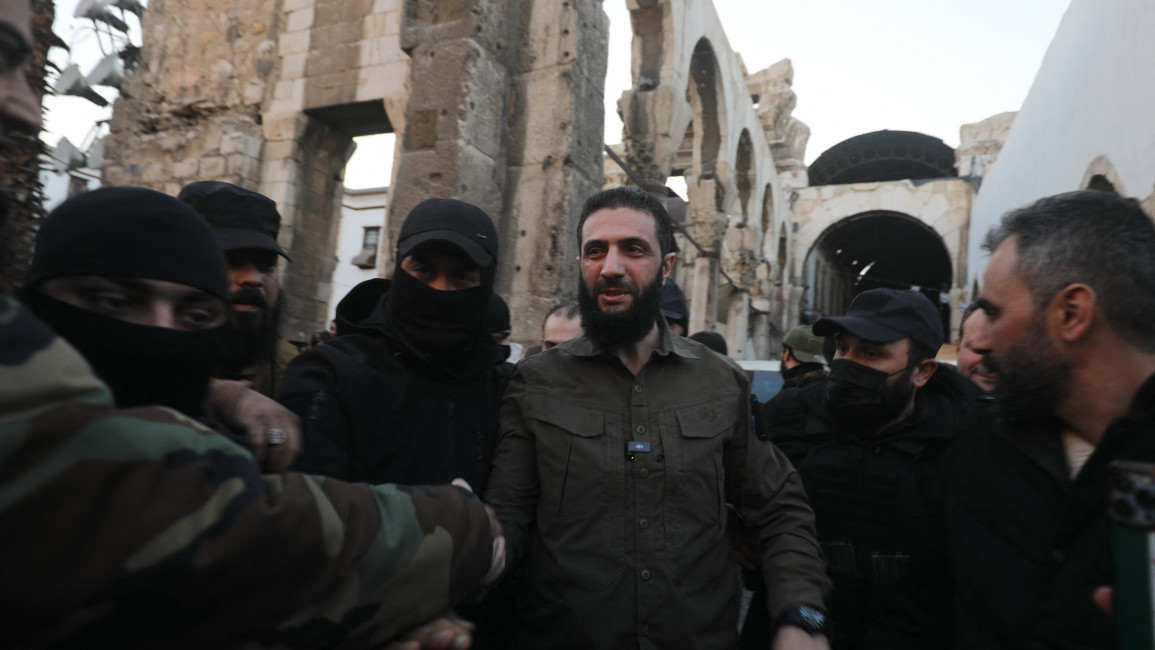
Foreign fighters played a central role in HTS’s offensive that toppled the Assad regime in December 2024. Their political future inside Syria remains unresolved. Photo: Getty Images.
Source Reliability Matrix
NATO grading: REL A (reliable) to F (unreliable). CRED 1 (confirmed) to 6 (cannot judge).
CRED 2
Primary wire service on the incident. Background sourcing; exact fighter count not confirmed at time of reporting.
CRED 2
Damascus-based correspondent with established Syria access. Analyst quotes are single-source to this article; flagged where used.
CRED 1
Corroborating outlets on the arrest figure of 16 and the elder mediation mechanism.
CRED 2
Named the mediating commander (Abu Abdo Taoum) and confirmed Al-Sharaa’s personal intervention; single-source on those specific details.
CRED 2
All four are established analysts with Syria expertise. Quotes are single-sourced to The New Arab interview and are presented as analysis, not verified fact.
Strategy Battles Assessment
Syria has successfully integrated the muhajirin into its military structure. It has not integrated them into its political compact, and the gap between those two facts is the crisis that Idlib keeps surfacing.
✓ What We Know
An Uzbek fighter’s arrest in Idlib city in May 2026 triggered an armed standoff at the Criminal Security Branch. Al-Sharaa intervened personally. Sixteen Uzbeks were arrested in a follow-on security sweep. The Turkistan Islamic Party’s approximately 3,500 fighters have been formally integrated into the 84th Division with US approval, while an estimated 1,500 Uzbeks remain distributed across multiple factions with varying loyalty to Damascus. The government has arrested foreign fighter critics without explanation and ordered muhajirin out of city centres. Two armed confrontations between foreign fighter contingents and government forces have occurred in eight months.
? What We Do Not Know
Whether Syria’s government intends to extend citizenship to the muhajirin and on what timeline. Whether the spontaneous, cross-factional character of the Uzbek mobilisation in May 2026 represents a permanent shift in community solidarity dynamics or a one-off response to a specific grievance. Whether Firqat Al-Ghuraba’s continued parallel governance in Harem will be tolerated indefinitely or whether Damascus will eventually force a confrontation. Whether Washington’s approval for 84th Division integration will hold if a major incident involving foreign fighters occurs against a US interest or ally.
☉ What To Watch
Whether Damascus announces a citizenship pathway for foreign fighters who have resided in Syria for more than a decade. Whether a third armed confrontation in Idlib occurs and whether it escalates beyond the resolution mechanisms used in October 2025 and May 2026. Whether China intensifies diplomatic pressure on Damascus over TIP’s presence in the 84th Division following the formal integration. Whether the Islamic State succeeds in recruiting disaffected muhajirin who conclude that Al-Sharaa’s nationalist project has no place for them.
Sources
- The Muhajirin: Inside Syria’s uneasy pact with foreign fighters, The New Arab, Cian Ward, 18 May 2026
- Syrian forces detain Uzbek fighters in Idlib security sweep, Reuters via The New Arab, 18 May 2026
- Syria arrests armed Uzbek fighters after stand-off in Idlib, The National, May 2026
- Syrian Forces Detain Uzbek Fighters in Security Sweep, Asharq Al-Awsat, May 2026
- Security Tension in Idlib After Brief Arrest of Uzbek Fighter, Syrian Observer, May 2026
- Syrian military integrates Al Qaeda-linked terror group into its ranks, FDD Long War Journal, May 2025
- Stateless Fighters, Stated Goals: Syria’s Precarious Balancing Act, The Soufan Center, 1 July 2025
Editorial Verification
The Uzbek fighter incident is verified through Reuters (two Syrian security officials), The National, Asharq Al-Awsat, Middle East Online, the Syrian Observer, and Hawa News. The arrest figure of 16 is confirmed by The National; Reuters did not specify a number at initial publication time. Al-Sharaa’s personal intervention is single-source to the Syrian Observer via Ultra Syria and is flagged accordingly. The name of the mediating commander, Abdul Hamid Sahari (Abu Abdo Taoum), is single-source to the Syrian Observer and has not been independently confirmed by Strategy Battles; treated as background context only. TIP/84th Division integration facts are corroborated by Reuters, FDD Long War Journal, Soufan Center, and the EU Agency for Asylum COI Report Syria, July 2025. Analyst quotes from al-Tamimi, Al-Reis, Zelin, and Hussein are single-sourced to The New Arab and are presented as analytical opinion. The October 2025 Harem clashes are corroborated by Reuters and the Syrian Observer. Approximate grid reference 37S CB 64000 07000 (36.4700N, 36.6400E) is derived from open-source mapping of Kafiriya, Idlib Governorate; it is an approximate point and is not independently verified from disclosed operational coordinates.
MGRS datum: WGS84 / UTM Zone: 37S / Cross-check reference: Idlib city centre approximately 37S CB 54000 96000 (35.9306N, 36.6339E). No satellite imagery has been used in this report.
All claims independently attributed and verified to open sources where possible.
Approved for Publication
Marcus V. Thorne
Lead Editor, Strategy Battles
©StrategyBattles.net 2026
This article is for news and analysis purposes only. Based on publicly available news sources and military updates. All rights reserved. Not for commercial reuse without permission.