Night Stalkers Were Deep Inside Iran: Destroyed Little Birds Reveal the True Scale of the F-15E Rescue
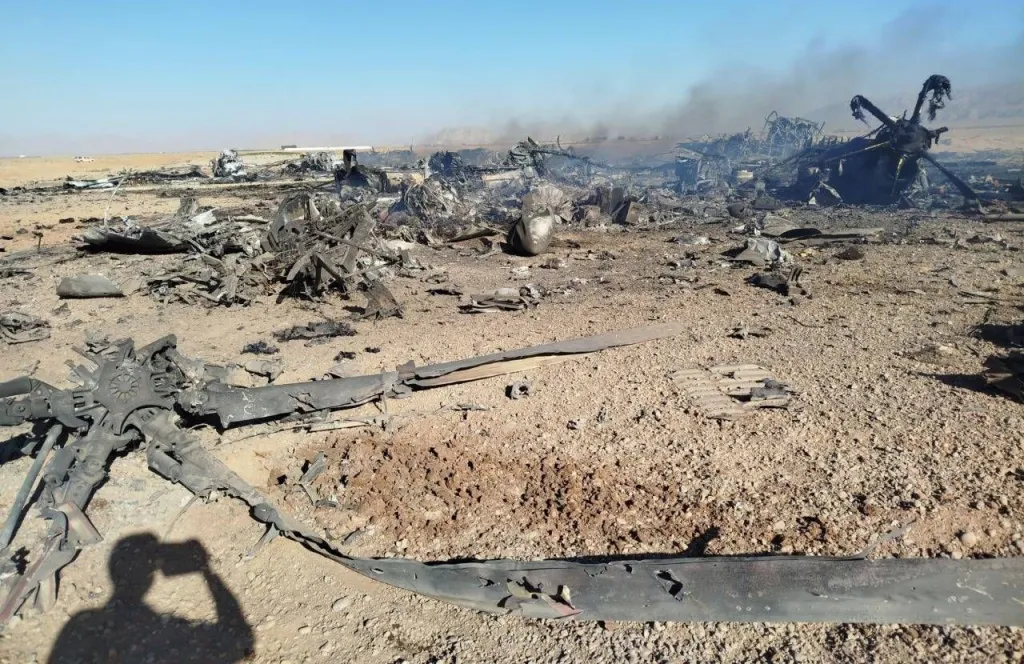
WASHINGTON, April 6, 2026 — New images emerging from the improvised forward airfield constructed deep inside Iran for the rescue of the downed F-15E weapons systems officer reveal that the operation was significantly larger and more complex than previously understood. Among the wreckage at the site — now geolocated by open-source analysts to a location just south of Isfahan — are the burned-out hulks of at least two AH/MH-6 Little Bird helicopters belonging to the U.S. Army’s 160th Special Operations Aviation Regiment, better known as the Night Stalkers. Their presence at a makeshift airbase 200 miles inside Iranian territory, alongside two deliberately destroyed MC-130J Commando II transport aircraft, reveals a mission that pushed America’s most elite special operations aviation unit to the absolute edge of its operational reach.
This analysis is based on reporting by The War Zone, combined with open-source geolocation data and publicly available images of the crash site. The images appear authentic after initial examination, though analysts caution that could change as further verification is conducted.
What the Images Show
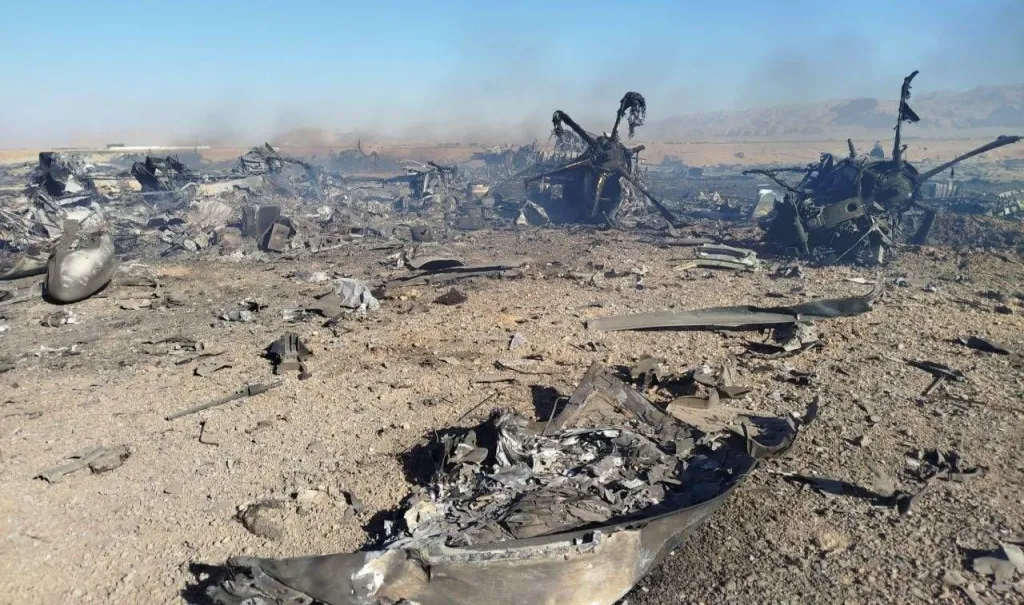
Images circulating on social media and examined by The War Zone show a debris field at what appears to be an improvised landing strip south of Isfahan. To the right of one image, the unmistakable silhouette of a burned-out AH/MH-6 Little Bird is clearly visible. In the background the hulk of a C-130 transport aircraft can be seen. A closer examination of additional images shows a rotor mast consistent with the H-6 airframe in the foreground, with the destroyed C-130 visible behind it. The debris field appears extensive. Open-source analysts, including OSINTtechnical and collaborators working with GeoConfirmed, have placed the site at approximately coordinates 32.258394N, 51.901927E — just south of Isfahan city, putting the forward operating base deep inside Iranian territory and approximately 200 miles from the Iranian coastline and roughly 230 miles from the nearest land border.
The significance of that location cannot be overstated. Isfahan is not remote Iranian countryside. It is one of Iran’s most strategically sensitive cities — home to missile production facilities, army bases, nuclear-related infrastructure, and the air base where Iran’s F-14 Tomcat fleet is stationed. The Night Stalkers and their special operations force did not build a temporary airbase in a quiet corner of southwestern Iran. They built it in the shadow of one of the most heavily militarised cities in the country.
“Location of the USAF forward base set up deep within Iran for the F-15 crew rescue mission. The base was set up just outside of Isfahan, a critical Iranian strategic hub with missile and army bases, nuclear facilities, and the airbase home to Iran’s F-14 fleet.”
— OSINTtechnical, April 5, 2026
What the Little Birds Were Doing There
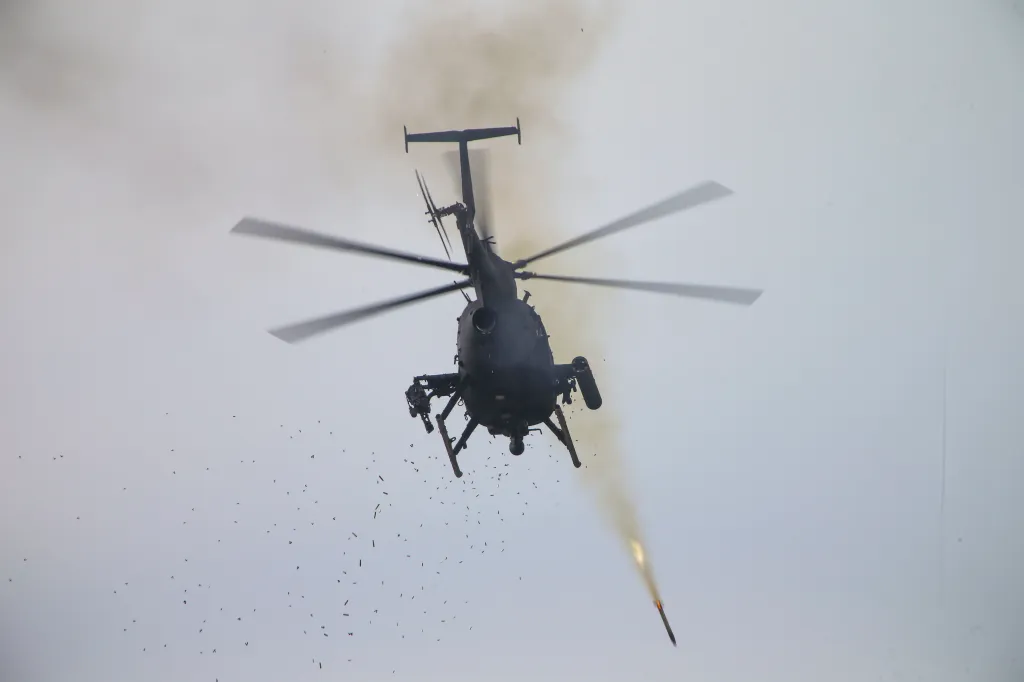
The AH-6 and MH-6 are two configurations of the same airframe. The AH-6 is the attack variant, equipped with rocket pods, miniguns, and Hellfire missiles. The MH-6 is the assault transport variant, capable of carrying special operations personnel on external bench seats. Both serve critical roles in exactly this type of mission.
If the helicopters at the Isfahan site were in AH-6 attack configuration — which The War Zone assesses as the most likely scenario given the mission profile — they were there to provide close air support and force protection for the larger special operations element on the ground. The AH-6’s small size, agility, and devastating firepower make it ideal for exactly this role: holding a perimeter, suppressing threats approaching the landing zone, and providing overwatch during the extraction of personnel. Reports now indicate the operation may not have involved a major ground firefight as initially described, but that Iranian forces approaching the base were engaged from the air — a description that fits precisely what an AH-6 crew would be tasked with doing in this scenario.
If any of the aircraft were in MH-6 configuration, they could additionally have been used to search for and support the colonel during the 36 hours he spent evading capture in the mountains — providing aerial search capability and potentially a means of rapid extraction if he could be reached from the air before the larger force arrived on the ground.
How the Little Birds Got There — and Why They Could Not Leave
The Little Bird’s greatest tactical asset is also relevant to understanding how they arrived at the Isfahan site and why they had to be destroyed. The AH/MH-6 can be rapidly broken down, loaded into a C-130, flown to virtually any improvised airstrip in the world, rolled out of the cargo hold, and be airborne in minutes. This is a core capability of the 160th SOAR and has been demonstrated repeatedly in exercises, as The War Zone has previously documented in detail. The MC-130J can serve simultaneously as the delivery aircraft, the weapons resupply platform, and the forward arming and refuelling point — a FARP — for the Little Birds once on the ground.
Given that the forward base was 200 miles inside Iran and approximately 230 miles from the nearest land border, The War Zone assessed that a direct flight by the Little Birds under their own power was almost certainly ruled out. Even with auxiliary fuel tanks the AH/MH-6’s range is limited, and flying that distance over Iranian airspace would have been extremely high-risk and at the very edge of the aircraft’s capability. The most probable scenario is that they were loaded into the MC-130Js, flown to the improvised airstrip, rolled out, and operated from the site using the C-130s as their fuel and weapons source.
When two of the MC-130Js became stuck and could not depart — as has now been widely reported and confirmed by The New York Times — the entire extraction plan had to be rebuilt in real time. Three replacement aircraft were eventually flown in to extract the force. But the Little Birds, whose fuel supply and transport home had just been immobilised, faced an impossible situation. They could not fly home independently. There was likely no room aboard the replacement aircraft to load them. The decision was made to destroy them in place — the standard protocol for any stranded special operations aircraft packed with sensitive sensors, communications systems, and classified equipment that cannot be allowed to fall into enemy hands.
Map: U.S. forward operating base location south of Isfahan — based on OSINT geolocation data. Strategy Battles graphic, not to scale.
Why the Night Stalkers
The 160th Special Operations Aviation Regiment is the U.S. Army unit dedicated entirely to special operations aviation. Known as the Night Stalkers, they are the aviation arm of America’s most sensitive military missions — flying Army Special Forces, Delta Force, SEAL Team Six, and other tier-one units into and out of the most hostile environments on earth. Their motto is “Night Stalkers Don’t Quit.” They have been present at virtually every major U.S. special operations mission of the past four decades, from the raid on Osama bin Laden’s compound in Abbottabad to the rescue of Captain Richard Phillips from Somali pirates.
The AH-6 and MH-6 Little Birds are among their most versatile and forward-deployable assets. The aircraft’s tiny size — it is one of the smallest military helicopters in the world — means it can be transported on platforms that larger helicopters cannot use, including commercial ships, oil rigs, and the smallest improvised airstrips. As The War Zone has previously reported, the Night Stalker crews train specifically for exactly the kind of forward arming and refuelling point operations that appear to have been conducted south of Isfahan — rolling Little Birds out of C-130s onto improvised strips, refuelling them from the aircraft’s own fuel supply, arming them from onboard weapons, and launching them within minutes of landing.
What This Tells Us About the Mission
The presence of Night Stalker Little Birds at the Isfahan forward base adds several critical layers of understanding to the rescue operation that were not previously apparent from initial reporting.
First it confirms that the special operations force deployed to Iran was not a small team inserted to pick up one person. It was a substantial force with its own organic close air support, its own forward fuel supply, its own communications infrastructure, and the capability to hold a perimeter against Iranian ground forces while simultaneously conducting a search-and-rescue operation across mountainous terrain. This was a full combat mission, not a pickup.
Second it confirms that the CIA deception operation reported by The New York Times — designed to convince Iranian forces that the colonel had already been recovered by ground transport — was necessary precisely because the actual operation was large enough to be detected. A force of this size operating an improvised airbase south of Isfahan generates heat signatures, radio emissions, and visual signatures that Iranian surveillance would eventually detect. Buying time through deception was operationally critical.
Third it reveals the true cost of the mission in equipment terms. Two MC-130Js and at least two AH/MH-6 Little Birds were destroyed inside Iran. Each MC-130J costs approximately $70 million. Each Little Bird costs several million dollars. More critically, all of these aircraft are packed with classified sensors, communications gear, and electronic warfare systems that U.S. forces go to extraordinary lengths to deny to adversaries. Destroying them was not a choice — it was a tactical and intelligence necessity. As The War Zone noted: “Destroying stranded special operations aircraft is absolutely critical as they are packed with sensitive sensors, communications, defensive systems and more.”
The Isfahan Forward Base — Key Facts
- Location: Just south of Isfahan — approximately 32.258394N, 51.901927E — geolocated by OSINTtechnical and GeoConfirmed
- Distance from Iranian coastline: Approximately 200 miles
- Distance from nearest land border: Approximately 230 miles
- Aircraft destroyed: 2x MC-130J Commando II — intentionally demolished to prevent capture
- Helicopters destroyed: At least 2x AH/MH-6 Little Bird — 160th SOAR Night Stalkers
- Replacement aircraft: 3x C-130 variants flown in to extract the force after the original two became stuck
- Little Bird likely role: Close air support and force protection in AH-6 attack configuration
- Why Little Birds were destroyed: Unable to fly home independently — no room on replacement aircraft — packed with classified equipment
- Isfahan strategic significance: Iranian missile production, nuclear facilities, army bases, F-14 air base
- Mission outcome: Colonel WSO rescued alive — seriously wounded but expected to fully recover
Analysis
Every new detail that emerges from this rescue operation makes it more remarkable and more sobering simultaneously. The Night Stalkers built an improvised airbase in the shadow of Isfahan — one of Iran’s most sensitive strategic cities — with no advance preparation, under time pressure, in a hostile environment, with Iranian forces actively hunting the man they were trying to rescue. They provided close air support with AH-6 Little Birds to hold the perimeter. They maintained the base long enough for the colonel to reach them. And when two of their transport aircraft broke down and could not leave, they did not abandon the mission. They called for more aircraft, waited for them, extracted the colonel and their personnel, and destroyed everything they could not take with them.
The burned-out Little Birds south of Isfahan are not a story of failure. They are evidence of a mission that went wrong in multiple ways — two C-130s immobilised, a rescue force stranded 200 miles inside Iran, a colonel wounded and evading capture across mountainous terrain for 36 hours — and still succeeded. Trump was right to call it one of the most daring operations in U.S. history. The wreckage in the desert south of Isfahan is the price of that success.
Strategy Battles — Related Coverage
Editorial Verification
This report has been reviewed for tactical accuracy and OSINT compliance.
Approved for Publication
Marcus V. Thorne
Lead Editor, Strategy Battles
Sources
- The War Zone — Night Stalker AH-6 Little Bird Helicopters Destroyed at Forward Landing Site in Iran (Tyler Rogoway, April 5, 2026)
- The War Zone — F-15E Weapon Systems Officer Shot Down Over Iran Has Been Rescued
- OSINTtechnical — Isfahan Forward Base Geolocation, April 5, 2026
- The War Zone — Night Stalker MH-6 Little Bird’s Ability to Appear Out of Nowhere
©StrategyBattles.net 2026
This article is for news and analysis purposes only. It is based on publicly available news sources and military updates. All rights reserved. Original reporting may come from various open sources. Not for commercial reuse without permission.