Trump Wanted Unconditional Surrender. Netanyahu Had Other Ideas. Now the Ceasefire Is Hanging by a Thread.
Executive Summary
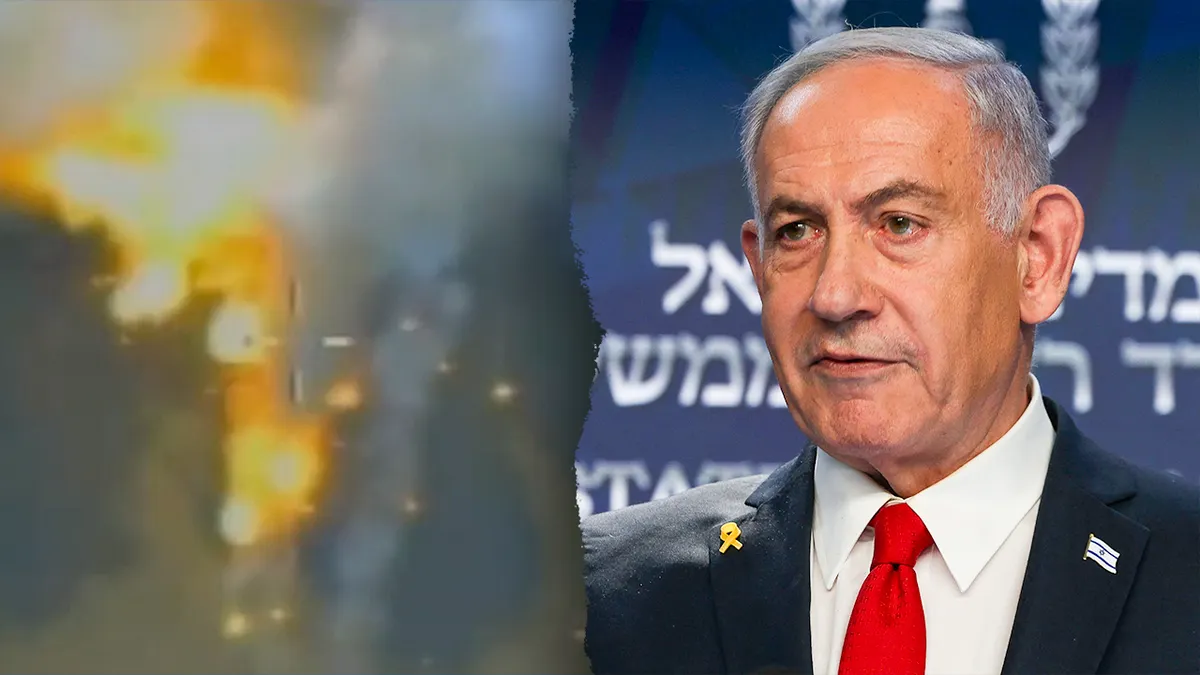
The two-week U.S.-Iran ceasefire announced April 7 is under strain from three directions simultaneously: Israel’s refusal to include Lebanon in the truce, Iran’s inability to reopen the Strait of Hormuz due to its own lost mines, and a growing domestic political cost in the United States from an inflation surge triggered by six weeks of war. At the centre of the crisis is a widening fault line between Donald Trump and Benjamin Netanyahu — two leaders who launched the war together but now want very different things from its ending. This report covers how that rift emerged, what it means for the Islamabad talks, and what the economic numbers are telling Washington about its negotiating position.
357
Killed in Lebanon in First Days of “Ceasefire” — Lebanon Health Ministry
3.3%
U.S. Inflation Rate — March 2026 CPI
21.2%
U.S. Gas Price Rise in One Month
13%
Global Oil Supply Shrunk by War — IMF
🔴 Section One
How the Rift Between Trump and Netanyahu Emerged
The roots of the current crisis lie in a meeting on February 11, weeks before the war began. The Week’s diplomatic analysis reported that Netanyahu personally lobbied Trump in the White House Situation Room, presenting an ambitious vision for a joint campaign against Iran that included neutralising Tehran’s missile programme, curbing its regional influence and potentially triggering regime change. He even showed a video outlining possible successors to Iran’s clerical leadership.
Senior American officials were deeply sceptical from the start. CIA Director John Ratcliffe dismissed the regime change scenarios as unrealistic. Secretary of State Marco Rubio rejected them outright. Vice President JD Vance emerged as the most forceful internal critic — warning that such a war would bring heavy casualties, destabilise the region and alienate Trump’s political base. And yet the war began on February 28.
Six weeks later, the tensions that were present in that Situation Room meeting have broken into the open. Bloomberg’s feature analysis reported that within hours of Trump announcing the ceasefire on April 7, Netanyahu challenged its terms — ordering some of the most intense airstrikes on Lebanon since the conflict began, killing hundreds, and prompting Tehran to warn the deal was at risk before the first direct talks had even taken place.
“Netanyahu had not been consulted about the ceasefire, nor was Israel invited to participate in negotiations.” — The American Prospect, April 10, 2026.
Trump’s response was a personal phone call. He told Netanyahu to “low-key it” in Lebanon. NPR reported Trump told NBC: “I spoke with Bibi and he’s going to low-key it. I just think we have to be sort of a little more low-key.” CNN reported the call was described as “tense” by sources familiar with the conversation, and that Netanyahu came to understand Trump might simply declare a ceasefire over his head if he did not agree to begin Lebanon talks. Under that pressure, Netanyahu announced direct negotiations with the Lebanese government — while simultaneously declaring, hours later: “There is no ceasefire in Lebanon.”
🟡 Section Two
The Lebanon Dispute — Who Said What, and When
The ceasefire’s Lebanon problem is not a simple misunderstanding. The New Republic reported that Trump was initially told the ceasefire would apply to the entire Middle East region including Lebanon — and Lebanon was even included in the version of the deal originally circulated by the Trump administration itself. Trump then abruptly reversed his position on Lebanon following a phone call with Netanyahu, according to multiple diplomatic sources cited by CBS News. Pakistani Prime Minister Shehbaz Sharif — who mediated the agreement — had explicitly stated it included Lebanon. France’s Emmanuel Macron said the same. Iran insisted on it. The EU foreign policy chief backed it.
| Party | Position on Lebanon in Ceasefire | Source |
|---|---|---|
| Pakistan (Mediator) — PM Sharif | INCLUDED — “ceasefire everywhere including Lebanon” | Sharif X post, April 7 |
| Iran — FM Araghchi / Parliament Speaker Ghalibaf | INCLUDED — negotiations impossible without Lebanon | Multiple Iranian statements, April 8–10 |
| France — President Macron | INCLUDED — “fully included” | Macron public statement, April 8 |
| EU Foreign Policy Chief Kallas | INCLUDED — “ceasefire must cover Lebanon” | Kallas X post, April 8 |
| Trump (initial) — White House draft | INCLUDED — Lebanon in original circulated text | CBS News / New Republic, April 10 |
| Trump (post-Netanyahu call) | NOT INCLUDED — reversed position after call with Netanyahu | CBS News, multiple sources, April 9 |
| Israel — PM Netanyahu | NOT INCLUDED — “insisted” Lebanon excluded from day one | Netanyahu statement, April 8 |
| VP Vance | NOT INCLUDED — called it a “misunderstanding” by Iran | Vance statements to reporters, April 8–9 |
CNN’s political analysis assessed the dynamics bluntly: “The combined picture is that one side — Trump — appears a lot more anxious to negotiate a deal than the other side — Iran does.” Iran’s parliament speaker Ghalibaf stated on April 10 that the Lebanon situation and Iran’s blocked frozen assets must be resolved before negotiations even begin. That was the public position of the Iranian delegation as Vance was already aboard Air Force Two en route to Islamabad.
🔵 Section Three
The Economic Numbers — Trump’s Shrinking Leverage
Six weeks of war have produced economic damage that is now showing up directly in U.S. domestic data. The New Republic’s April 10 tracker reported that the most recent U.S. consumer price index showed inflation rose 3.3% in March from one year ago, driven primarily by energy. Gas prices rose a record 21.2% in a single month. Energy prices overall surged 10.9%. Prices across the board rose 0.9% in March alone — the biggest monthly spike since 2022. The American Automobile Association reported gasoline costs nearly 40% more than it did before the war began in February.
The IMF, cited by the Times of Israel from an April 6 briefing by IMF managing director Kristalina Georgieva, stated the war had shrunk global oil supply by 13%, rippling through oil and gas shipments and related supply chains including helium and fertilizers. “All roads now lead to higher prices and slower growth,” Georgieva said. Even a rapid end to hostilities would produce a downgrade to global growth forecasts and upward revision of inflation projections, the IMF warned — with a protracted conflict producing significantly worse outcomes.
For Trump, the political calculus is stark. Republicans are already expressing concern about the economic fallout costing them in the 2026 midterm elections, per CNN’s political correspondent analysis. The war that was supposed to deliver “unconditional surrender” has instead delivered record gas prices, a weakened bargaining position and an ally in Netanyahu who launched the conflict’s most lethal single day against Lebanon within hours of Trump announcing peace.
Iran’s Strategic Paradox: Beaten Militarily, Winning Economically
Iran has absorbed over 11,000 confirmed strikes on its territory, lost its Supreme Leader, seen its steel capacity cut by 70%, and taken 2,076+ confirmed deaths. And yet its control of the Strait of Hormuz — even in the chaotic, mine-tangled form it now takes — gives Tehran an economic lever that Washington’s military dominance cannot simply override. The Strait’s closure has cost the global economy far more than the bombs that fell on Iran. As CNN’s analysis noted, setting the precedent of locking down the strait is theoretically a massive deterrent for any future attack on Iran — regardless of how this war ends. Iran entered Islamabad not as a defeated power seeking terms, but as a country that has proven it can hold the global economy hostage indefinitely.
🔴 Section Four
Islamabad and What Comes Next — Israel-Lebanon Talks Begin
Under heavy U.S. pressure, Netanyahu agreed to a significant step — direct Israel-Lebanon negotiations, the first since the two countries have no diplomatic relations. CNN confirmed that Israeli Ambassador Yechiel Leiter and Lebanese Ambassador Nada Hamadeh Moawad agreed on a call mediated by the U.S. Ambassador to Lebanon to meet at the U.S. State Department in Washington the following Tuesday “to discuss the declaration of a ceasefire and the date for the start of negotiations between Lebanon and Israel.” Israel simultaneously issued a caveat: it would not discuss a ceasefire with Hezbollah directly.
At the Islamabad talks, Trump’s stated priority was unambiguous. Speaking at Joint Base Andrews before departure to Virginia, Trump said of the Iran negotiations: “No nuclear weapon. That’s 99% of it.” On the Strait, he added: “I think it’s going to go pretty quickly. And if it doesn’t, we’ll be able to finish it off one way or the other.” Vance, departing for Pakistan, warned Iran the negotiating team would not be “receptive” if Tehran tried to “play” Washington.
Iran’s parliament speaker Ghalibaf, heading the Iranian delegation to Islamabad, had already set conditions before arriving. He cited ongoing Israeli strikes, a reported drone incursion into Iranian airspace, and Washington’s opposition to uranium enrichment as violations — stating these must be resolved “before negotiations begin.” Israel’s opposition leader Yair Lapid described the ceasefire from Israel’s perspective as “one of the greatest political disasters in all of our history,” arguing Israel had been sidelined during the core negotiations — an assessment that underscores just how differently the two allied governments are reading the same set of events, according to The Week’s diplomatic analysis.
Strategy Battles Assessment
The pattern of the past 72 hours reveals a U.S. administration managing three simultaneous deficits: a leverage deficit against Iran, whose Hormuz control has proven more durable than Washington anticipated; a coordination deficit with Israel, whose military aims in Lebanon are running directly counter to U.S. diplomatic objectives; and a domestic political deficit, with inflation data now arriving that will dominate the 2026 midterm conversation. Trump launched this war with promises of unconditional surrender. What he has in hand as the Islamabad talks begin is a two-week pause, a partially opened strait blocked by mines no one can locate, and an ally in Netanyahu who is pursuing his own war within the ceasefire. Whether Vance can bridge all three gaps in 14 days is the central question of the coming fortnight.
Strategy Battles — Related Coverage
Sources
- Bloomberg — Iran War: Trump, Netanyahu Divided Goals Threaten Ceasefire Deals (April 9, 2026)
- CNN — Day 42: Trump Warns Iran Ahead of High-Stakes Talks in Pakistan (April 10, 2026)
- CNN Politics — Grim New Economic Numbers Highlight How Trump Is Losing Leverage Against Iran (April 10, 2026)
- NPR — Israel Vows to Continue Fighting Hezbollah but Agrees to Talks with Lebanon (April 9–10, 2026)
- The New Republic — How Netanyahu Convinced Trump to Make Major Change on Iran Ceasefire (April 10, 2026)
- The Week — US-Iran Ceasefire Exposes Deep US-Israel Diplomatic Rift (April 10, 2026)
- The American Prospect — Israel and the Cease-Fire (April 10, 2026)
- CBS News — Iran accuses U.S. of violating ceasefire as Israeli attacks on Lebanon continue (April 2026)
- Times of Israel — April 6: Trump warns Iran, Netanyahu said to have warned against ceasefire (April 6, 2026)
- UK House of Commons Library — US/Israel-Iran Conflict 2026
Editorial Verification
This report has been reviewed for factual accuracy and OSINT compliance. All diplomatic and political claims are sourced to named, hyperlinked outlets. The Lebanon ceasefire dispute table is drawn directly from official statements and confirmed reporting from CBS News, NPR, Pakistan’s PM office and the EU. Economic data — CPI figures, gas prices, IMF assessments — are attributed to named sources including the U.S. Bureau of Labor Statistics via The New Republic and IMF managing director statements via the Times of Israel. The Strategy Battles assessment box is editorial analysis clearly labelled as such.
Approved for Publication
Marcus V. Thorne
Lead Editor, Strategy Battles
©StrategyBattles.net 2026
This article is for news and analysis purposes only. It is based on publicly available news sources and military updates. All rights reserved. Original reporting may come from various open sources. Not for commercial reuse without permission.