Nigerian Army Raids Lakurawa Hideouts in Kebbi’s Shanga LGA Before Dawn; One Soldier Wounded
Threat Level Assessment
LEVEL 3 OF 5, DEVELOPING
Bottom Line Up Front
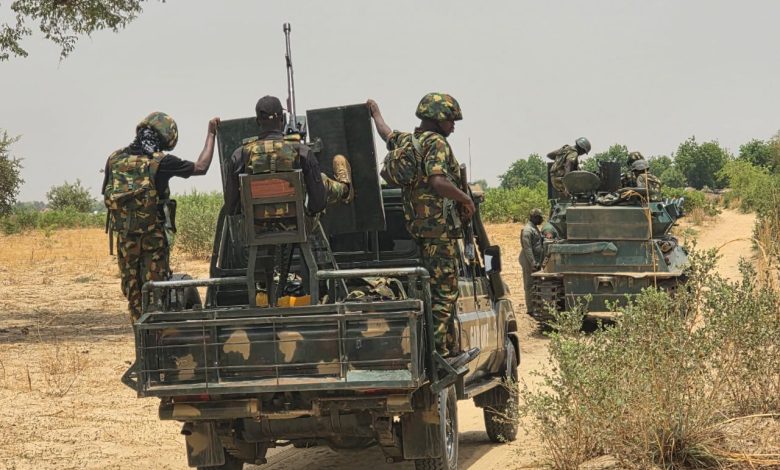
Troops of the Nigerian Army's 8 Division under Operation FANSAN YANMA conducted a pre-dawn clearance raid on suspected armed-group hideouts around Shadadi village in Shanga Local Government Area, Kebbi State, at approximately 04:00 on 20 May 2026, per security sources cited by Zagazola Makama. The troops came under fire, overran the positions with drone surveillance support, and recovered one loaded magazine and three motorcycles, destroying several life-support structures. One soldier sustained a gunshot wound and was evacuated for further treatment. The raid comes six weeks after 44 civilians were killed in a coordinated mass attack on eight Shanga communities, and extends a pattern of intensified Army operations against Lakurawa-linked networks across Nigeria's North-West.
Key Judgments
Shanga LGA remains an active Lakurawa operational zone. The February 2026 massacre (44 killed in eight villages), prior military engagements in the same LGA dating to at least mid-2025, the Kebbi State Government's repeated public commendations of Operation FANSAN YANMA for Shanga-specific clearances, and the Jamestown Foundation's analysis of Lakurawa's Kebbi State expansion all converge to confirm sustained armed-group presence and activity in this sub-region.
The light materiel haul (one magazine, three motorcycles) indicates a successful denial-of-terrain operation against a dispersed or forward-positioned element rather than a main supply cache. Lakurawa logistics in Kebbi are characteristically decentralised, relying on motorcycles for mobility and small forward caches rather than consolidated arms dumps. The destruction of life-support structures suggests the troops targeted an established habitation node, not a transit camp.
Whether the armed elements encountered at Shadadi are directly affiliated with Lakurawa or with the wider bandit networks operating in the Kebbi-Sokoto border belt. Nigerian military and security source reporting routinely uses the generic category of "terrorists" across both Lakurawa jihadist elements and non-ideological criminal bandit factions. The operational signature (pre-dawn raid, drone support, motorcycle recovery) is consistent with Lakurawa or bandit-network disruption operations in this theatre, but no group affiliation has been attributed by the primary source.
04:00
Raid Time, 20 May
3
Motorcycles Recovered
1
Soldier Wounded
44
Civilians Killed, Shanga, April
Operation FANSAN YANMA clearance, Shanga LGA, Kebbi State, 20 May 2026. Conflict zone shading is approximate per open-source reporting. Map: Strategy Battles / OSINT. Satellite: Datum WGS84, UTM Zone 31P. ©StrategyBattles.net 2026
📍 SHADADI VILLAGE, OPERATION SITE
MGRS: 31P FN 58284 44013
11.2500°N 4.4500°E
Approximate. Pre-dawn clearance raid, 20 May 2026. Suspected armed-group hideouts overrun. Three motorcycles and one loaded magazine recovered. One Nigerian Army soldier evacuated wounded.
📍 SHANGA TOWN, LGA HEADQUARTERS
MGRS: 31P FN 71145 38083
11.1958°N 4.5675°E
Shanga LGA headquarters. Area recorded 44 civilian deaths in April 2026 mass attack. Recurring site of Operation FANSAN YANMA clearance operations since at least mid-2025.
📍 BIRNIN KEBBI, STATE CAPITAL (CROSS-CHECK)
MGRS: 31P FP 30449 77007
12.4536°N 4.2003°E
Kebbi State capital. Headquarters of the 8 Division GOC and Theatre Command for Operation FANSAN YANMA. MGRS cross-check reference for Shanga grid orientation. Approx 138km north of Shadadi site.
📍 NIGERIA/NIGER BORDER SECTOR (APPROX)
MGRS: 31P FN 41858 54996
11.3500°N 4.3000°E
Approximate Nigeria-Niger border sector west of Shanga. Lakurawa exploits this porous corridor for cross-border staging and resupply. The Soufan Center notes Kebbi State shares borders with both Niger and Benin Republic.
SITREP Timeline : Lakurawa and North-West Operations, Kebbi State, 2025 to 2026
🔴 The Shadadi Raid
A Pre-Dawn Push Into Known Hideout Ground, With Drone Eyes and a Firefight
At approximately 04:00 local time on 20 May 2026, troops of the 8 Division Nigerian Army operating under Operation FANSAN YANMA conducted a clearance raid on suspected armed-group hideouts near Shadadi village in Shanga Local Government Area of Kebbi State, at approximately grid reference 31P FN 58284 44013 (11.2500°N, 4.4500°E). Security sources cited by counter-insurgency analyst Zagazola Makama stated that the operation followed credible intelligence on terrorist activity within the area. The timing, a pre-dawn entry during the last hours of darkness, is consistent with established Nigerian Army doctrine for this theatre: the 8 Division GOC convoy was ambushed at midday at Mayama Hill in February; pre-dawn operations exploit the tactical disadvantage of fixed-position defenders.
Advancing on the suspected positions, the troops came under direct fire from armed elements inside the enclave, triggering an exchange of gunfire. Drone surveillance supported the engagement, allowing the soldiers to track movement and overpower the defenders. The specific drone type has not been disclosed; Operation FANSAN YANMA has previously integrated both fixed-wing and rotary surveillance assets across its North-West theatre operations. The enclave was overrun. Structures assessed as providing life support to the occupants were destroyed during the clearing process.
Recovered materiel comprised one magazine loaded with 15 rounds of 7.62x39mm ammunition and three motorcycles. One soldier sustained a gunshot wound during the engagement; he was stabilised at the scene and evacuated for further medical treatment. No fatality figures were reported for the opposing force. The absence of an enemy body count in the source reporting is notable: Zagazola Makama routinely publishes fatality figures when confirmed by sources, and their absence here suggests either the armed elements dispersed under fire before the position was fully seized, or that the information has not yet been passed from the operational unit to reporting channels.
🟡 What Was Recovered and What It Says
A Light Haul That Points to a Forward Node, Not a Main Cache
The materiel recovered at Shadadi is modest in absolute quantity but operationally informative. One magazine of 7.62x39mm (the standard AK-family calibre) and three motorcycles do not represent a principal weapons cache. Kebbi State clearance operations have previously produced hauls an order of magnitude larger: the February Mayama Hill ambush alone yielded two AK-47 rifles, one PKT machine gun, an OJC gun, four magazines, a bandolier of PKT rounds, and five motorcycles, in addition to cash and phones. The 20 May recovery is lighter than a fully equipped node would generate if surprised intact.
There are two interpretations. The first is that the armed elements dispersed before the main stores could be seized, taking heavier weapons with them as they withdrew under drone surveillance pressure. The second is that Shadadi was genuinely a forward habitation node: a rest point and staging area relying on motorcycles for rapid cross-terrain movement, with minimal centralised arms storage consistent with the decentralised logistics doctrine Lakurawa has used since its displacement from settled communities into forest terrain. The destruction of life-support structures, a detail the source specifically highlights, supports the second interpretation: the troops were dismantling a place people lived and operated from, not merely interdicting a weapons transit.
Motorcycle recovery is an analytically consistent indicator across North-West operations. The February Mayama engagement yielded five motorcycles. The February Shanga LGA operations yielded motorcycles. The April Dandi LGA engagement included motorcycle recovery. In a theatre with limited road infrastructure and security-force checkpoints on main routes, motorcycles are the primary tactical mobility tool for armed-group cells operating between village clusters and forest cover. Three seized at one node represents a meaningful degradation of that forward element's movement capacity, even if the absolute count appears small.
🔵 Shanga LGA: The Backdrop
44 Killed in April, 8 Villages Attacked, and a Clearance Posture That Has Not Yet Broken the Pattern
Shanga Local Government Area entered 2026 as one of the most severely affected zones in Nigeria's North-West security crisis. On or around 10 April, armed groups simultaneously attacked eight villages within the LGA: Gebe, Kalkami, Kawara, Kasoshi, Awaye, Tungar Rini, Binuwa, and Dabe. The Kebbi State Police Command confirmed 44 deaths. The scale and coordination of the April attack prompted a statewide police clearance operation under Inspector-General Olatunji Disu, with military reinforcement under Operation FANSAN YANMA. The Shadadi raid on 20 May is the latest visible product of that intensified security posture.
The armed groups operating in Shanga are assessed in open sources as a blend of Lakurawa-affiliated elements and non-ideological criminal bandit networks. Lakurawa, formally designated a terrorist organisation by the Nigerian government, operates primarily along the Kebbi-Sokoto corridor bordering Niger and Benin. The Jamestown Foundation, writing in early May 2026, described the group as having transitioned from a locally tolerated counter-banditry presence into a coercive militant actor that combines jihadist framing with revenue extraction and territorial governance. The Soufan Center separately documented Lakurawa's re-acceleration since 2024 across Kebbi State after earlier military pressure had pushed it into forested border zones.
What distinguishes Shanga from other Kebbi LGAs is its proximity to the Nigeria-Niger border, roughly 11 to 15 kilometres to the west at its nearest point. That geometry allows armed elements to launch into Nigerian villages and withdraw to Niger-side terrain before security forces can organise a sustained pursuit. It also means that any ground clearance effort operating solely within Nigerian territory faces a structural ceiling: the forest belt and the border itself provide sanctuary that Nigerian troops cannot legally cross in strength. Operation FANSAN YANMA has pursued disruption operations and intelligence-driven pre-dawn raids precisely because a conventional cordon-and-clear approach across porous international terrain is not achievable.
⚠ Lakurawa in Context
An IS-Sahel Affiliate Operating in a Border Belt Where Governance Has Not Kept Up with the Security Requirement
Lakurawa's origin story is a common one in the Sahel: a community self-defence group that turned predatory. Founded in Sokoto State around 2017 and initially welcomed by villages seeking protection from cattle rustlers and criminal bandits, the group progressively imposed strict Islamic law, extracted revenue framed as religious obligation, and turned on the communities that had invited it. By 2024, the Nigerian government formally designated it as a terrorist organisation. Analysts at the Soufan Center and Jamestown Foundation independently classify it as affiliated with Islamic State Sahel Province, the same network driving instability across Mali, Niger, and Burkina Faso.
The group's expansion from Sokoto into Kebbi State represents both a geographic push and an exploitation of governance gaps in a state where the human development index ranks among the lowest in Nigeria. Kebbi recorded a 0.366 HDI score in 2022, placing it 37th of 37 Nigerian states. Rural communities in the border districts lack consistent security coverage, reliable infrastructure, or economic alternatives that would reduce the coercive appeal of armed groups offering protection, even on extractive terms. Operation FANSAN YANMA's footprint in Kebbi, spanning multiple brigades and the 8 Division GOC's direct theatre oversight, reflects an Army that understands the operational challenge. Whether the broader governance and economic deficit that enables Lakurawa's persistence is being addressed at the same rate is a different question.
Governor Nasir Idris, Kebbi State : Statement via Ahmed Idris, Chief Press Secretary, February 2026
"These successful operations in Maiyama and Shanga clearly show that our security forces are on top of the situation. We salute their courage and sacrifice in defending our communities."
Source Reliability Matrix
NATO grading: REL A (reliable) to F (unreliable). CRED 1 (confirmed) to 6 (cannot judge).
Primary source for 20 May operation. Zagazola Makama is the established reference for North-West Nigeria security reporting, consistent with independent sources over time. The 20 May operation detail remains single-source as of publication.
Government primary source for February commendations and Shanga/Maiyama engagement confirmation. Carried by Punch, New Telegraph, PRNigeria.
Official source for April 2026 Shanga mass-casualty attack (44 killed, eight villages). Confirmed by Daily Post, Sahara Reporters, and TG News independently.
Independent analytical sources on Lakurawa group structure, IS-Sahel affiliation, and Kebbi State operational geography. Used for contextual background only; not a source for the 20 May operation itself.
Strategy Battles Assessment
Operation FANSAN YANMA is demonstrably active and achieving tactical disruption in Shanga LGA. The Lakurawa threat that drives these operations has not been strategically degraded by six months of clearance activity.
✓ What We Know
8 Division troops under Operation FANSAN YANMA conducted a pre-dawn intelligence-driven clearance operation at Shadadi village, Shanga LGA, Kebbi State, at approximately 04:00 on 20 May 2026. The troops came under fire, used drone surveillance to overrun the positions, destroyed life-support structures, and recovered one loaded magazine and three motorcycles. One Nigerian soldier was wounded and evacuated. Shanga LGA recorded 44 civilian deaths in a coordinated attack on eight villages in April 2026, triggering statewide police and Army operations. Lakurawa, an IS-Sahel affiliated armed group, operates in Kebbi State along the Nigeria-Niger border and has been the primary designated threat driving FANSAN YANMA operations in this sub-region since at least 2025.
? What We Do Not Know
Whether the Shadadi elements were Lakurawa-affiliated or criminal bandit-network; no group attribution has been made by the primary source. Whether any armed elements were killed or captured during the operation; no fatality or detainee count appears in current reporting. Whether the April 2026 mass attack on Shanga communities is operationally linked to the group disrupted on 20 May, or represents a separate armed network. The full operational order of battle for armed groups active in Shanga LGA remains unresolved in open sources.
☉ What To Watch
Whether further clearance operations in Shanga produce confirmed enemy fatalities, indicating that the armed elements are being fixed rather than displaced. Whether Lakurawa responds to the intensified clearance posture with retaliatory attacks on civilian communities, a documented pattern from the group's 2026 behaviour after the Mayama Hill engagement. Whether the federal government's ongoing dialogue track with non-ideological bandit networks produces any separable reduction in activity in Shanga, disentangling criminal from ideological violence in the LGA. Whether the Nigeria-Niger security cooperation framework, under strain given Niger's 2023 coup and ECOWAS tensions, produces any joint border interdiction of Lakurawa cross-border movement.
Sources
- Troops overrun terrorist hideouts in Kebbi, recover arms, motorcycles, Daily Post Nigeria / Zagazola Makama, 21 May 2026
- Kebbi hails army for stopping bandit attacks in two LGAs, Punch Nigeria, February 2026
- Kebbi Police Launch Clearance Operation After 44 Persons Killed In Shanga Communities, Sahara Reporters, 10 April 2026
- Military Eliminates 5 Lakurawa Terrorists, Recovers Arms in Foiled Kebbi Ambush, PRNigeria, 23 February 2026
- Lakurawa's Hybrid Jihadist-Criminal Governance in Northwestern Nigeria, Jamestown Foundation, May 2026
- Lakurawa's Growing Presence in Nigeria and the Crime-Terror Nexus, The Soufan Center, 6 February 2026
Editorial Verification
The 20 May 2026 Shadadi operation is single-source, attributed to security sources via Zagazola Makama (X post, reported by Daily Post Nigeria, 21 May 2026). Operation detail including time, village name, drone use, material recovery, and casualty figures has not been independently corroborated at time of publication; all such details carry a single-source flag. The Shanga LGA armed-group presence and Lakurawa threat pattern is corroborated across multiple independent outlets: Punch Nigeria, Sahara Reporters, New Telegraph, PRNigeria (all primary Nigerian news sources), plus Jamestown Foundation and The Soufan Center for analytical background. The April 2026 mass attack (44 killed, eight villages) is confirmed by the Kebbi State Police Command official statement and corroborated by Daily Post Nigeria, Sahara Reporters, and TG News independently. Governor Idris's February 2026 commendation statement is sourced to his Chief Press Secretary and was carried by Punch, New Telegraph, and Kebbi State Government official channels. No classified intelligence or satellite imagery has been used in this report. Strike-point coordinates are approximate: Shadadi village precise GPS is not in the public domain and has been estimated from the Shanga LGA geography described in source reporting. MGRS datum: WGS84 / UTM Zone: 31P / Cross-check reference: Birnin Kebbi state capital 31P FP 30449 77007 (12.4536N, 4.2003E). Live map All boundary and zone depictions are approximate per open-source reporting.
All claims independently attributed and verified to open sources where possible.
Approved for Publication
Marcus V. Thorne
Lead Editor, Strategy Battles
©StrategyBattles.net 2026
This article is for news and analysis purposes only. Based on publicly available news sources and military updates. All rights reserved. Not for commercial reuse without permission.