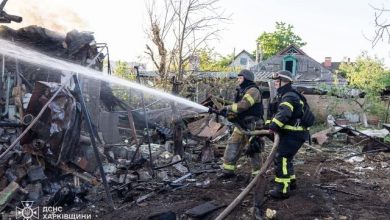
Ukraine Kills 65 Russian Drone Cadets in Snizhne, Destroys Academy-Linked Training Complex
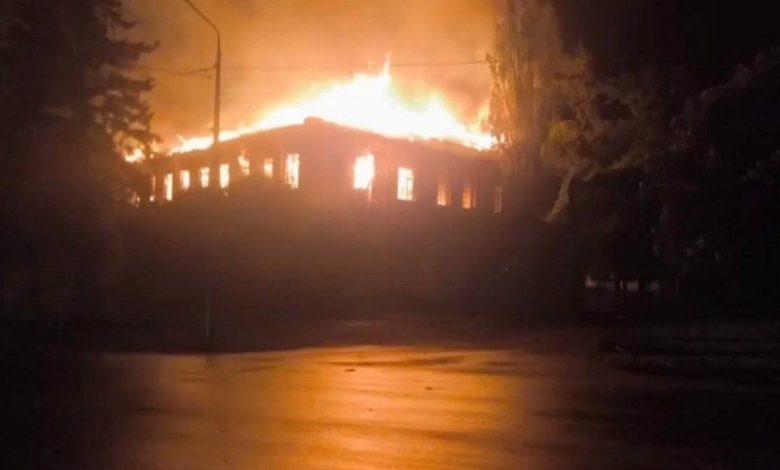
Threat Level Assessment
LEVEL 4 OF 5, SERIOUS
Bottom Line Up Front
On the night of 19 to 20 May 2026, Ukraine's Unmanned Systems Forces and the Security Service of Ukraine jointly struck a Russian UAV pilot training and assembly complex in the occupied city of Snizhne, Donetsk Oblast, killing at least 65 cadets of the 78th Sever-Akhmat Special Purpose Motorized Regiment and eliminating the facility's commander, Lieutenant Colonel "Buryi," a doctorate holder at the Russian Academy of Rocket and Artillery Sciences. The operation, codenamed Snow of Akhmat, destroyed a 2,484-square-metre two-story complex housing drone assembly, warhead production, and personnel quarters, along with four Tigr armored vehicles and basement ammunition stores. USF Commander Robert "Madyar" Brovdi confirmed the results on 20 May and stated that Russia now has two of its three such drone academies remaining in occupied Donetsk Oblast.
Key Judgments
The facility was a genuine dual-function military asset: both a UAV pilot training school and an active production site for drone components and warheads. This is confirmed by the Unmanned Systems Forces release, independently corroborated by OSINT analysis of the site geometry, and consistent with secondary explosions from basement ammunition stores documented in post-strike video. Striking a training school linked directly to the Russian Academy of Rocket and Artillery Sciences represents a higher-value target than a tactical depot or vehicle park.
The SBU's involvement and the Deep Strike Center's planning role signal this was a deliberate intelligence-led operation, not an opportunistic strike on a known map reference. The operation name, Snow of Akhmat, is a clear targeting statement directed at the Kadyrov-affiliated regiment. The recovery of the centre commander's identity and academic credentials before the operation is unusual and suggests a pre-existing intelligence thread, likely months in development.
The 65-casualty figure, while reported by the Ukrainian side and widely carried, cannot be independently verified from open sources. Post-strike video shows heavy structural damage and secondary explosions consistent with a high-yield event inside an occupied building. The figure is plausible given the complex housed personnel quarters on the upper floor and the strike appears to have been timed for when cadets were present; nonetheless, Russian sources have not confirmed losses and the number should be treated as a Ukrainian estimate pending additional corroboration.
Brovdi's claim that Russia has two of three such academies remaining in occupied Donetsk is single-source, attributed solely to his Facebook announcement. The existence and locations of the other two facilities are not corroborated in open-source reporting at time of publication. The claim is operationally significant if accurate, as it implies Ukraine holds targeting data on at least two further high-value sites.
65+
Cadets Killed (Est.)
2,484 m²
Complex Destroyed
4
Tigr Vehicles Destroyed
100 kg
Warhead Class, Strike Munitions
📍 Operation Snow of Akhmat Strike Site, Snizhne, Donetsk Oblast, 19 to 20 May 2026
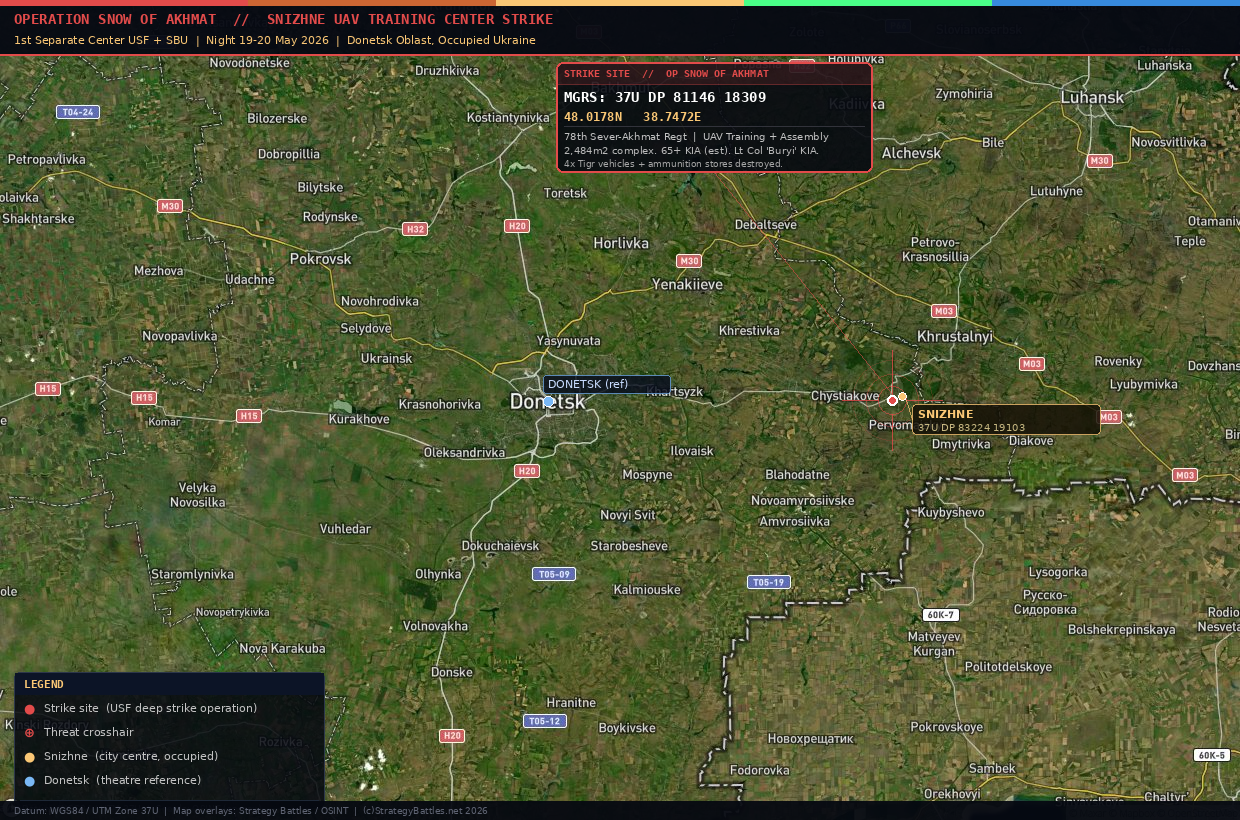
Strike site at 37U DP 81146 18309 (48.0178°N, 38.7472°E), vicinity of the former Udarnik mine complex, Snizhne. Datum WGS84, UTM Zone 37U. Map: Strategy Battles / OSINT. Satellite: Maxar .
📍 USF Strike Site, Snizhne (OSINT)
MGRS: 37U DP 81146 18309
48.0178°N 38.7472°E
Russian UAV pilot training school and assembly complex. Two-story building, 2,484 sq m. Linked to the 78th Sever-Akhmat Regiment and the Russian Academy of Rocket and Artillery Sciences. Destroyed night of 19 to 20 May. Coordinates per OSINT groups KyberBoroshno and Dnipro Osint; marked as approximate.
📍 Snizhne City Centre, Cross-Check Reference
MGRS: 37U DP 83224 19103
48.0250°N 38.7750°E
Occupied city centre, Snizhne, Donetsk Oblast. Russian forces have used the city as a rear logistics and support hub since 2014. Strike site is approximately 2.2 km west-southwest of this reference point. MGRS grid orientation reference.
📍 Donetsk City, Theatre Reference
MGRS: 37U DP 10735 18660
48.0150°N 37.8030°E
Occupied regional capital. Snizhne lies approximately 75 km east-northeast of Donetsk city. The Russian 42nd Division, parent formation of the 78th Sever-Akhmat Regiment, is operationally active across the Donetsk direction.
📍 Udarnik Mine, Snizhne (OSINT Anchor)
MGRS: 37U DP 81657 18774
48.0220°N 38.7540°E
Former inactive coal mine. OSINT group KyberBoroshno identified the targeted complex as sitting adjacent to this landmark. Used by Russian forces to anchor military infrastructure in the area. Coordinates approximate.
SITREP Timeline : Ukraine Deep Strike Campaign Against Russian UAV Infrastructure, May 2026
🔴 The Strike
A Training School, An Assembly Line, And A Timed Entry Through A Two-Story Building Full of People
At grid reference 37U DP 81146 18309 (48.0178°N, 38.7472°E), on the western edge of the occupied city of Snizhne, Donetsk Oblast, Ukraine's Unmanned Systems Forces destroyed a Russian UAV operator training school and drone production facility during the night of 19 to 20 May 2026. The site had been identified as sitting adjacent to the inactive Udarnik mine by OSINT analysts, and the targeting approach suggests the strike was the product of sustained intelligence preparation rather than a reactive hit on a known address. The munitions used were described by Brovdi as "middle strike" class weapons carrying 100-kilogram warheads, consistent with the heavy structural damage documented in post-strike footage.
The two-story main compound covered 2,484 square metres. The building held UAV assembly operations on one floor, warhead production facilities on another, and personnel accommodation within the same structure. Russian cadets of the 78th Sever-Akhmat Special Purpose Motorized Regiment were quartered inside. The timing of the strike, at night when personnel would be expected to be in the accommodation areas, is consistent with a deliberate targeting decision to maximise personnel losses. Basement ammunition stocks detonated as secondary explosions, which both deepened the structural collapse and served as post-strike confirmation of a live munitions store.
Four Tigr light multipurpose vehicles were destroyed in what the Ukrainian release described as the facility's repair bay. The Tigr is a standard Russian military utility vehicle used across multiple unit types. Their presence in a repair facility inside the same compound confirms the site was not solely a training school; it was an active support node for a deployed regiment. Drone components and assembled ammunition intended for frontline delivery were also destroyed, per the USF release, though the specific quantities have not been disclosed.
🟡 The Target Organisation
The Russian Academy of Rocket and Artillery Sciences Built a UAV Pilot School Inside a Regiment Base in a Rear City
The Russian Academy of Rocket and Artillery Sciences is a state scientific organisation, formally independent of the Ministry of Defence but deeply embedded in Russian military research. Its involvement in funding and staffing a front-line UAV training facility reflects the degree to which Russia has industrialised drone operator production. Snizhne sits approximately 100 kilometres from the active front line: far enough to be considered a rear area, close enough to service the Donetsk direction with trained cadets on a rotating basis. The city has been under Russian-backed control since 2014 and has been used throughout the full-scale war as a logistics and support hub.
The 78th Sever-Akhmat Special Purpose Motorized Regiment is one of the Chechen-affiliated formations that operates under the broader 42nd Division structure. The regiment carries the name of Akhmat Kadyrov, the deceased pro-Moscow Chechen president and father of Ramzan Kadyrov, the current Chechen leader. Sever-Akhmat formations have featured repeatedly in Ukrainian reporting as participants in the Donetsk offensive. Their presence in the targeted complex, as the source of the cadets killed, connects the strike directly to a regiment that has been operationally active in the contested Donetsk axis throughout 2026.
The elimination of Lieutenant Colonel "Buryi" carries particular significance beyond the personnel loss itself. Brovdi's identification of the commander as a doctorate holder at the Russian Academy of Rocket and Artillery Sciences indicates the facility was not staffed by frontline officers rotated through a rear training billet. It was run by a scientific cadre with institutional knowledge of the Russian UAV development programme. Replacing that expertise requires more than reassigning another officer; it requires finding another researcher with the equivalent credentials and operational knowledge, which is a longer pipeline than replacing a tactical commander.
🔵 The Operation
SBU Coordination, Deep Strike Planning, And A Named Covert Action Against a Named Regiment
Operation Snow of Akhmat was executed by the 1st Separate Center of the Unmanned Systems Forces, planned by the Deep Strike Center, and carried out in coordination with Ukraine's Security Service (SBU). That three-way architecture, combining a frontline drone formation, a dedicated deep strike planning cell, and the national intelligence service, is the same model Ukraine has used for its most precise long-range strikes throughout the war. The SBU's role here most likely supplied the human intelligence component: the identification of the facility's function, its personnel schedule, the commander's identity and rank, and the building's internal layout. None of that information is derivable from satellite imagery alone.
The operation name is a deliberate signal. Snizhne in Ukrainian means "snowy." The operation was named Snow of Akhmat, linking the geographic reference directly to the regiment whose cadets were inside the building. That kind of naming convention is uncommon in Ukrainian military announcements and suggests the operation was considered significant enough to mark publicly, both for domestic morale and as a message to Chechen-affiliated formations operating in the theatre.
This strike is part of a recognisable pattern in Ukraine's 2026 deep strike campaign. Ukraine's Unmanned Systems Forces announced in mid-May that a 48-hour coordinated offensive had targeted 46 high-value Russian assets. The destruction of the BARS-Sarmat development center in Zaporizhzhia Oblast in April preceded Snizhne. The targeting logic is consistent: rather than hitting depots or vehicle parks, Ukraine has increasingly focused its deepest strikes on the nodes that generate Russian combat capability, specifically the facilities that train operators, assemble munitions, and develop the doctrine that drives Russian drone tactics at the front. A single well-placed strike on a training facility removes not just the cadets present but the entire graduating cohort that would have reached the front within weeks.
⚠ What Russia Has Not Said
Moscow's Silence on Snizhne Is the Loudest Part of the Story
As of publication, the Russian Ministry of Defense has not issued any statement on the Snizhne strike. CNN confirmed it had contacted the Russian MoD for comment and received none. That silence is not unusual for strikes in occupied territory, but it is notable for a strike that, if the Ukrainian figures are accurate, would represent one of the single largest one-night personnel losses suffered by any identifiable Russian formation in 2026. Russia's standard practice when losses are significant and embarrassing is to say nothing officially and allow the volume of Telegram channel activity to generate its own confusion.
The 65-casualty figure carries caveats. It is a Ukrainian defense forces estimate, carried by Brovdi's public announcement. The number is plausible given the building's known function as a personnel residence as well as a training facility; if the strike was timed correctly and cadets were sleeping in the upper-floor quarters, a single building collapse plus ammunition detonation in an enclosed space could produce that scale of loss. But plausibility is not confirmation. The figure should be carried as a Ukrainian claim until additional evidence surfaces, whether from Russian social media, intercepted communications processed by third parties, or post-strike imagery that allows a damage assessment of the personnel areas.
Robert "Madyar" Brovdi : Commander, Unmanned Systems Forces, Facebook, 20 May 2026
"The destruction of such facilities directly affects the ability of Russian forces to train new UAV operators, repair equipment and maintain combat activity at the front. Russia had three such academies in temporarily occupied Donetsk Oblast. Now it has two."
Source Reliability Matrix
NATO grading: REL A (reliable) to F (unreliable). CRED 1 (confirmed) to 6 (cannot judge).
Named senior commander on official channel. Casualty figures are Ukrainian estimates; independent corroboration of the 65 KIA is not available at publication.
Primary source. Established Ukrainian defence publication, directly citing USF official release and footage.
Three independent Ukrainian publications corroborating the core event, the casualty figure, and the operation name from the same primary source.
Ukrainian OSINT groups. Strike coordinates (48.017798, 38.747165) published prior to official confirmation; consistent with USF release and Exilenova+ fire footage. Treated as approximate pending satellite confirmation.
International wire corroboration. CNN confirmed contact with the Russian MoD; no response received. Adds independent Western publication weight to the core event.
Strategy Battles Assessment
Ukraine is no longer just attritioning Russian equipment; it is now systematically dismantling the institutions that reproduce Russian combat capability at scale.
✓ What We Know
A two-story UAV training and assembly complex was destroyed in Snizhne, Donetsk Oblast, on the night of 19 to 20 May. The facility was linked to the Russian Academy of Rocket and Artillery Sciences and hosted cadets of the 78th Sever-Akhmat Special Purpose Motorized Regiment. The facility's commander, Lieutenant Colonel "Buryi," a doctorate holder at the Academy, was killed. Four Tigr vehicles and basement ammunition stores were also destroyed. The operation was a joint action of the 1st Center of the Unmanned Systems Forces, the SBU, and the Deep Strike Center. Corroboration spans at least seven independent publications, including CNN and Ukrainska Pravda.
? What We Do Not Know
Whether the 65-casualty figure will be independently confirmed or revised. The exact strike time within the overnight window. The specific drone type used for the main strike (100 kg warhead class narrows the field but does not resolve it). The location or status of the two remaining Russian Academy drone academies in occupied Donetsk Oblast that Brovdi referenced. Whether Russia will attempt to reconstitute the facility or relocate the training function further from the front.
☉ What To Watch
Whether satellite imagery of the Snizhne site confirms structural collapse consistent with the scale of reported casualties. Whether the 78th Sever-Akhmat Regiment's operational tempo in Donetsk shows a measurable reduction in drone activity over the coming weeks, which would indicate the training pipeline disruption is real. Whether Ukrainian forces strike either of the two remaining drone academies Brovdi identified. Whether Russia acknowledges the losses through any channel, including state media, Chechen official social media, or military blogger commentary. And whether the Deep Strike Center's targeting of institutional nodes rather than tactical assets becomes the stated priority for Ukraine's summer drone campaign.
Sources
- Unmanned Systems Forces Destroy Russian UAV Operator Training Center, Militarnyi, 20 May 2026
- Ukrainian forces destroy Russian drone operator training centre in Donetsk Oblast: 65 soldiers confirmed killed, Ukrainska Pravda, 20 May 2026
- Ukraine Says It Knocks Out Russian Drone Training Network in Occupied Donetsk, Kyiv Post, 21 May 2026
- Ukrainian drone strike kills 65 Russian cadets near occupied Donetsk, NV.ua, 20 May 2026
- Ukraine Strikes Deep in Donetsk, Reports 65 Sever-Akhmat Cadets Killed in Snizhne Operation, Defense Express, 21 May 2026
- Ukraine Wipes Out 65 Akhmat Cadets in Deep Strike on Russian Drone Training Hub, UNITED24 Media, 21 May 2026
- 65 Russian drone cadets killed in strike, Ukraine says, CNN, 21 May 2026
Editorial Verification
The core event (strike on Snizhne UAV training facility, night of 19 to 20 May 2026) is confirmed by seven independent publications: Militarnyi, Ukrainska Pravda, Kyiv Post, NV.ua, Defense Express, UNITED24 Media, and CNN. The primary official source is Commander Robert "Madyar" Brovdi's Facebook statement of 20 May, cited by all outlets. The operation name (Snow of Akhmat), unit identification (78th Sever-Akhmat Regiment, 42nd Division), the commander's identity and academic rank (Lt Col "Buryi," doctorate at the Russian Academy of Rocket and Artillery Sciences), building dimensions (2,484 sq m, two stories), and secondary vehicle losses (four Tigr vehicles) are all confirmed by multiple independent sources. The 65-casualty figure is a Ukrainian Defense Forces estimate; it is carried by all listed sources but has not been independently confirmed or denied by Russia. It is marked here as an estimate and should not be treated as verified without further corroboration. Strike site coordinates (48.017798N, 38.747165E) were published by OSINT groups KyberBoroshno and Dnipro Osint prior to official confirmation and are consistent with the described site near the Udarnik mine. All coordinate cards are marked approximate. The Brovdi claim that Russia retains two of three such drone academies in occupied Donetsk is single-source and flagged as LOW CONFIDENCE in the Key Judgments block. No satellite imagery was used in preparing this report; post-strike imagery from commercial providers had not been published at time of writing. MGRS datum: WGS84 / UTM Zone: 37U / Cross-check reference: Snizhne city centre at 37U DP 83224 19103 (48.0250N, 38.7750E).
All claims independently attributed and verified to open sources where possible.
Approved for Publication
Marcus V. Thorne
Lead Editor, Strategy Battles
FILE SB-2026-0521-08510254101 // CLEARED
©StrategyBattles.net 2026
This article is for news and analysis purposes only. Based on publicly available news sources and military updates. All rights reserved. Not for commercial reuse without permission.