Iraq Scrambles Air Defenses as Unidentified Drone Penetrates Baghdad’s Green Zone in First Ceasefire Breach
19:15
Local Time of Intercept
1 Injured
Shrapnel Casualty (Intercept)
21 Days
Since Ceasefire (8 April 2026)
📍 Baghdad Green Zone — Drone Intercept Location, 29 April 2026

Approximate drone approach route and intercept point based on available reporting. Exact flight path unverified. Map: Strategy Battles / OSINT.
🔴 The Incident
Air Defenses at Camp Honor Engaged the Drone at 7:15 p.m. Local
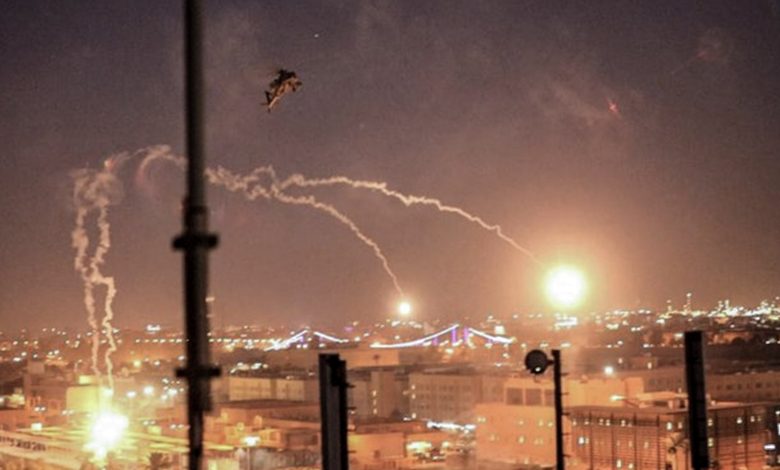
Iraqi air defense systems engaged an unidentified drone flying over Baghdad’s Green Zone on Tuesday evening, according to an Iraqi military source speaking to AFP. The intercept occurred at approximately 7:15 p.m. local time (16:15 GMT), when air defense assets at Camp Honor, which is linked to Iraq’s Defense Ministry, detected the unmanned aerial vehicle within Green Zone airspace.
The drone was not shot down despite the engagement. However, falling shrapnel from the intercept attempt injured one person. The military source did not specify the type of drone or its origin, leaving its provenance officially unconfirmed at time of publication.
AFP journalists on the ground in Baghdad independently corroborated the engagement, reporting they heard what sounded like gunfire and small explosions during the incident. This on-the-ground audio confirmation provides secondary verification for the intercept itself, even if the drone’s origin remains opaque.
🟡 The Target Zone
Baghdad’s Most Fortified District Houses the US Embassy and Iraqi Government
The International Zone, widely known as the Green Zone, is Baghdad’s most heavily protected area. It houses the US Embassy compound, foreign diplomatic missions, senior Iraqi government offices, international organizations, and residences of high-ranking Iraqi officials. A drone penetrating this airspace represents a direct security challenge to some of the most protected infrastructure in the country.
Camp Honor, the air defense site that engaged the drone, is a military installation tied directly to the Iraqi Defense Ministry. Its activation during this incident underscores that Iraqi security services treated the drone as a genuine threat, not a navigational error or civilian misadventure.
🔵 Ceasefire Context
First Aerial Security Breach Since the April 8 Truce Came Into Effect
Kurdistan24 and AFP explicitly characterize this as the first such aerial security breach in Baghdad since the ceasefire between the United States, Israel, and Iran came into effect on 8 April 2026. The significance cannot be overstated: in the weeks prior to the truce, Iran-backed armed factions operating inside Iraq had repeatedly targeted US interests, including diplomatic facilities and military-linked sites in both Baghdad and Erbil.
US forces responded to those pre-ceasefire attacks with strikes against positions associated with these groups, resulting in dozens of casualties among their fighters. Since April 8, that cycle of strikes and counter-strikes had been suspended. Tuesday’s drone incident is the first event to test whether that suspension holds.
The drone was not attributed to any faction by Iraqi authorities at time of reporting. Whether this represents a probe by a militia testing the limits of the ceasefire, or an isolated incident with a different explanation, remains to be determined.
US Embassy Baghdad — Statement on X, 29 April 2026
“We stand in solidarity with the Iraqi people.”
🟡 Political Backdrop
Incident Coincides With Iraq’s Government Transition and Fresh US Engagement
The drone incident lands at an unusually sensitive political moment. Iraq is currently undergoing a government transition, with Ali al-Zaidi named as Prime Minister-designate. The day after the intercept, the US Embassy in Baghdad publicly reiterated its support for al-Zaidi, emphasizing Washington’s commitment to Iraq’s stability as the country moves toward forming a new administration.
The embassy statement highlighted shared priorities between Baghdad and Washington, including protecting sovereignty, combating terrorism, and promoting long-term economic development. The timing of this statement, arriving within 24 hours of a drone incursion into the Green Zone, creates a compressed and politically charged sequence of events.
Iran-backed groups in Iraq have historically used drone and rocket attacks as leverage during politically sensitive periods, particularly when US-Iraqi relations are being recalibrated. A new prime minister attempting to build a working relationship with Washington while managing pressure from pro-Iran factions is a familiar, and precarious, position in contemporary Iraqi politics.
🔴 Regional Picture
Houthis Already Signal Dissatisfaction With the Ceasefire Framework
The Baghdad incident does not stand in isolation. On the same day, a Houthi commander publicly warned of a broader war and described the Iran-US ceasefire as weak, signaling that not all Iran-aligned forces in the region view the truce as binding or durable. This adds another layer of instability to the ceasefire’s first month in operation.
The Axis of Resistance operates as a network of semi-autonomous groups rather than a command-and-control hierarchy. Even if Tehran endorses a ceasefire at the strategic level, individual factions in Iraq retain both the motivation and the capability to conduct independent operations. The Green Zone drone intrusion may reflect exactly this dynamic.
🔴 Strategy Battles Assessment
A Ceasefire Probe, Not a Rogue Malfunction
The strategic context of this drone incident is more significant than its operational scale. A single unidentified UAV that failed to be intercepted and caused one shrapnel injury is, on paper, a minor security event. But in the context of a 21-day-old ceasefire governing one of the most volatile regional conflicts of the decade, it functions as a deliberate boundary test.
The Green Zone is not a target anyone reaches by accident. Drone operators capable of penetrating Baghdad’s most fortified airspace, even briefly, know exactly where they are flying. The fact that the drone was not shot down despite an active engagement by Camp Honor’s air defenses tells us two things: the intercept systems worked well enough to detect and engage, but not well enough to destroy the target. That is an operational intelligence data point for whoever launched it.
The simultaneous Houthi declaration that the ceasefire is “weak” reinforces the interpretation that Iran-aligned factions are actively evaluating whether the truce creates new operational space, rather than simply honoring it. Baghdad is being used as a testing ground. The new Prime Minister-designate al-Zaidi will face immediate pressure to demonstrate whether the Iraqi government can assert sovereignty over its own capital’s airspace, or whether armed factions continue to operate above and beyond government control.
Strategy Battles — Related Coverage
Sources
Editorial Verification
The intercept engagement and approximate time are confirmed via an Iraqi military source cited by AFP, with audio corroboration from AFP journalists on the ground. The drone not being shot down is confirmed. The single shrapnel injury is single-source (AFP via military) and is noted as such. The drone’s origin and type remain officially unverified and are not attributed in this article. The al-Zaidi US Embassy statement and Houthi ceasefire declaration are sourced directly from Kurdistan24 reporting. All editorial assessments in the Assessment section represent original Strategy Battles analysis and do not reflect the positions of any government or military authority.
Approved for Publication
Marcus V. Thorne
Lead Editor, Strategy Battles
©StrategyBattles.net 2026
This article is for news and analysis purposes only. Based on publicly available news sources and military updates. All rights reserved. Not for commercial reuse without permission.