Kim Jong Un Confirms Self-Blasting Order for North Korean Troops in Ukraine War
~2,000
DPRK Troops Killed (Est.)
~15,000
DPRK Troops Deployed to Russia
7+
DPRK Ballistic Missile Tests in 2026

Strategic deployment map: North Korean troop movement from Pyongyang to Russia’s Kursk region, with approximate DPRK combat zone highlighted. Sources: KCNA, AP, Bloomberg, Al Jazeera / StrategyBattles.net
🔴 The Confirmation
Kim Publicly Admits Soldiers Were Ordered to Die Rather Than Surrender
For the first time, North Korean leader Kim Jong Un has publicly confirmed that his troops fighting in Russia’s war against Ukraine were instructed to kill themselves on the battlefield rather than allow capture. The admission came on April 26, 2026, during the inauguration of a newly constructed memorial museum in Pyongyang dedicated to North Korean soldiers killed in the conflict. According to North Korea’s official Korean Central News Agency (KCNA), Kim twice referenced soldiers who had “self-blasted,” praising them as examples of extraordinary courage.
Kim described these fighters as heroes who defended the country’s honour and performed “self-sacrifice through self-blasting” without expectation of reward. The remarks align precisely with longstanding assessments from Ukrainian, South Korean, and Western intelligence agencies, who had separately reported that North Korean troops deployed to Kursk carried standing orders to avoid capture at all costs, including through suicide. This is the first time Pyongyang has confirmed this practice at the leadership level.
🟡 The Museum
Pyongyang Opens Trophy Hall Displaying Captured Western Hardware From Ukraine
The new facility, officially named the Memorial Museum of Combat Feats at the Overseas Military Operations, was opened on the one-year anniversary of what Russia and North Korea jointly describe as the “liberation” of the Kursk border region. The ceremony was attended by Kim Jong Un alongside senior North Korean officials and a high-level Russian delegation led by Defence Minister Andrei Belousov and State Duma Speaker Vyacheslav Volodin.
The museum includes an exhibition of military equipment claimed to have been seized on the battlefields of Ukraine. Displayed hardware includes Leopard 2A4 and M1A1 Abrams tanks, Marder infantry fighting vehicles, AMX-10RC armoured reconnaissance vehicles, VAB armoured personnel carriers, and Turkish-made Kirpi mine-resistant vehicles. Experts have raised questions about the chain of custody of the displayed items. Independent journalists were not granted access to verify the exhibits.
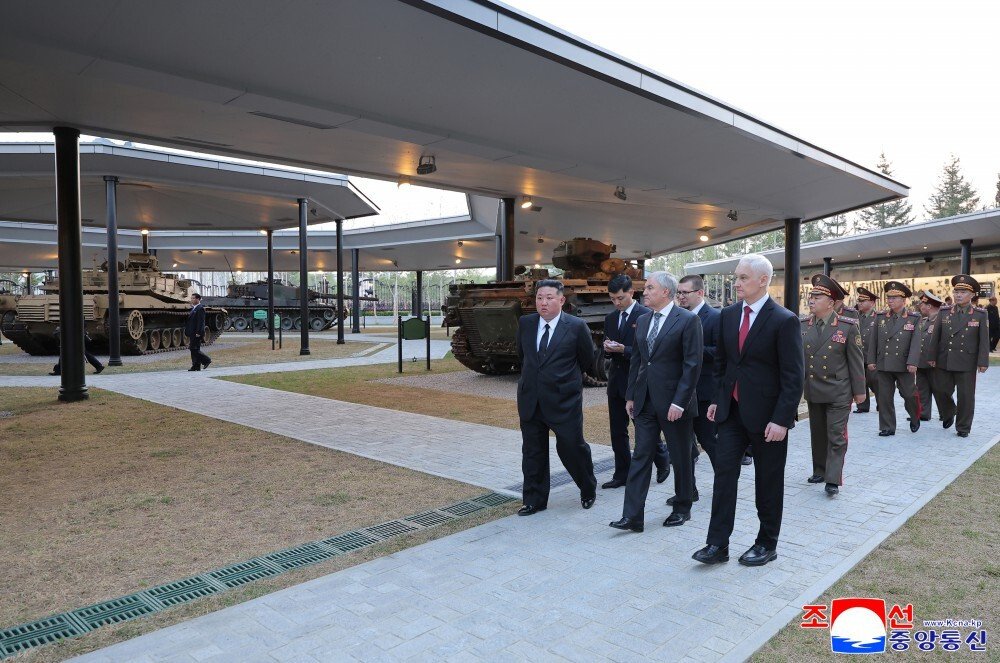
Captured hardware including Leopard 2A4 and M1A1 Abrams tanks on display at the Memorial Museum in Pyongyang. Photo: KCNA via Militarnyi.
🔴 The Deployment
~15,000 Troops Sent, ~2,000 Killed: How North Korea Joined Putin’s War
North Korea remains the only third party to have deployed ground troops directly to the frontlines of the Russia-Ukraine conflict. South Korea’s intelligence service has estimated that approximately 15,000 soldiers were sent to Russia’s Kursk border region, and that around 2,000 of them have been killed. Neither Moscow nor Pyongyang has publicly disclosed casualty figures. North Korean forces initially suffered heavy losses due to unfamiliarity with modern drone warfare and drone-saturated Ukrainian tactics, before adapting and becoming, in the assessment of Ukrainian military intelligence, a more capable force over time.
The first reports of North Korean involvement surfaced in October 2024, with Ukrainian forces confirming direct combat clashes with North Korean units in early November of that year. The first prisoners were reportedly taken by Ukrainian forces in January 2025. Formal acknowledgement from Russia came only in April 2025, when Chief of the General Staff Valery Gerasimov referenced the DPRK’s role during a briefing for President Putin. Pyongyang subsequently confirmed the deployment was ordered by Kim Jong Un under the terms of a bilateral strategic partnership agreement with Moscow.
Kim Jong Un — State Address, KCNA, April 26, 2026
“They did not expect any compensation, though they performed distinguished feats. They died a heroic death.”
🔵 The Alliance
Russia and North Korea Plan New Military Cooperation Pact Running to 2031
The Pyongyang ceremony served as more than a memorial event. During a separate bilateral meeting, Belousov told Kim that Russia was prepared to sign a new military cooperation plan covering the 2027 to 2031 period, according to Russia’s TASS state news agency. Kim pledged full North Korean support for Russia’s declared policy of defending its sovereignty and security interests. Putin, in a letter read aloud at the ceremony by Volodin, stated that the museum would stand as a lasting symbol of friendship and solidarity between the two nations.
The visit by Belousov was the latest in a string of high-level Russian delegations to Pyongyang in recent weeks. Western intelligence agencies have long warned that Russia may be transferring advanced military know-how to North Korea in exchange for troop deployments and conventional weapons shipments, potentially accelerating Pyongyang’s nuclear and ballistic missile programmes. The IAEA’s director general separately confirmed last week that his agency had detected a rapid increase in activity at North Korean nuclear facilities.
🟡 Weapons Testing
Ukraine Conflict Serves as Live Testing Ground for North Korean Weapons
Beyond the troop contribution, the Ukraine war has given Pyongyang an unprecedented opportunity to evaluate its own weapons systems in real combat conditions. North Korean forces have been active in tube artillery and MLRS strikes, aerial reconnaissance, and modern combat tactics including drone operations, according to Ukraine’s Defence Intelligence directorate. Ukraine has also stated that North Korea supplied Moscow with Hwasong-11 short-range ballistic missiles, also designated KN-23 and KN-24, which have been used in strikes against Ukrainian territory.
North Korea has conducted at least seven documented ballistic missile test launches in 2026 alone. The intersection of live battlefield data and active testing programmes represents a significant acceleration of Pyongyang’s military technology development cycle, a concern shared by South Korean and American defence planners alike.
Strategy Battles — Related Coverage
Sources
- Kyiv Post — “North Korean Troops Ordered to Kill Themselves in Ukraine, Kim Jong Un Confirms,” April 28, 2026
- Bloomberg — “Kim Jong Un Confirms Soldier ‘Self-Blasting’ Policy in Ukraine,” April 28, 2026
- Ukrainska Pravda — “Kim Jong Un Calls North Korean Soldiers Who Blew Themselves Up ‘Heroes’,” April 28, 2026
- Al Jazeera — “North Korea Opens Museum Commemorating Troops Killed Fighting for Russia,” April 27, 2026
- Militarnyi — “North Korea Opens Museum Showcasing Captured Weapons of Ukrainian Defense Forces,” April 27, 2026
- Military.com / AP — “North Korea Opens Memorial Museum for Troops Killed in Russia-Ukraine War,” April 27, 2026
- The Independent via Inkl — “Kim Jong Un Confirms Self-Destruct Policy for North Korean Fighters in Ukraine War,” April 28, 2026
Editorial Verification
Kim Jong Un’s use of the phrase “self-blasting” is verified via KCNA official transcript, reported by Bloomberg, AP, and Ukrainska Pravda. Casualty figures (~15,000 deployed, ~2,000 killed) are South Korean intelligence estimates; neither Moscow nor Pyongyang has released official numbers. Museum exhibits are documented via KCNA state photography and Militarnyi reporting; independent journalist access was not granted, and provenance of displayed hardware cannot be independently confirmed. The 2027-2031 military cooperation agreement is reported by Russia’s TASS, citing Belousov’s remarks to Kim. IAEA nuclear activity increase is single-source (IAEA director general statement). All Russian territorial and operational claims are labelled as claims and are not independently verified by Strategy Battles.
Approved for Publication
Marcus V. Thorne
Lead Editor, Strategy Battles
©StrategyBattles.net 2026
This article is for news and analysis purposes only. Based on publicly available news sources and military updates. All rights reserved. Not for commercial reuse without permission.