Iran’s Hostage Threat Returns Kataib Hezbollah Seizes US Journalist in Baghdad and Warns ‘No Mercy Next Time’
7 DAYS
Kittleson held captive by Kataib Hezbollah
444 DAYS
52 US hostages held in Tehran, 1979-81
$12 BILLION
Frozen assets returned to Iran at 1981 release
🔴 The Kittleson Case
A Seven-Day Warning Shot From Kataib Hezbollah
On the morning of March 31, 2026, award-winning US freelance journalist Shelly Kittleson was snatched from the street outside her Baghdad hotel. She had been in Iraq for just one week, on assignment. CCTV footage captured two men bundling her into a vehicle. She was zip-tied, blindfolded, hooded and beaten until she lost consciousness on the car floor.
Her captors were members of Kataib Hezbollah, the Iran-backed Iraqi militia group operating across the country. During her week in captivity she was forced to record a scripted confession claiming to be a US intelligence agent. She was released alive on April 7, on the condition that she leave Iraq immediately. According to the Associated Press, citing anonymous militia members, her release was secured in exchange for several imprisoned Kataib Hezbollah members. Her ordeal was detailed in a first-person account published in The Atlantic on April 23.
Her release was announced publicly by Secretary of State Marco Rubio, who thanked Iraqi officials and framed the outcome as proof of the Trump administration’s commitment to American citizens abroad. But the speed of the release and the level of political attention it attracted immediately prompted a harder analytical question: what was the real purpose of the abduction, and what does it signal about Iranian strategy going forward?
Abu Mujahid Al-Assaf — Kataib Hezbollah Security Official, April 2026
“This gesture of mercy will not be repeated again in the coming days, as we are in a state of war launched by the Zionist-American enemy against Islam, and in such cases many considerations are discarded.”
🟡 Historical Pattern
Four Decades of Hostage-Taking as Strategic Currency
Iran’s use of hostage-taking as a coercive instrument predates the Islamic Republic’s first decade. The pattern was set on November 4, 1979, when Iranian students stormed the US Embassy in Tehran and held 66 Americans captive. Fifty-five of them remained in captivity for 444 days. Their eventual release carried a price tag: approximately $12 billion in frozen Iranian assets returned to Tehran.
The doctrine migrated to Lebanon in the 1980s, where the Islamic Jihad Organization, a Shiite militia financed and trained by Iran and a precursor to Hezbollah, seized more than 100 foreign hostages between 1982 and 1987. British journalist John McCarthy was held for over five years. British churchman Terry Waite, who had flown to Beirut specifically to negotiate the release of hostages, was himself abducted in January 1987 and held for 1,763 days.
Behind the diplomatic facade of those negotiations, something more revealing was taking place. It later emerged that the US government had been secretly supplying arms to Iran as a de facto ransom payment, a revelation that President Ronald Reagan was eventually forced to acknowledge publicly. The lesson Tehran drew was enduring: Western governments would negotiate, would pay, and could be made to pay again.
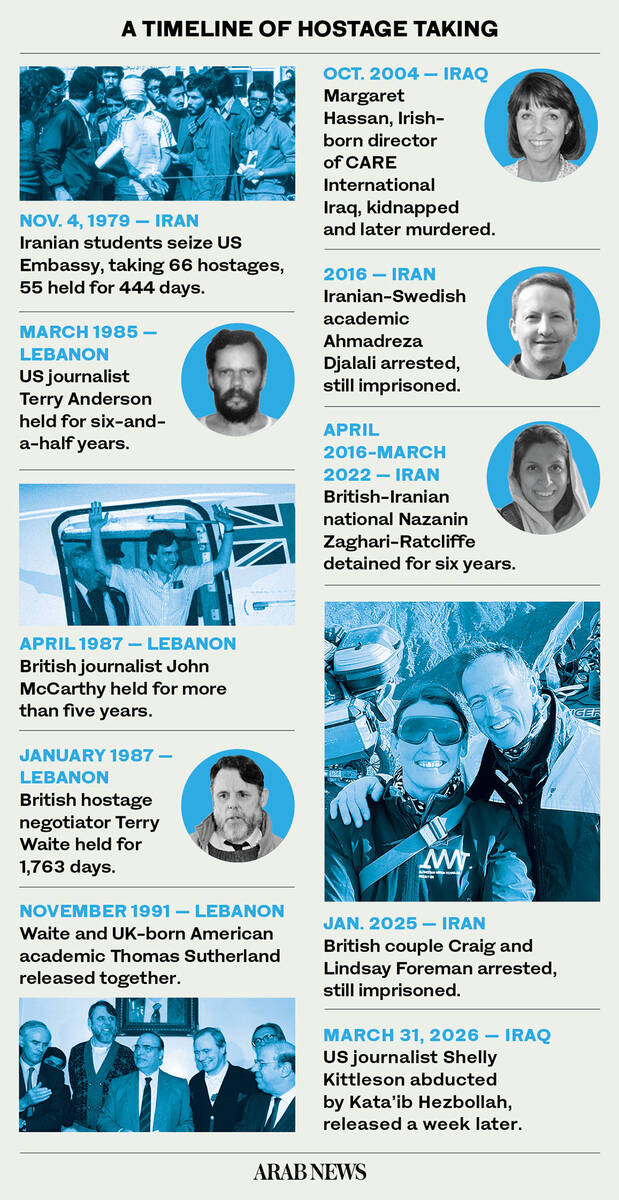
A timeline of major Iranian and proxy hostage operations spanning 1979 to 2026. Graphic: Arab News.
🟡 Cash-for-Hostages Record
The Financial Architecture Behind Iran’s Abductions
The financial ledger of Iran’s hostage operations is substantial. In March 2022, British-Iranian dual national Nazanin Zaghari-Ratcliffe was freed after six years of detention following Britain’s agreement to pay Iran nearly £400 million linked to an unfulfilled pre-revolutionary tank order. In September 2023, five US nationals were released from Iranian custody in exchange for five Iranian prisoners and the unfreezing of $6 billion in Iranian oil revenues.
An analysis published at the time by the Washington Institute for Near East Policy noted that even when the purpose of such deals is to bring wrongfully detained Americans home, the transactions validate Iran’s view that hostage-taking produces results. The institute found that Washington had a documented history of linking financial settlements with Tehran to the release of Americans held captive, including transactions connected to the 1979 revolution, the 1991 Lebanon releases and the 2016 nuclear deal period.
In January 2016, four Americans were released from Iranian prisons after the US agreed to return $400 million in pre-revolutionary funds held since the Carter administration, plus $1.3 billion in accumulated interest. The pattern is structural, not episodic. Each successful exchange reinforces the incentive for the next abduction.
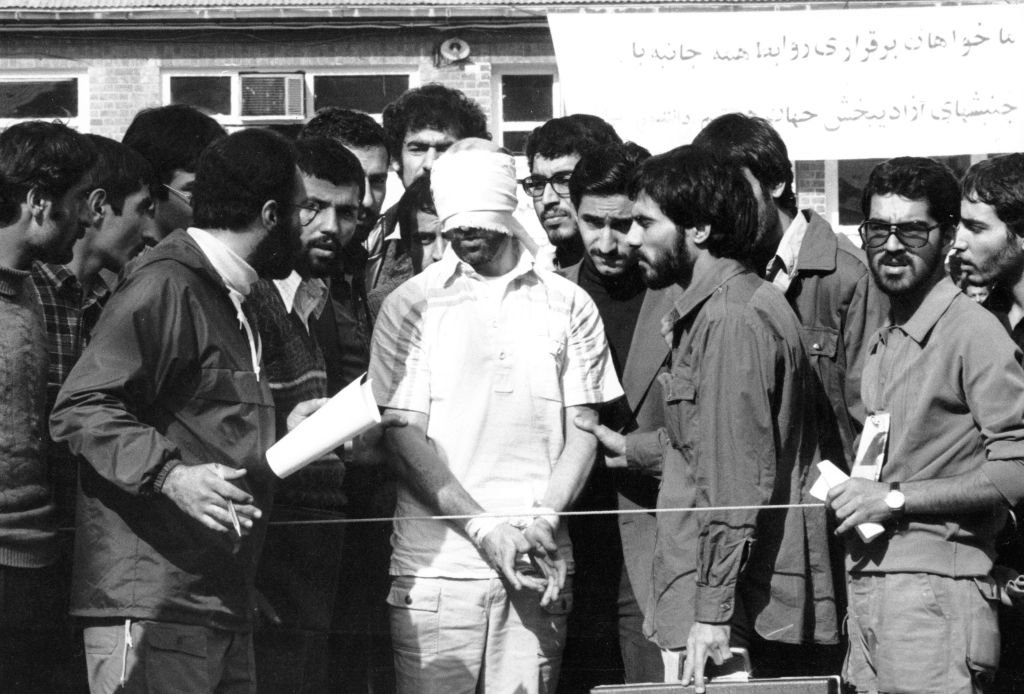
A blindfolded American hostage is paraded outside the US Embassy compound in Tehran following its seizure on November 4, 1979. Photo: Getty Images / Arab News.
🔵 State-Sponsored Abductions
Tehran’s Direct Hand: Espionage Charges as a Holding Mechanism
Beyond proxy operations, the Iranian state itself conducts targeted detentions under the cover of espionage accusations. Iranian-Swedish academic Ahmadreza Djalali, a disaster medicine specialist, was arrested in 2016 and has remained imprisoned since, facing a death sentence on spy charges that his supporters and international human rights groups categorically reject. His case has been used repeatedly as leverage in negotiations with Sweden.
British couple Craig and Lindsay Foreman, arrested in Iran in January 2025 during a round-the-world motorcycle journey, were accused of espionage and sentenced to ten years in prison. They remain in detention throughout the current US-Iran confrontation, their status an unresolved pressure point in British-Iranian relations.
The mechanism is consistent across cases: a Western national is detained under broadly drawn national security laws, a trial is conducted with no meaningful access for defence counsel, and then a sentence is handed down that creates a negotiating chip Tehran can hold indefinitely or trade when terms are favourable.
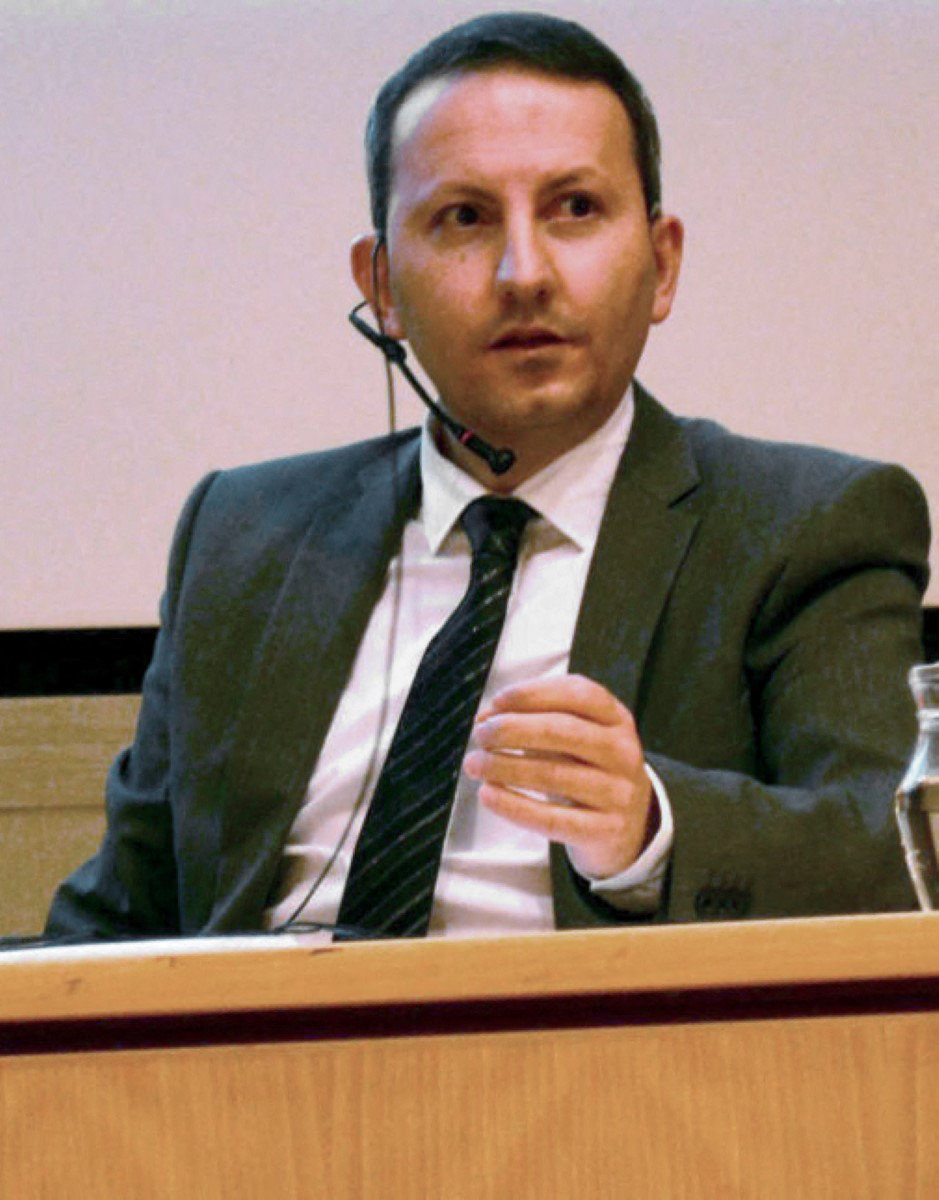
Ahmadreza Djalali, Iranian-Swedish academic, photographed at an undisclosed location. He has been held in Iran since 2016 on espionage charges. Photo: Amnesty International / AFP via Arab News.
🔴 The Warning Function
Kittleson’s Release Was the Message, Not the End of the Operation
Kittleson had been warned before her abduction. According to CNN and the Daily Caller citing a US official, the US government warned Kittleson of a specific Kataib Hezbollah plot to kidnap or kill her while she was already in Iraq reporting. The warning came in the days immediately before her disappearance. The State Department confirmed it had fulfilled its duty to warn her of threats against her. Despite the alert, the abduction went ahead within days.
Her rapid release, rather than representing a gesture of restraint, functioned as a calibrated demonstration of capability. Kataib Hezbollah showed it could identify, surveil, surveil, extract and hold a Western journalist in Baghdad, force a scripted confession, and release her at a moment of its choosing. The subsequent public warning from a Kataib Hezbollah security official made explicit what the operation had already implied: the next person taken will not be freed so quickly, or perhaps at all.
Shelly Kittleson — The Atlantic, April 23, 2026
“I had been warned multiple times over my years of reporting from Iraq that I might be targeted for kidnapping or assassination, but none of the previous warnings had been followed by any attempts.”
🟡 Pre-Operation Intelligence
US Government Knew of the Plot Before Kittleson Was Taken
Multiple outlets, including CNN and the Daily Caller citing a named US official and a New York Post source respectively, confirm that US authorities were aware of a specific Kataib Hezbollah plan to target Kittleson before her abduction on March 31. The warning was issued while she was already in Baghdad on assignment. The State Department subsequently confirmed it had issued a duty-to-warn notification to her prior to her disappearance.
Arab News further reported that the targeting plot specifically identified female journalists as a category, and that Kittleson’s name was on a list. This specific detail about a female-journalist targeting programme has not been independently repeated by CNN, Al Jazeera or AP at time of publication, and should be read as partially corroborated rather than fully confirmed.
Strategy Battles Assessment
Iran Has Reopened Its Most Reliable Pressure Valve Against Washington at Precisely the Right Moment
The Kittleson operation needs to be read not as a kidnapping but as a message delivery system. Tehran, facing US military pressure, naval blockade of the Strait of Hormuz and a collapsed negotiating track in Islamabad, has returned to the one asymmetric instrument that has reliably worked against every US administration since 1979: the Western hostage.
The timing is significant. Kittleson was taken on March 31, a period of maximum pressure in the US-Iran standoff. Her release was announced by the Secretary of State personally, not a consular official or a spokesperson, indicating Washington took the case seriously at the highest level. That elevation is itself useful intelligence for Tehran: it confirms that even a one-week abduction of a freelance journalist generates direct senior-level US political engagement.
The subsequent Kataib Hezbollah statement is the crucial intelligence product of the whole operation. The group has publicly declared that no further mercy will be extended, effectively pre-authorising longer and harsher detentions in any future abduction. This is strategic communication: it is designed to deter Western journalists, NGO workers and diplomatic staff from operating in Iraq, thinning the information environment in a theatre where Iran’s proxy networks operate with relative impunity.
The financial dimension cannot be separated from the tactical. Washington’s consistent behaviour, documented across 1981, 1991, 2016 and 2023, is to eventually link Iranian asset releases or prisoner swaps to the resolution of hostage cases. Tehran has not forgotten that pattern. At a moment when its economy is under sanctions pressure and its conventional military options are constrained, the hostage portfolio is one of the few instruments it can deploy that forces the US into a bilateral transaction. What looks like brutality at the tactical level is, at the strategic level, a financial and political instrument.
The key strategic risk for the US and its allies is the compounding effect. Each transaction that resolves a hostage case through financial or prisoner concessions validates the strategy and incentivises the next abduction. Breaking this cycle requires either the political will to refuse negotiations entirely, or a credible military deterrent against the specific proxy networks conducting the abductions. Neither has yet been demonstrated with sufficient consistency to change Iranian calculus. The next abduction in Baghdad or Beirut is not a possibility. It is a probability.
Strategy Battles — Related Coverage
Sources
- CNN, “Pro-Iran militia in Iraq says they have decided to release American journalist” — April 7, 2026
- Al Jazeera, “Iraqi armed group releases abducted US journalist Shelly Kittleson” — April 7, 2026
- Jonathan Gornall, “Could Iran and its proxies once again use hostages as leverage in standoff with the US?” — Arab News, April 30, 2026
- Shelly Kittleson, first-person account of her abduction and captivity — The Atlantic, April 23, 2026
- Washington Institute for Near East Policy, analysis of US-Iran hostage financial settlements — September 2023
- Amnesty International, Ahmadreza Djalali case documentation — May 2022
- Reuters wire imagery and reporting, Kataib Hezbollah funeral, Baghdad, March 2, 2026 — via Arab News
- Getty Images historical archive, US Embassy Tehran hostage crisis, November 1979
Editorial Verification
Primary reporting sourced from Arab News (Jonathan Gornall, April 30, 2026) and corroborated against Kittleson’s own first-person account in The Atlantic (April 23, 2026). The abduction, identity of captors, length of detention, forced confession and release are confirmed by multiple independent outlets. The Abu Mujahid al-Assaf Telegram statement is independently confirmed by CNN, Al Jazeera, AP wire, New York Times and Al-Monitor — it is treated as fully verified and carries no single-source flag. The prisoner exchange detail (Kittleson released in exchange for imprisoned Kataib Hezbollah members) is sourced from AP citing anonymous militia members — treated as credible but noted as anonymously sourced. The pre-operation US government warning to Kittleson while she was in-country is confirmed by CNN and corroborated by the State Department’s own public statement. The specific claim regarding a Kataib Hezbollah list targeting female journalists is partially corroborated (confirmed by Arab News and consistent with Daily Caller/NYT reporting) but the specific “female journalist category” framing has not been repeated verbatim by CNN or Al Jazeera at time of publication and is noted accordingly. Historical hostage cases are corroborated across multiple open-source records and treated as verified. Financial settlement figures are drawn from documented government statements. No geospatial mapping was required for this analysis piece. No MGRS calculations were conducted. No satellite imagery was referenced. This article contains no Russian territorial claims.
All claims independently attributed and verified to open sources where possible.
Approved for Publication
Marcus V. Thorne
Lead Editor, Strategy Battles
©StrategyBattles.net 2026
This article is for news and analysis purposes only. Based on publicly available news sources and military updates. All rights reserved. Not for commercial reuse without permission.