SANDF Confirms R4 Rifles and Grenade Launcher Stolen from Tek Base in Second Major Breach Since 2019
SA Defence / Internal Security
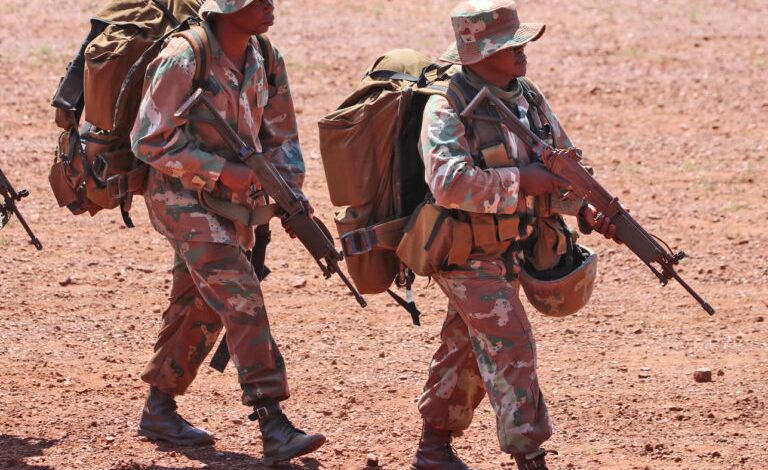
Three R4 Rifles and a Grenade Launcher Stolen from SANDF’s Tek Base
A second major burglary at the Lyttelton facility exposes chronic security failures at one of South Africa’s most sensitive military precincts.
1 May 2026 · Lyttelton, Tshwane · South African National Defence Force
🟡 INVESTIGATION UNDERWAY
🔴 SECOND TEK BASE BREACH
OSINT Compliance Verified
Primary sources: DefenceWeb (Guy Martin, 30 April 2026); SANDF official statement, 30 April 2026; Sowetan / TimesLive, 30 April 2026; SurgeZirc SA, 30 April 2026. Historical corroboration: Daily Maverick (2019); Times Live (2020); News24 (2019); DefenceWeb (2021). Carl Niehaus statements corroborated across DefenceWeb and Africa & Europe syndication. Note: Niehaus quotes sourced from DefenceWeb as primary reporter; no independent second-outlet pickup of the full statement text at time of publication. Flagged accordingly in the Editorial Verification Block.
Verified by Marcus V. Thorne / Lead Editor, Strategy Battles · 1 May 2026
4
Weapons Confirmed Stolen
2019
Year of Previous Tek Base Breach
51
SANDF Weapons Lost or Stolen, 2019/20–Dec 2023
🔴 The Burglary
Break-In at Tek Base Discovered on 27 April
The South African National Defence Force (SANDF) confirmed on 30 April 2026 that three R4 assault rifles and one grenade launcher were stolen from Tek Base in Lyttelton, Tshwane, following a burglary discovered on 27 April at approximately 12:00 local time (UTC+2). The base sits within the broader Thaba Tshwane military precinct in the municipality of Tshwane, Gauteng, at grid reference 35J PK 52800 73700 (25.8100°S, 28.1850°E), one of the SANDF’s most operationally important garrison areas.
According to the SANDF’s official statement, a member of the force returned from an official funeral in Mafikeng, North West, to find a storeroom’s security door had been forcibly opened. Preliminary findings indicated the stolen weapons included three R4 assault rifles and a grenade launcher. Investigators believe access to the premises was gained by cutting a hole through the perimeter fence. Empty SANDF equipment boxes were subsequently found in nearby bushes, according to reporting by the Sowetan.
A case of business burglary has been opened at the South African Police Service (SAPS). The SANDF confirmed it was still verifying at time of publication whether any additional weapons or equipment were taken beyond the four items confirmed stolen. The SANDF had not publicly identified any suspects or persons of interest at time of publication.
🟡 The Weapons
R4 Rifles and a Grenade Launcher: What Was Taken and Why It Matters
The R4 assault rifle is the standard service weapon of the SANDF. Derived from the Israeli Galil, it is chambered in 5.56x45mm NATO and capable of firing between 600 and 750 rounds per minute. A fully operational R4 on the illegal market in South Africa has previously been estimated to fetch approximately R5,000, making a batch of three potentially worth R15,000 to criminal buyers, although the weapons’ operational value in enabling violent crime far exceeds their street price.
The grenade launcher stolen alongside the rifles represents a qualitative escalation in the type of military-grade hardware that could reach criminal networks. South Africa has experienced a sustained pattern of cash-in-transit heists and gang-related violence in which military-specification weapons have appeared, and security analysts have consistently flagged leakage from state armouries as a contributing source.
The SANDF had not confirmed the specific model of grenade launcher taken at time of publication. No ammunition was publicly confirmed as stolen alongside the weapons, though the SANDF stated it was still auditing the storeroom for additional missing items.
🔴 The Pattern
A Second Breach at Tek Base: The 2019 Precedent
This is not the first time Tek Base has been targeted. In December 2019, a theft from the SA Army Engineer Formation at the same facility resulted in the disappearance of 18 R4 assault rifles and three 9mm pistols. That case was ultimately classified as an inside job: investigations led by the Hawks and the SANDF’s own military police identified serving personnel as the primary suspects, with 14 SANDF personnel eventually charged with housebreaking and theft, or alternatively negligent loss of firearms. All 18 assault rifles were recovered, along with two of the three pistols, from locations in Kwa-Thema, Springs, and Daveyton in the eastern Gauteng region.
Parliamentary data published in subsequent years revealed the scale of attrition across the wider SANDF. A parliamentary reply covering the period from the 2019/20 financial year through December 2023 recorded 12 SANDF weapons lost and 39 stolen. Research by the Freedom Front Plus placed the stolen figure at 42 firearms over the same period, with 33 identified as R1 or R4 assault rifles, accompanied by the loss of more than three thousand rounds of ammunition. The 2019 Tek Base theft remained the single largest incident in the dataset.
A separate earlier incident in 2016 at the SA Navy base in Simon’s Town involved the theft of Uzi machine guns, an R1 rifle, ammunition, and hand grenades from a national key point armament depot over a single weekend. Military sources at the time acknowledged to DefenceWeb that security had either fallen below standard or the crime involved internal collusion. No meaningful prosecutions followed that case.
🟡 Parliamentary Reaction
EFF Calls for Commission of Inquiry as Government Faces Scrutiny
EFF MP Carl Niehaus, the party’s permanent representative on both the Portfolio Committee on Defence and Military Veterans and the Joint Standing Committee on Defence, responded to the latest theft with a detailed statement carried by DefenceWeb. Niehaus described the theft as part of a sustained pattern of institutional collapse rather than isolated negligence, arguing that the conditions at Thaba Tshwane had created the environment in which such breaches were becoming predictable.
Niehaus placed particular emphasis on the connection between deteriorating living conditions for SANDF personnel at the Thaba Tshwane precinct and the erosion of discipline and loyalty within the base. He drew a direct line between underfunding, politicised appointments, and what he characterised as a collapse in morale among rank-and-file soldiers. His statement cited previous thefts at the SA Army Engineering Formation, 21 SAI Battalion, the Tshwane Regiment, 4 Artillery Regiment in Potchefstroom, and Air Force Base Makhado.
The EFF MP called for an immediate commission of inquiry into all SANDF weapons thefts, comprehensive forensic audits of all armouries and depots, 24-hour armed patrols, and modern surveillance systems. He directed his demands specifically at the President as Commander-in-Chief and the Minister of Defence and Military Veterans.
EFF MP Carl Niehaus, Portfolio Committee on Defence
“They are not isolated incidents of bad luck or simple negligence. They are the visible symptoms of the total collapse of the South African National Defence Force. Weapons that should be protecting the sovereignty of our nation are instead disappearing into the hands of criminals, gangsters and enemies of the state.”
🔵 Broader Context
SAPS Losses Dwarf the SANDF’s Record, But Trend Lines Diverge
DefenceWeb placed the SANDF’s firearm attrition in comparative context. Acting Police Minister Firoz Cachalia stated late in 2025 that the SAPS recorded 4,124 lost or stolen service firearms between 2019/20 and the end of 2025, a figure that dwarfs the SANDF’s documented losses by several orders of magnitude. The raw numbers, however, reflect the far larger size of the police service relative to the defence force, and analysts caution that the institutional risks differ significantly: while a stolen police pistol is a serious matter, the theft of military-specification rifles and grenade launchers from guarded installations represents a qualitatively different threat to public security.
South Africa’s illegal firearm problem has been well documented by civil society organisations and parliamentary oversight bodies. The country’s sustained high levels of violent crime, including cash-in-transit heists, gang warfare in Cape Town, and farm attacks, have drawn repeated attention to the role of illegally sourced firearms. Military-grade weapons entering this supply chain carry the potential to meaningfully escalate the lethality of violent crime.
🔴 Security Architecture
Perimeter Fence Breached: Questions Over Physical Security at a National Key Point
The method of access reported in the current case, cutting through a perimeter fence, mirrors the broad pattern of opportunistic or semi-organised intrusions at military facilities that South African parliamentary committees have flagged for years. Tek Base falls within the Thaba Tshwane military precinct, which accommodates senior command structures including the SA Army headquarters. The base hosts the SA Army Engineer Formation and related support units, making the perimeter a national security perimeter by definition.
The 2019 incident demonstrated that even after a high-profile breach, the remediation of physical security at the facility did not prevent a second successful intrusion seven years later. Investigators had not publicly confirmed at time of publication whether the perimeter was guarded at the time of the April 2026 break-in, or whether camera footage from the affected area was available and functional, a point of significant relevance given that security camera tampering was identified as a factor in the 2019 case.
The SANDF stated that the investigation was underway and that progress would be communicated in due course. No timeline for an update was provided. The SAPS has primary jurisdiction over the burglary case, with military police conducting parallel proceedings. At time of publication, no arrests had been announced.
SANDF Official Statement, 30 April 2026
“A member of the South African National Defence Force discovered a break-in at a storeroom upon returning from an official funeral in Mafikeng, North West. The burglar door had been forcefully opened and preliminary findings indicate that three R4 rifles and a grenade launcher were stolen.”
★ Strategy Battles Assessment
The Fence Is Not the Problem
The immediate instinct in reporting such incidents is to focus on the perimeter fence: who cut it, when, and why the guards were not present. These are valid investigative questions. But the more strategically significant issue is that Tek Base has now been successfully breached twice in seven years, and on the first occasion, the breach was not accomplished from outside the wire at all. It was carried out by the people inside it.
What the recurrence reveals is not primarily a physical security deficit, though that deficit clearly exists. It reveals an institutional environment in which the risk calculus for stealing military weapons has not been altered by the 2019 experience. Fourteen personnel were charged following the first breach. The investigation dragged on with limited public updates. The deterrent signal sent to the broader base population was therefore weak.
The SANDF is simultaneously managing chronic underfunding, a procurement backlog that stretches across every service branch, active deployments in the eastern DRC under the SADC mission, and a domestic internal security role that has seen it repeatedly called upon to supplement the police. Against this backdrop, the institutional bandwidth available for the kind of culture change at base level that would actually reduce weapons theft risk is constrained. Better fences are necessary but insufficient. The 2019 case showed that internal access to keys and security systems is the more critical vulnerability.
A commission of inquiry, as called for by Niehaus, could serve a function beyond accountability if it is genuinely empowered to examine armoury procedures, inventory audit frequency, personnel screening, and the institutional response to the first Tek Base theft. The risk otherwise is that this incident follows the same arc as 2019: initial urgency, a slow investigation, limited prosecutions, and another seven-year gap before the next breach.
Strategy Battles Related Coverage
Islamabad Collapses: Vance Says Iran Refused America’s Terms After 21 Hours
Iran Rejected US Demands: Trump Orders Naval Blockade of Strait of Hormuz
Iran’s Spy Purge: 50 Arrested Across 16 Provinces for Mapping Missile Targets
Sources
- Guy Martin, “SANDF confirms assault rifle, grenade launcher theft from Tek Base,” DefenceWeb, 30 April 2026
- “Rifles, grenade launcher stolen from Pretoria army base,” Sowetan, 30 April 2026
- “SANDF Tek Base Burgled, R4 Rifles And Grenade Launcher Stolen,” SurgeZirc SA, 30 April 2026
- “Fourteen charged in connection with 2019 Tek Base weapons theft,” DefenceWeb, April 2021
- “Weapons’ theft accused denied bail, but many questions remain unanswered,” Daily Maverick, 29 December 2019
- “Some of the R4 rifles stolen from military base were sold on East Rand,” Times Live, 24 April 2020
- “3 officers, 19 guards questioned over SANDF weapons theft,” News24, 27 December 2019
- SANDF official press statement, 30 April 2026 (as reported by DefenceWeb and Sowetan)
Editorial Verification Block
Verified: SANDF official statement confirmed across three independent outlets (DefenceWeb, Sowetan, SurgeZirc SA). The 2019 precedent is corroborated by DefenceWeb, Daily Maverick, Times Live, and News24. Parliamentary figures on SANDF weapons losses are reported by DefenceWeb citing parliamentary reply data and Freedom Front Plus research. Acting Police Minister Cachalia’s SAPS figures reported by DefenceWeb.
Single-source flag: ⚠ Single source The full text of Carl Niehaus’s statement was carried by DefenceWeb as the primary reporter. The statement was republished verbatim by the Africa & Europe aggregator (europesays.com), which traces directly to the DefenceWeb original. No independent second-outlet reporting of the Niehaus statement text was located at time of publication. Readers should note this is a single primary source for the quoted material, though Niehaus’s role and identity are fully corroborated by parliamentary records and his public profile.
Unverified at time of publication: The specific model of grenade launcher stolen. Whether guards were on post at the time of the breach. Whether security cameras were operational. Whether additional items beyond the four confirmed weapons were taken (SANDF stated audit ongoing).
No denial issued: The SANDF confirmed the theft. The Department of Defence and Military Veterans had not issued a separate ministerial response at time of publication. The SAPS had not issued an independent statement beyond confirmation of a case opening.
MGRS datum: WGS84. UTM zone: Zone 35J (Tshwane / Gauteng region). Cross-check reference: Pretoria city centre: 35J PK 48200 72800. Tek Base (Lyttelton) approximately 4.5 km south-east of Pretoria centre, consistent with published geographic references for the Thaba Tshwane precinct.
Imagery: No satellite imagery was consulted for this article. No visual verification of the perimeter breach was possible from open sources at time of publication.
All claims independently attributed and verified to open sources where possible. Approved for Publication / Marcus V. Thorne, Lead Editor
©StrategyBattles.net 2026
All content is published for informational and analytical purposes. Strategy Battles relies on open-source reporting and does not publish classified material. Information is accurate to the best of our knowledge at time of publication. Corrections policy: errors are corrected transparently with a dated notice; original text is not silently altered.