Japan Lifts 80-Year Arms Export Ban: Ukraine Sees Path to Japanese Weapons and Air Defence Funding
21 Apr
Cabinet Decision Date
17
Countries Eligible for Japanese Arms
$4bn+
NATO PURL Programme Supplied to Date
🟡 The Policy Shift
Japan Ends an 80-Year Arms Export Taboo
On 21 April 2026, the Cabinet of Prime Minister Sanae Takaichi approved a sweeping revision of Japan's defense export framework, scrapping a ban on lethal weapons exports that had stood, in various forms, since the end of World War Two. The decision allows Japan to sell fighter jets, missiles and destroyers to partner nations for the first time in the postwar era, ending restrictions that had confined arms transfers to five non-lethal categories: rescue, transport, warning, surveillance and minesweeping.
The overhaul represents the most comprehensive revision of Japan's Three Principles on Transfer of Defence Equipment since Prime Minister Shinzo Abe's 2014 reforms, which themselves permitted limited joint development of military equipment with allies. A further revision under Prime Minister Fumio Kishida in 2023 allowed Japan to export finished lethal weapons produced under foreign licences back to the licensing country. The Takaichi Cabinet decision of April 2026 goes further still, removing the categorical ban and replacing it with a case-by-case approval process requiring clearance from Japan's National Security Council.
Exports remain, in principle, prohibited to countries actively engaged in armed conflict. However, the new guidelines create exceptions where Tokyo determines a transfer serves Japan's security interests or promotes peace and international cooperation. It is precisely this exception that Kyiv's diplomats are now seeking to use. Under the revised rules, arms transfers are initially limited to 17 countries that have signed defence equipment and technology transfer agreements with Japan.
Announcing the change, Takaichi stated that no country can protect its security alone and that Japan must support its partners in an increasingly severe security environment. The policy drew sharp criticism from China, whose Foreign Ministry spokesperson Guo Jiakun warned the international community would resist what Beijing characterised as Japan's reckless moves toward a new form of militarism. The United States Ambassador to Japan, George Glass, described the move as a historic step forward for allied defence cooperation.
Ambassador Yurii Lutovinov, Ukraine Embassy, Tokyo, 28 April 2026
“This allows us to talk. Theoretically, it's a very big step forward.”
🔵 Ukraine's Strategic Approach
Kyiv Moves Carefully, Eyes Air Defence Funding First
Ukraine's Ambassador to Japan, Yurii Lutovinov, told Reuters in an interview at the Ukrainian Embassy in Tokyo on 28 April 2026 that Kyiv is approaching the question of Japanese arms with deliberate caution, citing the political sensitivity of defence exports within Japan. Any future equipment transfer would require Ukraine to first conclude a defence and equipment technology transfer agreement with Tokyo, a process Japan has completed with 18 countries including Germany, Australia, the Philippines and Vietnam. Ukraine has not yet concluded such an agreement.
In the shorter term, Lutovinov said the more immediate priority is investment rather than direct equipment transfer. He stated that Ukraine possesses the industrial capacity to produce its own air defence systems but requires external funding to scale that production and reduce its dependence on US-made Patriot missiles, stocks of which are under growing strain across NATO. Japan, he indicated, could provide that funding without the legal and political complications of direct lethal equipment export.
Lutovinov also confirmed that discussions are under way regarding Japan contributing to NATO's Prioritised Ukraine Requirements List, known as PURL. This programme has supplied more than $4 billion in equipment and munitions since its creation, with Australia and New Zealand joining in 2025 as the first non-NATO members to participate. Japan, Lutovinov said, could join within its own legal framework, including through contributions of non-lethal equipment, without requiring a change in domestic law.
🟢 The Indo-Pacific Connection
Tokyo Links Ukraine's Fate to Taiwan and East Asia Security
Japan's turn toward Ukraine is not driven by European solidarity alone. Tokyo has explicitly framed its support for Ukraine within the context of its own regional security calculus. Japanese territory extends to within 110 kilometres of Taiwan, and successive governments have concluded that a successful Russian conquest of Ukraine would embolden China toward more assertive action in the Indo-Pacific. Former Prime Minister Fumio Kishida stated publicly in 2022 that Ukraine today could be East Asia tomorrow, a formulation that became the conceptual foundation for Japan's accelerating military buildup.
Ambassador Lutovinov reinforced this logic in his Reuters interview. He argued that Ukraine's continued resistance directly serves Japanese security interests and that a collapse of Ukrainian defences would send a dangerous signal to authoritarian powers across the Pacific. His argument echoed the framing Takaichi used to justify the April 2026 arms export overhaul to a domestic audience.
Australia's signature of a landmark agreement with Japan on 19 April 2026, covering the delivery of three Mogami-class frigates with eight more to be jointly produced, underscores how rapidly the new export framework is translating into concrete deals. New Zealand has also expressed interest in the same frigate class. Several South-East Asian nations, including the Philippines and Indonesia, have approached Tokyo about additional equipment categories now available under the revised rules.
A delegation of 30 NATO representatives visited Japan in the week of the Cabinet decision to discuss deepening ties, a visit whose timing was almost certainly coordinated with the policy announcement. The International Institute for Strategic Studies noted that the revision followed a proposal from the ruling coalition, including the Liberal Democratic Party and the Japan Innovation Party.
Ambassador Lutovinov, Reuters Interview, 28 April 2026
“If Ukraine falls, it's going to be a big domino effect. That's why the Indo-Pacific and the European continent are inseparable from the point of view of our security.”
🔵 Technology and Drones
Ukraine Offers Drone Combat Experience; Japan Needs Component Alternatives to China
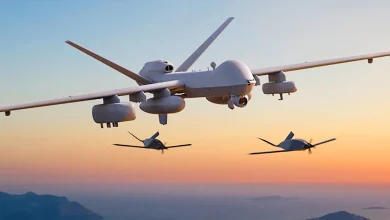
Lutovinov made explicit that Ukraine is not approaching Japan merely as a recipient of support. During the Reuters interview, a Vampire bomber drone built by Ukrainian manufacturer Skyfall sat in the embassy reception room, positioned deliberately as a statement of Ukraine's industrial capability. Skyfall, Lutovinov noted, has now reached sufficient production capacity to begin exporting its low-cost strike drones.
Ukraine's drone inventory has historically depended heavily on Chinese-made electronic components and micro-components. A 2025 report by the Ukrainian think tank Snake Island Institute confirmed that Chinese-sourced parts dominated the supply chain for the thousands of drones Kyiv has deployed on the front lines. That dependency represents a strategic vulnerability: Chinese firms could face pressure to restrict supply, and the components are liable to inspection and reverse engineering if captured.
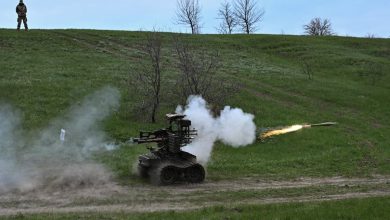
Japanese electronics and precision manufacturing represent a high-quality alternative. Lutovinov proposed a technology exchange model in which Japan's manufacturing precision and component supply chains would combine with Ukraine's three years of combat-refined drone development experience. The Takaichi administration is itself preparing a defence strategy this year expected to call for a significant expansion of Japan's own drone capabilities across air, sea and land domains. Ukraine's practical wartime knowledge of drone deployment, electronic warfare countermeasures and autonomous systems would directly serve that objective.
🟡 Domestic Politics
Takaichi Has Not Publicly Endorsed Ukraine Arms; Government Stays Deliberately Ambiguous
Despite the broad significance of the April 2026 arms export revision, Prime Minister Takaichi has given no public indication that she would support direct lethal exports to Ukraine specifically. In a readout of a telephone call with President Volodymyr Zelensky in November 2025, her office stated that Japan stands with Ukraine and supports its efforts toward achieving a just and lasting peace, without committing to any form of military supply. Japan's Foreign Ministry and Prime Minister's Office did not respond to requests for comment made in connection with the Reuters report.
This silence is politically calculated. Takaichi, who took office in October 2025 and is regarded as a China hawk within the Liberal Democratic Party, has built the arms export overhaul as a structural change to Japan's defence posture rather than as a Ukraine-specific policy. Framing any export to Ukraine as a special case would risk public backlash in a country where postwar pacifism retains deep roots. Protesters gathered outside the National Diet building in the days before the 21 April Cabinet vote, carrying signs opposing the constitutional shift.
The defence industry is now listed as one of 17 strategic growth areas under the Takaichi government. Japanese contractors, many of which had long withdrawn from the domestic defence market due to low profitability, are returning as the government increases funding for defence startups and dual-use technology research. Australia's Defence Minister Richard Marles, speaking alongside his Japanese counterpart Shinjiro Koizumi following the Mogami frigate deal, described the relaxed export controls as critical to developing a seamless allied defence industrial base.
Ambassador Lutovinov, Reuters Interview, 28 April 2026
“We are not the country that would like to just ask. We are the country that is going to provide as well. The technology of Japan and experience of Ukraine, if we can put them together, it would be a high-class product.”
🔵 Strategy Battles Assessment
Japan's Arms Export Pivot Is a Structural Shift, Not a One-Off Concession
The significance of Japan's April 2026 policy revision extends well beyond any single potential transfer to Ukraine. By removing the categorical prohibition on lethal exports and replacing it with a case-by-case National Security Council process, Tokyo has created a permanent institutional mechanism for arms sales that did not exist a month ago. Subsequent governments will find it politically far easier to use that mechanism than Takaichi did to create it. The door, once opened at this scale, has historically proven very difficult to close in comparable democracies.
For Ukraine, the immediate practical value of the policy change is likely to manifest through financial channels rather than direct lethal supply. Kyiv's proposal to use Japanese capital to fund domestic air defence production sidesteps the legal barriers that still technically preclude Tokyo from selling into an active conflict zone. This is a shrewd piece of diplomacy: it extracts economic benefit from the new relationship while allowing both governments to manage their respective domestic political constraints simultaneously.
The drone component supply chain angle is arguably the more consequential long-term development. Ukraine's dependence on Chinese-manufactured electronics for its drone fleet is a structural vulnerability that has persisted despite years of war. Japan's precision electronics sector offers a credible alternative that would not only reduce that exposure but would also give Tokyo insight into Ukraine's most combat-proven autonomous systems technology, a strategic asset as Japan prepares to expand its own drone capability. The mutual interest here is genuine, not merely diplomatic.
China's characterisation of the policy change as reckless militarism is predictable but also strategically revealing. Beijing's public condemnation signals that it reads the shift not primarily as a Ukraine policy but as a broader Indo-Pacific posture change, one that complicates Chinese options in any future Taiwan contingency. The fact that a 30-member NATO delegation visited Tokyo in the same week as the Cabinet vote confirms that the Western alliance views Japan's arms export liberalisation as an alliance-wide strategic gain, not merely a bilateral commercial development.
Strategy Battles Related Coverage
Sources
- Reuters via Arab News: “Ukraine sees path to Japanese arms after Tokyo eases export rules”, 1 May 2026
- Associated Press via PBS NewsHour: “Japan lifts ban on lethal weapons exports in major change of its postwar pacifist policy”, 21 April 2026
- NPR: “Japan approves scrapping a ban on lethal weapons exports”, 21 April 2026
- Al Jazeera: “Japan lifts ban on lethal weapons exports in major shift of pacifist policy”, 21 April 2026
- CNBC: “Japan scraps ban on lethal weapons exports in major shift of pacifist policy”, 21 April 2026
- The Diplomat: “Breaking the Postwar Taboo: Japan Lifts Its Ban on Lethal Arms Exports”, April 2026
- Prism News: “Japan eases weapons export rules, opening possible arms path for Ukraine”, 1 May 2026
Editorial Verification Block
Verified: All statements attributed to Ambassador Yurii Lutovinov confirmed across Reuters (primary source, exclusive interview 28 April 2026, Tokyo), The Standard (Hong Kong), UNN (Ukraine), Milli Chronicle and Prism News. Minimum two independent outlets for all direct quotes. Japan Cabinet decision of 21 April 2026 confirmed by AP, NPR, Al Jazeera, CNBC and The Diplomat independently.
MGRS datum: N/A. This article covers a diplomatic and policy development with no fixed operational geographic location requiring MGRS precision. No strike or military operation coordinates are cited.
Single-source items: None. All key claims verified across multiple independent outlets.
Non-response noted: Japan's Foreign Ministry and Prime Minister's Office did not respond to Reuters requests for comment prior to publication of the original report, as stated in the primary source.
Claim: Snake Island Institute 2025 drone component report. Attributed to Reuters primary source, which cites the think tank directly. Strategy Battles has not independently located the full report text but accepts attribution from Reuters as a tier-one wire agency.
Takaichi quotes: Drawn from X (formerly Twitter) posts and official Cabinet readouts as cited by AP, NPR and Al Jazeera. English translations from Japanese sourced from Google translation notation cited by AP.
All claims independently attributed and verified to open sources where possible. Approved for Publication / Marcus V. Thorne, Lead Editor
©StrategyBattles.net 2026. All rights reserved.
This article is produced for informational and analytical purposes only. All content is drawn from open-source reporting and does not represent the views of any government, military or intelligence agency. StrategyBattles.net makes no warranties as to the completeness or accuracy of open-source information used in this analysis.