UAE Intercepts 12 Iranian Ballistic Missiles and Drones, Fujairah Oil Terminal Struck
19
Munitions Fired by Iran (4 May 2026)
2,838+
Total Drone / Missile Attacks on UAE Since 28 Feb
3
Indian Nationals Injured at Fujairah Oil Zone
📍 UAE Air Defence Operation, Fujairah Strike Zone — 4 May 2026

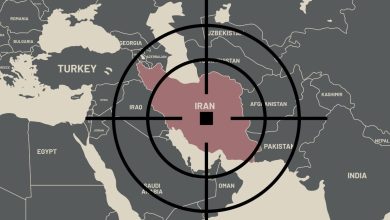
Red dashed lines show inbound Iranian ballistic and cruise missile trajectories; amber dashed line indicates drone flight path. Strike marker at Fujairah Oil Industry Zone (MGRS 40R DN 33632 77876). Datum WGS84, UTM Zones 39S / 40R. Map: Strategy Battles / OSINT.
📍 FUJAIRAH OIL INDUSTRY ZONE, UAE
MGRS: 40R DN 33632 77876
25.1153°N 56.3417°E
Eastern UAE oil export terminus and endpoint of the Abu Dhabi Crude Oil Pipeline. Struck by Iranian drone on 4 May 2026, sparking a fire at the liquid terminal. Three Indian nationals were moderately injured and hospitalised. The only major UAE crude export route bypassing the Strait of Hormuz.
📍 ABU DHABI, UAE: AIR DEFENCE HQ
MGRS: 40R BN 34124 07001
24.4539°N 54.3773°E
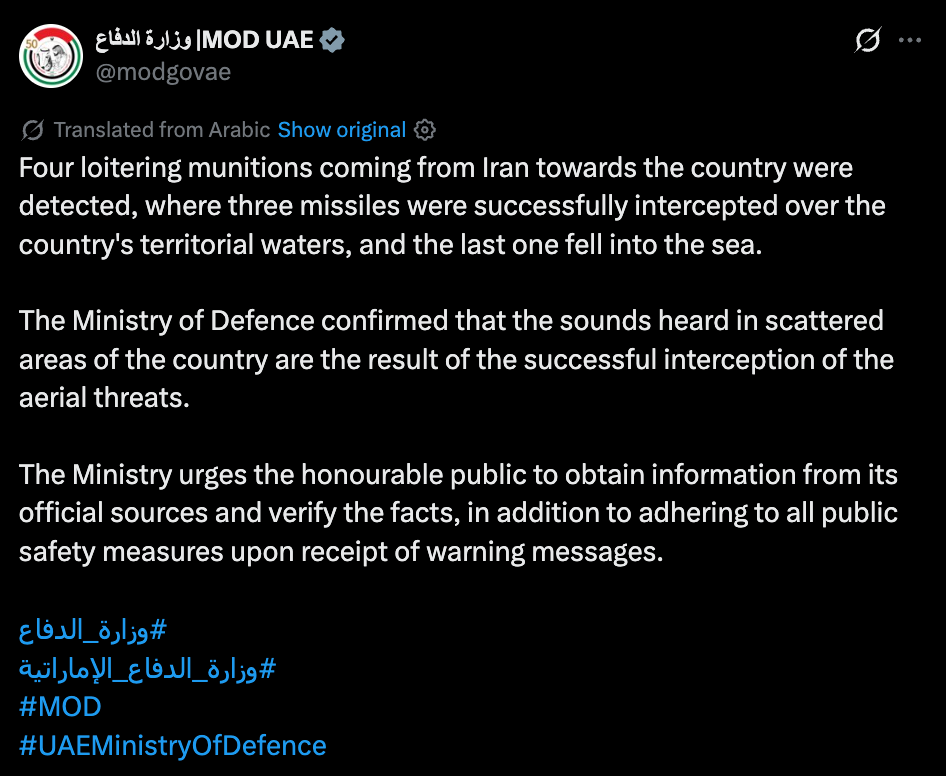
UAE Ministry of Defence operational centre coordinating the interception of 12 ballistic missiles, three cruise missiles, and four drones on 4 May 2026. All aerial threats were engaged over UAE territorial waters. National emergency shelter alerts were broadcast to residents for the first time since the 8 April ceasefire.
🔴 The Barrage
Iran Fires 19 Munitions at UAE, Breaking a Month-Long Ceasefire
The UAE intercepted a mass Iranian missile and drone barrage on 4 May 2026, the most significant attack on the country since a fragile ceasefire took hold on 8 April. According to the UAE Ministry of Defence, air defence systems engaged 12 ballistic missiles, three cruise missiles, and four drones launched from Iran. The intercept operation was centred around the Abu Dhabi air defence network at grid reference 40R BN 34124 07001 (24.4539°N, 54.3773°E), with engagements occurring across UAE territorial waters.
The UAE Ministry of Defence confirmed on its official account on X that the sounds heard across the country were the result of successful aerial interceptions, not ground impacts. Four separate shelter alerts were broadcast to residents, urging them to seek safe places inside the closest secure building. The alerts marked the first such warnings issued to the public since the ceasefire began nearly a month earlier.
Commercial aviation was severely disrupted. Aircraft bound for Dubai International Airport and Abu Dhabi International Airport turned around mid-air as the intercept operation was underway. Flights largely resumed to near-normal operations by the following morning, according to reporting by The National News.
🔴 The Strike on Fujairah
Iranian Drone Hits UAE’s Only Hormuz-Bypass Oil Export Terminal
An Iranian drone penetrated the defences covering the Fujairah Oil Industry Zone at grid reference 40R DN 33632 77876 (25.1153°N, 56.3417°E), sparking a fire at a liquid terminal on the eastern coast of the UAE. The Fujairah Media Office confirmed that three Indian nationals were moderately injured in the strike and were taken to hospital for treatment. Civil defence teams were deployed immediately to contain the blaze. Reporting by Reuters confirmed the fire at the facility and the injury count.
The strategic significance of the Fujairah strike cannot be overstated. The port sits at the terminus of the Abu Dhabi Crude Oil Pipeline, a dedicated export route built specifically to carry UAE crude from inland fields to the Gulf of Oman, entirely bypassing the Strait of Hormuz. Since Iran closed the Strait to non-sanctioned traffic on 28 February, Fujairah has been the UAE’s sole remaining avenue for crude oil exports to global markets. It is also the world’s second-largest bunkering hub by volume.
A separate incident unfolded simultaneously in the Strait of Hormuz itself, where the UAE accused Iran of targeting an Abu Dhabi National Oil Company (ADNOC) tanker with two drones. No injuries were reported in that attack, but the UAE confirmed the vessel was struck. The British military’s United Kingdom Maritime Trade Operations centre separately reported a cargo vessel fire approximately 66 kilometres north of Dubai, noting all crew were accounted for and the cause remained under investigation.
UAE Ministry of Foreign Affairs, Statement, 4 May 2026
“These attacks represent a dangerous escalation and an unacceptable violation… the UAE reserves its full and legitimate right to respond.”
🔴 The Iranian Denial
Tehran Claims No Plans to Target UAE, Blames US Military Moves in Hormuz
Iranian state television cited an anonymous military official as saying Tehran had “no plan” to target the UAE or any of its oil fields. The official attributed the Fujairah fire to what was described as “US military adventurism” in attempting to create what Iran characterised as an illegal passage through the Strait of Hormuz. This framing placed responsibility for any collateral damage on US naval escorts that began moving commercial vessels through the Strait on the same day as the attack.
Iranian Foreign Minister Abbas Araghchi issued a statement on X on 5 May 2026, warning that both the US and the UAE “should be wary of being dragged back into quagmire.” The statement was reported by NPR. Araghchi stopped short of confirming or denying the attacks directly, maintaining the Iranian position that its forces were responding to US-Israeli aggression, not conducting offensive operations against Gulf states.
The Iranian claim that the Fujairah strike was unintentional is directly contradicted by the pattern of targeting. Iran has previously identified Fujairah specifically as a strategic pressure point, and the IRGC Navy issued a map on 4 May 2026 that Iranian news agencies reported as depicting an expansion of areas under Iranian control near the Strait of Hormuz, explicitly encompassing the ports of Fujairah and Khorfakkan, as well as the Umm Al Quwain coastline. Strategy Battles notes this IRGC map was reported by Reuters and represents a significant statement of intent.
🟡 The Regional Response
Gulf States Unite Behind UAE; Saudi Arabia Calls for De-escalation and Pakistani Mediation
Saudi Arabia’s Crown Prince Mohammed bin Salman contacted UAE President Sheikh Mohamed bin Zayed by telephone on 4 May 2026 to condemn the attacks, according to the Saudi Press Agency. Prince Mohammed bin Salman reaffirmed Saudi support for the security and stability of the UAE. Separately, the Saudi foreign ministry called for de-escalation across the region and urged nations to support Pakistani diplomatic efforts aimed at reaching a political solution to the Iran conflict.
GCC Secretary-General Jassem Al-Budaiwi condemned Iran’s attacks on the UAE as a serious act of aggression and a blatant escalation. His statement, corroborated by the Peninsula Qatar and Voice of Emirates, described the strikes as a flagrant violation of international law, the principles of good neighbourliness, and a direct threat to the security of Gulf navigation and global energy supply chains. Al-Budaiwi called on the international community to assume its responsibilities in ending the repeated Iranian attacks.
Qatar also condemned the attacks, stating through its foreign ministry that it strongly rejected the targeting of civilian sites and facilities in the UAE using missiles and drones. European Commission President Ursula von der Leyen described the Iranian strikes as a clear violation of sovereignty and international law, stating that security in the Gulf has direct consequences for Europe and pledging to work with partners on de-escalation. UK Prime Minister Keir Starmer separately called for de-escalation, according to Arab News.
UAE Ministry of Defence emergency shelter alert broadcast to residents, 4 May 2026. Photo: Arab News / UAE MoD.
🔵 Cumulative Attrition
UAE Air Defences Have Now Engaged Over 2,800 Iranian Munitions Since 28 February
The UAE Ministry of Defence has released cumulative air defence figures that provide significant insight into the scale of the Iranian campaign. Since the start of the conflict on 28 February 2026, UAE air defence systems have engaged a total of 549 ballistic missiles, 29 cruise missiles, and 2,260 drones, according to figures current as of 4 May 2026. This places the UAE as the most heavily targeted country in Tehran’s campaign against Gulf nations, a characterisation repeated across multiple wire agency reports. Arab News similarly put the total munitions figure above 2,800 across the same period.
The 4 May barrage came as the United States began escorting commercial vessels through the Strait of Hormuz under US Navy protection, a move Iran characterised as a violation of the 8 April ceasefire conditions. The US military simultaneously engaged Iranian small boats in the Strait, sinking six vessels that were reported to have been targeting civilian ships. The coincidence in timing of the UAE barrage and the US Hormuz escort operation is consistent with Iranian tactical doctrine of using Gulf state territory as a secondary pressure vector when directly confronting US forces.
The UAE’s schools and universities shifted to distance learning from 5 May through 8 May 2026 following the attack, with both the Ministry of Education and the Ministry of Higher Education and Scientific Research issuing directives covering all public and private institutions. Dubai’s Knowledge and Human Development Authority confirmed private educational institutions in Dubai would operate remotely through 8 May. As reported earlier on StrategyBattles, Iran’s strategy of threatening regional infrastructure has been a consistent element throughout the conflict, including the previous targeting intelligence operation uncovered during Iran’s spy purge.
GCC Secretary-General Jassem Al-Budaiwi, Official Statement, 4 May 2026
“A serious act of aggression and a blatant escalation… these attacks constitute a flagrant violation of international law and the principles of good neighbourliness.”
Strategy Battles Assessment
The Fujairah Strike Is a Signal, Not a Mistake: Iran Is Targeting the Hormuz Bypass
The IRGC’s decision to publish a maritime control map explicitly naming Fujairah and Khorfakkan as areas under Iranian operational reach on the same day as the attack eliminates any credible reading of the Fujairah strike as unintentional. The anonymous Iranian official’s claim that the Fujairah fire resulted from “US military adventurism” is a post-hoc narrative designed to shift responsibility while preserving deniability. The pattern of Iran striking the Fujairah Oil Industry Zone is well established across the conflict; this was at minimum the third significant attack on the facility since February.
The strategic logic is clear. The Abu Dhabi Crude Oil Pipeline to Fujairah is the UAE’s only functioning oil export route that bypasses the Strait. Iran cannot afford for Gulf states to demonstrate that its Hormuz leverage is irrelevant. Every barrel that flows through Fujairah weakens Tehran’s core coercive instrument. The drone strike was therefore not a battlefield accident but a deliberate economic pressure operation timed to coincide with the US Hormuz escort mission, intended to signal to Gulf states that even the bypass route is not beyond reach.
The UAE foreign ministry’s assertion of its “full and legitimate right to respond” is a notably strong formulation. For the first time in this conflict, all six GCC states jointly affirmed a collective self-defence right in formal language. The next pressure point will be whether any of those states exercises that right. The most probable near-term UAE response remains diplomatic and through the US alliance framework rather than direct kinetic action, but the formal legal architecture for a response is now publicly recorded. Tehran may have miscalculated the threshold it could push Gulf states to without triggering a response that extends beyond the US-Iran bilateral framework into a broader regional escalation.
Strategy Battles — Related Coverage
- Arab News: UAE intercepts missiles and drones from Iran, expresses right to respond, 4 May 2026
- The National News: UAE intercepts four missiles as new safety alerts issued, 4 May 2026
- Reuters via U.S. News: Fujairah Oil Zone Hit by Fire After Drone Attack, 4 May 2026
- Gulf News: UAE intercepts 12 ballistic missiles, three cruise missiles and four drones, 4-5 May 2026
- NPR: The US fights to reopen the Strait of Hormuz as UAE says it is attacked by Iran, 4 May 2026
- Khaleej Times: UAE ceasefire day 27 live updates, 4 May 2026
- The Peninsula Qatar: GCC Secretary-General condemns Iran attacks on UAE, 5 May 2026
- Voice of Emirates: GCC Secretary-General statement on Iranian attacks, 5 May 2026
- Wikipedia: 2026 Iranian strikes on the United Arab Emirates (cumulative statistics log)
Editorial Verification
The core attack parameters (12 ballistic missiles, three cruise missiles, four drones) are confirmed across Arab News, The National News, Gulf News, Khaleej Times, and the UAE Ministry of Defence official X account. The injury count of three Indian nationals at Fujairah is confirmed by Reuters (via U.S. News), the Fujairah Media Office cited in Gulf News, and Arab News. The ADNOC tanker drone attack in the Strait of Hormuz is confirmed by UAE Ministry of Defence statement reported in Khaleej Times; details remain sparse and are noted accordingly. The IRGC maritime control map claim citing Fujairah and Khorfakkan was reported by Reuters via U.S. News and is attributed to Iranian news agencies, not directly verified by Western OSINT imagery at time of publication. The Iranian Foreign Minister Araghchi statement on X is attributed to NPR. The anonymous Iranian military official quoted by Iranian state television is noted as single-source via NPR; no second outlet carried the direct quote independently. The GCC Secretary-General statement is verified across two independent outlets: Peninsula Qatar and Voice of Emirates. The Saudi MBS phone call is confirmed by Arab News citing the Saudi Press Agency. EU President von der Leyen and UK PM statements are reported by Gulf News and Arab News respectively and are treated as verified.
MGRS datum: WGS84 / UTM Zones: 39S (Tehran) and 40R (UAE locations) / Cross-check reference: Dubai International Airport 40R CN 25780 88745 (25.2048°N, 55.2708°E). All UAE coordinates cross-checked against this reference within UTM Zone 40R.
No satellite imagery was used in this report. Cumulative air defence statistics are sourced from UAE Ministry of Defence official statements as compiled in Gulf News live coverage and the Wikipedia 2026 Iranian strikes on the United Arab Emirates log (figures current as of 4 May 2026).
All claims independently attributed and verified to open sources where possible.
Approved for Publication
Marcus V. Thorne
Lead Editor, Strategy Battles
©StrategyBattles.net 2026
This article is for news and analysis purposes only. Based on publicly available news sources and military updates. All rights reserved. Not for commercial reuse without permission.