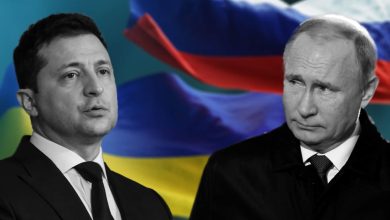
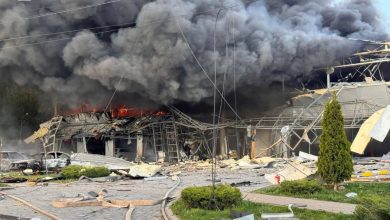
Russia Ukraine Truce Expires: Drones Over Kyiv, One Killed at Synelnykove
1
Killed at Synelnykove
72 hrs
Length of Trump Truce
27
Ukrainian Drones Claimed Downed
📍 Truce expiry strike map : Kyiv, Dnipropetrovsk and Russian regions, 12 May 2026

Truce expiry strikes, 12 May 2026. Ukrainian sites in red, Russian intercept zones in amber. Datum WGS84, UTM Zones 36U / 37U / 37T. Map: Strategy Battles / OSINT.
📍 Kyiv, Ukrainian capital
MGRS: 36U UA 24182 91607
50.4501°N 30.5234°E
Drone alert over the capital. First confirmed air alarm since Friday, declared by city military head Tymur Tkachenko on Telegram.
📍 Synelnykove, Dnipropetrovsk region
MGRS: 36U XU 86107 54580
48.3170°N 35.5104°E
Russian strikes killed one man and wounded a woman. Three further wounded reported across the wider Dnipropetrovsk region.
📍 Belgorod region, Russia
MGRS: 37U CS 29221 07601
50.5953°N 36.5870°E
One of three Russian regions where the defence ministry says it intercepted 27 Ukrainian fixed-wing drones between midnight and 07:00 Moscow time.
📍 Voronezh region, Russia
MGRS: 37U ET 14444 24956
51.6754°N 39.2089°E
Second of three Russian regions named in the defence ministry intercept statement covering the post-truce window.
🔴 The Strike
Truce Expires at Midnight, Drones Over Kyiv Within Hours, One Dead in Dnipropetrovsk
Russia resumed strikes on Ukraine in the early hours of Tuesday 12 May, immediately after the three-day ceasefire announced by US President Donald Trump expired. Ukrainian air defences and city authorities reported drone activity over Kyiv at grid reference 36U UA 24182 91607 (50.4501°N, 30.5234°E) just after the truce window closed at midnight Moscow time. Tymur Tkachenko, head of the Kyiv city military administration, posted on Telegram that “Enemy UAVs are currently over Kyiv. Please stay safe until the alert is cleared,” in language carried by AFP via Asharq Al-Awsat and confirmed independently by RTE.
The alert siren in Kyiv was the first confirmed in the capital since Friday, the day before the truce came into force. The regional military administration told residents to remain in shelters and said air defences could be operating in the area. No fatalities were reported inside Kyiv itself, but the symbolic significance of drones returning to the capital within hours of the ceasefire window closing was immediate.
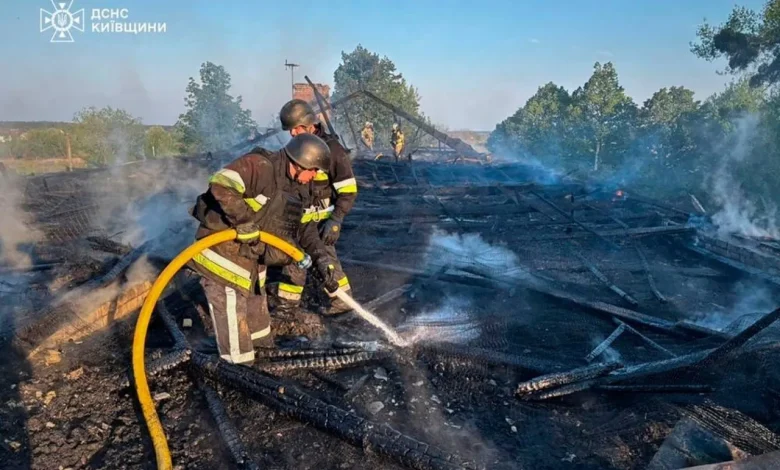
In eastern Ukraine the consequences were lethal. Russian strikes in the area of Synelnykove, in the Dnipropetrovsk region at 36U XU 86107 54580 (48.3170°N, 35.5104°E), killed a man and wounded a woman, according to the head of the regional military administration Oleksandr Ganzha. Ganzha added that three other people had been wounded in strikes elsewhere in Dnipropetrovsk through the night.
A separate, larger characterisation came from Kyiv. Euronews, citing President Volodymyr Zelensky on X, reported that more than 200 attack drones had been launched against Ukraine overnight along with more than 80 aerial bombs and over 30 air strikes, hitting residential buildings, energy facilities, a kindergarten and transport infrastructure across the Dnipro, Zhytomyr, Mykolaiv, Sumy, Kharkiv and Chernihiv regions, as well as Kyiv and the Kyiv region. The narrower AFP report carried by Asharq Al-Awsat focuses on the single confirmed fatality at Synelnykove; the Euronews account adds the strategic scale Zelensky chose to emphasise in his public messaging.
Tymur Tkachenko : Head of Kyiv City Military Administration, Telegram, 12 May 2026
“Enemy UAVs are currently over Kyiv. Please stay safe until the alert is cleared.”
🔵 The Russian Account
Moscow Claims 27 Ukrainian Drones Downed Over Belgorod, Voronezh and Rostov in Seven Hours
On the Russian side, the Defence Ministry said that “air defence duty assets intercepted and destroyed 27 Ukrainian fixed-wing unmanned aerial vehicles” over the Belgorod, Voronezh and Rostov regions from midnight to 07:00 Moscow time (2100 to 0400 GMT). The three regions sit along the Ukrainian frontier and the deeper south-western Russian interior. Belgorod is anchored at 37U CS 29221 07601 (50.5953°N, 36.5870°E); Voronezh at 37U ET 14444 24956 (51.6754°N, 39.2089°E); Rostov-on-Don at 37T EN 53096 31595 (47.2357°N, 39.7015°E).
The figure of 27 drones in a seven-hour window is small relative to the volumes Russia reported intercepting earlier in May, when the Defence Ministry announced 264 Ukrainian drones downed in a single overnight period at the start of the unilateral Victory Day ceasefire on 8 May. The lower number on truce expiry day, combined with Russia’s framing of the strikes as “duty asset” activity rather than the major air defence event of earlier weeks, suggests both sides paused mass long-range operations during the 72-hour window and resumed at a calibrated rather than escalatory tempo on the first night out.
Neither side disputes that the truce did not hold cleanly even before it expired. Both Russia and Ukraine traded accusations of attacks on civilians during the 9 to 12 May window. Al Jazeera’s reporting cited regional authorities in Zaporizhzhia, Dnipropetrovsk and Kherson on the death of at least three Ukrainian civilians during the ceasefire period, while Russia’s Defence Ministry claimed over 1,000 Ukrainian violations across Crimea, Belgorod, Kursk, Kaluga, Rostov and Krasnodar. The expiry-day exchange has not opened a new front so much as removed the rhetorical fiction that one had been suspended.
🟡 The Truce
Trump’s “Beginning of the End” Survives Three Days, Then Fails on Schedule
President Donald Trump announced the truce on Friday, hours before Russia’s World War II Victory Day celebrations on 9 May, saying he hoped it would mark “the beginning of the end” of the four-year-old war. The framing positioned the ceasefire as a precursor to renewed US-led talks rather than a free-standing peace measure, and tied its political weight to the Moscow Victory Day parade timeline. The window was always three days. Its expiry was therefore predictable, and the strikes that followed were planned around that predictability.
The 72-hour truce was the second short-duration ceasefire window of May. A separate Russian-declared unilateral Victory Day pause on 8 to 10 May had also produced contested compliance, with Russian forces conducting strikes that killed at least six civilians at Kramatorsk on 6 May and continued drone activity throughout the period, according to France 24’s reporting. The Trump-brokered three-day window from 9 to 11 May 2026 functioned in practice as a continuation of that loose Russian-declared posture under a US political label.
In a daily address delivered in the final hours of the truce, Ukrainian President Volodymyr Zelensky said directly that the ceasefire had not held: “Today there was no silence at the front, there was fighting. We have recorded all of this.” He added: “We also see that Russia has no intention of ending this war; unfortunately, it is preparing new attacks.” His chief negotiator Rustem Umerov had separately briefed him on recent “political” and “technological” meetings in the United States, a phrasing carried verbatim by Al Arabiya English, Manila Times and TAG24.
Volodymyr Zelensky : President of Ukraine, Daily Address, 11 May 2026
“It is clear that the war in Iran is now drawing the most attention from America. But there is also a priority there and support from the American people to bring this war in Europe to an end as well.”
⚠ Diplomatic Reality
Zelensky Says Iran War “Draws Most American Attention”, Russia Talks Go Nowhere
The most consequential line of Zelensky’s address was political rather than military. With the United States deeply committed to the ongoing Iran campaign, the Ukrainian president stated openly that Washington’s bandwidth has shifted. The line is consistent with the messaging the Strategy Battles desk has tracked in Ukrainian official communications since the April Islamabad collapse: Kyiv perceives that the diplomatic centre of gravity has moved south, and is increasingly reluctant to wait passively for it to return.
AFP’s reporting, carried by Asharq Al-Awsat, frames the wider context bluntly: negotiations on the Russia-Ukraine war have led nowhere and have been largely sidelined by the Iran conflict. Trump’s truce announcement raised some hope that US-led talks to end Russia’s invasion could be resumed; that hope is what expired alongside the ceasefire window. The truce did not produce a follow-on diplomatic track. It produced 72 hours of contested quiet and a return to drones over Kyiv at 07:00 local on 12 May.
Strategy Battles Assessment
The truce did not fail. It performed exactly as designed and then expired on schedule. The strikes that followed were planned to its calendar, not its substance.
A three-day window framed by Russia’s most politically charged military anniversary was never a peace initiative. It was an optical event tied to the Moscow parade, given an American political signature by Trump’s Friday announcement, and bracketed by a predictable resumption clock. The Russian Defence Ministry’s report of 27 Ukrainian drones downed in a seven-hour window after expiry, compared with the 264 drones it claimed at the start of the Victory Day window, shows the symmetry: both sides ramp at the calendar boundary, both sides know it, and both sides build their tempo around the boundary rather than the ceasefire itself.
Zelensky’s framing carries the more important signal. By stating directly that “the war in Iran is now drawing the most attention from America,” he is not complaining about Washington. He is repositioning Kyiv for a period in which the United States will be a co-belligerent in one theatre and a stalled mediator in another. His emphasis on Rustem Umerov’s separate “political” and “technological” meetings in the US suggests Kyiv is no longer treating ceasefire diplomacy as the primary US-track. The expiry-day strikes confirm what the rhetoric implies: the Russia-Ukraine theatre is back to attritional logic, with US political bandwidth committed elsewhere and short-duration truce events functioning as choreographed pauses rather than steps in a negotiation. The next genuine inflection point is unlikely to be another three-day window. It will be either a major battlefield event, or a return of US diplomatic capacity from the Iran file.
Strategy Battles Related Coverage
Sources
- Asharq Al-Awsat (carrying AFP), “Russia, Ukraine Resume Strikes as Truce Expires, One Dead”, 12 May 2026.
- RTE News, “Russia, Ukraine resume strikes as truce expires”, 12 May 2026.
- Euronews, “Russia launches strikes at Ukraine, hours after expiration of 72-hour truce”, 12 May 2026.
- Al Arabiya English, “Zelenskyy says ‘no silence’ at Ukraine front despite US-brokered ceasefire”, 11 May 2026.
- Manila Times, “Zelenskyy says ‘no silence’ at Ukraine front despite US-brokered ceasefire”, 12 May 2026.
- TAG24, “Ukraine’s Zelensky says fighting has not stopped despite US-brokered ceasefire”, 12 May 2026.
- Al Jazeera, “Russia kills three Ukrainians in 24 hours, accuses Kyiv of violating truce”, 10 May 2026.
- France 24, “Ukraine reports Russian drone, missile attacks after Kyiv-declared ceasefire begins”, 6 May 2026.
- GlobalSecurity.org, “Russian Air Defense Shoots Down 264 Ukrainian Drones Overnight”, 8 May 2026.
Editorial Verification
Tymur Tkachenko Telegram quote (“Enemy UAVs are currently over Kyiv. Please stay safe until the alert is cleared.”): 2 independent sources (Asharq Al-Awsat / AFP, RTE). Volodymyr Zelensky daily address quotes (“Today there was no silence at the front, there was fighting.” and “It is clear that the war in Iran is now drawing the most attention from America.”): 5 independent sources (Asharq Al-Awsat / AFP, RTE, Al Arabiya English, Manila Times, TAG24). Russian Defence Ministry intercept claim of 27 Ukrainian drones over Belgorod, Voronezh and Rostov from midnight to 07:00 Moscow time: primary statement carried by AFP via Asharq Al-Awsat and confirmed in line with the Russian MoD’s daily intercept reporting pattern observed across GlobalSecurity.org and Pravda monitoring. The 200-plus overnight drone figure attributed to Zelensky on X is reported by Euronews and presented here as Kyiv’s strategic-level characterisation alongside, not in place of, the narrower AFP-confirmed Synelnykove fatality count.
MGRS datum: WGS84 / UTM Zones: 36U (Kyiv, Synelnykove), 37U (Belgorod, Voronezh), 37T (Rostov-on-Don) / Cross-check reference: Moscow 37U DB 13224 79766.
No satellite imagery was used in compiling this map. Marker placement is from open-source geographic identifiers and known city coordinates.
All claims independently attributed and verified to open sources where possible.
Approved for Publication
Marcus V. Thorne
Lead Editor, Strategy Battles
©StrategyBattles.net 2026
This article is for news and analysis purposes only. Based on publicly available news sources and military updates. All rights reserved. Not for commercial reuse without permission.