Russia’s Victory Day Ceasefire Collapses: 850 Drone Strikes Hit Ukraine as Kyiv Hits Yaroslavl Oil Facility
850+
Russian Drone Strikes on Ukraine in 24 Hours
264
Ukrainian Drones Downed by Russia Overnight
1,820
Russian Ceasefire Violations Recorded by Ukraine by 10:00 on 6 May
📍 Russia-Ukraine Ceasefire Collapse and Strike Theater / Victory Day 2026 / 8 May 2026

Blue arrows: Ukrainian long-range drone strike vectors. Red arrow: Russian drone attack axis into Ukraine. Red line: approximate frontline as of 8 May 2026. Datum WGS84, UTM Zones 36T / 36U / 37U / 37V. Map: Strategy Battles / OSINT.
📍 Kyiv, Ukraine: Presidential Command
MGRS: 36U UA 24182 91607
50.4501°N 30.5234°E
Ukraine’s presidential and military command center. Zelensky confirmed present throughout the ceasefire window. Target of Russian evacuation threats on 8 May 2026.
📍 Moscow, Russia: Red Square Parade Site
MGRS: 37U DB 13439 79551
55.7539°N 37.6208°E
Site of the 9 May Victory Day parade. Military hardware removed for first time in nearly 20 years due to Ukrainian drone threat. Mobile internet disrupted city-wide.
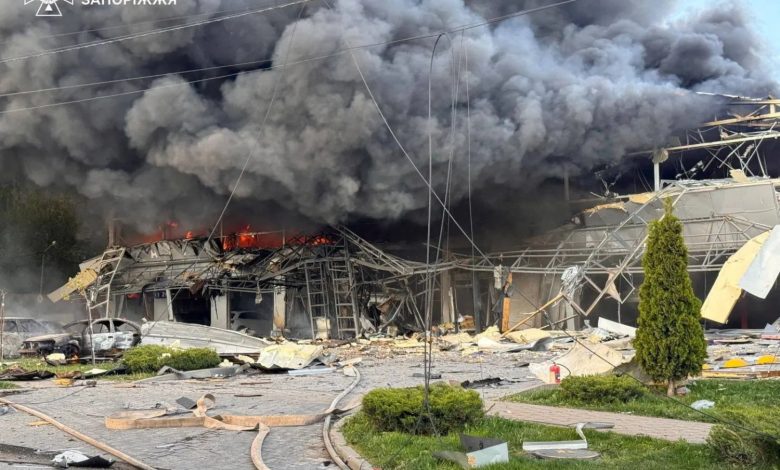
📍 Zaporizhzhia, Ukraine: Russian Air Strike Site
MGRS: 36T XU 60097 00600
47.8388°N 35.1396°E
Russian air strike site documented 5 May 2026 by the State Emergency Service of Ukraine in Zaporizhzhia region, confirmed via Reuters handout imagery.
📍 Yaroslavl, Russia: Ukrainian Deep Strike Target
MGRS: 37V ED 52825 87428
57.6261°N 39.8845°E
Oil refinery struck by Ukrainian long-range drone on 8 May 2026. Approximately 1,000 km from the front line. Zelensky cited the strike as retaliation for Russian attacks on Ukrainian cities.
🔴 The Collapse
Russia’s Unilateral Truce Fails in Its Opening Hours; Both Sides Accuse Each Other of Violations
Russia’s declared two-day ceasefire around its World War II Victory Day celebrations disintegrated on the morning of 8 May 2026, with operations continuing on both sides without pause. The Russia-Ukraine ceasefire collapse was visible from the first hours: Ukrainian President Volodymyr Zelensky, confirmed as remaining in Kyiv at grid reference 36U UA 24182 91607 (50.4501°N, 30.5234°E), reported that Russian forces had fired more than 850 drone strikes of various types and launched more than 140 assault operations on frontline positions in the preceding 24 hours. The Russian ceasefire was announced by Moscow’s defense ministry for 8 to 9 May, timed to protect the Victory Day parade at Red Square.
Russia’s defense ministry, simultaneously, claimed its air defense systems had downed 264 Ukrainian drones overnight, covering the opening window of its own ceasefire. Officials in Moscow additionally reported attempted Ukrainian strikes on the capital itself, at grid reference 37U DB 13439 79551 (55.7539°N, 37.6208°E), and on targets in the Perm region deep inside Russia. Ukraine’s air force reported downing 56 Russian drones during the same period. Neither side showed any operational restraint consistent with a ceasefire.
This collapse followed the failure of Ukraine’s own ceasefire proposal. Zelensky had announced an open-ended halt to hostilities beginning at midnight on 6 May 2026. Russia did not reciprocate and continued military operations. By 10:00 on 6 May, Zelensky had recorded 1,820 Russian ceasefire violations, including nearly 30 assault operations and more than 20 airstrikes using over 70 guided glide bombs. A kindergarten in the Sumy border region was struck, killing two people. Ukraine’s stated position from that point was one of mirror response: whatever Russia does, Ukraine does in kind.
Volodymyr Zelensky, President of Ukraine, 8 May 2026
“On the Russian side, there was not even a token attempt to cease fire on the front. As we did over the past 24 hours, Ukraine will respond in kind today as well.”
🟡 The Parade Calculation
Putin’s Victory Day Spectacle Is Degraded Before a Single Soldier Has Marched
The 9 May Victory Day parade at Red Square, Moscow (37U DB 13439 79551), is Russia’s most important annual projection of military power under Vladimir Putin. This year it is diminished before it begins. Russia’s defense ministry confirmed it will omit military hardware from the procession for the first time in nearly 20 years. The decision is an explicit acknowledgment of Ukrainian drone reach: Moscow calculates that the risk of a strike on tanks or missile launchers rolling through the capital’s central square during a nationally televised event is non-trivial.
The diplomatic guest list has also contracted sharply. Only the leaders of Belarus, Malaysia, and Laos will attend the parade, alongside the heads of two Russia-backed Georgian breakaway republics that lack United Nations recognition. This compares poorly to prior years when Putin could assemble a broader audience for the spectacle. Moscow also began intermittent city-wide internet blackouts in the days before 9 May, seeking to degrade the targeting capability of Ukrainian drones that might attempt to reach the capital.
Zelensky used these vulnerabilities openly. He warned governments planning to send representatives to Moscow that their presence was inadvisable and framed the ceasefire demand in blunt political terms. Russia, he said, wanted Ukraine’s permission to hold its parade safely for one hour and then to resume killing. Hours before the Russian ceasefire was to begin, Zelensky also said he had received messages from states close to Russia indicating their representatives planned to be in Moscow, adding that he did not recommend it.
Volodymyr Zelensky, President of Ukraine, 7 May 2026
“They want from Ukraine a permit to hold their parade so that they can go out onto the square safely for one hour once a year, and then go on killing.”
🔵 Deep Strike Campaign
Ukraine Hits Yaroslavl Oil Facility as Long-Range Drone Reach Extends Over 1,000 Kilometres
On 8 May 2026, Ukraine reported striking a Russian oil facility in Yaroslavl, at grid reference 37V ED 52825 87428 (57.6261°N, 39.8845°E), approximately 1,000 kilometres from the front lines. Zelensky described the strike as a direct response to Russian attacks on Ukrainian cities and villages, framing it as part of Ukraine’s long-range sanctions campaign. The Yaroslavl region sits deep in central Russia, well beyond the operational range that Kyiv could credibly reach in the early stages of the war.
Ukraine has in recent weeks struck targets near Moscow and in multiple Russian regions using domestically produced long-range drones, including the Flamingo cruise missile used in a strike on a factory in Cheboksary in the Chuvash Republic, approximately 1,500 kilometres from the front. The accumulating pattern of these strikes has created measurable unease inside Russia ahead of the parade. Moscow’s decision to remove military hardware from the Red Square procession is the most visible operational consequence of this campaign.
Russia’s response to the continuing drone campaign was to urge Kyiv’s civilian population and the staffs of foreign diplomatic missions to evacuate the city before a potential large-scale retaliatory missile strike. The Russian defense ministry, cited by AFP, issued that warning explicitly on 8 May. Britain’s foreign office condemned the threat as unwarranted, irresponsible, and completely unjustified, stating that any attack on a diplomatic mission would constitute a serious further escalation. Germany confirmed it would not withdraw its embassy staff from Kyiv. ⚠ SINGLE SOURCE: German FM Wadephul Bloomberg statement sourced from primary article only.
🟢 Diplomatic Posture
Western Allies Hold Their Positions as Talks Stall and Zelensky Stays in Kyiv
Zelensky remained in Kyiv throughout the ceasefire window. A senior source close to the Ukrainian president, speaking to AFP on condition of anonymity, confirmed this on 8 May 2026. The decision is deliberate signaling: that Ukraine’s leadership will not be evacuated or displaced from its capital regardless of Russian threats, and that the government functions normally under pressure. The same senior source did not elaborate on security arrangements.
Peace talks remain frozen. Russia continues to demand that Ukraine withdraw from four regions it claims as its own territory, terms rejected outright by Kyiv and all of its Western partners as prerequisites for negotiation. Wider diplomatic efforts have been largely displaced from international attention by the Iran conflict. Andrii Sybiha, Ukraine’s foreign minister, stated that Russia’s fake ceasefire calls on 9 May have nothing to do with diplomacy and that Putin cares only about military parades, not human lives. Estonian Foreign Minister Margus Tsakhna said his country and other EU allies supported Zelensky’s 6 May ceasefire proposal and expected Russia to reciprocate.
Russia had not issued any public response to Ukraine’s open-ended ceasefire proposal at the time of publication beyond its continued military operations. The competing unilateral declarations have produced a familiar pattern: both governments use ceasefire announcements as information warfare tools rather than genuine operational agreements, each calculating that the other side will be blamed for any violations recorded.
Strategy Battles Assessment
The Victory Day Ceasefire Was a Force Protection Request Dressed as Diplomacy
What Russia asked Ukraine to do was suspend combat operations not around a diplomatic opening, not around a framework for talks, but around a domestic political ceremony. The 8 to 9 May ceasefire was timed precisely to protect the Red Square parade: a nationally televised event whose value to Putin is entirely symbolic and whose credibility depends on it proceeding without incident. When read against the 1,820 ceasefire violations Russia committed within hours of Ukraine’s own proposed halt on 6 May, Moscow’s later announcement reads not as a peace overture but as a force protection request dressed in the language of commemoration.
The removal of military hardware from Red Square is the most operationally significant detail in this story. For nearly 20 years the parade’s tanks, missile systems, and armored vehicles have served as a direct live demonstration of Russian weapons programs to domestic and international audiences. That demonstration is now assessed by Moscow as too dangerous to conduct. Ukraine’s drone reach has imposed a real cost on Russia’s most visible annual projection of military power. That is a strategic outcome regardless of what happens on the battlefield in the days that follow.
The Yaroslavl strike on the opening day of the Russian ceasefire is similarly deliberate. Ukraine is signaling that long-range strikes will continue regardless of any truce declaration from Moscow, and that energy and industrial infrastructure deep inside Russia remains within Kyiv’s operational reach. Combined with Zelensky’s public warnings to foreign governments and his confirmed presence in the capital, this is a posture designed to demonstrate that Ukraine is not negotiating from exhaustion. The war enters May 2026 with no verified ceasefire, no credible diplomatic framework, and escalating strike depth on both sides of the front.
Strategy Battles Related Coverage
Sources
- Asharq Al-Awsat, Russia, Ukraine Trade Major Attacks Ahead of Kremlin’s WWII Celebrations (8 May 2026)
- Al Jazeera, Russia and Ukraine Trade Fire, Blame Despite Victory Day Ceasefire (8 May 2026)
- Bloomberg, Russia and Ukraine Trade Drone Strikes Amid Ceasefire Proposal (8 May 2026)
- Kyiv Independent, Ukraine Rejects Russia’s Victory Day Truce After Moscow Violates Kyiv’s Ceasefire (6 May 2026)
- Kyiv Post, Zelensky Accuses Russia of Violating Ceasefire, Signals Possible Mirror Response (8 May 2026)
- Ukrainska Pravda, Explosions Reported at Yaroslavl Oil Refinery as Drones Target Moscow and Rostov (8 May 2026)
- Defense News, Dueling Victory Day Ceasefires for War in Ukraine Collapse Almost Immediately (7 May 2026)
- Euronews, Russia Unilaterally Declares Victory Day Ceasefire While Zelensky Tables Own Truce (4 May 2026)
- Euronews, Ukraine Says Russia Broke Unilateral Ceasefire With Air Strikes (6 May 2026)
- NPR, Russia Declares a Truce in Ukraine to Mark Victory Day (5 May 2026)
- UK Foreign Office / OSCE Statement, Russia Must Cease Threats and Attacks Against Civilians in Ukraine (6 May 2026)
Editorial Verification
Zelensky statement (“not even a token attempt”): verified across Asharq Al-Awsat (AFP wire), Al Jazeera, The Journal, and Kyiv Post (4 independent sources). Russia 264 drones downed claim: verified via Bloomberg, Ukrainska Pravda, and Al Jazeera (3 sources). Ukraine 850-plus strike count: sourced from Zelensky statement on X, corroborated by Al Jazeera and Defense News (3 sources). Ukraine air force 56-drone intercept: sourced from Asharq Al-Awsat (AFP) and Kyiv Post (2 sources). Ukraine 1,820 violations figure by 10:00 on 6 May: Kyiv Post and Defense News (2 sources). Yaroslavl oil facility strike: Zelensky statement confirmed by Ukrainska Pravda (2 sources). Russian MoD Kyiv evacuation warning: AFP wire as carried by Asharq Al-Awsat and The Journal (2 sources). UK foreign office “unwarranted, irresponsible and completely unjustified” language: Asharq Al-Awsat (primary) corroborated by UK OSCE statement 6 May 2026 via ukpol.co.uk (2 sources). German FM Wadephul Bloomberg statement: single-source via Asharq Al-Awsat only; flagged with purple tag in article body. Parade hardware removal confirmed via Euronews, NPR, and BBC (3 sources). Guest list confirmed via Asharq Al-Awsat and NPR (2 sources). Zelensky in Kyiv: AFP source (single named wire agency, standard practice for protective anonymity). Ukraine FM Sybiha statement: Kyiv Independent and Euronews (2 sources). Russian response to Ukraine open-ended ceasefire: Russia had not issued a formal public response at time of publication beyond continued military operations.
MGRS datum: WGS84 / UTM Zones: 36T, 36U, 37U, 37V / Cross-check reference: Kyiv Pechersk Lavra monastery 36U UA 24523 90870 (50.4335°N, 30.5574°E).
No satellite imagery used in this report. All claims attributed to open-source wire agency and verified news outlet reporting.
All claims independently attributed and verified to open sources where possible.
Approved for Publication
Marcus V. Thorne
Lead Editor, Strategy Battles
©StrategyBattles.net 2026
This article is for news and analysis purposes only. Based on publicly available news sources and military updates. All rights reserved. Not for commercial reuse without permission.