South Korea Opens Forensic Probe as HMM Namu Attack Debris Arrives in Seoul from Strait of Hormuz
4 May
Date of Attack
2 Strikes
Unidentified Aerial Objects
24 Crew
On Board, 1 Minor Injury
📍 HMM Namu Attack Site, Dubai Port, Debris Chain to Seoul / Strait of Hormuz, 4 to 15 May 2026

Attack site at 40R DQ 38173 22346, approx. UAE side of Strait of Hormuz. Vessel towed to Dubai Port (40R CN 29770 95884). Engine debris flown to Seoul (52S CG 21424 59640) 15 May 2026. Datum WGS84, UTM Zone 40R. Map: Strategy Battles / OSINT.
📍 HMM NAMU ATTACK SITE
MGRS: 40R DQ 38173 22346
26.4200°N 56.3800°E
Approximate position of HMM Namu when struck by two unidentified aerial objects, 4 May 2026, UAE side of Strait of Hormuz.
📍 DUBAI PORT (VESSEL DOCKED)
MGRS: 40R CN 29770 95884
25.2697°N 55.3095°E
Dubai Port where the HMM Namu was towed after the attack. South Korean investigation team conducted on-site inspection here, 7 to 8 May 2026.
📍 STRAIT OF HORMUZ CHOKE POINT
MGRS: 40R DQ 35273 40447
26.5833°N 56.3500°E
Central navigational choke point of the Strait of Hormuz. Iran has blocked most international shipping traffic here since February 2026.
📍 SEOUL, SOUTH KOREA (DEBRIS DESTINATION)
MGRS: 52S CG 21424 59640
37.5665°N 126.9780°E
Engine debris from the attacking objects flown from Dubai to Seoul by air, 15 May 2026. Scheduled for forensic analysis by a specialised South Korean institution.
🔴 The Attack
Two Objects Strike the HMM Namu in the Strait of Hormuz
At approximately 15:30 local time on 4 May 2026, two unidentified airborne objects struck the Panama-flagged bulk carrier HMM Namu at grid reference 40R DQ 38173 22346 (26.4200°N, 56.3800°E), on the UAE side of the Strait of Hormuz. The objects hit the outer shell of the port-side ballast tank near the vessel’s stern roughly one minute apart, triggering an explosion and a fire in the engine room. The HMM Namu is operated by South Korean shipping giant HMM Co. and was anchored in the strait when the attack occurred.
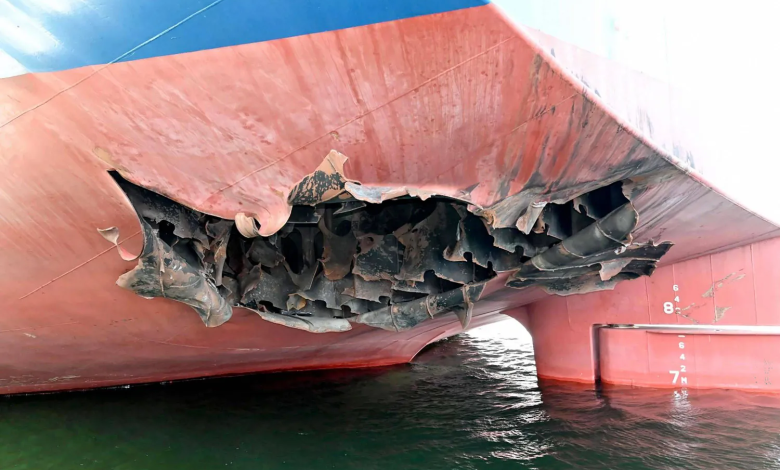
The impact left a rupture approximately seven metres wide and five metres deep in the outer hull, positioned roughly one to 1.5 metres above the waterline. A South Korean government joint investigation team, comprising three maritime investigators and four fire forensics experts, arrived in Dubai on 7 May, one day after the HMM Namu was towed to port. They conducted a day-long on-site inspection on 8 May. None of the 24 crew members aboard, including six South Korean nationals, suffered serious injuries, though one later confirmed a minor injury that was not initially disclosed.
The South Korean Foreign Ministry confirmed the objects were captured on CCTV footage from the vessel, but stated that investigators face limitations in determining the exact type, physical size, and launch origin of the projectiles. Officials noted the damage pattern made a mine or torpedo strike unlikely, raising the strong possibility that the vessel was struck by air-launched drones. Engine debris recovered from the scene was identified as a key forensic item and flagged for further technical analysis back in Seoul.
Wi Sung-lac : Presidential National Security Adviser, Seoul, 11 May 2026
“Attacks on civilian vessels such as HMM Namu cannot be justified or tolerated. We’ll seek through further investigation to identify the party responsible for the attack, the exact type of projectile and its physical size.”
Presidential National Security Adviser Wi Sung-lac’s statement, delivered at a press briefing on 11 May, represented Seoul’s strongest public language on the incident to date. Wi added that South Korea would decide on its response once further analysis identifies both the attacker and the type of projectile involved. He confirmed the government is coordinating with regional partners to strengthen protection for South Korean ships and crews operating near the Strait of Hormuz.
🟡 The Debris Chain
Forensic Material Arrives in Seoul after UAE Government Consultations
Engine debris believed to originate from the attacking objects arrived in South Korea by air on 15 May 2026, following consultations between Seoul and Abu Dhabi. The South Korean Foreign Ministry confirmed the material will now be examined by a specialised domestic institution, though it declined to name the facility or provide a timeline for results. The chain of custody from Dubai to Seoul represents the most critical phase of the investigation to date, shifting the analytical process from field inspection to controlled laboratory forensics.
The arrival follows Foreign Minister Cho Hyun’s public commitment on 12 May that the debris would reach Seoul imminently for in-depth analysis. Investigators noted that determining whether the projectiles were drones or missiles will require examining factors including flight trajectory, angle of impact, and explosive residue. Experts cited by the Korea Herald cautioned that sufficient evidence had not yet been secured for a definitive identification, and that more time would be needed.
A senior Foreign Ministry official told domestic media on 14 May that the likelihood of a non-Iranian actor being responsible for the attack is low, though formal attribution has not been made. The official stressed that the investigation is ongoing and that the government remains focused on gathering evidence before reaching any public conclusion. The Foreign Ministry has been simultaneously communicating with both Iran and the United States regarding the incident.
South Korea Foreign Ministry : Press Statement, 15 May 2026
“The vessel debris arrived in South Korea by air following consultations with the UAE government. It is scheduled to undergo detailed analysis by a specialised institution.”
🔵 The Denial
Tehran Categorically Rejects Involvement as Hormuz Tensions Remain High
Iran’s embassy in Seoul issued a statement in the days following the 4 May attack firmly rejecting any involvement by its armed forces. The statement said the Islamic Republic of Iran “firmly rejects and categorically denies any allegations regarding the involvement” of its military in the incident. Tehran has not issued further public comment since South Korean investigators released their preliminary findings identifying the strikes as externally inflicted. Notably, Iranian state television initially reported that force had been used against a South Korean vessel, creating a confusing mixed signal that Seoul has not publicly resolved.
The attack occurred against the backdrop of an ongoing conflict between the United States and Israel on one side and Iran on the other, which erupted in February 2026. Iran subsequently moved to largely block shipping through the Strait of Hormuz. Iran’s Foreign Minister Abbas Araghchi, speaking to reporters in New Delhi on 15 May 2026 during the BRICS foreign ministers’ meeting, stated that all vessels may pass through the Strait of Hormuz except those at war with Tehran, and that ships wishing to transit must coordinate with the Iranian navy. Araghchi described the situation around the strait as “very complicated.”
U.S. President Donald Trump separately stated that Iran had “taken some shots” at the HMM Namu and other targets, and pressed South Korea to take a greater role in protecting shipping lanes in the region. The assessment from a senior South Korean official that the probability of a non-Iranian actor being responsible appears low places South Korea in a diplomatically sensitive position, caught between its formal alliance with Washington and its need to preserve economic and diplomatic channels with Tehran and the wider region.
🟢 Strategic Pressure on Seoul
Fuel Caps, Alliance Obligations, and the Cheonghae Unit Question
South Korea stands as Asia’s fourth-largest economy and historically depended heavily on Middle Eastern fuel imports, the majority of which transited the Strait of Hormuz during peacetime. The prolonged closure has forced the government to impose a fuel price cap for the first time in nearly 30 years. As of 14 May, the Ministry of Trade, Industry and Energy extended the cap for the fifth time in as many weeks, freezing maximum wholesale prices for gasoline, diesel, and kerosene. More than 96 percent of South Korean gas stations complied with the cap as of 14 May, keeping retail prices within a managed range.
The HMM Namu attack has significantly increased U.S. pressure on Seoul to contribute directly to maritime security operations around the strait. South Korea’s Defense Minister Ahn Gyu-back travelled to Washington on 11 May for talks with Defense Secretary Pete Hegseth, with the agenda expected to include cooperation on restoring freedom of navigation through the strait. The Defence Ministry stated the government will “carefully review our position, taking into account international law, the safety of international sea lanes, the South Korea-US alliance, security conditions on the Korean Peninsula and domestic legal procedures.”
If Seoul opts for a direct military contribution, analysts point to the naval Cheonghae Unit as the most likely asset. The unit, currently deployed in the Gulf of Aden on anti-piracy operations, consists of approximately 300 personnel and special forces aboard a destroyer, along with high-speed boats and helicopters. The ROKS Wang Geon is currently in transit to relieve the existing vessel. Deploying the Cheonghae Unit to the Strait of Hormuz would require approval from South Korea’s National Assembly, a process that observers say could require considerable time and political deliberation.
Strategy Battles Assessment
Debris Analysis Is the Geopolitical Clock. Every Day It Remains Inconclusive, Iran Retains Deniability.
The arrival of engine debris in Seoul converts the HMM Namu incident from a field assessment into a forensic test case. The outcome of that analysis will have consequences well beyond the fate of one cargo vessel. If the debris can be positively identified as components from a specific Iranian drone model, South Korea will face an immediate escalation in U.S. pressure to commit forces to the Hormuz security mission. If identification proves inconclusive, Iran retains a deniability window that complicates both Seoul’s domestic politics and the broader coalition that Washington is attempting to assemble.
The confusion created by Iranian state television initially appearing to claim the strike, followed by the embassy denial, is a recognisable pattern. It is consistent with Iran testing allied resolve while preserving political escape routes. The fact that senior South Korean officials have privately concluded that a non-Iranian actor is unlikely to be responsible, while publicly maintaining that the investigation is ongoing, suggests Seoul already believes it knows who struck the vessel but is managing the pace of public disclosure for diplomatic reasons.
The economic stakes for Seoul are substantial and immediate. A fuel price cap in force for five consecutive rounds, combined with a refiner compensation mechanism, signals that the government is already absorbing significant structural cost from the Hormuz closure. The longer the strait remains constricted, the harder Seoul’s domestic political position becomes, regardless of what the laboratory analysis eventually confirms. South Korea’s window for diplomatic ambiguity is narrowing on two fronts simultaneously: its ally is demanding action, and its domestic economy is absorbing a sustained shock.
Strategy Battles Related Coverage
Sources
- South Korea to Investigate Ship Debris from Hormuz Attack, Asharq Al-Awsat (AFP), 15 May 2026
- Seoul Confirms Strike on Vessel in Strait of Hormuz, Bloomberg, 11 May 2026
- Debris from Hormuz Strike on HMM Vessel Arrives in South Korea for Analysis, Korea Herald, 15 May 2026
- Debris from Strike on Korean Ship in Hormuz to Arrive in Seoul Soon, Korea Times, 12 May 2026
- Hormuz Strike Debris Heads for Analysis as Seoul Weighs Response, Korea Herald, 12 May 2026
- South Korea Says HMM Namu Hit by Two Unidentified Objects, UPI, 11 May 2026
- Confirmed Strike on Vessel May Reshape Seoul’s Stance on Joining US-Led Hormuz Mission, Korea Herald, 11 May 2026
- Seoul Condemns Strike on Vessel in Strait of Hormuz as Probe Continues, Insurance Journal (Bloomberg), 11 May 2026
- Korea Extends Fuel Price Cap for Fifth Time, Seoul Economic Daily, 7 May 2026
Editorial Verification
Wi Sung-lac statement (“cannot be justified or tolerated”): verified to Bloomberg, Korea Herald, Insurance Journal (3 independent outlets). South Korean Foreign Ministry debris statement (15 May 2026): verified to Asharq Al-Awsat/AFP, Korea Herald (2 independent outlets). Iran embassy denial: verified to Korea Herald, UPI, WSWS (3 independent outlets, all tracing to original Foreign Ministry channel). Senior official assessment that non-Iranian actor “likelihood is low”: Korea Herald (12 May 2026) only; flagged as single-source in nature but corroborated contextually by Trump’s public statement (Bloomberg). Fuel price cap extension: verified to Seoul Economic Daily, Prokerala/Yonhap (2 outlets). CCTV limitations statement: verified to Asharq Al-Awsat, Korea Herald, UPI (3 outlets).
MGRS datum: WGS84 / UTM Zone: 40R / Cross-check reference: Abu Dhabi 40R BN 34124 07001.
No satellite imagery used. All coordinates calculated programmatically and verified against known reference points.
Single-source item: “likelihood that non-Iranian actor is behind the attack appears low” attributed to a single senior Foreign Ministry official via Korea Herald. Noted and contextually supported but not independently confirmed at time of publication.
All claims independently attributed and verified to open sources where possible.
Approved for Publication
Marcus V. Thorne
Lead Editor, Strategy Battles
©StrategyBattles.net 2026
This article is for news and analysis purposes only. Based on publicly available news sources and military updates. All rights reserved. Not for commercial reuse without permission.