Kyiv Missile Strike Kills 24 Including Three Children as Zelensky Vows to Hit Russia’s Oil Industry and Arms Plants
24
Killed in Kyiv (incl. 3 children)
1,560+
Russian drones fired in 48-hr blitz
205
Ukrainian POWs freed (Phase 1)
📍 Ukraine conflict map: Kyiv strike, Ryazan counter-strike, POW exchange / 15 May 2026

Ukraine conflict overview, 15 May 2026. Red markers: Russian Kh-101 missile strike on Kyiv (Darnytskyi district) and Ukrainian drone counter-strike on Ryazan. Blue marker: Ukraine-Russia POW exchange, Belarus border. Datum WGS84, UTM Zones 36U and 37U. Map: Strategy Battles / OSINT.
📍 KYIV: DARNYTSKYI DISTRICT (STRIKE SITE)
MGRS: 36U UA 28500 89784
50.435°N 30.585°E
Russian Kh-101 cruise missile impact. Darnytskyi district, left bank of the Dnipro. Apartment building partially destroyed: 24 killed, 48 injured. 14 May 2026.
📍 RYAZAN, RUSSIA (COUNTER-STRIKE)
MGRS: 37U EA 47836 53760
54.629°N 39.741°E
Ukrainian overnight drone strike on Ryazan, approximately 185 km southeast of Moscow. Ukrainian army says the intended target was an oil refinery. 4 killed including a child. 15 May 2026.
📍 POW EXCHANGE: UKRAINE-BELARUS BORDER
MGRS: 36U UC 59210 60798
51.980°N 30.950°E
First phase of Trump-brokered 1,000-for-1,000 POW exchange. Ukraine freed 205 Ukrainian soldiers, Russia freed 205 Russian soldiers. UAE served as mediator. 15 May 2026.
🔴 The Strike on Kyiv
Russian Kh-101 Missile Destroys Kyiv Apartment Block, Killing 24
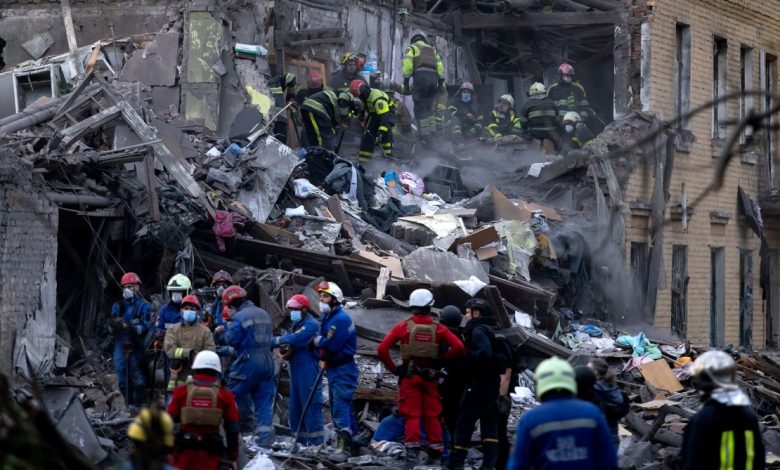
A Russian Kh-101 cruise missile struck a residential apartment building in Kyiv’s Darnytskyi district, on the left bank of the Dnipro River, at grid reference 36U UA 28500 89784 (50.435°N, 30.585°E), during the early hours of 14 May 2026. The strike killed 24 people, including three girls aged 12, 15 and 17, and injured 48 others. Emergency services carried out rescue operations for more than 28 hours, sifting through an estimated 3,000 cubic metres of rubble before declaring the search complete.
Ukrainian President Volodymyr Zelensky confirmed the casualty figure after visiting the site, where he laid flowers and spoke with rescue workers amid a courtyard strewn with debris. Ukrainian authorities stated that initial forensic analysis of recovered missile fragments identified the weapon as a Kh-101 air-launched cruise missile manufactured in the second quarter of 2026. The finding directly challenges the premise of Western sanctions on Russia, indicating that Moscow continues to source the components needed for missile production.
Two dozen survivors remained hospitalised as of the evening of 15 May, according to Kyiv Mayor Vitali Klitschko. Ukraine’s Prime Minister Yulia Svyrydenko confirmed that the father of the youngest victim, 12-year-old Liubava Yakovleva, had himself died earlier in the war fighting Russia’s invasion. Kyiv’s city administration declared 15 May an official day of mourning, with national flags at half-mast across the capital and all public entertainment suspended.
The Darnytskyi strike was part of Russia’s heaviest aerial campaign on Ukraine this year. Ukrainian air force data placed the total munitions fired between 12 and 14 May at more than 1,560 drones and dozens of cruise and ballistic missiles, spread across at least two distinct attack waves. In total, more than 180 sites were reported damaged across Ukraine during the 48-hour blitz, including more than 50 residential buildings. Six people were killed in the western regions of the country during the daytime drone waves, in strikes that reached areas rarely targeted in previous years of the war.
🔴 Ukraine’s Counter-Strike
Ukrainian Drones Strike Ryazan, Killing Four Including a Child
Ukraine responded with overnight drone strikes on the Russian city of Ryazan, at grid reference 37U EA 47836 53760 (54.629°N, 39.741°E), approximately 185 kilometres southeast of Moscow. Regional governor Pavel Malkov confirmed that four people, including a child, were killed when drones hit two high-rise apartment blocks and an unnamed industrial facility in the city. Ryazan, with a population of approximately 500,000, had been the subject of previous Ukrainian long-range strikes targeting its energy infrastructure.
The Ukrainian armed forces stated that the intended military target was an oil refinery in the Ryazan region, a facility that feeds Russian domestic fuel supply and military logistics. Unverified social media footage circulating on 15 May showed plumes of smoke rising from a high-rise block and several floors with visible fire damage; Strategy Battles notes this footage had not been independently cross-checked by a named wire agency at time of publication. The Telegram channel Mash, which covers Russian emergency incidents, reported one entrance to a residential block had been sealed off, preventing residents from leaving.
Russia’s Defence Ministry confirmed large-scale Ukrainian drone activity overnight on multiple regions of the Russian Federation. Moscow has not issued a specific statement on the Ryazan casualties beyond the regional governor’s confirmation. Both governments routinely accuse the other of deliberately targeting civilian infrastructure, while each insists its own strikes are directed solely at military or energy targets.
President Volodymyr Zelensky : Post on X, 15 May 2026
“We are entirely justified in our responses against Russia’s oil industry, military production, and those directly responsible for committing war crimes against Ukraine and Ukrainians.”
🟡 Zelensky’s Vow and the Strategic Context
Ukraine Signals Sustained Campaign Against Russian Energy and Arms Production
Zelensky’s public statement on 15 May framed Ukraine’s retaliatory drone campaign not as proportional reprisal but as a sustained strategic effort directed at Russian oil infrastructure, weapons manufacturing capacity, and individuals in the Russian chain of command responsible for strikes on civilians. The language was deliberate: Ukraine is signalling to its Western partners and to Moscow alike that it intends to prosecute a long-range attrition campaign regardless of the state of ceasefire negotiations.
Ukrainian Foreign Minister Andrii Sybiha, writing on X, directed an appeal at both US President Donald Trump and Chinese President Xi Jinping, calling on them to condemn the attacks. Trump was in Beijing for a high-stakes bilateral summit at the time of the Kyiv strike. Sybiha characterised the Russian assault as a deliberate provocation timed to coincide with international diplomatic activity, describing Moscow’s conduct as a global security threat rather than a bilateral conflict.
US Secretary of State Marco Rubio, speaking separately, acknowledged that Washington’s peace mediation effort had lost momentum over the preceding months. Moscow has shown no willingness to accept a comprehensive ceasefire, continuing to demand that Ukraine formally cede the four oblasts, which Russia declared annexed in September 2022, namely Donetsk, Luhansk, Zaporizhzhia and Kherson, none of which is under full Russian military control on the ground. Russia currently occupies approximately a fifth of internationally recognised Ukrainian territory.
The scale of the aerial campaign this week was historically significant. Ukrainian air force figures placed the number of Russian attack drones fired in April 2026 alone at 6,663, with 141 cruise and ballistic missiles fired in the same period. The May offensive surpassed that within 48 hours, representing a deliberate accumulation of munitions for a massed strike intended to overwhelm Kyiv’s air defences. The fact that a single Kh-101 broke through to destroy a residential building signals a sustained gap in Ukraine’s point-defence coverage of the capital.
🔵 The POW Exchange
Phase One of Trump’s 1,000-for-1,000 Deal Delivers 205 Ukrainian Soldiers Home
Against the backdrop of renewed strikes on Kyiv and Ryazan, Ukraine and Russia completed the first phase of a major prisoner-of-war exchange near the Ukraine-Belarus border, at grid reference 36U UC 59210 60798 (51.980°N, 30.950°E). Zelensky confirmed on 15 May that 205 Ukrainian service personnel had been released from Russian captivity and that Ukraine had freed a corresponding 205 Russian prisoners in return. The swap was the opening phase of a broader 1,000-for-1,000 exchange framework announced by US President Donald Trump on 8 May 2026, linked to the three-day Victory Day ceasefire that ran from 9 to 11 May.
Nearly all of the freed Ukrainians had been held in Russian captivity since 2022, during the opening months of the full-scale invasion. Among those returned were servicemen who had defended the Azovstal steel complex in Mariupol and personnel captured at the Chernobyl Nuclear Power Plant in the initial days of the Russian advance. The released soldiers ranged in age from 21 to 62, spanning the Armed Forces of Ukraine, the Navy, the Air Assault Forces, the National Guard and the State Border Guard Service. AFP journalists at the handover described the freed men as shaven-headed, draped in Ukrainian flags, embracing one another and waiting to be reunited with their families.
Russia’s 205 returned soldiers were transferred to Belarus for medical and psychological rehabilitation, according to Moscow’s Defence Ministry, which also confirmed that the United Arab Emirates provided humanitarian assistance during the handover. Zelensky separately thanked the US and the UAE for what he described as their critical mediation. The two sides also exchanged the remains of fallen soldiers in a parallel operation, with Ukraine receiving 526 bodies and Russia receiving 41.
The exchange stands as one of the few concrete outcomes of the Trump-mediated diplomacy that has otherwise stalled since the May 9 to 11 ceasefire, which both sides accused the other of violating. Hours after the ceasefire expired late on 11 May, Russia launched the aerial campaign that culminated in the Darnytskyi district strike. The juxtaposition of a humanitarian exchange and a mass missile attack within the same 72-hour window illustrates the fractured and unpredictable nature of the current phase of the conflict.
Strategy Battles Assessment
Sanctions Are Failing the Test That Matters Most: Missile Production
The recovery of Kh-101 fragments from the Darnytskyi site, identifiable by Kyiv’s own forensic teams as manufactured in the second quarter of 2026, is not simply a data point about one missile. It is a statement about the structural failure of the Western sanctions architecture as it applies to Russia’s precision munitions industry. Kh-101 production requires imported electronic components, precision guidance sub-systems and specialised materials. If Russia is still assembling these weapons at scale in early 2026, the export controls applied since February 2022 have not cut the supply chain at the rate Western governments publicly maintained they would.
Zelensky understands this and is making the political case for a different form of pressure: direct strikes on Russia’s energy revenue and arms production capacity. Ukraine’s long-range drone campaign against Russian oil refineries, fuel depots and industrial targets is not a tactical improvisation. It is a strategic substitute for the economic strangulation that sanctions have only partially achieved. Kyiv is, in effect, attempting to do with drones what sanctions have failed to do with balance sheets.
The POW exchange, while genuinely significant for the 205 families reunited, should not be read as evidence of diplomatic momentum. The exchange was the product of a framework negotiated weeks ago, tied to a ceasefire that both sides violated and that Russia immediately followed with its most destructive aerial campaign of the year. Moscow’s willingness to release prisoners while simultaneously launching 1,560 drones at Ukrainian population centres reveals a negotiating posture built around compartmentalisation: offering symbolic concessions on one track while maintaining maximum military pressure on another. That is not a path toward a ceasefire. It is the management of a war Russia intends to continue.
Strategy Battles Related Coverage
Sources
- Ukraine Vows More Strikes on Russia After Attack on Kyiv Kills 24, Asharq al-Awsat, 15 May 2026
- Zelenskyy Condemns Russia After Strike on Kyiv Apartment Block Kills 24, Reuters via US News, 15 May 2026
- Russian Attack on Kyiv Kills at Least 24, Including Child; Zelensky Tells Military to Prepare Response, The Kyiv Independent, 14-15 May 2026
- Zelenskyy Rages at Russia After Strike on Kyiv Housing Block Kills 24, CBC News, 15 May 2026
- Zelensky Calls for Russia to Be Punished After Strike on Kyiv Housing Block Kills 24, The Globe and Mail, 15 May 2026
- Death Toll in Attack on Kyiv Apartment Building Now Stands at 24, NPR, 15 May 2026
- 205 Ukrainian POWs Return from Russian Captivity in Latest Exchange, The Kyiv Independent, 15 May 2026
- Ukraine and Russia Swap 205 Prisoners of War Each in US-Brokered Exchange, Euronews, 15 May 2026
- Russia and Ukraine Swap 205 Prisoners of War Each, Reuters via Daily Maverick, 15 May 2026
- Russia Kills Several in Kyiv Attack as Zelenskyy Urges Global Response to Terror, ABC News, 15 May 2026
Editorial Verification
Kyiv strike death toll (24 killed, 3 children): confirmed by Reuters, CBC News, The Kyiv Independent, NPR, The Globe and Mail, ABC News, Washington Post, and Asharq al-Awsat. Verified against a minimum of 8 independent outlets. Casualty figures as of 15 May 2026 morning local time; subject to revision.
Kh-101 missile identification: stated by Zelensky on Telegram citing Ukrainian expert analysis; confirmed as reported by Reuters, CBC News, The Kyiv Independent, and The Globe and Mail. Missile identification by forensic fragment analysis is a single-source technical claim (Ukrainian SES); no independent Western OSINT confirmation of the specific production quarter at time of publication. Flagged accordingly.
Ryazan drone strike (4 killed including a child): confirmed by Reuters, CBC News, and The Globe and Mail citing regional governor Pavel Malkov. Verified against 3 independent outlets. Unverified social media footage referenced in body and flagged as such.
Zelensky statement (X post / Telegram): confirmed across Reuters, Asharq al-Awsat, CBC News, Kyiv Independent, NPR, and multiple other outlets. 6 independent sources.
POW exchange (205 for 205, first phase of 1,000-for-1,000): confirmed by The Kyiv Independent, Euronews, Reuters via Daily Maverick, Moscow Times, UNITED24 Media, and Athens Times. 6 independent sources. UAE mediation confirmed by both Russian Defence Ministry and Zelensky.
Trump announcement of 1,000-for-1,000 framework on 8 May 2026: confirmed by NPR, Euronews, and Kyiv Independent. 3 independent sources.
MGRS datum: WGS84 / UTM Zones: 36U (Ukraine / western Russia) and 37U (Ryazan) / Cross-check reference: Kyiv city centre (Independence Square / Maidan Nezalezhnosti) MGRS 36U UA 24182 91607 (50.4501 N, 30.5234 E). All MGRS coordinates calculated using the Python mgrs library against WGS84 datum.
No satellite imagery used in this article. Map produced from open-source geographic data.
All claims independently attributed and verified to open sources where possible.
Approved for Publication
Marcus V. Thorne
Lead Editor, Strategy Battles
©StrategyBattles.net 2026
This article is for news and analysis purposes only. Based on publicly available news sources and military updates. All rights reserved. Not for commercial reuse without permission.