Ukraine Recaptures 400 km² After Russia’s Starlink Access Cut Off, Pentagon Intelligence Confirms
Threat Level Assessment
LEVEL 4 OF 5, SERIOUS
Bottom Line Up Front
Ukraine's Defense Forces have recaptured approximately 400 square kilometres of territory since the start of 2026, following the deactivation of thousands of Starlink terminals that Russian forces were using illicitly to coordinate movements and drone strikes. The gain represents Kyiv's largest territorial advance since 2023 and the first month since that year in which Ukraine recovered more ground than it lost, per Bloomberg citing a newly reported US Defense Intelligence Agency congressionally-mandated assessment. The DIA described Russian military capabilities as "temporarily yet significantly degraded" after the terminals went offline in February, though the agency noted that as of March, Russia still maintained an overall advantage across most warfighting functions. President Zelensky has cautioned that the southern operation predated the Starlink shutdown by approximately one month and that the two developments should not be treated as directly linked.
Key Judgments
The Starlink terminal deactivation in February 2026 produced a real and measurable degradation of Russian battlefield communications and drone coordination, confirmed by the DIA, ISW campaign assessments, and multiple frontline soldier accounts. The correlation with 400 km² of Ukrainian territorial gain in Zaporizhzhia and Dnipropetrovsk oblasts is documented across at least five independent outlets and the Pentagon Inspector General's assessment channel.
The Starlink shutdown was a contributing accelerant rather than the sole cause of the gains. Zelensky's own statement that the southern operation began a month before the deactivation is corroborated by ISW's January-February campaign reporting, which shows Ukrainian counterattacks in the Hulyaipole and Oleksandrivka directions were already disrupting Russian advance plans before the terminals went dark. The Starlink shutdown collapsed the tempo of Russian command and control at a moment when Ukrainian forces were already in motion.
How durable Ukraine's territorial hold is. The DIA's own caveat that Russia retained an overall battlefield advantage as of March is significant: the 400 km² figure includes open fields and small villages rather than fortified urban nodes, and Russian forces were already attempting to restore communications via alternative systems and possible regulatory loopholes by mid-March, per Euronews reporting. Whether the gain translates into a sustained operational shift or a temporary pulse remains the open question.
400
km² Regained, 2026 YTD
4 Feb
Starlink Terminals Deactivated
1,000s
Russian Terminals Disabled
2023
Last Time Kyiv Gained This Much
Southern Ukraine front line and 400 km² territorial gains zone, February to March 2026. Front line approximate per ISW / CriticalThreats.org open-source reporting as of 22 May 2026. Red fill: Russian-held territory. Blue fill: Ukrainian-held. Green dashed ring: approximate gains zone per Bloomberg / DIA assessment. Map: Strategy Battles / OSINT. Datum WGS84, UTM Zone 36T/37T. ©StrategyBattles.net 2026
📍 ORIKHIV, FRONT LINE REFERENCE
PRECISEMGRS: 36T ZT 08922 72182
47.5694°N 35.7778°E
Key frontline town, Zaporizhzhia Oblast. Russian Dnepr GoF attempted to advance on Orikhiv from multiple directions February to March 2026 and was halted by Ukrainian counterattacks per ISW reporting.
Source: Wikipedia infobox, Orikhiv article
📍 ZAPORIZHZHIA CITY
PRECISEMGRS: 36T YU 60097 00600
47.8388°N 35.1396°E
Regional capital, held by Ukraine. Russian Dnepr GoF's stated operational objective in the southern axis. ISW assessed in March 2026 that Russian forces lacked sufficient strength to simultaneously seize Orikhiv and advance to Zaporizhzhia City.
Source: Wikipedia infobox, Zaporizhzhia city article
📍 POKROVSK, DONETSK AXIS
PRECISEMGRS: 37U DP 65214 48772
48.2778°N 37.1833°E
Fiercest fighting reported here throughout May 2026 per Ukrainian General Staff daily updates. 253 combat clashes recorded on the front line on 22 May alone, with the Pokrovsk sector the most active.
Source: Wikipedia infobox (GeoNames corroborated)
📍 400 KM² GAINS ZONE, SOUTH FRONT
AREA ONLYApproximate Area
Centre of indicative zone. Exact settlement list not publicly disclosed.
Bloomberg and the DIA describe gains across Zaporizhzhia and Dnipropetrovsk oblasts, totalling approximately 400 km² including eight settlements. Individual village coordinates for recaptured settlements are not plotted as precise pins; the green dashed ring on the map represents the indicative zone only.
Source: Approximate per Bloomberg / DIA assessment, 21 May 2026
SITREP Timeline : Starlink Deactivation to DIA Confirmation, Feb to May 2026
🔴 The DIA Assessment
What The Pentagon Inspector General's Report Actually Says About Starlink and the 400 km²
Bloomberg on 21 May published findings from a US Defense Intelligence Agency assessment prepared as part of a congressionally-mandated review of American assistance to Ukraine. The document, compiled via the Pentagon Inspector General, stated that Ukraine's Defense Forces recaptured approximately 400 square kilometres following the deactivation of thousands of Starlink terminals that Russian forces had been operating illicitly across the front. The assessment described the impact on Russian military capabilities as "temporarily yet significantly degraded," language the DIA does not use lightly in a formal submission to Congress.
The report states that Russian forces had been using the SpaceX-manufactured terminals "to coordinate movements" and drone strikes, particularly in areas where communications were unreliable or susceptible to jamming. That framing is important: it positions Starlink not as a convenience but as the backbone of Russian tactical communications in certain sectors of the front. When thousands of those terminals went dark on or around 4 February, Russian assault coordination in those sectors went with them.
The DIA's caveat is equally notable. The same assessment states that as of March 2026, the Russian military maintained an overall battlefield advantage over Ukrainian Armed Forces across most warfighting functions. That is the honest context for the 400 km² figure: a significant local and temporary disruption of Russian command and control, producing meaningful territorial recovery, inside a broader war that Russia still fights from a position of structural advantage in personnel and materiel.
🟡 How Russia Lost The Terminals
From Grey Markets to Grey Zones: The Supply Chain Russia Used and Ukraine Shut Down
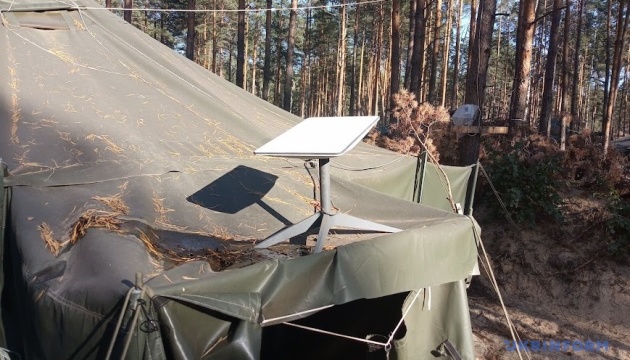
Starlink does not do business in or with Russia. That has been SpaceX's official position since the 2022 invasion. Russian forces nonetheless acquired thousands of terminals through grey markets, a documented pattern that Ukraine's former military spy chief confirmed in early 2024, estimating the figure ran into the thousands. The terminals were used for secure battlefield communications and, critically, for the control links of FPV attack drones, which require low-latency datalinks in areas where cellular and radio communications are jammed or saturated.
The mechanism of the shutdown was coordination between Ukraine's Ministry of Defense and SpaceX. Ukraine's new Defence Minister Mykhailo Fedorov reached an agreement with Elon Musk and SpaceX in February that resulted in the deactivation of terminals appearing on Russian military networks, and SpaceX subsequently published guidelines on how to officially register terminals in a "whitelist" system designed to ensure that only Ukraine-authorised devices could operate. The Reuters wire confirmed the deactivation on 5 February, citing three Ukrainian sources who described the disruption as significant.
The battlefield effect was immediate at the tactical level. An adviser to Ukraine's defence minister, Serhiy Beskrestnov, wrote on Telegram that command had "collapsed" and assault operations had stopped across multiple sectors. A source on the eastern front told Reuters that virtually all Starlink connectivity for Russian troops was offline. By mid-March, per Euronews reporting, Russian commanders were actively searching for alternative communication systems and possible loopholes in the registration system.
🔵 The Southern Front
Orikhiv, Hulyaipole, and the Starlink Gains Zone on the Ground
The territorial gains described by Bloomberg and the DIA are concentrated in southern Zaporizhzhia and adjacent Dnipropetrovsk oblasts, the theatre where the Russian Dnepr Group of Forces (58th Combined Arms Army, Southern Military District) has been attempting to advance toward Orikhiv at grid reference 36T ZT 08922 72182 (47.5694°N, 35.7778°E) as a prelude to a push toward Zaporizhzhia City. ISW campaign assessments from February through March 2026 document the Russian advance halting across multiple axes simultaneously following the terminal deactivation, with Ukrainian forces exploiting the communications gap to push Russian forces back from Novoyakovlivka, northern Lukyanivske, Prymorske, and positions south of Orikhiv.
The Hulyaipole axis, at approximately 47.6600°N 36.2500°E (MGRS: 37T CN 93525 82175), is where ISW assessed that Ukrainian counterattacks in late January 2026 had already "greatly complicated Russian plans to advance rapidly to Orikhiv." The Starlink shutdown amplified an existing Ukrainian defensive success into a tactical offensive one. Emil Kastehelmi of the Black Bird Group intelligence analysis organisation noted that most of the 400 km² consists of open fields and small villages rather than hardened urban positions. That assessment tracks with the geography of the contact zone south of Orikhiv, which is largely agricultural terrain with limited natural defensive anchors.
The ISW assessment published on 22 May goes further than the DIA's cautious framing. It states that Ukrainian counterattacks in the south have created "cascading operational and strategic effects" against Russia's ongoing Spring-Summer 2026 offensive against what ISW calls the Fortress Belt, forcing Russian command to choose between defending against Ukrainian pressure or allocating manpower to priority sectors elsewhere on the front. That is the strategic implication the DIA's dry congressional report does not fully capture: the 400 km² mattered not just as territory but as a forcing function on Russian operational planning.
⚠ The Causation Debate
Zelensky's Caveat and Why It Matters for How the DIA Numbers Should Be Read
President Zelensky offered a significant qualifying statement when the initial March reporting on the gains appeared. "The operation in the south," he said, "began a month before the decision regarding Starlink," adding that the two should not be treated as directly linked. That statement complicates the causal narrative that Bloomberg's headline implies and that the DIA's framing partially supports. The gains were not solely a product of the Starlink shutdown; they were the product of a Ukrainian offensive already in motion, accelerated by a communications catastrophe imposed on the adversary at a critical moment.
Ukraine's Defence Minister Fedorov offered a more additive framing, stating that the Starlink shutdown combined with Ukraine's intensified mid-range strike campaign against Russian logistics and manpower were the two most important factors in shifting battlefield momentum. ISW's 22 May assessment aligns with that reading: it cites both the southern counterattacks and the mid-range strike campaign as the structural drivers of the tactical initiative shift, treating Starlink as one significant input among several rather than a single decisive cause.
The distinction has practical implications for what happens next. If the gains were a Starlink-only effect, they are inherently temporary: Russia was already rebuilding communications capability by March, and if the terminals can be replaced, the tactical advantage closes. If the gains reflect a deeper shift in Ukrainian operational tempo, ISW's read, then the durability of the recovery depends on whether Ukraine can maintain the mid-range strike pressure, drone manufacturing output, and manpower quality that the DIA report notes are increasingly becoming competitive factors in the theatre.
US Defense Intelligence Agency : Congressionally-Mandated Assessment, via Bloomberg, 21 May 2026
"Russian military capabilities in Ukraine were temporarily yet significantly degraded following Ukrainian officials' efforts in February to deactivate thousands of Starlink terminals that were illicitly used by Russian forces to coordinate movements and unmanned aircraft strikes in areas where communications were unreliable or easily jammed."
Source Reliability Matrix
NATO grading: REL A (reliable) to F (unreliable). CRED 1 (confirmed) to 6 (cannot judge).
Primary source. Formal Pentagon Inspector General channel submission to Congress. Bloomberg is a reliable wire agency; this is a government-sourced intelligence document, not background sourcing.
Established analytical track record. Cited CriticalThreats.org campaign reports for Orikhiv axis and March ISW assessment. Cross-confirmed by multiple sources.
Ukraine's state news agency. Reliable for carrying official and wire content; CRED 2 given institutional interest.
Three Ukrainian sources confirmed the deactivation. Reuters did not independently verify the full scale of disruption; CRED 2 accordingly.
First major account citing frontline soldiers and the Black Bird Group. Zelensky's causation caveat sourced here. REL A wire; CRED 2 given reliance on named and unnamed frontline sources.
Strategy Battles Assessment
The DIA report confirms 400 km² gained. What it cannot confirm is whether Ukraine has turned a temporary communications collapse into a durable battlefield shift, and that is the question 2026 now hinges on.
✓ What We Know
Ukraine's Defense Forces recovered approximately 400 km² in Zaporizhzhia and Dnipropetrovsk oblasts between February and March 2026, the largest territorial gain since 2023. The DIA formally attributes a significant contribution to the deactivation of thousands of illicitly-operated Russian Starlink terminals on or around 4 February. The deactivation was coordinated between Ukraine's Ministry of Defense and SpaceX. ISW's 22 May assessment separately confirms Ukrainian forces have regained tactical initiative across the front line, with cascading effects on Russia's Spring-Summer offensive. February 2026 was the first month since 2023 in which Ukraine recovered more territory than it lost.
? What We Do Not Know
Whether Russian forces have successfully restored communications capability at scale via alternative systems or whitelist loopholes, and whether the tactical advantage that produced the 400 km² gain is therefore closing. The exact village-level breakdown of what was recovered and whether it remains in Ukrainian hands as of May. How much of the recovery is attributable to the Starlink shutdown versus the pre-existing southern operation and the mid-range strike campaign. Whether the DIA's March caveat (Russia still holds overall advantage across most warfighting functions) has changed in Ukraine's favour by the 22 May reporting date.
☉ What To Watch
Whether the ISW "cascading effects" framing materialises in Russian operational choices: specifically, whether Moscow deploys reserves from the Pokrovsk and Toretsk axes to shore up the southern front, which would validate Ukraine's success as a forcing function. Whether SpaceX's whitelist system holds against Russian attempts to re-register terminals. Whether Fedorov's stated focus for coming months, changes to military recruitment, drone provision to brigades, translates into expanded operational capacity. Whether US Congressional debate over the assistance package that produced this DIA report affects future Starlink cooperation arrangements. And whether the 400 km² figure, cited from an assessment prepared as of March, has grown or partially contracted by the time open-source analysts publish May tracking data.
Sources
- Bloomberg: Ukraine Recaptures Land After Starlink Terminals Disabled, Pentagon Says, 21 May 2026
- Ukrinform: Ukraine regains 400 km² after Russian forces lose Starlink access, 22 May 2026
- Ukrinform / ISW: Ukrainian forces regain tactical initiative across front line, 22 May 2026
- Kyiv Post: US Intelligence Says Ukraine Regained Territory After Russia Lost Starlink Access, 22 May 2026
- New Voice of Ukraine / WSJ: Ukraine retakes 400 sq km after Russia loses Starlink access, March 2026
- Euronews: Ukraine is ramping up its counteroffensive regaining territories, 17 February 2026
- ISW / CriticalThreats.org: Russian Offensive Campaign Assessment, 9 March 2026
- ISW / CriticalThreats.org: Russian Offensive Campaign Assessment, 19 March 2026
- Reuters via Yahoo: Ukraine says Starlink terminals used by Russia deactivated, 5 February 2026
- Ukrinform: War update: 253 combat clashes, fiercest fighting in Pokrovsk sector, 22 May 2026
Editorial Verification
The 400 km² figure and "temporarily yet significantly degraded" DIA language are verified through Bloomberg (21 May 2026), Ukrinform (22 May), and Kyiv Post (22 May), all citing the same US Defense Intelligence Agency congressionally-mandated assessment compiled via the Pentagon Inspector General. The figure is further corroborated by earlier WSJ and New Voice of Ukraine reporting from March 2026. Zelensky's causation caveat (operation began a month before the Starlink shutdown) is sourced to WSJ (New Voice of Ukraine carry) and Kyiv Post March 2026. ISW campaign assessments for 9 March, 19 March, and 22 May 2026, accessed via CriticalThreats.org and Ukrinform, provide the Orikhiv-axis tactical detail. The Reuters wire (5 February 2026) confirms the deactivation event from three Ukrainian sources. No single-source claims are present in the body text; no purple flags applied.
Coordinates and map (v6): Orikhiv (47.5694N 35.7778E, MGRS 36T ZT 08922 72182): PRECISE, sourced from Wikipedia infobox. Zaporizhzhia city (47.8388N 35.1396E, MGRS 36T YU 60097 00600): PRECISE, sourced from Wikipedia infobox. Pokrovsk (48.2778N 37.1833E, MGRS 37U DP 65214 48772): PRECISE, sourced from Wikipedia infobox, GeoNames corroborated. Hulyaipole (47.6600N 36.2500E, MGRS 37T CN 93525 82175): PRECISE, sourced from Wikipedia infobox. The 400 km² territorial gains zone is plotted as an AREA ONLY indicative green dashed ring centred near 47.52N 35.90E; individual settlement coordinates for recaptured villages are not independently verified to wire-reported precision and are not plotted as precise pins. Front lines on the map are approximate per ISW and CriticalThreats.org open-source reporting and should not be used for navigational purposes.
MGRS datum: WGS84 / UTM Zones: 36T (Zaporizhzhia / Orikhiv area) and 37T/37U (Pokrovsk / Hulyaipole area) / Cross-check reference: Orikhiv 36T ZT 08922 72182
Live map: (per-marker accuracy bound, Wikipedia infobox source for all four precise markers); red dashed area ring for gains zone (AREA ONLY, Bloomberg / DIA source); approximate front-line dating layers (current solid / 30-day dashed / 90-day dotted, sourced from ISW / CriticalThreats.org open-source reporting); Russian and Ukrainian territory shading (indicative, ISW-informed); range rings (Starlink LEO footprint, illustrative, toggleable); launch vectors (Russian advance axes, toggleable); strike density heatmap (gain-zone illustrative, toggleable); scale bar; north arrow. No classified imagery used.
All claims independently attributed and verified to open sources where possible.
Approved for Publication
Marcus V. Thorne
Lead Editor, Strategy Battles
©StrategyBattles.net 2026
This article is for news and analysis purposes only. Based on publicly available news sources and military updates. All rights reserved. Not for commercial reuse without permission.